Arts & Entertainment
Gay themes at Fringe
Edgy D.C. festival features several LGBT stories, players
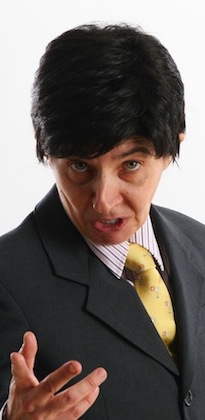
Laura Zam in ‘An Hour with Ken Johnson.’ (Photo courtesy of Fringe)
For this year’s Capital Fringe Festival, Laura Zam is stuffing a sock in her underpants.
Recently she explained: Along with a short wig and the suit and tie that she’ll wear to play the title motivational speaker in her one-woman show “An Hour with Ken Johnson” (at the Goethe Institut), she’s decided to complete the costume by adding a bulge down below.
“It’s fantastic to dress as a man,” says the seasoned performer. “I’ve played men in the past, but Ken is my most sustained male role. As a writer and an actor it’s allowed me to enter an entirely new world. The sock should only make it better.”
“What I’m doing combines comedy, theater and motivational talk,” continues Zam, a Brooklyn transplant who lives with her husband in D.C. “And Ken is part evangelical preacher and a little bit Anthony Robbins. He’s also a recovering Internet porn addict, and though he’s kind of weird and a bit of clown, he delivers a message of optimism and comments on human resilience. Hopefully audiences will have a laugh but also get something out of what he has to say.”
An annual performing arts event, the Capital Fringe Festival features more than 140 performances including theater, dance and music in various venues around town. It draws both accomplished and less experienced artists performing both well known and original, untested works. The results are uneven but rarely dull. Tickets are affordable.
Local African-American historian Anthony Cohen has twice retraced arduous Underground Railroad routes. After completing his second trek, walking from Alabama to Canada, Cohen uncovered an account describing how his runaway slave African-Jewish-Irish-Cherokee ancestor Patrick Sneed had traveled the identical path to freedom in 1849.
Blown away by his discovery, Cohen who is gay, began speaking about his connection to Sneed’s experience. For this year’s Fringe he’s adapted his lecture expressly for theater with a one-man show titled “Patrick & Me” (at Goethe Institut), supplementing the material with visuals and musical montages. “I went searching for the Underground Railroad,” says Cohen, “but the Underground Railroad was searching for me.”
At the Apothecary, Mixrun Productions presents Shakespeare’s “King Lear.” Only this time the tragic tale of betrayal and insanity is played out by present day bikers locked in a violent turf war. And while the company’s take on the classic is heavily abridged, says cast member Katie Wanschura who is gay, the text is otherwise mostly faithful. Because almost one third of the parts have been re-imagined as gay or bisexual, some pronouns have been changed.
A web designer by day, Wanschura is thrilled to be cast wily and wicked Edmund restyled as a flirtatious lesbian bartender at the aptly named Gloucester. “From behind the bar, I get to watch the story unfold,” she says. “Also I hit on the female patrons and interact with the audience. It’s great.”
For several years, Patrick Doneghy has toyed with the idea of doing a revue featuring men singing Broadway songs typically performed by women. With Dominion Stage’s “That’s What She Sang” at Studio’s Mead Theatre, he’s realized and expanded on the idea by writing, staging and acting in a juke box musical with a connected story.
Comprised of a seven man, mostly gay cast (Doneghy is gay), the show focuses on a queer men’s support group and the problems its members encounter. Songs include women’s tunes like “Gimme Gimme” from “Thoroughly Modern Millie,” and “Maybe This Time” from “Cabaret.”
“We’re exploring romantic mishaps here, not big social issues,” says Doneghy. “It’s a chance to hear music we all know in a new way and to hear some LGBT stories that don’t always get told.”
In “Cecily and Gwendolyn’s Capital Balloon Ride,” Philadelphia improv partners Kelly Jennings and Karen Gertz play a pair of time-traveling Victorian cultural anthropologists. Wherever they land — in this case Mountain at Mount Vernon Church– these curious, slightly loopy ladies take stock of their surroundings and set to work getting to know the locals.
“It’s unlike anything you’ve ever seen,” says Jennings, who is gay. “While our characters kick off the conversation, the audience actually guides the show exploring subjects that are important to them. Participation isn’t mandatory, but once warmed up, almost everyone is willing talk; and people leave feeling they’ve connected with their community in a way that doesn’t happen in any other theater experience.”
For performance schedules and venue locations, go to capfringe.org.

Celebrity News
My evening with Madonna
Gay icon headlined the World Pride Music Festival in Amsterdam

Editor’s note: International News Editor Michael K. Lavers and Photo Editor Michael Key will be on assignment in the Netherlands through Aug. 10. They will be covering World Pride in Amsterdam.
AMSTERDAM — Madonna and 6,000 of her closest friends celebrated World Pride at Amsterdam’s AFAS Live concert hall early Sunday morning. I was fortunate enough to be one of them.
Madonna last Wednesday nearly broke the internet when she said on social media in Dutch that “I got somethin’ I wanna talk about,” referring to an opening line in “Danceteria,” one of the tracks on her “Confessions II” album that has received rave reviews since its July 2 release. The track has been on near constant replay on my playlist since I first heard it.
— Madonna (@Madonna) July 28, 2026
MISTR — a telehealth platform that offers free access to PrEP, Doxy PEP, STI testing, and long-term care that has organized Madonna’s Club Confessions shows in the U.S. and the U.K. — later confirmed the rampant speculation. I woke up on July 30 to an email in my inbox from MISTR and the World Pride Music Festival PR team that said I was on the press list.
Madonna was indeed going to headline the World Pride Music Festival that Jake Resnicow and Insomniac produced, and I was going to be there. OMFG!!!!
The gay icon had one more surprise in store.
The Dutch internet on Saturday once again broke over speculation that Kylie Minogue was going to appear alongside Madonna. I was getting ready to leave our hotel in Amsterdam on Saturday night when I saw a video of the two of them together.
“Madonna is now teasing Kylie Minogue on her social media … she may be one of her ‘special guests’ tonight,” I wrote in a text to Washington Blade Editor Kevin Naff at 8:46 p.m.
“Have fun! This is turning into the gayest concert ever,” he responded.
I arrived at AFAS Live shortly before 11 p.m. My press contact walked me and two other Dutch journalists into the venue’s cavernous main room known as the Black Box. We made small talk for a few minutes before I started to walk around and listen to Josh Harrison who was on the decks.
Madonna was scheduled to take the stage at 1:30 a.m., but she is known for being late — she is Madonna and she does what she wants. Hayla, a British singer, and Bebe Rexha are among those who performed ahead of Madonna. Thousands of sweaty men — including a group of Australians next to me who were eagerly awaiting Kylie’s anticipated appearance — packed the Black Box and were dancing, anticipating what was to come.

MISTR CEO Tristan Schukraft at one point came on stage and declared Madonna was indeed in the building. The moment for which we were all eagerly waiting finally came shortly before 2:30 a.m.
“Mother is here and this is gay heaven,” said Madonna when she took the stage.
Stuart Price, who produced her “Confessions on a Dance Floor” album in 2005, manned the decks during Madonna’s set.
She opened it with “I Feel So Free” from “Confessions II.” Madonna then sang “Bring Your Love” and “Danceteria” to which this reporter — and everyone else — sang along.
Madonna then teased a surprise before she began to perform “Love Sensation.” Kylie soon appeared on stage. It was nearly too much for my fellow partygoers from Australia. It was indeed the gayest concert ever!
Madonna and Kylie performed “Love Sensation” together. They then sang “Hung Up” and “Sorry” from “Confessions on a Dance Floor” to round out the set that ended shortly after 3 a.m.
Madonna and I share the same birthday — Aug. 16 — and I would like to think she and Kylie gave me an early birthday present. In all seriousness though, it was an amazing night for me and for everyone else who was fortunate enough to be there.
“On the dance floor I feel so free,” says Madonna in the opening of “I Feel So Free.”
For those few precious hours at AFAS Live I did not think about the Trump-Vance administration and the myriad ways it is destroying the U.S. I did not think about the National Guard troops deployed to D.C. I did not think about the pointless wars that continue to ravage Ukraine and other countries around the world. I simply lost myself on the dance floor and celebrated an icon who has always stood with my community.
Thank you, Madonna.

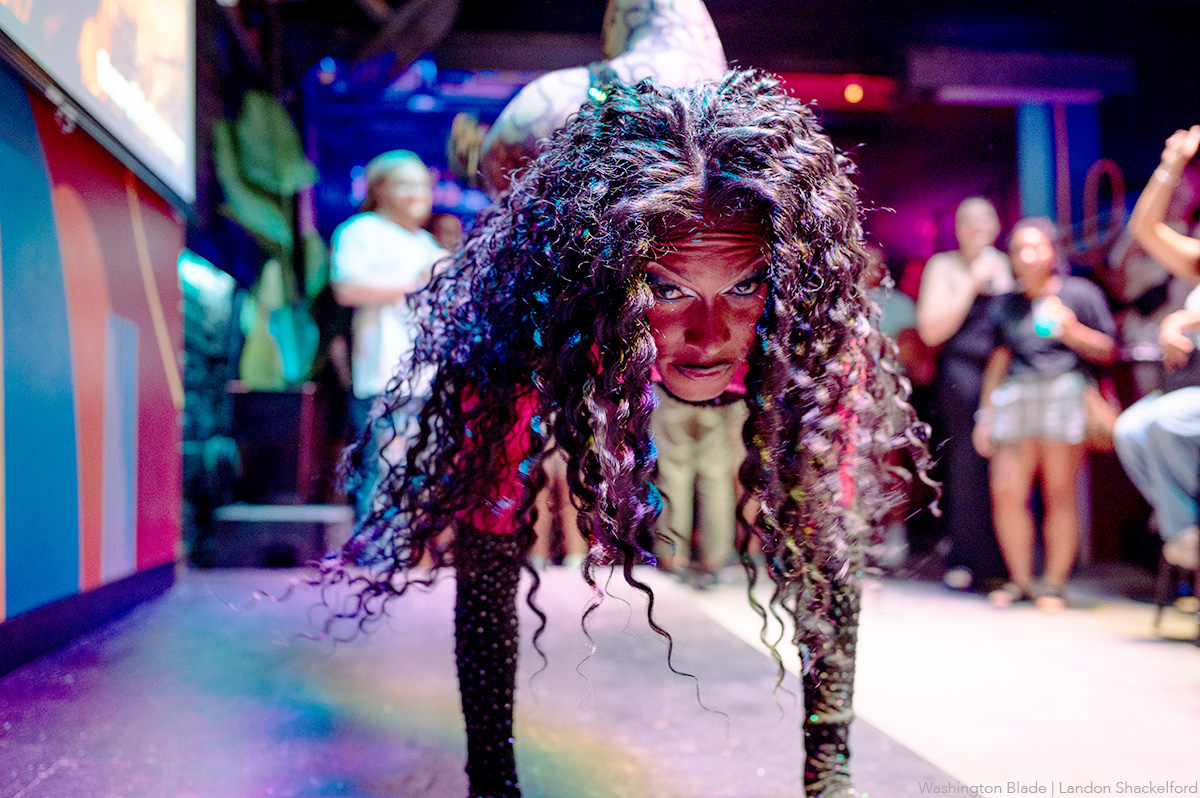
The Petal Release Party and Drag Show was held at Spark Social on Friday, July 31. Performers included Tiara-Missou, Labianna and Darcy de la Cuadra.
(Washington Blade photos by Landon Shackelford)




Celebrity News
Madonna headlines World Pride Music Festival in Amsterdam
Kylie Minogue made surprise appearance alongside gay icon

AMSTERDAM — Madonna on Sunday headlined the final night of the World Pride Music Festival in Amsterdam.
The gay icon took the stage shortly before 2:30 a.m. local time (8:30 p.m. ET on Saturday) during Club Confessions, a set that MISTR, a telehealth platform that offers free access to PrEP, Doxy PEP, STI testing, and long-term HIV care, organized.
“Mother is here and this is gay heaven,” said Madonna when she took the stage inside Amsterdam’s AFAS Live concert hall that can hold up to 6,000 people.
Stuart Price, who produced Madonna’s 2005 “Confessions on a Dance Floor” album and “Confessions II,” which debuted on July 2, DJed the set.
Kylie Minogue made a surprise appearance. She and Madonna performed a new remix of “Love Sensation” from “Confessions II.”
(Washington Blade video by Michael K. Lavers)
“Throughout my career, I’ve always supported efforts to fight HIV and AIDS, and that fight begins with education and access,” said Madonna in a MISTR press release. “With MISTR, (CEO) Tristan (Schukraft) is expanding access to HIV prevention and sexual healthcare for everyone. Through this work, he’s helping preserve and strengthen LGBTQ+ spaces while investing in the communities and culture that have long sustained us.”
Minogue in an Instagram post thanked Madonna, Price, Schukraft, and MISTR.
Madonna appeared at The Abbey in West Hollywood, Calif., in April. Madonna in June celebrated Pride month with a pop-up performance in New York’s Times Square.
Jake Resnicow and Insomniac produced the World Pride Music Festival that also featured Bebe Rexha and Paris Hilton, among others.
“Pride has always been about bringing our community together,” said Resnicow. “At a moment when too many people are being told to hide or make themselves smaller, gathering openly, joyfully, and without apology matters more than ever. I couldn’t be prouder of what this festival brought to life in Amsterdam — one dance floor, completely free.”

Suzanne Goode is not good for Rehoboth Beach

Continue to engage in community after Pride month

Doug Ollivant to face Eugene Vindman in Va. 7th Congressional District

LGBTQ advocates optimistic about D.C.’s expected new mayor

Progressives score victory as El-Sayed wins Mich. Senate primary

PHOTOS: Amsterdam Pride Canal Parade

Amsterdam Pride Canal Parade draws hundreds of thousands

Reggie White relishing first season as artistic director of Woolly Mammoth

Madonna headlines World Pride Music Festival in Amsterdam

PHOTOS: Petal Release Party
-

 Photos5 days ago
PHOTOS: Amsterdam Pride Canal Parade
-
Netherlands5 days ago
Amsterdam Pride Canal Parade draws hundreds of thousands
-
Theater4 days ago
Reggie White relishing first season as artistic director of Woolly Mammoth
-
Celebrity News4 days ago
Madonna headlines World Pride Music Festival in Amsterdam