
Local
Police log: September 9
The following incidents were reported by the D.C. Metropolitan Police Department’s Gay & Lesbian Liaison Unit
The following incidents were reported by the D.C. Metropolitan Police Department’s Gay & Lesbian Liaison Unit:
On Sept. 5, while in the 1900 block of Minnesota Avenue, S.E., a man reported that he was approached by two black males who began to call him homophobic epithets. Complainant then advised that he ignored the suspects who were on bikes, at some point Suspect-1 got off his bike and punched Complainant in the face, suspect two approached from behind and punched complainant as well. Suspect one took complainant’s property. Both suspects fled on bikes.
On Sept. 5, at 3:30 a.m. in the 2200 block of Chaplain Street, N.W., a man reported that he and a suspect had a verbal dispute over their relationship. Complainant reports that the suspect then became upset and struck him in the face with a closed fist.
On Sept. 5, at approximately 4:20 p.m. in the 5000 block of B Street, S.E., a woman reported that she and her girlfriend were involved in a verbal argument that escalated into a physical assault. The suspect choked and then struck the woman with a broom. The suspect was arrested at the scene. Complainant was provided government and non-government resource agency information.
On Sept. 2, members of the First District requested assistance at 4th and K streets, N.W., in reference to a notice of infraction issued on a member of the GLBT community for a pedestrian violation. The pedestrian was advised of the reason for the issuance of the ticket as well as the options available to contest the ticket.
On Sept. 2, members of the First District requested assistance at 1st and K streets, N.W., in reference to an arrest made of a member of the GLBT community. The citizen was stopped and issued a notice of infraction for a pedestrian violation. A background check revealed that the citizen had an outstanding bench warrant for her arrest. The suspect was arrested and transported to the district for processing.
On Sept. 2, in the 1500 block of Butler Street, S.E, a woman reported that her domestic partner assaulted her by choking her and slammed her against the wall. Suspect was arrested and taken to the district for processing.
On Sept. 2, in the 1600 block of Argonne Place, N.W., a citizen contacted police because earlier in the day he had a verbal altercation with his neighbor. The neighbor thought the complainant knocked on his door. The neighbor used homophobic epithets against the complainant. The complainant walked away with no further incident.





Maryland
Silver Spring holds annual Pride In The Plaza
‘Today means inclusion. It means to build resilience’
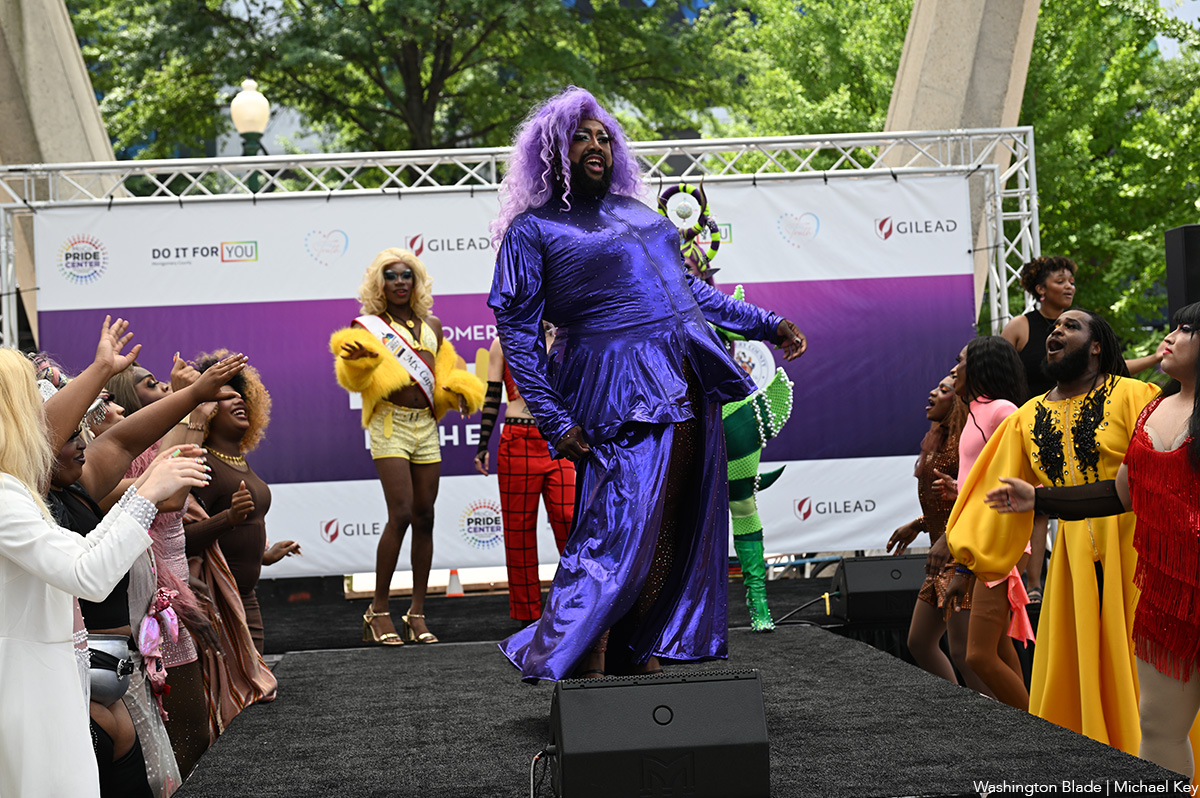
Silver Spring’s annual Pride in the Plaza event took place on Sunday to celebrate the LGBTQ community and emphasize inclusion and resilience.
“Today means inclusion. It means to build resilience, love,” Robyn Woods, program and outreach director for Live In Your Truth, which organized the event, said. “I mean, just being surrounded by the community and so many great entrepreneurs, business owners, and just being a part of this whole rainbow coalition that we call the LGBTQIA to be about.”
With the event being her first time organizing for Live In Your Truth, Woods said she felt emotional to see the support and love at the event.
“Some people (are) bringing out their children, their babies, their grandparents,” Woods said. “It’s a lot more allies here than anything else. That type of support to me means so much more than just support from my community; just outside support, inside support, so much support around it, so much love. Everyone’s smiling outside, helping each other.”
Attendees of the event were able to head over to the Family Fun Zone, an air-conditioned Pride Cool Down Lounge, or watch live drag performances in the main stage area.
Along with entertainment and a shaved-ice stand, rows of information tables stood along the plaza, including FreeState Justice, the Washington Spirit, Trans Maryland, Moco Pride Center, and the Heartwood Program, an organization that offers support, therapy, education, and resources to the LGBTQ community.
“I want people to know about our services, and I love what we have to offer,” Jessica Simon, psychotherapist for Heartwood Program’s Gender Wellness Clinic, said. “I (also) want to be part of a celebration with the community, and so it feels good to be here with other people who have something they want to give to the community.”
She added that within today’s political climate, to which she called an “antidote to shame,” it’s important to be celebrating Pride.
“There’s a lot of demonization of LGBTQI people,” Siena Iacuvazzi, facilitator for Maryland Trans Unity, said. “(Pride) is part of the healing process.”
Iacuvazzi said she was taught to be ashamed of who she was growing up, but being a part of a community helped her flourish in the future.
“I was taught how to hate myself. I was taught that I was an abomination to God,” she said. “But being a community is like understanding that there are people who have experienced the same thing, and they’re flourishing. They’re flourishing because they’re willing to stand up for themselves as human beings and discover themselves and understand what’s true for themselves.”
She added that Pride allows for a mutual understanding to take place.
“It’s more of a sense of belonging … and just taking that home and understanding you’re not alone,” Iacuvazzi said. “We’re each taking our own journey — we’re not putting that on each other. It’s just walking away with a sense of belonging and humanity.”
Similar to Iacuvazzi, Woods said she hopes attendees’ biggest takeaways would be family, fun, resilience, and pride.
“Being proud of yourself, being happy for who you are, and representation and how much it matters,” she continued. “And I think all these young people that are walking around here get to see versions of themselves, but older. They get to see so many different lesbian, gay, bisexual, pansexual people that are successful, that are showing love, that care, and it’s not how we’re portrayed in the media. It’s lovely to see it out here. (It’s) like we’re one big old, happy family.”
Virginia
Spanberger touts equality, reproductive rights in Arlington
Democratic Va. gubernatorial nominee made campaign stop at Freddie’s Beach Bar
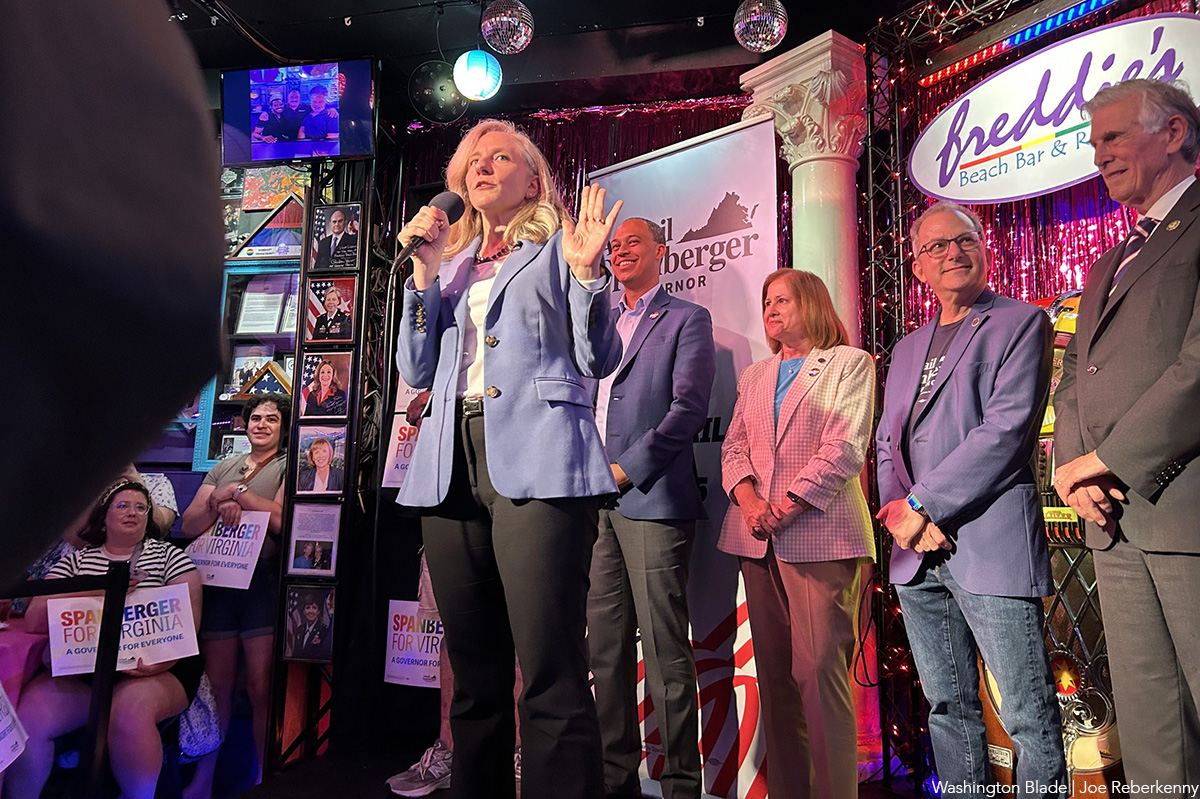
With the general election heating up and LGBTQ rights under increasing threat nationwide, Virginia gubernatorial candidate Abigail Spanberger brought her “Span Virginia Bus Tour” to Arlington’s Freddie’s Beach Bar for a campaign stop filled with cheers, policy pledges, and community spirit.
Spanberger, who served three terms in the U.S. House of Representatives from 2019 through early 2025 for Virginia’s 7th Congressional District, also served as a federal law enforcement officer specializing in narcotics and money laundering cases, and as a CIA case officer working on counterterrorism and nuclear counterproliferation.
Spanberger is running against Republican nominee Winsome Earle-Sears, the current lieutenant governor of Virginia, who said she was “morally opposed” to a bill protecting marriage equality in the commonwealth.
She was joined by other Democratic candidates and supporters: lieutenant gubernatorial candidate Ghazala Hashmi, attorney general candidate Jay Jones, Virginia state Sen. Adam Ebbin (D-Alexandria), and Congressman Don Beyer.
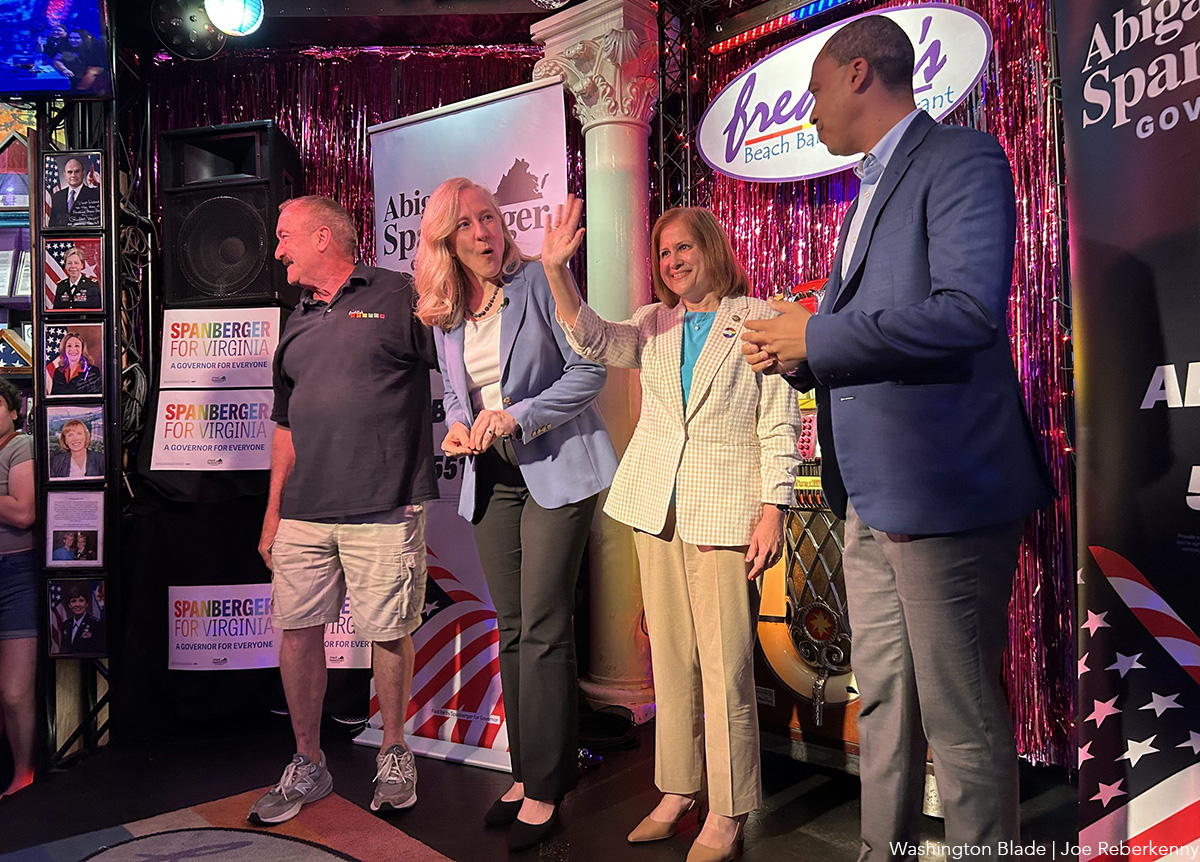
Freddie’s was packed wall-to-wall with supporters, many of whom wore “Spanberger for Virginia” shirts in the progressive Pride flag colors. In her speech, she made it clear that LGBTQ Virginians’ rights are on the ballot this year.
“I’m so excited to be here, and I am so grateful to the entire staff of Freddy’s for letting us overtake this incredible venue that is not just an awesome place to come together in community, but is a symbol to so many people of joy, of happiness, of community and of celebrating our friends and our neighbors,” Spanberger told the packed restaurant. “It is exciting to be here, and particularly during this Pride month, and particularly as we reflect on the 10-year anniversary of Obergefell and the reality that we still have so much work to do.”
“The reality is there are so many people who still would be inclined to take us backwards,” she said. “In this moment when we see attacks on people’s rights, on people’s humanity, on Virginia, on our economy, on research, on public education, on food security, on health care, on Virginians, on their jobs, on public service and on people — it can get heavy.”
“What it does for me is it makes me want to double down, because once upon a time, when I was talking to my mother about some horror show or sequence of activities coming out of a particular administration, she did not really have the patience to listen to me and said ‘Abigail, let your rage fuel you’ — and the conversation was over. And so I reflect on that, because, in fact, every day there is so much fuel to be had in this world and in this moment.”
One of the points Spanberger continued to emphasize was the importance of steadfast state government officials following the election of President Donald Trump, which has led to rollbacks of LGBTQ and bodily autonomy rights as a result of the conservative-majority U.S. Supreme Court.
“What the past few years have shown us is that a Supreme Court decision, no matter how many years we have celebrated its existence, does not protect us in the long term. And so as governor, I will work to make sure that every protection we can put in place for the dignity, the value, and the equal rights of all Virginians is a priority.”
During her speech, Spanberger highlighted several of the key values driving her campaign — protecting reproductive freedom and human rights, lowering healthcare costs, safeguarding Virginia’s environment, and ensuring that public education is affordable, accessible, and rooted in truth, not politics.
Spanberger went as far as to say that she wants to amend the state’s constitution to remove Section 15-A. “The reality is that in Virginia, we still have a ban in our state constitution on marriage equality. It is of the utmost urgency that we move forward with our constitutional amendment.”
“We will work to ensure that that terrible constitutional amendment, that was put in years ago, is taken out and updated and ensuring that Virginia is reflective in our most essential documents of who we are as a commonwealth, which is an accepting place that celebrates the vibrancy of every single person and recognizes that all Virginians have a place, both in that constitution and in law,” she added.
Following the event, two supporters spoke to the Washington Blade about why they had come out to support Spanberger.
“I came out because I needed to show support for this ticket, because it has been a particularly rough week, but a long few years for our rights in this country, in this state, with this governor, and it’s — we need to flip it around, because queer people need protection,” said Samantha Perez, who lives in Ballston. “Trans people need protection. Trans kids need protection. And it’s not gonna happen with who’s in Richmond right now, and we just need to get it turned around.”
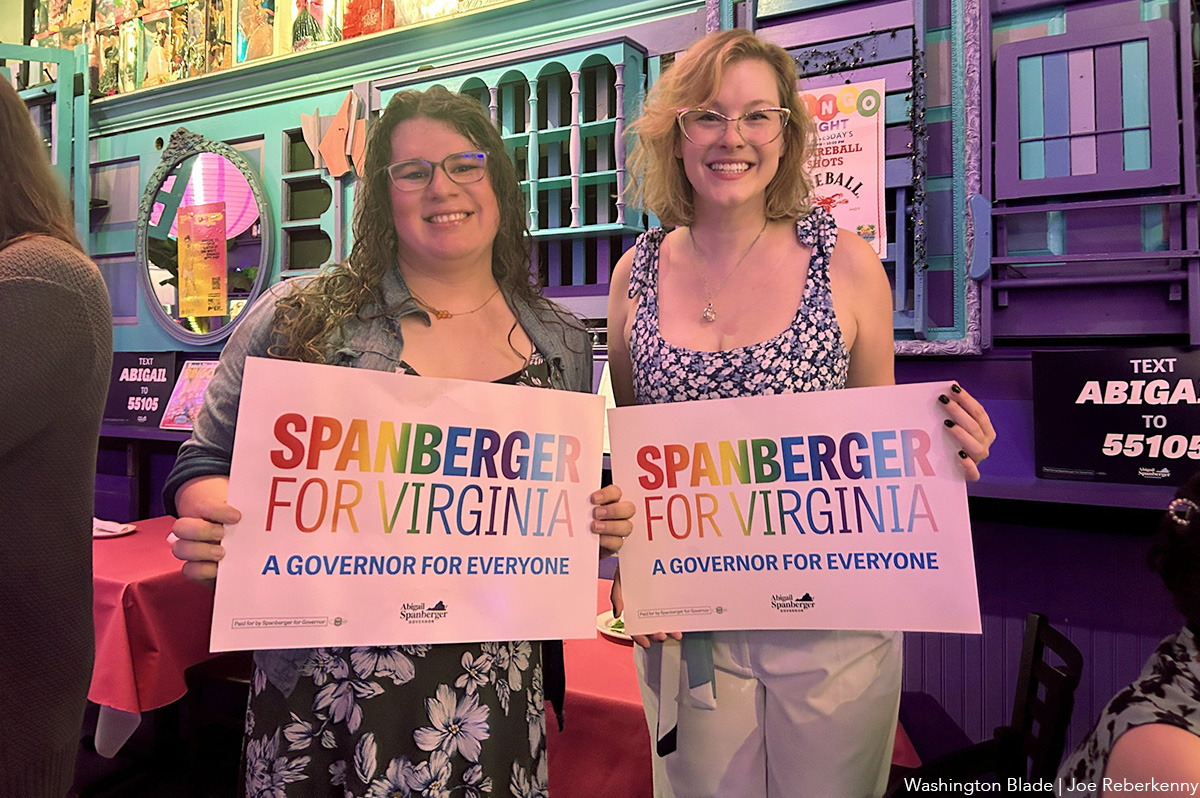
“The whole neighborhood’s here. All our friends are here,” said Annie Styles of Pentagon City. “It means the world to me to take care of each other. That’s what a good community does. That’s not what we’ve had with the Republicans here or across the nation for a really long time. It’s time to show that care. It’s time to make sure that good people are in a position to do good things.”
District of Columbia
Activists protest outside Hungarian Embassy in DC
Budapest Pride scheduled to take place Saturday, despite ban
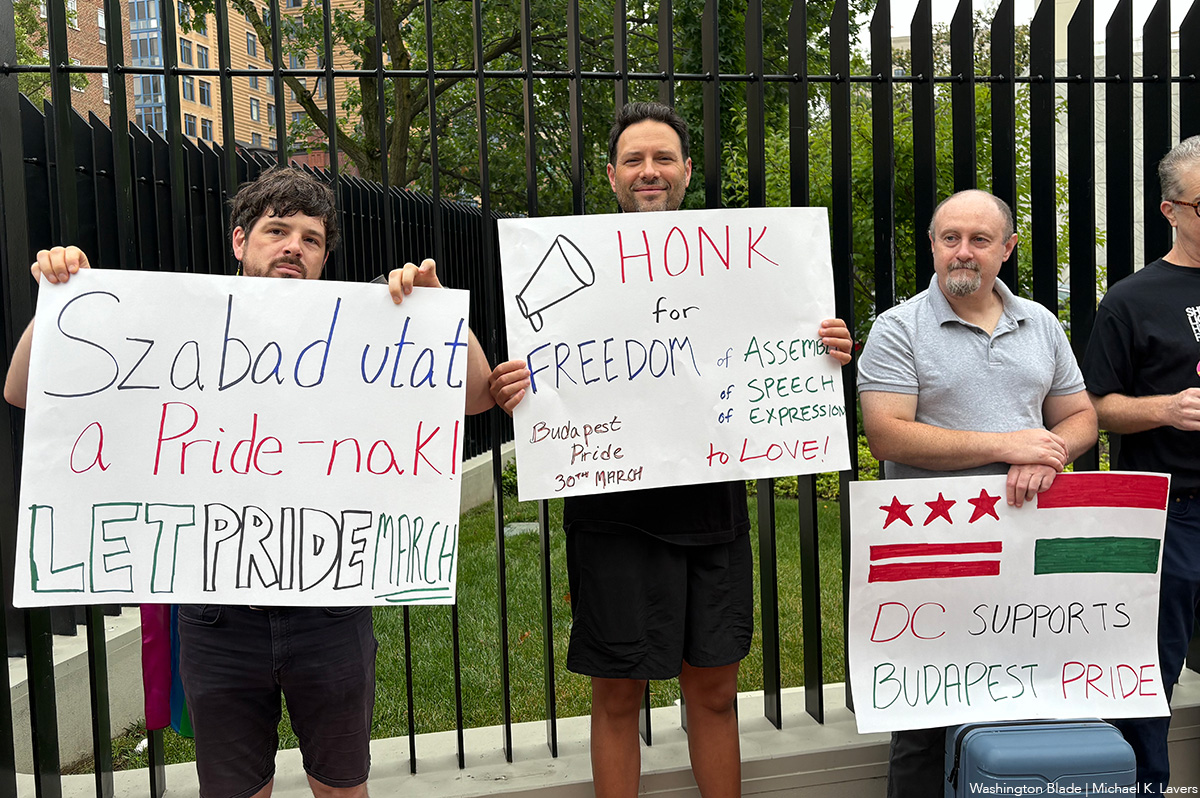
More than two dozen activists gathered in front of the Hungarian Embassy in D.C. on Friday to protest the country’s ban on Budapest Pride and other LGBTQ-specific events.
Amnesty International USA Executive Director Paul O’Brien read a letter that Dávid Vig, executive director of Amnesty International Hungary, wrote.
“For 30 years Budapest Pride has been a celebration of hope, courage, and love,” said Vig in the letter that O’Brien read. “Each march through the streets of Budapest has been a powerful testament to the resilience of those who dare to demand equality, but a new law threatens to erase Pride and silence everyone who demands equal rights for LGBTI people.”
“The Hungarian government’s relentless campaign against LGBTI rights represents a worrying trend that can spread normalizing division and hatred,” added Vig. “Thank you for standing with us when we refuse to be intimidated.”
Council for Global Equality Chair Mark Bromley and two of his colleagues — Stephen Leonelli and Keifer Buckingham — also spoke. Health GAP Executive Director Asia Russell and Chloe Schwenke, a political appointee in the Obama-Biden administration who worked for the U.S. Agency for International Development, and Planned Parenthood staffers are among those who attended the protest.
(Washington Blade video by Michael K. Lavers)
Hungarian lawmakers in March passed a bill that bans Pride events and allow authorities to use facial recognition technology to identify those who participate in them. MPs in April amended the Hungarian constitution to ban public LGBTQ events.
Budapest Pride is scheduled to take place on Saturday, despite the ban. Hundreds of European lawmakers are expected to participate.
“Sending strength to the patriotic Hungarians marching tomorrow to advance human dignity and fundamental rights in a country they love,” said David Pressman, the gay former U.S. Ambassador to Hungary, on Friday on social media.
Sending strength to the patriotic Hungarians marching tomorrow to advance human dignity and fundamental rights in a country they love. Szabadság és szerelem. My past remarks on Budapest Pride: https://t.co/y1QhA9QouA
— David Pressman (@AmbPressman) June 27, 2025

PHOTOS: Fredericksburg Pride

Two teens shot steps from Stonewall Inn after NYC Pride parade

Anaya Bangar challenges ban on trans women in female cricket teams

Zohran Mamdani participates in NYC Pride parade

La marcha LGBTQ desafía el silencio en El Salvador

Supreme Court upholds ACA rule that makes PrEP, other preventative care free

Supreme Court rules parents must have option to opt children out of LGBTQ-specific lessons

Indian court rules a transgender woman is a woman

Evan Wolfson on the 10-year legacy of marriage equality

Senate parliamentarian orders removal of gender-affirming care ban from GOP reconciliation bill
-
 U.S. Supreme Court3 days ago
Supreme Court upholds ACA rule that makes PrEP, other preventative care free
-
 U.S. Supreme Court3 days ago
Supreme Court rules parents must have option to opt children out of LGBTQ-specific lessons
-
 India5 days ago
Indian court rules a transgender woman is a woman
-
 National4 days ago
Evan Wolfson on the 10-year legacy of marriage equality