Local
Md. Senate hearing on marriage draws hundreds
Governor, Baltimore mayor testify in favor of bill
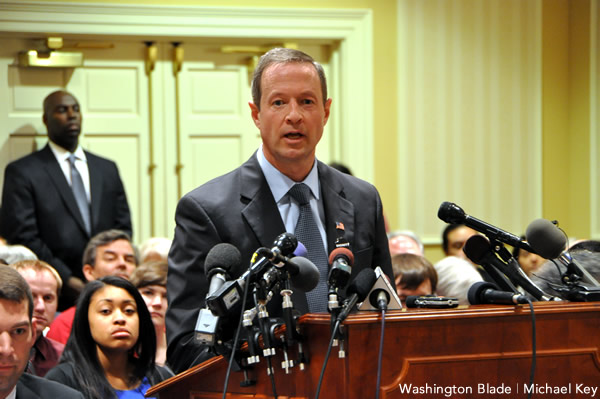
Gov. Martin O'Malley testifies before the Senate Judicial Proceedings Committee Tuesday in favor of the Civil Marriage Protection Act. (Washington Blade photo by Michael Key)
ANNAPOLIS, Md. — Over the course of four hours on Tuesday, opponents and supporters of same-sex marriage delivered compelling testimony before a Maryland Senate committee in hopes of swaying lawmakers on a landmark bill.
The Maryland Senate Judicial Proceedings Committee heard testimony on the Civil Marriage Protection Act throughout the afternoon on the last day of January, as lawmakers, experts, clergy and regular citizens from both sides of the issue shared their feelings on the bill at two minutes a piece.
Gaithersburg resident Stephanie Kreps arrived early to the hearing, proudly wearing a ‘Marylanders for Marriage Equality’ sticker to show her support for the bill as the mother of a gay son.
“It’s simple to me,” Kreps told the Blade. “I have rights that my gay son doesn’t have, and I want those rights for him and all other gay people.”
Kreps was looking forward to hearing the testimony of the bill’s supporters and said she was hopeful for the bill’s prospects considering the Governor’s support this year, and the growing trend toward supporting marriage for same-sex couples in Maryland.
The first witness to testify in favor of the bill was Maryland Gov. Martin O’Malley, who has made the bill part of his 2012 legislative agenda. O’Malley, who had at one time hesitated to support extending full marriage rights to gay couples, has become a proponent of the legislation.
“As you know we already recognize civil marriages that come from other states,” Gov. O’Malley said during his brief testimony, “the civil marriage equality bill draws upon the lessons that we have learned from these other states.”
“This bill balances an individual’s civil marriage rights with the important protections of religious freedoms for all,” O’Malley continued. “And because it protects both of these inalienable rights, it is supported by a broad coalition of Marylanders, which includes clergy, community leaders, faith-based organizations, civil rights groups and those who hold the most important title of all in our democracy, and that title is citizen.”
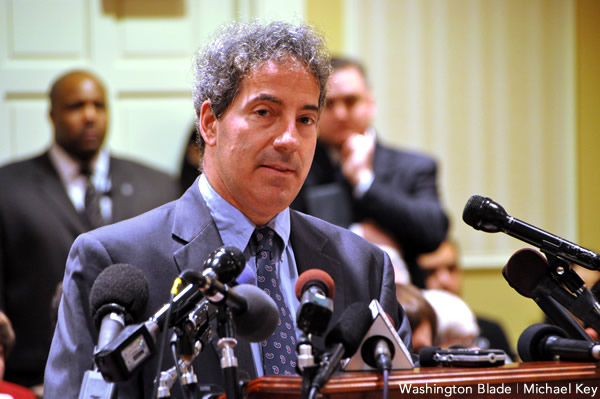
Sen. Raskin testifies in favor of the bill, Tues. (Blade photo by Michael Key)
O’Malley was followed by gay Sen. Richard Madaleno who spoke from the heart about his love for his partner and raising a child, and relayed a story about a walk with his young daughter that expressed the very essence of family.
“We were picking flowers along the way, and she was picking buttercups and dandelions,” Madaleno said. “As she picked a few of the flowers, and went on to pick more, she handed me a little bouquet, and said ‘daddy will you hold my wishes for me?’” When he asked her what she meant, she explained. “She said ‘This is a wishing flower, you blow on it, and you see where your wishes go.’”
“I don’t know why people fall in love, I don’t know exactly why I have fallen in love with Mark as opposed to someone else, but I have, and together we have formed a family, and that family includes children.”
Following Madaleno were Democratic Sens. Jamie Raskin and Robert Garagiola and Republican Sen. Allan Kittleman, as well as Attorney General Douglas Gansler (video below courtesy GoodAsYou), all of whom urged passage of the bill.
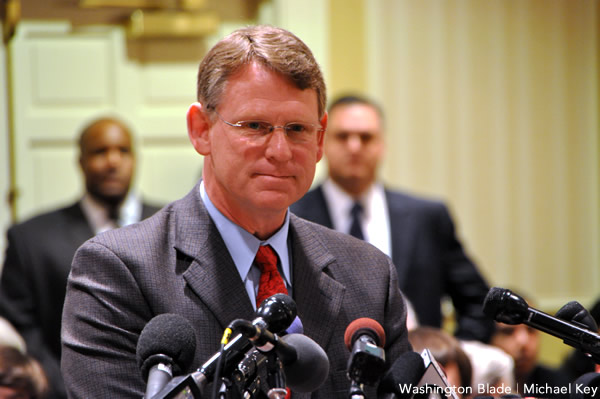
Sen. Kittleman broke ranks with Republicans to support the bill. (Washington Blade photo by Michael Key)
Kittleman, who spoke about his father’s work in the civil rights movement, said he feels so strongly about the legislation because “I really do believe it’s about family, it’s about liberty, it’s about equality.”
“I remember my dad telling me years later that when he was fighting for the civil rights movement, and integration in the public schools in Howard County, and he was talking to people who were opposed to it, especially school board members, the would say things like ‘but you don’t know what will happen if we accept African Americans. Here’s what might happen. They’re going to do this in the hallway,’ or ‘they’ll do this in the classroom,’ or ‘they’ll cause this problem.’ Always ‘might be this’ or ‘might be that.’ What I’m urging you is don’t succumb to the mights. What my father taught me is that you don’t take away someone’s civil rights because of something that might happen. You can deal with the ‘mights’ later on. But make sure we get the civil rights done now. Make sure we get that equality for everyone in our community now.”
“You don’t say no to civil rights because you’re worried about what might happen in the future,” Kittleman concluded.
Raskin, for his part, strongly defended the religious protections in the bill, confirming that churches and church sponsored and operated facilities would be exempt from having to “lend any of its accommodations, programs, or services for the purpose of promoting a marriage it disapproves of for religious reasons.”
However, Raskin was quick to differentiate religious groups and private individuals or businesses, who have been barred in law since 2001 from discriminating against Marylanders in public accommodation because of sexual orientation.
http://www.youtube.com/watch?v=z0aThYUXJ64
Sen. Raskin defends the marriage bill.
Also testifying in favor of the bill was Baltimore Mayor Stephanie Rawlings-Blake.
“I believe that all couples regardless of their sexual orientation, want their children protected under the law,” Rawlings-Blake testified. “Please don’t be mistaken, this bill is about more than those rights, it’s also about civil rights and about equality under the law.”
Both sides were given two hours each to present their witnesses in four parts — the first and third hours in support of the law, and the second and fourth in opposition.
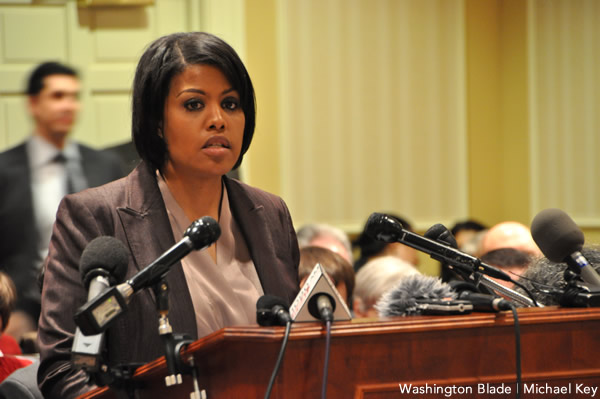
Baltimore mayor Stephanie Rawlings-Blake testifies in favor of the bill. (Washington Blade photo by Michael Key
All told, more than 75 citizens delivered testimony both for and against the bill over a period of four and a half hours. Opposition to the bill ran from the colorful — like local same-sex marriage hearing mainstay Minister Leroy Swailes, who produced groans even from other opponents of the bill — to the passionate; while support ran from the clinically factual to the deeply moving — such as the ardently supportive mother of a lesbian daughter, Penny Nichols.
The supporters also included dozens of same-sex couples raising children, parents of gay children and straight children raised by same-sex couples, all in an attempt to counter arguments by the opposition that same-sex marriage would be detrimental to the development of children in Maryland.
Also testifying in support of the law in the first hour were gay veteran and law enforcement officer Irene Huskens of Fort Washington; president of the Maryland AFL-CIO union, and father of a gay child, Fred Mason; gay federal worker and long-time Maryland resident Candy Holmes; supportive Unitarian-Universalist minister Rev. John Crestwell; and David Rocah, staff attorney at the ACLU of Maryland.
One of the questions that Rocah fielded from committee member Sen. Joseph M. Getty after his testimony dealt with whether the law discriminates against close family members that wish to marry “because of genetics, and the familial relationship is because of genetic relationships.”
“It’s long-standing policy in Maryland to prohibit marriage between people of a particular familial relation,” Rocah answered. “They don’t all relate with genetics. Maryland has prohibited relationships between stepfathers or stepmothers, they’re not genetically related. Different states have different degrees of familial relationships in which marriage is prohibited. I don’t see the issue of discrimination that you’re referring to.”
Both the hearing room itself and an overflow room were filled to capacity through much of the hearing, producing an electric and anxious atmosphere among those in attendance. Same-sex marriage supporters sat next to opponents, making it difficult in many cases to distinguish who was there in favor of and who was there against. Most in attendance could only be differentiated by the round stickers given out by both the proponents and opponents — which themselves were similar in shape, size and coloring.
Among those in the audience in opposition to the bill was Maryland resident Ruby Wilson who says she has concerns about the bill because she believes it will harm children.
“I believe children are being affected already in Massachusetts with the bill that’s there,” Wilson — who says as a Catholic she does not believe gays should adopt children — told the Blade. “In the fifth grade they’re given a book …and it tells all the ways that you can enjoy yourself as a homosexual. I don’t want my grandchildren to have that.”
“Also they said that there’s going to be a conscience clause in this bill for Christians,” Wilson continued. “Well, they just take that to court, and the courts just take it out. And then where are we at? We just have no protection.”
“I’m totally against it,” Wilson said, though she is not opposed to civil unions for same-sex couples. “I’m just opposed to redefining marriage.”
Wilson’s feelings about “redefining marriage” were echoed by Maryland resident Edna Kersey.
“I think that traditionally that is what marriage defines, is a man and a woman, and I feel that they should find another term for the same-sex marriage, or the same-sex union, so that it not tamper with the name that we so long stood on,” Kersey told the Blade. “That’s what our foundation is built on, the tradition marriage, which is between a man and a woman. So its not the union itself, it is the name or the title that they are trying to change.”
However, Kersey tells the Blade that she is not in support of Civil Unions, unlike Wilson.
In the second hour, the opposition first presented Maryland Family Alliance president Pastor Dereck McCoy, who set a cordial, respectful tone.
“Regardless of the tenuous debate that we’re in,” McCoy said, “I think we need to understand that Marylanders are separated on this issue, but it’s a deep and passionate thing in the root and the heart of the communities and many people’s lives.”
However, regardless of the result of the vote, McCoy said the definition of marriage would not change for opponents. “People will still feel that marriage should be defined as one man, and one woman. That does not change.”
Following McCoy was Maryland Baptist ministers Rev. Dr. John Lund, and Rev. Dr. Nate Thomas, as well as Presbyterian pastor Bob Borger, former mega-church pastor Joel Peebles — who recently lost a court battle over control over his Jericho City of Praise Ministry — as well as some Catholic voices such as Pastor of Our Lady of Perpetual Help, Father Eric Arnold, and Maryland Catholic Conference’s Mary Ellen Russell.
“Among those who testified last year, there were some who seemed to bring hatred and prejudice into the hearing,” said Father Arnold. “In fact, the Baltimore Sun reported that at least one Senator changed his stance on the bill because of the demonization that he sensed in some of the testimony. So as I speak to you today, I ask you to please not lump my testimony in with those who may be driven by hatred or prejudice.”
Father Arnold assured the committee that he, and many of those testifying with him, were there with good will.
“We are here today simply to speak on behalf of the wonderful and unique institution of marriage as it exists in between one man and one woman,” he continued, saying that preferring such unions was ‘not prejudice.’ “We ask you to recognize that the family based on a marriage of a man and a woman is a natural institution that is prior to the state.”
Mary Ellen Russell, in the adjacent audio file, seemed to come out both in favor and against civil unions during her testimony (hear her testimony at GoodAsYou.org).
The testimony was concluded by an attorney specializing in representing churches and ministers, Erika Cole, the Beckett Fund for Religious Liberty’s Eric Baxter, and the anti-gay Alliance Defense Fund’s Brian Raum (hear his testimony at ThinkProgress.org).
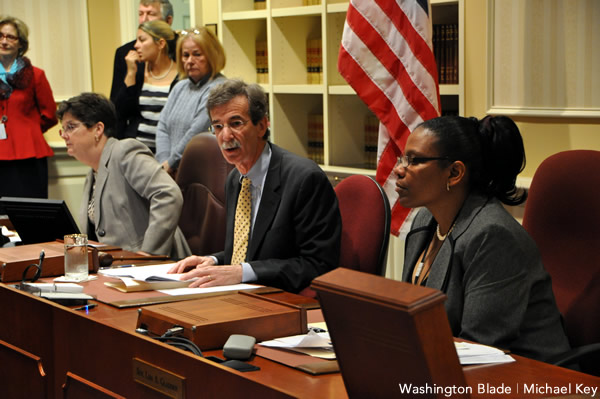
Committee chair Sen. Brian Frosh and Lisa Gladden. (Washington Blade photo by Michael Key)
Several times throughout the proceedings — both the hearing room and the overflow room where the testimony was projected upon two large screens at the fore of the room — parts of the audience erupted into cheers and applause in response to testimony given, often soliciting a stern reminder from committee chair Sen. Brian E. Frosh that for the sake of time, applause was to be held until the end, in recognition of the number of witnesses to get through.
Leading the supporters of the bill to testify in the third hour were the Human Rights Campaign’s Sarah Warbelow, who gave a statement about the way same-sex couples in Maryland were treated unequally in terms of property ownership, child rearing, healthcare and inheritance.
“Hundreds of laws cover the benefits, rights, and obligations of spouses,” Warbelow told the committee. “When same-sex couples cannot participate in marriage, their families are more vulnerable.”
Following Warbelow were Baltimore Presbyterian pastor Andrew Foster Connors, Baltimore’s Rabbi Elyssa Sachs Kohen, Doug Prouty of the Montgomery County Education Association, Henry Dugan president of the Maryland State Bar Association, along with State Bar member Craig Little, Daphne Mcclellan executive director of the National Association of Social Workers Maryland chapter, Rev. Madeleine Beard coordinator of public policy for the Episcopal Diocese of Maryland, MCC Bishop Rev. Darlene Garner and Rev. Jill McCrory Chair of Association of Welcoming and Affirming Baptists.
They were joined by social workers and radio hosts Bob and Lori Hollander, Progressive Maryland Interim Executive Director Kate Planco Waybright, and Ezekiel Jackson political organizer for 1199 SEIU, who said, “as a heterosexual African American man, I’m here for equality.”
http://www.youtube.com/watch?v=qfBGyIhtWfw
A.G. Gansler testifies
Opposition in the fourth hour brought some of the most curious testimony of the day. Openly gay father Doug Mainware lamented the lack of a mother in the lives of his children, and cited his conservative beliefs and “thinking deeply about this issue in a reasoned way,” as impetus for coming to oppose the bill after previously supporting it. Senator Raskin, intrigued by the curiosity of the situation, asked Mainware, “how do you undermine an institution by bringing more people into it?”
Mainware believes that the term belongs specifically to the union between a man and a woman, but did admit he is not opposed to civil unions.
Mainware was followed by a cordial Rob Lucas and anti-gay group MassResistance’s Brian Camenker, who warned lawmakers that parents will lose control over what children are taught in school if marriage is extended to same-sex couples, and even warned about a particular case, frequently cited by same-sex marriage foes, in which David Parker was arrested for opposing a pro-gay curriculum in his child’s school.
Also opposing in the fourth hour were Pastor Victor Kirk, Maryland Gubernatorial candidate Corrogan Vaughn, Ruth Jacobs, Silver Springs pastor Robert Nelson, leader of Maryland Marriage Savers Mike McManus, Pierre Bynum, Chaplain at the Family Research Council, Martha and Ed Jenkins, Todd Braun, the colorful Minister Leroy Swailes, and Grace Harley who opposes the bill but — after reciting from the biblical book of Matthew — proclaimed, “I once lived as a man, I once married a woman in 1978, I’ve been before you many times.”
After the final round of opponents, several prominent supporters were able to give their testimony, including Kate Oliver of the group COLLAGE which brings together the children of gay parents, Rev. Lisa Ward, Liz Seaton of the National Center for Lesbian Rights, Rev. MacArthur Flournoy who had led the clergy rally earlier in the day, president of the Maryland Gay and Lesbian Chamber of Commerce Mark Yost and Episcopal priest Rev. Kathleen Corbet Welsh, a happily partnered lesbian for many decades.
Among these prominent voices was Equality Maryland executive director Carrie Evans, who echoed the sentiments of all of the heartfelt statements that had preceded hers.
“Today you have heard from individuals and families who represent the wonderful and cherished diversity of our great state,” Evans told the committee. “Each person has shared the sometimes personal and touching reasons why you should vote to end marriage discrimination.”
Also in this group was memorable mother of a lesbian daughter at Drexel University, Penny Nichols, who proclaimed “As a devoted mother, I knew my daughter was gay since the second grade.”
“When she finally said to me at the age of 16, ‘mom I’m gay,’ I shocked her with my response, for I hugged my daughter, and I said ‘I’m so proud of you for being your authentic self,” Nichols said. “I want my lesbian daughter to live in a just world.”
“The only obstacle my lesbian daughter should face is her mother’s rule that she cannot marry until after she receives her degrees,” Nichols continued. “I am not gay, but I birthed a gay daughter. I don’t know who’s louder or prouder — she or I — but I will tell you, I think I am outer and prouder!”
After the completion of the last supporters, the committee agreed to exhaust the speaker’s list by giving those remaining — both supporting and opposing — one minute each to add their own testimony.
http://www.youtube.com/watch?v=o-Tsr7rz9Og



Rehoboth Beach
CAMP Rehoboth hires new executive director
Dr. Robin Brennan’s background includes healthcare, fundraising roles
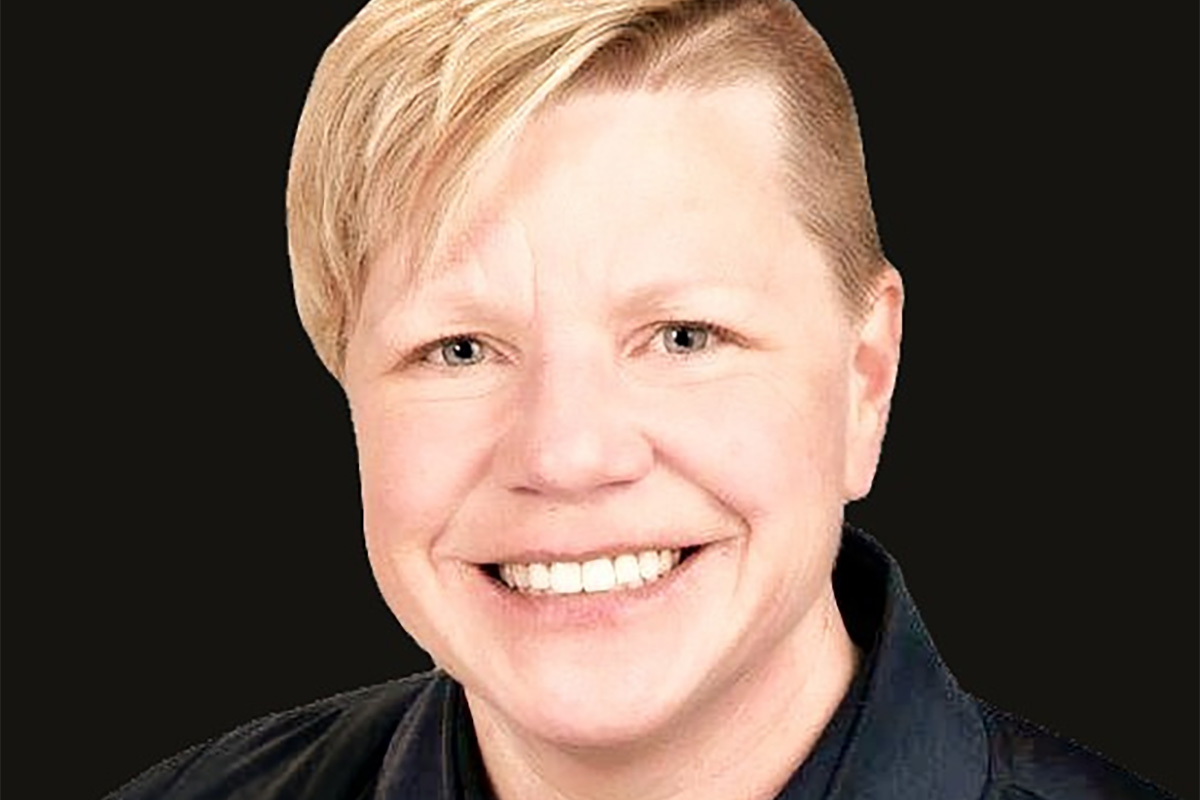
CAMP Rehoboth, the Delaware LGBTQ community center, on Monday announced Dr. Robin Brennan as the organization’s new executive director.
Brennan, who is relocating full time to Rehoboth Beach with her wife and daughter, will start on March 23. The position opened up following the retirement of Kim Leisey after more than two years in the role.
Brennan’s background is in health systems. At Nemours Children’s Health in Wilmington, Del., she held senior roles in evaluation, population health, and DEI education, according to a CAMP Rehoboth statement. Most recently, she served as vice president and Chief Diversity and Inclusion Officer at Redeemer Health. Brennan is an experienced fundraiser, according to the statement.
“After conducting a comprehensive national search, the Board of Directors selected Robin because of her depth of leadership experience, her fundraising acumen and her overall joyful, focused approach,” said Leslie Ledogar, president of the CAMP Rehoboth board of directors and chair of the Executive Director Search Committee. “The fact that core to her leadership is her belief that community well-being is inseparable from access to health, culture, education and the arts – an approach that mirrors CAMP Rehoboth’s holistic mission – makes Robin the exact next person to lead CAMP Rehoboth today and into the future.”
“I am deeply honored to serve as CAMP Rehoboth’s executive director as we enter an exciting new chapter,” said Brennan. “I was drawn to CAMP Rehoboth because of its unwavering mission, deep roots in the community, and the meaningful role it plays in bringing people together. I look forward to meeting members of the community, listening to their stories, and building meaningful relationships with the many people who make CAMP Rehoboth such a vital community anchor.”
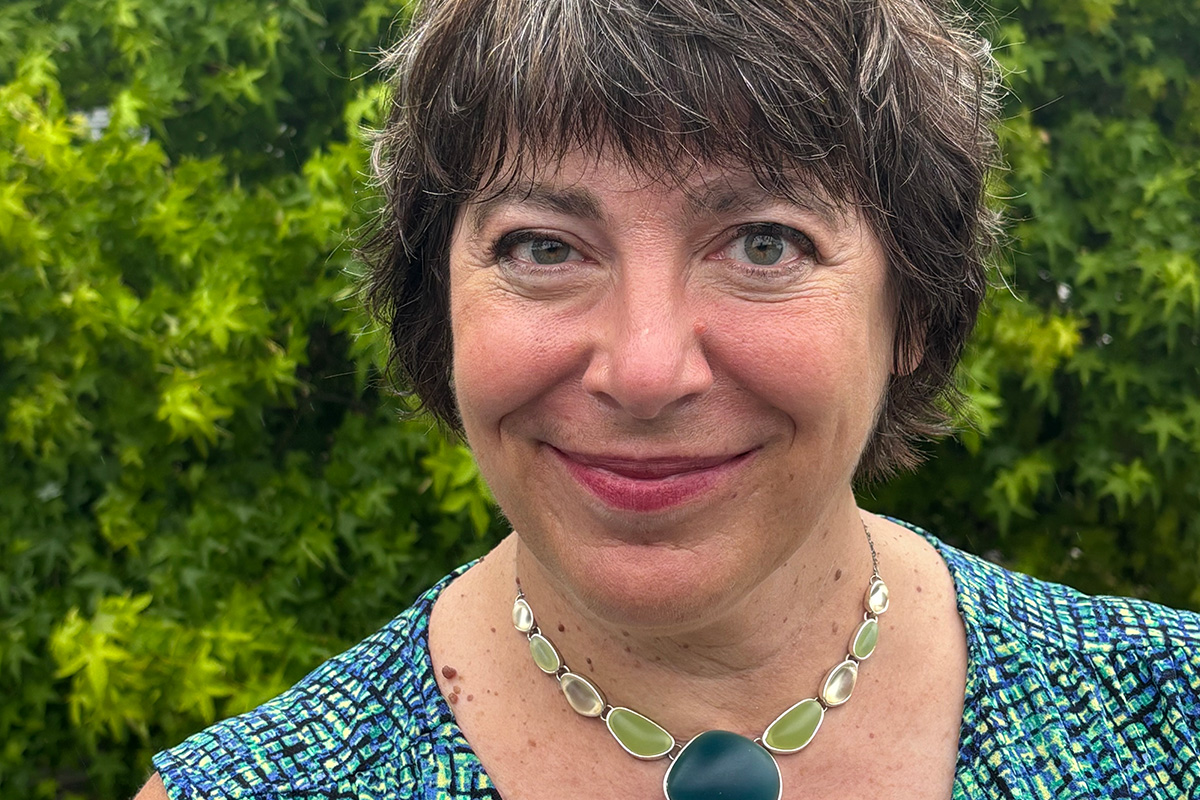
The Comings & Goings column is about sharing the professional successes of our community. We want to recognize those landing new jobs, new clients for their business, joining boards of organizations and other achievements. Please share your successes with us at [email protected].
The Comings & Goings column also invites LGBTQ+ college students to share their successes with us. If you have been elected to a student government position, gotten an exciting internship, or are graduating and beginning your career with a great job, let us know so we can share your success.
Congratulations to Susan Ferentinos, Ph.D., on her appointment to the Advisory Board of the Smithsonian’s National Museum of American History. On her appointment she said, “This is a moment when historians must stand up for accuracy, complexity, and the full breadth of the American story. I look forward to working with my fellow board members to ensure the National Museum of American History continues to fulfill its mission of serving all Americans with the highest standards of scholarship and integrity.”
Ferentinos operates her own national consulting business based in Port Townsend, Wash., with satellite operations based in Delaware County, Pa. Her business helps museums, historic sites, and government agencies expand and diversify the stories they tell about the American past. Her work focuses on interpreting LGBTQ history and women’s history, bringing overlooked narratives into mainstream historical interpretation. Her clients have included the National Park Service, the American Association for State and Local History, Baltimore Heritage, and numerous museums and historic sites across the country. Among her many accomplishments, Susan was part of the teams responsible for getting three LGBTQ sites designated as National Historic Landmarks. Two of those landmarks are in Washington, D.C. She authored the NHL nominations for the Furies Collective, in Capitol Hill, building on research performed by local historian Mark Meinke, and she authored the NHL nomination for the home of African-American educators Lucy Diggs Slowe and Mary Burrill, in Brookland, building on research by Eric Griffitts and Katherine Wallace, of EHT Traceries.
Ferentinos earned her bachelor’s degree from College of William and Mary in International Development and Philosophy; a master’s from Indiana University in United States History; and a Ph.D. from Indiana University in United States History.
Congratulations also to Shawn Gaylord on joining a team at Berkshire Hathaway PenFed Reality in Solomons, Md. His focus will be Southern Maryland – Calvert, St. Mary’s, Charles, and Anne Arundel. Gaylord still leads the LGBTQ+ Strategies Team at The Raben Group and works part-time on federal policy for GLSEN.
Maryland
Md. Commission on LGBTQIA+ Affairs released updated student recommendations
LGBTQ students report higher rates of bullying, suicide
The Maryland Commission on LGBTQIA+ Affairs has released updated recommendations on how the state’s schools can support LGBTQ students.
The updated 16-page document outlines eight “actionable recommendations” for Maryland schools, supplemented with data and links to additional resources. The recommendations are:
- Developing and passing a uniform statewide and comprehensive policy aimed at protecting “transgender, nonbinary, and gender expansive students” against discrimination. The recommendation lists minimum requirements for the policy to address: name, pronoun usage, and restroom access.
- Requiring all educators to receive training about the specific needs of LGBTQ students, by trained facilitators. The training’s “core competencies” include instruction on terminology, data, and support for students.
- Implementing LGBTQ-inclusive curricula and preventing book bans. The report highlights a “comprehensive sexual education curriculum” as specifically important in the overall education curriculum. It also states the curriculum will “provide all students with life-saving information about how to protect themselves and others in sexual and romantic situations.”
- Establishing Gender Sexuality Alliances “at all schools and in all grade levels.” This recommendation includes measures on how to adequately establish effective GSAs, such as campaign advertising, and official state resources that outline how to establish and maintain a GSA.
- Providing resources to students’ family members and supporters. This recommendation proposes partnering with local education agencies to provide “culturally responsive, LGBTQIA+ affirming family engagement initiatives.”
- Collecting statewide data on LGBTQ youth. The data on Maryland’s LGBTQ youth population is sparse and non-exhaustive, and this recommendation seeks to collect information to inform policy and programming across the state for LGBTQ youth.
- Hiring a full-time team at the Maryland Department of Education that focuses on LGBTQ student achievement. These employees would have specific duties that include “advising on local and state, and federal policy” as well as developing the LGBTQ curriculum, and organizing the data and family resources.
- Promoting and ensuring awareness of the 2024 guidelines to support LGBTQ students.
The commission has 21 members, with elections every year, and open volunteer positions. It was created in 2021 and amended in 2023 to add more members.
The Governor’s Office of Communication says the commission’s goal is “to serve LGBTQIA+ Marylanders by galvanizing community voices, researching and addressing challenges, and advocating for policies to advance equity and inclusion.”
The commission is tasked with coming up with yearly recommendations. This year’s aim “to ensure that every child can learn in a safe, inclusive, and supportive environment.”
The Human Rights Campaign’s most recent report on LGBTQ youth revealed that 46.1 percent of LGBTQ youth felt unsafe in some school settings. Those numbers are higher for transgender students, with 54.9 percent of them saying they feel unsafe in school.
Maryland’s High School Youth Risk Behavior Survey reveals a disparity in mental health issues and concerns among students who identify as LGBTQ, compared to those who are heterosexual. LGBTQ students report higher rates of bullying, feelings of hopelessness, and suicidal thoughts. Nearly 36 percent of LGBTQ students report they have a suicide plan, and 26.7 percent of respondents say they have attempted to die by suicide.
The commission’s recommendations seek to combat the mental health crisis among the state’s LGBTQ students. They are also a call for local and state governments to work towards implementing them.

Man stuck in Lebanon as Iran war escalates

CAMP Rehoboth hires new executive director

Claudia López wins primary in Colombian presidential race

Too afraid to leave home: ICE’s toll on Latino HIV care

Intense doc offers transcendent treatment of queer fetish pioneer

13 HIV/AIDS activists arrested on Capitol Hill

PHOTOS: Sydney Gay and Lesbian Mardi Gras Parade

Fla. Senate passes ‘Anti-Diversity’ bill that could repeal local LGBTQ protections

Ugandan activist named Charles F. Kettering Foundation fellow

Liza Minnelli makes surprise appearance at GLAAD Media Awards
-

 National4 days ago
13 HIV/AIDS activists arrested on Capitol Hill
-
Photos5 days ago
PHOTOS: Sydney Gay and Lesbian Mardi Gras Parade
-
Florida3 days ago
Fla. Senate passes ‘Anti-Diversity’ bill that could repeal local LGBTQ protections
-
Uganda4 days ago
Ugandan activist named Charles F. Kettering Foundation fellow