Arts & Entertainment
Affirming their faith
Lutheran LGBT group holding D.C. conference this weekend
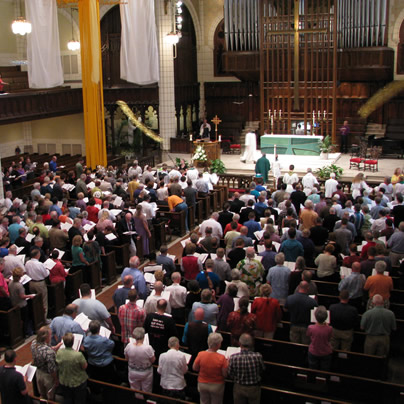
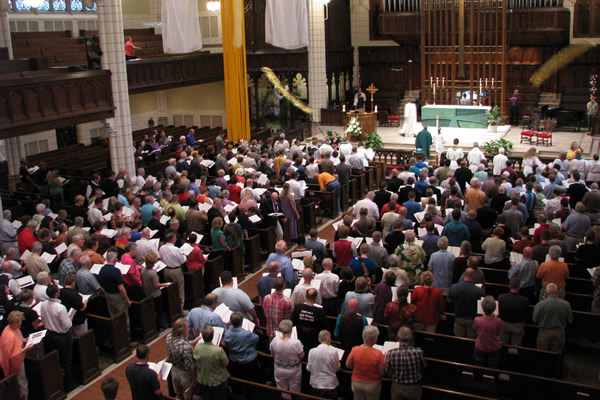
The 2010 ReconcilingWorks conference in Minnesota. (Photo courtesy ReconcilingWorks)
A contingent of LGBT Lutherans will be in Washington this weekend for its biennial conference and while the denomination is still celebrating a 2009 decision that allows partnered gay and lesbian clergy to live openly, the group says it still has much work to do.
ReconcilingWorks — Lutherans for Full Participation was founded in 1974 by six people when it was known as Lutherans Concerned for Gay and Lesbian People. This year’s gathering, which runs Friday through Tuesday based at Luther Place Memorial Lutheran Church (1226 Vermont Ave., N.W.) will find a few hundred LGBT believers and allies here to fellowship, lobby, hear a keynote address from Presiding Bishop Mark Hanson and more. Those interested in attending can still get involved — visit reconcilingworks.org for information.
“Our primary purpose is always movement building,” says Emily Eastwood, executive director of ReconcilingWorks, a life-long Lutheran and lesbian. “We gather for personal transformation and support as well as skills building, education and action planning.”
Despite the 2009 decision, she says the group’s work is not done.
“As we know from the years of history with the Civil Rights Movement, when policies change, when laws change, that doesn’t mean the practice of it is immediately implemented or that the cultural shifts have occurred,” she says. “We believe full inclusion will take a period of years, perhaps even the rest of my life, to make sure the new policies become fully practiced within our denomination.”
Only about 500 of the 10,000 or so individual churches within the Evangelical Lutheran Church in America (ELCA) are “reconciling in Christ,” the group’s term for openly welcoming LGBT Christians. The D.C. area has more percentage wise — about 20 of the 70-odd ELCA churches that are part of the Metro D.C. Synod are “reconciling,” according to Philip Moeller, convener of the D.C. ReconcilingWorks chapter since 1991.
“What we’re basically saying is that it is possible to reconcile differences on these issues and move ahead in a way that’s commensurate with the gospel,” Moeller says.
Members say it’s a huge step for the entire denomination to have Hanson address their group. Moeller says Hanson was always sensitive to their issues but measured in his public stance prior to the 2009 vote. He’s been more unequivocal in his support since then, members say, and his appearance is unprecedented for the 4.2 million-member ELCA.
“This is the first time we’ve ever had a presiding bishop address us and it really says something about the change that’s happening within the church,” Moeller says.
On Tuesday, members will visit Capitol Hill for a lobbying effort.
Phil Soucy, the organization’s director of communications, says it’s part of the group’s belief that its work matters in the context of society at large.
“We’re going to be going to our representatives to tell them our thoughts to make sure they’re aware of the things we consider important in our lives as Lutherans and as citizens,” Soucy, who’s gay, says.
So how has ReconcilingWorks managed to make further strides within its denomination compared to other gay Christian groups working within the Roman Catholic Church or the United Methodist Church? Is it a matter of activism, theology or both?
“You’ve got a real tough issue with the Roman Catholic Church in that it’s very hard to change the Vatican,” Moeller, who’s also gay, says. “In terms of the Protestant denominations, I think the reason we’ve been so successful is that we really understood early on that confrontation gets you nowhere. If you’re in somebody’s face, you’re not going to change their mind about anything. You can even write a friendly discourse on theology and it won’t accomplish anything. What works is hearing the stories of people who have faith and who are LGBT. We haven’t left the church, we’re still in the church. We don’t want to be welcomed back, we want to be fully welcomed with all the same rights and privileges as everybody else has. … It’s really a matter of having a shift from confrontation to constructive engagement.”
Eastwood says her church’s belief on the nature of the grace of Christ, is central to their progress.
“The primary tenet of our faith is that we are saved through our faith and that that’s a gift from God,” she says. “It’s not through any kind of work that we do on our own, so our heritage seems to be a bit more progressive than other denominations.”
She also says relationship building has been essential.
“It’s about meeting people and walking with them for a time to build relationships rather than resorting to debate,” she says.


It’s surely a sign of the times that this year’s spring preview of upcoming screen entertainment doesn’t hold nearly as much boldly out-and-proud queer content as we would like – but then again, there are only a small handful of noteworthy titles overall – especially on the big screen, where, just like any year, the top-grade content is being saved for summer.
Even so, we’ve managed to put together a list of the movies and shows on the horizon that offer a much-needed taste of the rainbow; a mix that includes returning favorites, “don’t-miss” events, and a few promising big screen crowd-pleasers, it should keep you occupied until the summer season brings a fresh new crop of (hopeful) blockbusters with it.
Scarpetta (Prime Video, March 11). Proving once again that she’s on a quest to accumulate more screen appearances than any other actor in history, Nicole Kidman returns for another star turn by way of this true-crime-ish mystery series, adapted from the bestselling “Kay Scarpetta” novels by lesbian author Patrica Cornwell, as a “brilliant and beautiful” forensic pathologist who uses her knowledge to solve murders. If that’s not enough to draw you in, her co-stars include fellow Oscar-winners Jamie Lee Curtis (as her feisty older sister) and Ariana DuBose (as her nosy lesbian niece), as well as Bobby Cannavale and Simon Baker.
It’s Dorothy! (Peacock, March 13). Filmmaker Jeffrey McHale first won our attention with his fun and insightful “Showgirls” documentary, and now he’s back with a look at perhaps the ultimate queer icon in popular culture: none other than Dorothy Gale, that Kansas farm girl who taught us all that “there’s no place like home” in L. Frank Baum’s classic novel “The Wonderful Wizard of Oz” and its sequels – and of course, in a certain movie adaptation starring Judy Garland. Charting the journey of the fictional heroine across a century of cultural reiterations – on the page, the stage, the screen, and beyond – with a mix of archival material, artistic interpretations, and commentary from queer and queer-friendly voices such as John Waters, Rufus Wainwright, and Lena Waithe, it’s sure to be required viewing for every “Friend of Dorothy” – and all of their friends, too.
The 37th Annual GLAAD Media Awards (Hulu, March 21). Sure, it’s already happened and you already knew (or can find out with a few quick taps of your phone screen) who and what the winners were – but, hey, we already know that the Oscars aren’t going to offer much in the way of queer victories (since there are only a small handful of queer nominees), so why not plan to watch the GLAAD ceremony (recorded live on March 5 for later streaming)?
The Comeback: Season 3 (HBO Max, March 22). Another returning gem is this inventive “mockumentary” style sitcom-about-a-sitcom, starring Lisa Kudrow as a “B-list” television star trying to revive her own faltering career. Slow to catch on in its first season (which originally aired in 2005), it won acclaim (and new fans) when it was rebooted in 2014 by Kudrow and collaborator/co-creator Michael Patrick King (former executive producer of “Sex in the City,” and now returns after a 12-year hiatus for another installment, which tracks “never-was” has-been Valerie Cherish through yet another attempt to make stardom happen. If you like cynical, sharp-edged satire, especially when it’s aimed at the behind-the-scenes world of show-biz, then you’ve probably already discovered this one – but if you haven’t, now’s your chance to jump on board.
Heartbreak High: Season 3 (Netflix, March 25). Fans of this imported Australian teen “dramedy” series – itself the “soft reboot” of another popular Australian series from the ‘90s – will be thrilled for the arrival of its third and final installment, which picks up where it left off in the lives (and sex lives) of the students and teachers of a suburban high school. As always, it can be expected to push the envelope (and some buttons) with its irreverent treatment of issues of class, race, and sexuality – and to deliver another season’s worth of the colorful and striking costume designs that have been acclaimed as a highlight of the show. And yes, it includes a refreshingly significant number of variously queer characters, so if you’re not already on board with his hidden gem of a streamer, we suggest you should give it a shot – you can probably even catch up on the first two seasons before this one drops.
Pretty Lethal (Prime Video, March 25). Fresh from a March 13 debut at the SXSW Film and TV Festival, this girl-power fueled action thriller from director Vicky Jewson and writer Kate Freund centers on a troupe of ballerinas who, while en route to a prestigious ballet competition, are stranded by a bus breakdown and must take shelter at a remote roadside inn run by Uma Thurman as a ruthless crime boss. Needless to say, the girls are forced to adapt their dance prowess into combat skills before the night is over. With a cast that includes Maddie Ziegler, Lana Condor, Avantika, Millicent Simonds, and Michael Culkin, our bet is that it’s sure to be campy fun with a feminist twist.
Forbidden Fruits (Theaters, March 27). Adapted from the play “Of the woman came the beginning of sin, and through her we all die” by Lily Houghton (who co-wrote the screenplay with director Meredith Alloway), this comedy/horror film about a group of young witches who operate a “femme cult” out of the basement of a mall store called “Free Eden” looks like another campy treat, full of witchy wiles and bitchy rivalries, but something about its theatrical pedigree tells us it will also be more than that. Even if we’re wrong, though, we’ll be perfectly happy; why would anyone say no to a delicious piece of camp, especially when it has a cast led by Lili Reinhart, Lola Tung, Victoria Pedretti, and Alexandra Shipp, with creator/influencer Emma Chamberlain in her film debut and heavyweight talent Gabrielle Union thrown in for good measure? We’re ready to join the coven.
Club Cumming (WOW Presents Plus, March 30). Queer icon Alan Cumming (currently riding high as host of “The Traitors”) takes us inside his NYC East Village gay bar, nightclub, and showplace for a behind-the-scenes reality series that spotlights the talent, fashion, and fabulously queer vibe that makes the establishment one of queer New York’s most iconic nightspots. Cabaret singer Daphne Always, go-go dancer and drag performer Michelle Wynters, Drag queen Brini Maxwell, Drag king Cunning Stunt, and Comedian Jake Cornell are among the many reasons why this little slice of the queer New York scene is reason enough alone to become a subscriber to World of Wonder’s streaming platform – though if you’re a “Drag Race” superfan, chances are good you already are.
The Boys: Season 5 (Prime Video, April 8). Amazon’s violent superhero satire, complete with its divisive and deliciously challenging emphasis on queer storylines and its in-your-face caricature of contemporary American “culture war” politics, returns for its fifth and final season, along with all the thorny issues of racism, nationalism, and xenophobia it has showcased all along, and an ensemble cast that includes Karl Urban, Jack Quaid, Antony Starr, Erin Moriarty, and the rest of the usual players. A decidedly queer-informed game-changer in the mainstream fan culture, it’s a show that will be sorely missed – but with several spin-offs already in existence (including the even-queerer “Gen V”) and another (“Vought Rising”) on the way, we can take comfort in knowing that its influence will live on.
Euphoria: Season 3 (HBO Max, April 12). The controversial Sam Levinson-created drama that is HBO’s fourth most-watched series of all time is back after a lengthy hiatus, rejoining the lives of its dysfunctional characters – queer struggling addict Rue (Zendaya), trans teen Jules (Hunter Schafer), abusive sexually insecure football star Nate (Jacob Elordi), and the rest – a full five years later, away from the social traumas of high school and settled into what we can only assume is an equally-dysfunctional life as young adults. Renowned for its cinematic visual styling and its no-holds-barred treatment of “triggering” subject matter, this long-awaited return is likely to be at or near the top of a lot of watchlists – and ours is no exception.
Mother Mary (Theaters, April 17). One of the most promising (and queerest) offerings of the season is this psychological thriller set in the world of pop music, helmed by acclaimed filmmaker David Lowery (“A Ghost Story,” “The Green Knight”) and starring Anne Hathaway (“The Devil Wears Prada,” “Les Misérables”) as a pop singer who becomes entwined in a twisted affair with fashion designer Michaela Cole (“I May Destroy You,” “Black Earth Rising”). Besides its two queer-fan-fave stars, it features trans actress Hunter Schafer (“Euphoria”), FKA Twigs, and Jessica Brown Findlay (“Downton Abbey”) in supporting roles, and to top it all off, it includes a soundtrack full of original songs. With a celebrated director behind it and an award-winning pair of leading ladies, this one has all the potential of a future classic.
The Devil Wears Prada 2 (Theaters, May 1). Meryl Streep is back as Miranda Priestley, need we say more? We know the answer to that is “no,” but we still need to remind you that Anne Hathaway, Emily Blunt, and Stanley Tucci are all part of the deal, too, as this hotly anticipated sequel hits the screen just ahead of the summer rush. Along for the ride are Kenneth Branagh, Justin Theroux, Lucy Liu, B.J. Novak, Conrad Ricamora, Sydney Sweeney, Rachel Bloom, Donatella Versace, and Lady Gaga herself. We trust that will be sufficient to ensure that you will show up on opening day – dressed accordingly, of course.
The Sheep Detectives (Theaters, May 8) Rounding out our roundup with a fun-for-the-family treat that blends live action with animation for an inter-species “whodunnit” with an all-star array of talent, this adaptation of Leonie Swann’s 2005 novel “Three Bags Full” centers on a flock of sheep as they attempt to solve the murder of their beloved shepherd. Boasting onscreen performances from Hugh Jackman, Emma Thompson, Nicholas Braun, Nicholas Galitzine, and Molly Gordon, along with character voices provided by Julia Louis-Dreyfus, Bryan Cranston, Chris O’Dowd, Regina Hall, Patrick Stewart, Bella Ramsey, Brett Goldstein, and Rhys Darby, this one might be just the kind of lightweight entertainment we all need as we move deeper into the confounding year of 2026.
And if not, stay hopeful – the films and shows of summer will be here soon enough.
a&e features
D.C. springs back to life with new, returning events
Cherry blossoms, Rehoboth season kickoff, and more on tap
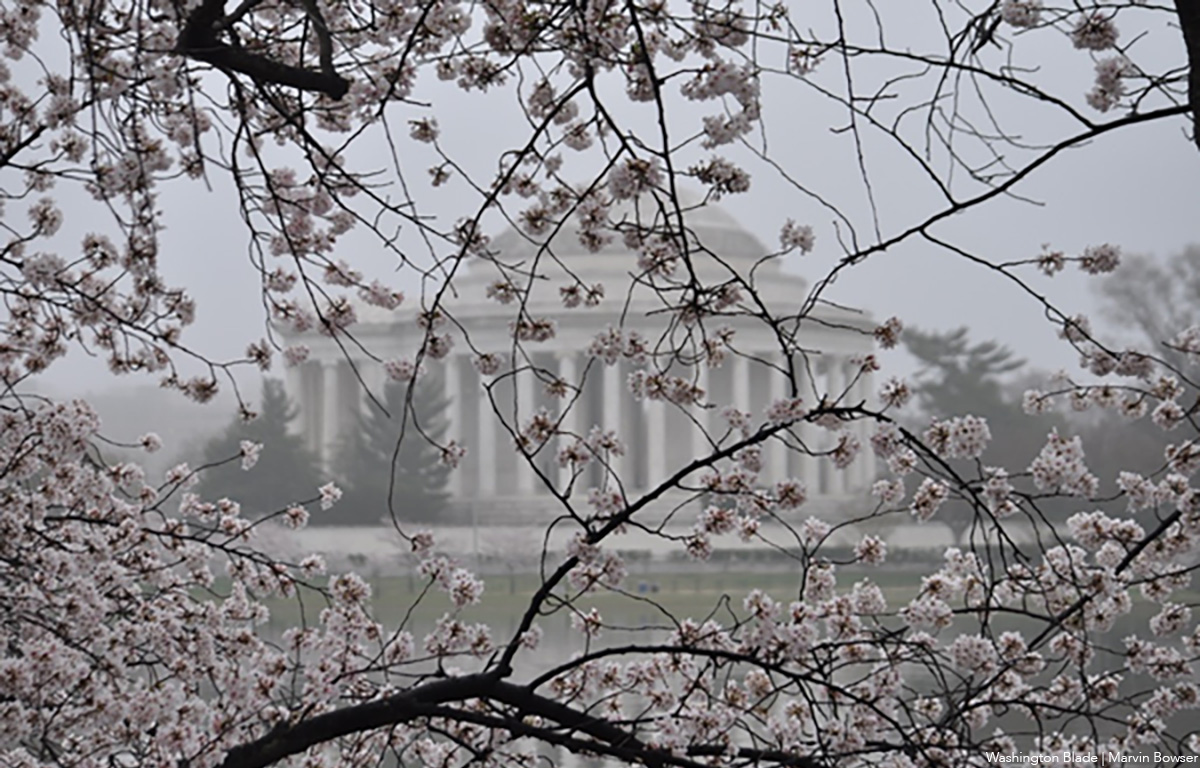
Longer and warmer days are back meaning: It’s time to get out of the house and enjoy Washington D.C.’s many events. Below are a few to check out this spring.
The National Museum of Women in the Arts will host “Making their Mark: Works from the Shah Garg Collection” until Sunday, July 26. This exhibition illustrates women artists’ vital role in abstraction, considers historical contributions, formal and material breakthroughs and intergenerational relationships among women artists over the last eight decades. For more details, visit. NMWA’s website.
Art in the Attic will host a pop-up on Saturday, March 14 at 6 p.m. at 1012 Madison St., Alexandria, Va. There will be a variety of vendors selling products across different modes of art. For more details, visit Eventbrite.
Play Play will host “Indoor Recess – The art of play” on Sunday, March 15 at 2 p.m. This event will embody classic recess energy, including opportunities to build and experience community and connections through games, movement, art stations, and creative freedom. Tickets are $12.51 and can be purchased on Eventbrite.
Spark Social will host “Gay Bar Crawl on U Street” on Friday, March 20 at 7:30 p.m. This will be a fun night out in gay D.C. with other gay people, whether you’re visiting D.C., new to the area, or just looking to expand your social circle. Many crawlers have formed lasting friendships and even romantic relationships after just one night out. Tickets are $35.88 and are available on Eventbrite.
Creative Suitland Arts Center will host “EFFERVESCENT: House of Swann” on Saturday, May 30 at 7 p.m. This will be a gay, good time where we will celebrate love, joy, wellness, and visibility for the LGBTQIA+ community. Tickets start at $17.85 and can be purchased on Eventbrite.
SWAG Works DC will host “Unapologetically Her” on Saturday, March 14 at 2 p.m. at 701 E St., S.E. This event is a powerful celebration of womanhood, resilience, creativity, and self-expression in honor of Women’s History Month. This all-women exhibition highlights the diverse voices, stories, and artistic perspectives of women who create boldly, live authentically, and stand confidently in their truth. This event is free and more details are available on Eventbrite.
9:30 Club will host “Gimme Gimme Disco: A Dance Party Inspired by ABBA” on Saturday, March 14 at 6 p.m. There will also be a “Donna Summer Power Hour – The Queen of Disco” segment during this event. It’ll be one hour of music with no skips. Tickets are available on 9:30 Club’s website.
Harder Better Faster Stronger will host “Heated Rivalry Rave” on Friday, March 20 at 9 p.m. at Howard Theatre. This event is open to all ages. Tickets are available on the theater’s website.
CAMP Rehoboth hosts its 25th annual Women’s+ FEST, April 9-12 in Rehoboth Beach, Del. Entertainers include headliner Mina Hartong, a comedian, storyteller, and founder of Lez Out Loud; and singer Yoli Mayor. There are dances, dinners, pickleball, and much more. Details and tickets at camprehoboth.org.
Also in Rehoboth Beach, the Washington Blade’s 19th annual Summer Kickoff Party is set for Friday, May 15 featuring Ashley Biden, who will accept an award on behalf of her brother Beau. State Rep. Claire Snyder-Hall will also speak. More speakers and the venue to be announced soon.
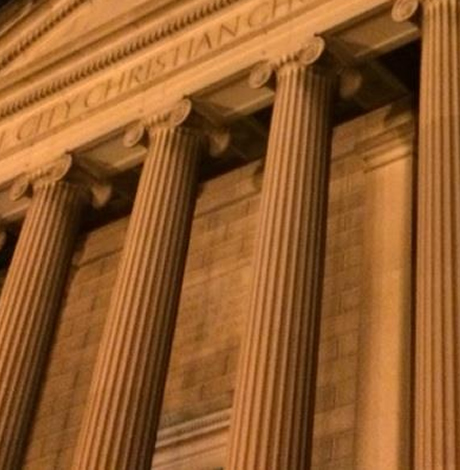
The annual D.C. Cherry Blossom Festival kicks off March 21 at DAR Constitution Hall and culminates with Petalpalooza on April 4, the day-long, outdoor street party with music and art, stretching across Navy Yard, and ending with fireworks over the Anacostia River.
a&e features
‘Queer Eye’ star Dorriene Diggs on life before and after appearing on hit show
Emotional January episode highlighted 40-year love affair with partner

Dorriene Diggs, 70, whose 40-year relationship with her domestic partner, Diane until Diane’s passing in 2020, the couple’s tense relationship with their respective parents, and Dorriene’s current living arrangement with her straight sister Jo, were the focus of a final season episode of the popular TV series “Queer Eye.”
In a recent interview with the Washington Blade, Diggs told of how her appearance on the show has impacted her life. She elaborated on the many aspects of her life experiences that she told to the five “Queer Eye” co-hosts who interviewed her and her sister in their D.C. home.
Although her parents and her partner’s parents, who have since passed away, were not accepting of their relationship, Diggs has said most of her family members at this time reacted positively to her appearance on the show.
“They loved it,” she told the Blade. “Yes, everybody that saw the show called me and said they loved the show, they really enjoyed themselves watching it.”
Through an arrangement with D.C.’s Rainbow History Project, the “Queer Eye” show featuring Diggs and her sister was presented in a special screening on a large video screen at the D.C. History Center in January.
“Dorriene, a 70-year-old Black lesbian living in Washington, D.C., had spent decades building a life with her partner while navigating silence within her own family,” a “Queer Eye” statement announcing the episode on Diggs states.
“The Fab Five did not arrive to introduce Dorriene to herself, but to help ensure her story was finally heard in full,” the statement says.
Blade: Can you tell us how your appearance on the “Queer Eye” program came about? How did they find out about you?
Diggs: You know, I still don’t have all the details. I think it was my niece, Missy. And she knows somebody there from “Queer Eye.”
Blade: So, did you first learn about it when someone from “Queer Eye” contacted you?
Diggs: No, the “Queer Eye” guy knocked on my bedroom door and started talking. I was in my bedroom watching television and the next thing I know my door opened up and there was Karamo [Karamo Brown, one of the “Queer Eye” co-hosts] with his big black cowboy hat on, opening the door grinning. … They contacted Jo first. And when they came here, they realized there was a gay woman in the house, too. Because my name was not mentioned at first. After they came here, they learned about me, because when Missy reached out to them, she reached out to them about Jo. But that doesn’t bother me. This was all about Jo in the beginning, and not me. … They started talking to me and Jo. And he said, Dorriene, ‘you’ve done so much for so many people, it’s time for someone to do something for you.’ That’s what they said. He said, ‘this is the day we’re doing it for you.’
And so, they put me and my sister up in a hotel for a week. They gave us a personal driver to take us anywhere we wanted to go. And then they took us to a bunch of places. We didn’t know why they were doing all of this. We had no idea that they were renovating the house and renovating our bedrooms. We had no idea.
Blade: What was your reaction when you saw the home renovation?
Diggs: It was amazing. And they bought us all new complete wardrobes – clothes, shoes. But most of the stuff they got me I gave away to a women’s shelter. But it was so nice. Actually, to meet the guys. I’ve been watching the show for 10 years. I have watched it from the beginning. And actually, it brought me and my sister closer – really. We’re closer now than we’ve ever been. She’s my baby sister – not the baby, but next to the baby. She’s the younger one.
Blade: What has been the reaction to your appearance on the show? Do more people now recognize you?
Diggs: Yes, yes. I’m getting phone calls and it’s almost like I’m a celebrity. And I don’t want people to make a fuss over me. All the things I did I did from the heart. I really did. And I don’t want people to think I’m more than I am. I’m just a good Christian woman that believes in giving back.
And I do. God gives me help giving. That’s what I do. And I don’t want anything in return from anyone. You know, because I know what it means to not to have. I know what it means to go to bed hungry, with no food. Going to school with holes in your shoes. I know that. I know that feeling. I’ve been there. And I promised myself as a kid I would never live like this again. And when I got bold enough to leave home, I left home at 14, and I moved in with a drag queen. Damen was his name.
Blade: Did your appearance on the show change your life and your relationship with your sister?
Diggs: Yeah, yeah, it actually did. We are actually closer now than we’ve ever been. Because, like I said, I moved away from home early and I never went back. My parents had a problem with my lifestyle. They really did. My mom looked at me with such hatred. When I was old enough to say goodbye, I never looked back. And to come back around now in the last few years after Diane died, that’s when I came back here.
And at one point I stayed with my nephew Todd and his wife – but he got killed in a car accident. I couldn’t stay at his house anymore. So, then I called Jo and told her I need to get out of here. And without hesitating she came and picked me up and brought me to her home. And I’ve been here ever since.
Blade: Can you tell a little about when it came about and how you met your partner?
Diggs: We lived on 18th Avenue in condos. I just bought one. Hers was above mine. I bought the bottom one. When my brother came over, she was getting out of her car. She was driving a Vega. And I turned to my brother and I said – this is the God’s honest truth – I said Keith, that’s the woman I’m going to spend the rest of my life with. Just like that. And he started laughing. He said, girl you’re crazy. I said I know I’m crazy, Keith, but I’m telling you that woman right there is who I’m going to spend the rest of my life with.
Blade: And when was that?
Diggs: It was 1980 actually. And then I started going to the laundry room to do my laundry. So I started talking to her. She said, ‘I’m not speaking to you.’ Isaid ‘why not?’ She said ‘because you’re nothing but a female gigolo.’ And I said I’m not dating anymore. I’m waiting for you. ‘No, you’re too fast for me.’ I said, ‘well, I’m not giving up.’
And I didn’t give up. So, I was playing an album one day and she knocked on the door and asked what I was playing, I think. I said you liked that. She said yeah. I said OK, I’ll bring it upstairs and we can listen to it together. So, when I went up there to her apartment that day and whenever I went up there, I never left.
Blade: So, your partner’s name was Diane?
Diggs: Yes, Ruth Diane Robinson. But she hated the name Ruth. So, the only people who called her Ruth were at work, the people she worked with. Everybody else called her Diane.
Blade: And how many years were you together?
Diggs: Forty. Forty years together
Blade: And where were you living with her most of the time?
Diggs: We lived in Hagerstown the longest, Hagerstown, Md. And so, if Diane hadn’t died I probably still would have been in our house in Hagerstown.
Blade: Can you tell me a little about what you were doing career wise during those years?
Diggs: I do computers. I used to do computers. And before that I cooked. I love to cook like my mom. And then I wanted to do something else. So, I taught myself computers. I taught myself how to build computers and stuff. So, then I got my own computer business called Ida One Computer Consulting. And so, we helped build computers for people.
Blade: Around when was this, in the 1980a or 1990s?
Diggs: Yes, in the 1980s. I think I stopped I would say around ’96, when I stopped. Because we both said we were going to retire at 55. And we did. We both retired at 55. And then she started diabetes. Every day I had to give her an injection because she was afraid of needles. She couldn’t give it to herself. So, I had to give her an injection every day One time, I don’t remember when, she had a mild stroke. And I had to take care of her. I’ve always taken care of her. And I don’t regret it. I never regretted it. It’s taking care of the one you love.
Blade: When was it that she passed away?
Diggs: In 2020. I found her on the kitchen floor.
Blade: How did your family and your extended family react to your relationship with Diane?
Diggs: Well, her family, oh my God, they hated me – her mother the worst. Because I put a stop to them treating her really bad. I told her mother – I said never in my life – my mother raised me well. Never disrespect someone’s mother. I said but this time I’m going to disrespect you because you are going to start treating Diane like you ought to. This is a wonderful woman and you and your son and you it’s always about your son. You never, ever say anything good about your daughter.
I said it isn’t going to happen again. You’re never going to disrespect her again. I said you take a damn good look at her because you’ll never see her again. I meant that. I grabbed Diane. I said it’s time to go. They don’t care about you.
Blade: Can you tell a little about your family?
Diggs: Yeah, I’m a triplet sister. So, it’s Dorriene, Chorine, and Chrissy — we are the triplets. So, my mom had a set of twins and a set of triplets within nine months. One of the twins died at birth. So, the other twin is Margaret.
Blade: So then how did your family react to you and Jo being on “Queer Eye”?
Diggs: Most of my family really had no problem with it.
Blade: Were you out to them?
Diggs: Oh yeah. I was never in the closet. I didn’t give a damn what people felt about me, sweetheart. I really didn’t. I didn’t care. Because I was going to be me. And for people who didn’t like it, I wasn’t living for them, I was living for me. I’ve always been out. I had a brother who was also gay, Marvin. God rest his soul, too. But he stayed in the closet. He was in the closet until he was about 55 years old.
But everything I said on the show was the truth – my account. The things that I went through with family … You can’t tell me how I felt. If they try to make mom and dad out as perfect, they weren’t perfect. They were the worst parents. That’s my account of it.
So yes, everything I said on that interview was the truth. That’s one thing people who know me know – I do not lie.
Blade: What are some of the things you like to do these days?
Diggs: I’m a sports lover. I love sports. So, my baseball season is getting ready to get started. Baseball is my favorite sport. Yes, I love baseball. I like the statistics of it. And watching the guys. I wish they had a women’s professional baseball team, honestly. … I’m a D.C. sports fan. The Wizards, the Nationals, the Mystics, the Caps. … And see, I’m a diehard Redskins fan and I refuse to call them the Commanders. They’re the Redskins. They will always be the Redskins to me. I love my sports teams.
Blade: Can you tell a little about the history of the house where you and Jo now live and where they did the filming of the “Queer Eye” show?
Diggs: Jo had a house on 17th Street, I think it was Northeast because it was over there by H Street, N.E. And I think somebody wanted to buy her house. I don’t know why she moved. So, she found this house. Because she wanted to buy something where she could buy a house straight out. She didn’t want a mortgage on another house.
Blade: What are your thoughts on being on the last season of “Queer Eye?”
Diggs: Yeah, we were the last ones. We took it out with a bang, me and Jo. That was it.
Blade: Can you say how you and Jo appearing on the show impacted your life?
Diggs: I don’t know. I’m the same person. I’ve been getting calls from people saying I saw you on the show. And friends who I haven’t seen in years have been calling. … So yeah, the show, people I haven’t seen and talked to in years have been calling. I think that’s a good thing.

‘Are you on PrEP?’

Bowser appoints first nonbinary person to Cabinet-level position

Top EU court issues landmark transgender rights ruling

Senegalese lawmakers approve bill to further criminalize homosexuality

Spring’s best in queer TV and film

Too afraid to leave home: ICE’s toll on Latino HIV care

Intense doc offers transcendent treatment of queer fetish pioneer

Trump will refuse to sign voting bill without anti-trans provisions

Claudia López wins primary in Colombian presidential race

CAMP Rehoboth hires new executive director
-

 Health4 days ago
Too afraid to leave home: ICE’s toll on Latino HIV care
-
Movies4 days ago
Intense doc offers transcendent treatment of queer fetish pioneer
-
The White House3 days ago
Trump will refuse to sign voting bill without anti-trans provisions
-
Colombia4 days ago
Claudia López wins primary in Colombian presidential race