Arts & Entertainment
‘Alive and Well’
Zippy ‘Jacques Brel’ revue a smartly paced sonic treat
‘Jacques Brel is Alive and Well and Living In Paris’
Through Oct. 21
MetroStage
1201 North Royal Street, Alexandria
$45-$50 (student and military discounts)
1-800-494-8497
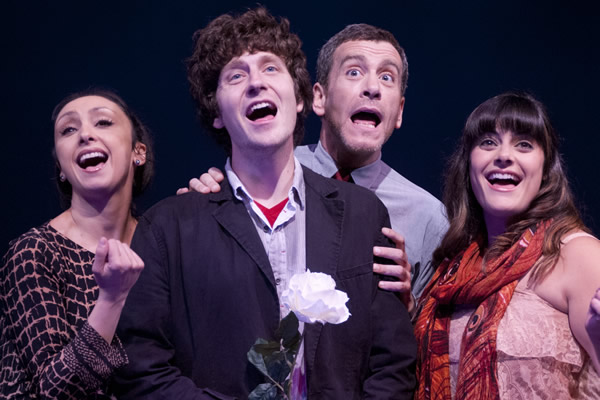
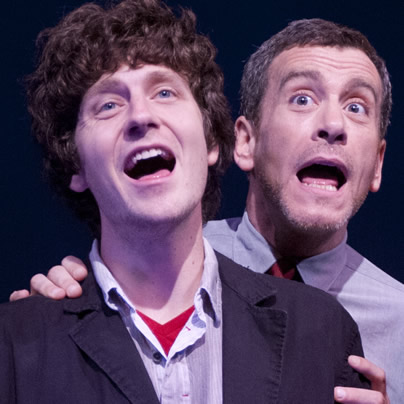
The cast of ‘Jacques Brel,’ a well-staged French revue. (Photo courtesy MetroStage)
Belgian-born singer songwriter Jacques Brel might have joined the family cardboard manufacturing business and lived a life of quiet desperation. Happily, he didn’t. Brel instead escaped to postwar Paris and became the musical voice of his generation, turning out popular French songs about war, death, love, bulls and carousels.
In “Jacques Brel is Alive and Well and Living in Paris,” the best of Brel’s vast songbook is featured in two cabaret-like acts; and lucky for us locals, a topnotch production of the musical is now up and running at MetroStage (Carolyn Griffin’s intimate and estimable playhouse on the edge of Old Town Alexandria) through mid-October.
Translated from the original French by American poet Eric Blau and songwriter Mort Shuman, “Jacques Brel” premiered off-Broadway in 1968. Subsequent successful revivals have run in New York over the years including a 2006 revised production (which MetroStage is presenting).
The show opens with “Le Diable/Ca Va,” a zippy tune noting that the devil rules supreme on earth. And while Brel might believe modern existence is essentially crap, other songs prove he does find some things to savor in life like wit, wistful memories and the exquisite pain of lost love and missed opportunity.
A lot of the music is nostalgic and sounds French (accordion and all), but overall there’s variation ranging from the catchy, bourgeois-denigrating drinking song titled “The Middle Class” to “Next” (a young vet’s sardonic recollection of his experience with camp followers) to Brel’s familiar “Amsterdam,” an earthy ode to the lowly seaman, powerfully sung by Bobby Smith who brilliantly embodies the world-weary boulevardier.
Each of the show’s almost 30 songs is a self-contained story with its own beginning, middle and end all drawn from past romances, reckless youth, disappointment and hard living. Lighting designer Jessica Winfield evocatively sets the mood for each melodic tale and all four cast members are superb storytellers with terrific diction and phrasing to boot. In addition to the aforementioned Smith, the terrific cast includes Natascia Diaz, Bayla Whitten and a shaggy-haired Sam Ludwig.
Diaz performed in the off-Broadway 2006 production and it shows. She gives life to the spirit of Brel’s Paris, capturing the sadness, wit and irony in equal measure. Her heartrending interpretation of “My Death” is not soon forgotten. She’s just as effective singing Brel’s gorgeous Piaf-esque ballad “Ne Me Quitte Pas” (“Don’t Leave Me”) as the quietly potent “Old Folks,” a sort of lullaby about the inevitability of old age and death. Hers is a stunning performance.
The younger cast members Ludwig and Whitten (a lovely soprano) are excellent too. He beautifully inhabits the angry-but-girl crazy young man while she is at turns both naïve and jaded.
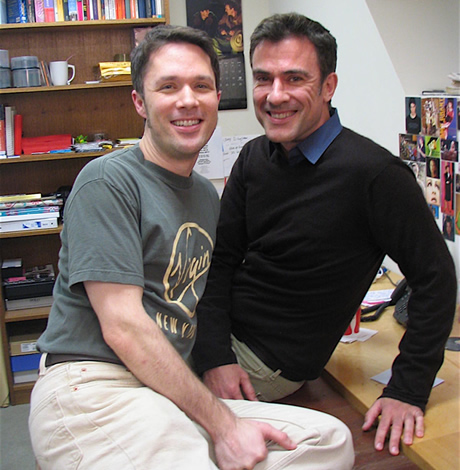
This “Jacques Brel” brings together Studio Theatre’s producing artistic director Serge Seiden with Signature Theatre’s associate artistic producer Matthew Gardiner (both gay). Seiden’s staging is beyond solid. The production moves briskly and seamlessly without ever feeling rushed or forced. Gardiner’s cheery choreography is reserved mostly for the more lighthearted numbers. It’s fun, but more importantly, his dance sequences allow the players to interact in ways that might otherwise appear awkward.
Except for a pole with lights evocative of a street lamp and two simple café chairs that disappear when not needed, the shadowy stage is completely bare. Off to the side, the band (ably led by musical director Jenny Cartney on piano) is visible throughout the show. It could be the late night Parisian club scene where Brel got his start. For the first act, Janine Sunday smartly costumes the cast in vaguely late-‘60s gear, nicely conveying an era of protest and change. Puzzlingly, the second act — sartorially speaking — is more a hodgepodge of castoffs.
Contrary to the title, Brel is neither well nor alive. He died of lung cancer in 1978, but the music endures. Today his songs resonate as strongly as ever. For the uninitiated (which included myself prior to a recent matinee), MetroStage’s stylish effort serves as a marvelous introduction to Brel’s work. It’s also first rate entertainment.
Movies
‘Into the Grey’ unites Cavill, Gyllenhaal for thrills and gay love
Did studio sabotage film’s release because of queer plot?
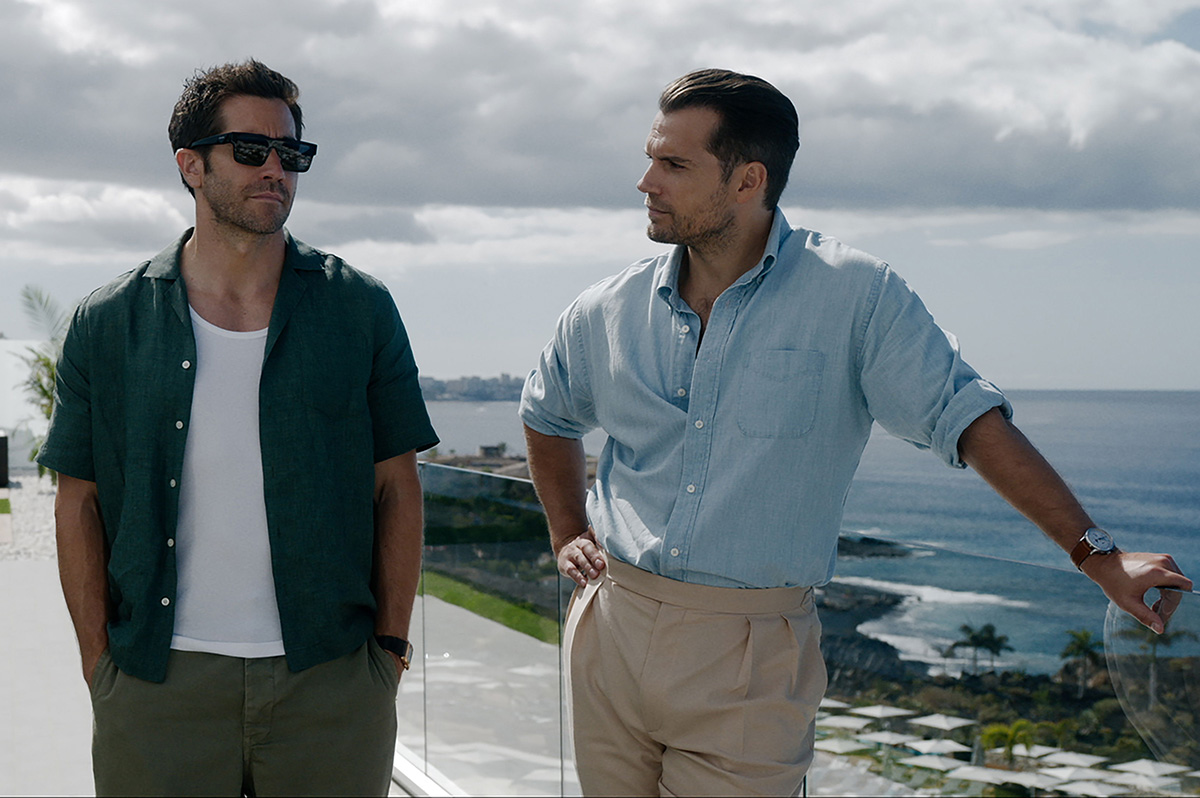
What if they released the LGBTQ-themed action movie we’ve all been waiting for and they didn’t bother to tell us?
It’s a rhetorical question, really, because we already know the answer, and it can be found between the lines in the distribution-and-release history of “In the Grey,” a typically slick and cynical “caper thriller” from veteran filmmaker (and former Madonna husband) Guy Ritchie, which is now available on VOD platforms after a perfunctory theatrical opening in May.
Like almost all of Ritchie’s films, it’s fast-paced, clever, and full of surprises, some of which have to do with the plot, but most of all involve its characters – who, also in the tradition of Ritchie’s former work, inhabit a rarified world in which confidence, bravado, and stoic humor define the moral environment while something else (call it “fate” or “karma” or simply “the consequence of choices”) works behind the scenes to deliver a conclusion that satisfies our jaded sense of justice even as it fairly drips with irony. Also like most of Ritchie’s films, it succeeds in sucking us into its plotting while drawing a clear line between the “good guys” (i.e. the ones who are ostensibly working toward an equitable outcome, if not a moral high ground) and the out-of-balance despotism of a weighted power hierarchy that defines the shadowy status quo of human endeavor.
The caper in question is being run by Rachel Wild (Eiza Gonzalez), an elite lawyer who specializes in retrieving funds owed to high-finance “asset management” firms by wealthy clients, whose latest case puts her into a showdown with ruthless crime boss Manny Salazar (Carlos Bardem) over a billion-dollar debt. She’s elite for a reason, though; she’s backed up by her own small militia of “fixers” headed by trusted “extralegal” operatives Bronco and Sid (Jake Gyllenhaal and Henry Cavill, respectively), who are more than capable of carrying out her plans and have no intention of allowing Salazar to gain the upper hand. The plan involves blocking and handicapping his operations until he is forced to return the money; but when their powerful quarry decides to make things personal by going after Rachel in retaliation, it’s up to her loyal protectors (and their highly skilled team) to keep her safe.
Crafted by Ritchie with his usual blend of intricate plotting, jocular amorality, and shocking violence, it’s also a movie that fairly oozes testosterone; yes, there’s a smart and powerful woman at the center of it all, but she’s got as much (or more) macho swagger as anybody else so the effect is just the same. In fact, there’s a lot of hyper-masculine posturing, attitude, and tough talk that goes on all around, most of it delivered with that jocularity we mentioned. Action, naturally, is key to the formula, and “In the Grey” ramps it up to near orgiastic levels with an escalating collection of high-octane set pieces – chases, gunfights, explosions, zip-lining – all carefully spelled out ahead of time for us, point for point, in expository detail so that we can keep up with them as they unfold. It’s a movie about planning and strategy as much as anything else, and it wants to make sure we’re all prepped and ready for “go time.”
As for feelings, in a film like this, you might just think they don’t matter and leave it at that – but that’s not entirely true. Almost hidden in the middle of all this morally murky bluster and bravado is an unexpected angle, and it lends a touch of tenderness to the whole thing that somehow ends up being essential.
The movie takes pains to create a slow reveal, so it feels like a spoiler (consider this your warning) to say it, but underneath all the non-stop action there’s a love story going on, and it’s between the two leading men. We’re not sure at first, though the jovial banter between Cavill and Gyllenhaal has a distinct “romcom” vibe from the beginning, but as the movie goes on it gradually becomes clear that they are, in fact, a couple.
Perhaps not surprisingly, there was no mention of the nature of their relationship in any of the film’s publicity; the studio (Lionsgate) delayed release for months and eventually gave up distribution rights to Black Bear International. When it hit theaters, it finished ninth at the box office; even the popularity of its two stars was not enough to make up for the lack of push that accompanied its release. Does all of this suggest that the studio scuttled their own movie just because of the “gay angle” and the reaction it might get in today’s environment? It’s hard not to speculate on that possibility, but either way, those two characters are gay.
Does it matter to the plot? Not really; there’s no lovestruck romance here – these guys have obviously been together a long time, and they carry the comfortable familiarity to prove it – nor is there even a kiss. It’s just a layer to their characters, a nuance that offers a glimpse of relatable, everyday humanity in a plot where almost everything else is bombast. Importantly, it also raises the stakes for the audience; knowing they are together gives us a reason to root for them beyond simple “good guy/bad guy” dynamic (which is complicated in a movie where both sides are trying to gun each other down mercilessly), and while we might not be so invested in the film’s overarching plot – do we really care if a venture capital corporation gets its money back from the murderous gangster they lent it to in the first place? – we can at least hope that these two handsome mercenaries will be able to go home to their cats together at the end.
As for the acting, this is not a film that demands anything more subtle than broad strokes from its players, but Cavill and Gyllenhaal, given such rich possibilities for subtext in their otherwise formulaic dialogue, clearly play it up with enthusiasm; they also convey that all-important tenderness – especially Gyllenhaal, who stirs an occasional echo of his “Brokeback Mountain” performance from two decades back. The rest of the cast – with the exception of Fisher Stevens as Salazar’s long-suffering lawyer, and Rosamund Pike as Rachel’s treacherous client – mostly play stock characters, familiar, predictable, and not too deep, but they do it well enough.
All that said, and with or without the gay couple in the middle of it, “In the Grey” is not a very remarkable movie. It’s more clever than smart, and while it benefits from Ritchie’s signature fast-paced, edgy style it sometimes feels repetitive – it’s nothing we haven’t seen before, and even if the setting within the corrupt world of the financial elite might strike a note for some viewers today, it never gets political enough to stir up any kind of fervor.
Cavill and Gyllenhaal, however, are good enough together to make it worth a watch – so why not? After all, brains (and eyes) like candy once in a while, too.
Friday, July 24
The DC LGBTQ+ Community Center hosts Trans Discussion Group from 7-9 p.m. via Zoom. The Trans Discussion Group is intended to provide an emotionally and physically safe space for trans people and those who may be questioning their gender identity/expression to join together in community and learn from one another. For more details, visit the DC Center’s website.
Saturday, July 25
Go Gay DC will host “LGBTQ+ Community Brunch” at 11 a.m. at Freddie’s Beach Bar & Restaurant. This fun weekly event brings the DMV area LGBTQ+ community, including allies, together for delicious food and conversation. Attendance is free and more details are available on Eventbrite.
The DC LGBTQ+ Community Center will host Black Lesbian Support Group at 11 a,.m. Join the DC Center and the Beta Kappa Chapter of the Beta Phi Omega Sorority for a peer-led support group devoted to the joys and challenges of being a Black Lesbian. For more details, visit the Center’s website.
Sunday, July 26
“Nellie’s DC Drag Brunch” will be at 12 p.m. at Nellie’s Sports Bar. Come get served like a queen by a queen. Join Sapphire Blue, Deja Diamond and their team of amazing drag performers for the most fun you’ll have all weekend. Tickets are $58.51 and are available on Eventbrite.
Monday, July 27
The DC LGBTQ+ Community Center will host Queer Book Club at 6:30 p.m. This month’s selection is “Uncomfortable Labels” by Laura Kate Dale. The meeting will be held via Zoom.Email [email protected] for details.
Tuesday, July 28
Center Bi+ Roundtable will be at 7 p.m. on Zoom. This is an opportunity for people to gather in order to discuss issues related to bisexuality or as bi individuals in a private setting. Visit Facebook or Meetup for more information.
Wednesday, July 29
Job Club will be at 6 p.m. on Zoom upon request. This is a weekly job support program to help job entrants and seekers, including the long-term unemployed, improve self-confidence, motivation, resilience and productivity for effective job searches and networking — allowing participants to move away from being merely “applicants” toward being “candidates.” For more information, email [email protected] or visit thedccenter.org/careers.
Thursday, July 30
The DC Center’s Fresh Produce Program will be held all day at the DC LGBTQ+ Community Center. People will be informed on Wednesday at 5 p.m. if they are picked to receive a produce box. No proof of residency or income is required. For more information, email [email protected] or call 202-682-2245.
Virtual Yoga Class will be at 7 p.m. on Zoom. This free weekly class is a combination of yoga, breath work and meditation that allows LGBTQ+ community members to continue their healing journey with somatic and mindfulness practices. For more details, visit the DC Center’s website.
a&e features
Summer in D.C. brings sports, Restaurant Week, festivals, and more
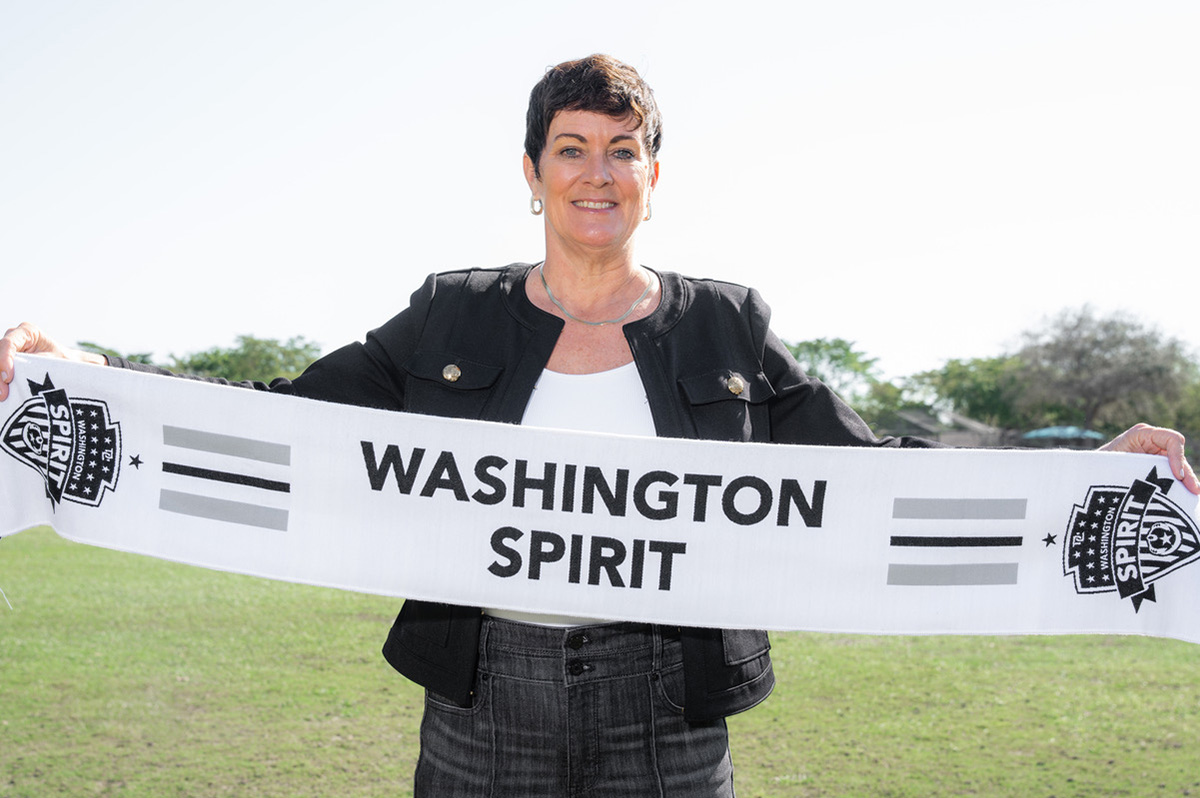
Summer in D.C. just hits different. Congress is out, school is out, the sun is out, thighs are out. With the skies clearing from Canadian smoke, here are a few ways to stay entertained.
Dining
Summer restaurant week: The Restaurant Association of Metropolitan Washington (RAMW) is once again hosting Summer Restaurant Week, Aug. 18-24. This weeklong dining experience showcases the dynamic dining scene of the DMV, including 2026 RAMMY Award-winning favorites (the annual D.C. food awards show that took place June 29). Participating restaurants will offer three-course brunch and lunch selections for $25 or $35 per person, and three-course dinners for $40, $55 and $65 per person.
New Restaurants: A handful of new spots have opened, so the summer is a great time to check them out:
- Oribu: A new Mediterranean-Japanese restaurant in the Grand Hyatt hotel, which just underwent a remodeling effort. The sleek restaurant brings upscale charm, with dishes like Wagyu beef tartare with potato pavé and caviar.
- The Oak Room: A snazzy old-school American grill has just opened in Georgetown, alongside its sister upstairs supper club (Bernadette’s) restaurant, in the old El Centro space.
- Uchi: This showy Japanese sushi-forward chain has landed in Dupont with a chef’s tasting menu of favorites like fatty tuna.
- Kathmandu: Recalling the capital of Nepal, this warm, buzzy subterranean restaurant right in the heart of U Street brings spice, flair, and rare ingredients to its dishes (see: buffalo burgers) and drinks.
Sports
- Washington Spirit Pride Night OUT: On Sunday, Aug. 23, head to Audi Field for a massive, high-energy game following the exciting month of World Cup. The designated Pride Night OUT game promises boisterous crowds plus pre- and post-game community engagements.
- Washington Tennis Open – Now called the Mubadala DC Open, this annual tournament is only combined mens’ and womens’ 500-level tennis tournament in the world. The open is one of D.C.’s longest-standing sports traditions, and will take place at the Rock Creek Park Tennis Center July 25-Aug. 2. Naomi Osaka, Venus Williams, Ben Shelton, Frances Tiafoe, and others are expected to play.
Festivals
- Afro Plus Fest: This huge, three-day Afro-Caribbean Hip-Hop Festival brings together headliners Davido, Alkaline, and Wizkid, plus Tems and Ayra Starr. The event moves from RFK to the Northwest Stadium Complex for three days, Sept. 4-6.
- Capital Fringe Festival: Running from July 11-21, this massive celebration features dozens of live theater, comedy, dance, and boundary-pushing nighttime performances across multiple DC neighborhoods.
- The National Book Festival returns, with headliners like Cynthia Erivo, and Martin Scorsese. The one-day festival, Saturday, Aug. 22, brings together bookworms and word nerds under the theme “America 250: It’s Your Story.” There are talks, workshops, musical sessions and more.
- All Things Go: A three-day festival Sept. 25-27 at Merriweather Post Pavilion featuring Mitski, Hayley Williams, Brandi Carlile, MUNA, Zara Larsson, Ethel Cain, and many, many more artists. There are single-day and three-day tickets. Featuring and highlighting female artists, the festival has turned into a must-see for many LGBTQ audience members.
- Fuchsia Fest: The inaugural Fuchsia Fest is a new multi-day celebration created to celebrate LGBTQ community and expression, bringing together a mix of community gatherings, entertainment, and nightlife. The event takes place Sept. 18-20 and is hosted by Capital Pride.
Art and Music
- United We Dance: A high-energy rave with house, techno, bass, and festival music, on Aug. 1 at the 9:30 Club.
- The Fray. On Aug. 14, this American rock band famous for How To Save A Life is at Merriweather Post Pavilion.
- Kesha: Kesha’s high-energy The Freedom Tour comes to the D.C. area on Aug. 14 at Jiffy Lube Live.
- ALOK: On Sept. 3 at Lincoln Theater, ALOK (they/them) performs. The poet, comedian, and actor is putting on a new comedy show.
- 2charm, the emerging Australian electronic club-pop duo popular with the queer community, which blends hyperpop and dance music, comes to the Atlantis.
- Sapphic Dance Party: a vibrant, inclusive nightlife and social event designed specifically for queer women, lesbians, bisexuals, trans individuals, and nonbinary folks, at Atlantis on Aug. 21.
- Jazz in the Garden: The most quintessential of D.C. activities returns Friday evenings through Aug. 14. This season’s theme, “American Sounds,” is a nod to the nation’s 250th anniversary. Tunes themes range from Appalachian and Americana to Creole jazz, Hill Country blues, contemporary jazz, and more. Tickets are available through a lottery system a week before each event.

‘Into the Grey’ unites Cavill, Gyllenhaal for thrills and gay love

Winsome Earle-Sears launches campaign against Va. marriage equality amendment

Calendar: July 24-30

Pentagon says hormones make trans troops unfit but gives them to men

At Alliance Defending Freedom’s summit, church and state are one

Tickets on sale for chef Patrick O’Connell’s book launch event

Wanda Alston Foundation announces passing of founding executive director Brian Watson

In the middle of the Bible Belt, a summer camp lets trans kids exhale

Remembering Victoria Cruz, Stonewall veteran and beloved trans activist

Polish president vetoes same-sex relationship recognition bills
-

 a&e features4 days ago
Tickets on sale for chef Patrick O’Connell’s book launch event
-
District of Columbia5 days ago
Wanda Alston Foundation announces passing of founding executive director Brian Watson
-
National4 days ago
Remembering Victoria Cruz, Stonewall veteran and beloved trans activist
-
North Carolina4 days ago
In the middle of the Bible Belt, a summer camp lets trans kids exhale