Local
Here come the grooms
With the city’s historic same-sex marriage law expected to take effect in less than three weeks, the application form for a marriage license at the D.C. Superior Court still leaves space only for the names of bride and groom.
But a spokesperson for D.C. Council member David Catania (I-At Large), author of the Religious Freedom & Civil Marriage Equality Amendment Act, said the marriage license application form is among a few last-minute details that the city and the court are expected to address in the next two weeks.
The law that Catania wrote and the City Council approved allows partners to describe themselves on a marriage license as a bride, groom or spouse.
Ben Young, Catania’s chief of staff, told DC Agenda this week that the form change was “being worked on.”
“Should the D.C. bill become law, the court will be ready on the effective date with forms for applicants to use that refer to spouses, not brides and grooms,” said Superior Court spokesperson Leah Gurowitz.
For same-sex couples planning to wed in the District after the new law takes effect March 3, a civil wedding at the courthouse or a religious wedding from an LGBT-friendly place of worship will be available to them.
Under city law, all couples seeking to be married must apply for and receive a marriage license, which costs $35. The application for the license can be obtained online at dccourts.gov, but it must be submitted and paid for in person.
Also under D.C. law, the minimum age for obtaining a marriage license without the need for parental consent is 18. A marriage license for people between the ages of 16 and 17 can be obtained only with the consent of a parent or legal guardian, and no one under age 16 can marry.
“When applying for a marriage license, you may request a civil wedding, specifying the date and time you would like to be married, at least 10 days from the date of application,” according to the Marriage Bureau Section of the court’s web site.
The site says a court clerk will contact the applicants to confirm the date and make final arrangements for a civil ceremony, which is performed by a court official in a designated room at the courthouse. The courthouse is located at 500 Indiana Ave., N.W.
According to the court’s web site, the “marriage ceremony room” holds about one dozen guests. A certified copy of the marriage license can be obtained on the day of the ceremony for $10. There is no fee for the ceremony or use of the room, but wedding participants are asked to consider making a tax-deductable donation to the D.C. Superior Court Art Trust Fund.
Unlike some jurisdictions, judges in D.C. don’t routinely perform civil marriages, although some judges do so for couples with whom they are personal friends, according to a court source who spoke on condition of not being identified. D.C. Mayor Adrian Fenty is not authorized to perform civil marriages under city law.
“The Clerk of the Court, and those he deputizes, may perform marriages at the courthouse, as well as judges,” Gurowitz said. “Generally, judges do not perform courthouse weddings, as they are on the bench with their calendars to handle during weekday work hours.”
Gurowitz declined to say whether court personnel authorized to perform civil marriages would be allowed to decline to perform a same-sex marriage if they have religious or moral objections to such marraiges, as is the case in some states.
“We do not comment on personnel and staffing matters,” she said.
Several D.C. clergy members said this week that despite the vocal opposition to same-sex marriage from some local clergy, a large number of clergy and their places of worship stand ready and willing to perform gay weddings.
The new law allows clergy to refuse to perform same-sex marriages and refuse to allow their facilities to be used for such marriages if performing such marriages is contrary to their religious beliefs.
“We’re prepared to begin marrying same-sex couples as soon as the law goes into place,” said Rev. Robert Harties, pastor of All Souls Unitarian Church. “I’ve already been in conversation with members of my congregation who are interested in becoming married and who are making plans for their wedding dates.”
Harties serves as co-chair of D.C. Clergy United for Marriage Equality, which he said has close to 200 members. He noted that most members of the group, along with their respective churches or other places of worship, including synagogues, are planning to host same-sex wedding ceremonies.
Also looking forward to performing same-sex weddings are at least five LGBT-oriented churches or congregations in the city that have long performed same-sex commitment ceremonies. Among them are Metropolitan Community Church of D.C., Unity Fellowship and Inner Light Ministries, which provide Protestant services; Bet Mishpachah, widely known as the city’s LGBT syngogue; and Dignity Washington, which offers a weekly Mass for LGBT Catholics.
Rev. Dwayne Johnson, pastor of the Metropolitan Community Church since January, said MCC churches across the country have performed what some of its members consider to be weddings since the church was founded in 1969.
“In a sense it was a form of political resistance on some level,” he said. “What was not accepted in the eyes of the state we felt was accepted in the eyes of God. So we will continue to bless relationships, and now to be able to do it legally is really exciting.”
Rev. Abena McCray, pastor of Unity Fellowship, which has a largely African-American protestant congregation, said the church is preparing to offer same-sex weddings when the D.C. gay marriage law takes effect.
Jack Hillelsohn, Bet Mispachah’s vice president for religious affairs, said the congregation’s rabbi, Toby Manewith, is a member of D.C. Clergy United for Marriage Equality and is excited about performing same-sex marriages.
“Kiddushin is the Hebrew word for marriage, and we have performed these in the past without legal standing,” Hillesohn said. “There’s always been the need for this ceremony, and now we’re pleased to be able to do it with full legal standing.”
Ray Panas, president of Dignity Washington, said the LGBT Catholic group recognizes that plans to arrange for Catholic same-sex marriage ceremonies in D.C. will face difficulties given the Catholic Church’s strong opposition to same-sex marriage. The Catholic Archdiocese of Washington is expected to prohibit diocesan priests from performing same-sex marriages.
But Panas said priests associated with Catholic orders or societies independent of the archdiocese have often celebrated the Catholic Mass for Dignity members. He noted that the group is hopeful some arrangements can be made for a priest to perform same-sex marriages for its members.
Under D.C. law, clergy who are licensed and credentialed under their respective religious faiths must also obtain a city license to perform a marriage. Johnson and McCray aren’t currently licensed to perform marriages, but the two said they are taking immediate steps to obtain a license, which is also issued at the D.C. Superior Court.
Harties and officials with the four LGBT-oriented congregations said their respective congregations have long offered various forms of relationship counseling for couples contemplating marriage or domestic partnerships. They said they would continue this practice with same-sex couples seeking to marry.
However, gay rights attorneys have advised same-sex couples considering marriage to be aware of local divorce laws in the event that a relationship ends and a separation is sought.
One aspect of the D.C. divorce laws that could be a factor for same-sex couples who come to the District from other states to marry is a six-month residency requirement. Either spouse must be a city resident for at least six months before the couple is eligible to file for divorce.
Other aspects of the city’s divorce laws, including options of both no-fault and fault filings and property distribution and child custody and support provisions, can be reviewed in the divorce section of the Superior Court’s web site.



Maryland’s legislative caucuses outlined their legislative priorities heading into the final weeks of the 2026 General Assembly during a joint press conference on March 24.
The press conference was titled “We are Maryland,” where a representative for each of the legislative caucuses outlined priorities.
State Del. Kris Fair (D-Frederick County) of the LGBTQ+ Caucus opened the press conference with a statement on the unity of Maryland’s caucus.
“Together we can show our state and our community a different world, one where we mutually support one another and through that support uplift every Marylander,” he said.
In a press conference on March 5, the LGBTQ+ Caucus outlined its top legislative priorities. Fair highlighted two of those bills again during the “We are Maryland” press conference.
The first of the two highlighted pieces of legislation was Senate Bill 626 and House Bill 1589.
The bills would simplify the process of updating an individual’s birth certificate and align the Department of Health and DMV systems to reflect those changes. The bill is being led by state Sen. Clarence Lam (D-Anne Arundel and Howard Counties) and state Del. Ashanti Martinez (D-Prince George’s County).
The second piece of legislation is Senate Bill 950 and House Bill 1209, which would update and modernize laws and regulations around so-called conversion therapy. The bills have failed to pass either chamber thus far. They are being led by state Sen. Cheryl Kagan (D-Montgomery County) and state Del. Bonnie Cullison (D-Montgomery County).
(The U.S. Supreme Court on Tuesday ruled against a Colorado law that bans so-called conversion therapy for minors. Maryland is among the U.S. jurisdictions that prohibit the widely discredited practice for anyone under 18.)
Martinez and Lam have introduced bills in their respective chambers that would expand PrEP access in Maryland. Martinez did not attend the press conference, and Fair did not mention it when he spoke.
State Del. N. Scott Phillips (D-Baltimore County) represented the Black Caucus during the press conference. State Del. Dana Jones (D-Anne Arundel County) spoke on behalf of the Women’s Caucus, State Del. Teresa Woorman (D-Montgomery County) represented the Latino Caucus, and State Del. Lily Qi (D-Montgomery County) represented the Asian-American and Pacific Islander Caucus. State Del. Jared Solomon (D-Montgomery County) represented the Jewish Caucus, and state Del. Sean Stinnett (D-Baltimore County) represented the Muslim Caucus during the press conference.
Solomon ended the press conference by explaining the importance of all the caucuses coming out together.
“We are stronger when we’re together, and many of these issues that we have talked about, again, impact all of us,” said Solomon.
District of Columbia
Blade contributor, husband exchange vows in D.C.
Yariel Valdés and Kevin Vega held ceremony at Jefferson Memorial on March 23

Washington Blade contributor Yariel Valdés and his husband, Kevin Vega, exchanged vows at the Jefferson Memorial on March 23.
The couple married in Fort Lauderdale, Fla., on Nov. 24, 2025. The Jefferson Memorial ceremony — which Blade International News Editor Michael K. Lavers and Samy Nemir Olivares officiated — coincided with the third anniversary of Yariel and Kevin’s first date.
Yariel in 2019 asked for asylum in the U.S. because of the persecution he suffered as a journalist in his native Cuba. He spent nearly a year in U.S. Immigration and Customs Enforcement custody before his release on March 4, 2020.
Yariel wrote a series of articles about his time in ICE custody that the Blade published. The series was nominated for a GLAAD Media Award in 2022.
Yariel and Kevin live in South Florida.
District of Columbia
‘Out for McDuffie’ event held at D.C. gay bar
Mayoral candidate cites record of longtime support for LGBTQ rights
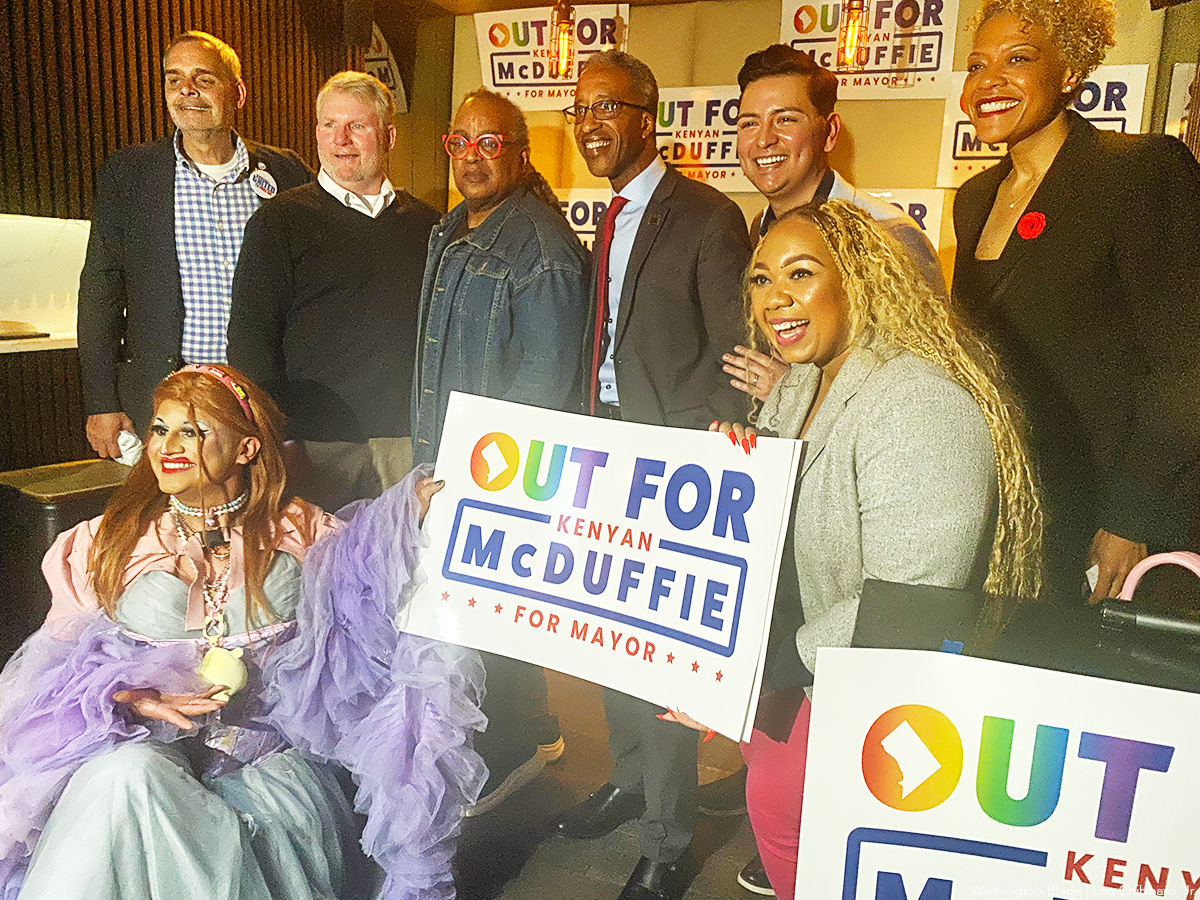
More than 100 people filled the upstairs room of the D.C. gay bar Number 9 on Thursday night, March 26, to listen to D.C. mayoral candidate Kenyan McDuffie at an event promoted as an “Out for McDuffie” meet and greet session.
Several local LGBTQ activists who attended the event said they support McDuffie, a former D.C. Council member, in his run for mayor while others said they had not yet decided whom to vote for in the June 16 D.C. Democratic primary election.
As of March 27, eight other Democrats were competing against McDuffy in the June 16 primary, including D.C. Council member Janeese Lewis George (D-Ward 4), considered McDuffie’s lead opponent. Lewis George also has a record of strong support on LGBTQ issues.
Most political observers consider McDuffie and Lewis George the two lead candidates in the race, with the others having far less name recognition.
The two lead organizers of the Out for McDuffie event were LGBTQ rights advocates Courtney Snowden, a former D.C. deputy mayor in the administration of Mayor Muriel Bowser, and Cesar Toledo, a local LGBTQ youth housing services advocate.
“I’m a candidate for mayor of Washington, D.C. and I’m running for mayor because I love this city,” McDuffie told the gathering after being introduced by Snowden. “And now more than ever we need leadership to take us to the future,” he said, adding that he and his administration would “stand up and fight” against President Donald Trump’s efforts to intervene in local D.C. affairs.
“Our strength is in the 700,000 beautifully diverse residents of Washington, D.C.” he told the gathering. “And as Courtney said, I didn’t just show up and run for mayor and then start saying that I’m going to be an ally for the queer community, for the LGBTQ+ community,” he said, “I’ve lived my entire professional life fighting for justice and fighting for fairness.”
Following his speech, McDuffie told the Washington Blade, “We’re going to fight to protect our LGBTQ+ community every single day. That’s what I’ve spent my career doing, making sure we have a beautifully diverse and inclusive city.”
He remained at Number 9, located at 1435 P St., N.W., for nearly an hour after he spoke, chatting with attendees.

The cost of speaking one’s mind

Senegalese president signs bill that further criminalizes homosexuality

Md. lawmakers reaffirm legislative priorities

Supreme Court rules against Colo. law banning conversion therapy for minors

Thousands attend ‘No Kings’ protests in D.C.

Celebrate cherry blossoms the drag way

Lorato ke Lorato: marriage equality, democracy, and the unfinished work of justice in Botswana

Japanese Supreme Court to consider marriage equality

The outrage economy is not the LGBTQ community

Anti-trans visa ruling echoes Nazi regime destroying trans documents
-

 Out & About4 days ago
Celebrate cherry blossoms the drag way
-
Botswana4 days ago
Lorato ke Lorato: marriage equality, democracy, and the unfinished work of justice in Botswana
-
Japan4 days ago
Japanese Supreme Court to consider marriage equality
-
Opinions4 days ago
The outrage economy is not the LGBTQ community