Local
Couples plan courthouse visits to celebrate D.C. marriage law
Aisha Mills and her domestic partner, Danielle Moodie, plan to mark March 3, the day the District’s same-sex marriage law is scheduled to take effect, by going to the courthouse to apply for a marriage license.
Due to a mandatory three-business-day waiting period, jubilant same-sex couples — some of whom have been in relationships for more than 20 years — won’t be able to marry until March 9 at the earliest. That’s when the D.C. Superior Court’s Marriage Bureau completes the processing of their marriage licenses.
But for Mills, president of the same-sex marriage advocacy group Campaign for All D.C. Families, March 3 nevertheless represents an historic day.
“The Campaign for All D.C. Families has been working hard for some time to ensure that all residents of the District of Columbia have the opportunity to wed here, and we are excited that it will finally become a reality on March 3,” she said.
Mills’ group and other local LGBT organizations were still finalizing plans this week for a celebration linked to a possible joint appearance by same-sex couples at the courthouse on the morning of the March 3 to fill out their applications for a marriage license.
“We have at least a half-dozen couples expected at the courthouse,” said Cathy Renna of Renna Communications, an LGBT-oriented public relations firm that’s coordinating plans for celebrating the start of the marriage law.
Under court rules, a $35 license application fee plus a $10 fee for a Certificate of Marriage, must be paid by cash or money order to enable couples to submit their applications. All this takes place in Room 4485 of the Moultrie Superior Court Building at 500 Indiana Ave., N.W.
Other groups involved in the same-sex marriage equality effort in D.C. that were expected to participate in a celebration March 3 include the Gay & Lesbian Activists Alliance, D.C. for Marriage, and D.C. Clergy United for Marriage Equality.
District resident Reggie Stanley and partner Rocky Galloway “definitely” plan to be at the courthouse on the morning of March 3 to apply for a marriage license, Stanley said. But Deacon Maccubbin and longtime partner Jim Bennett, owners of the recently closed Lambda Rising Bookstore, weren’t sure this week whether to join other same-sex couples at the courthouse that morning.
“Jim and I haven’t had time to sit down and actually work out how we want to do this — whether we want to be in that first wave or whether we just want to take our time and do it in the old-fashioned way, so to speak,” Maccubbin said.
But regardless of which couples are in the first wave — or which couple is the first to wed in D.C. — Rick Rosendall of GLAA said the shared moment will be special.
“Whichever couples happen to be first in line on March 3, and whoever happens to have the first [wedding] ceremony on March 9,” he said, “it will be a deeply satisfying moment for those of us who have worked to make it possible.”
Local same-sex marriage advocates expressed a sigh of relief Feb. 19 when a Superior Court judge denied a request by their opponents for a court injunction to stop the same-sex marriage law from taking effect.
The opponents, led by Bishop Harry Jackson, pastor of Hope Christian Church in Beltsville, Md., said an injunction was needed to give them more time to organize a voter referendum that could overturn the marriage law.
Judge Brian Holeman denied the injunction request on grounds that the court lacked legal authority to block a law approved by the local D.C. government and cleared by Congress through its regular 30 legislative day review, which ends March 3.
Holeman, in a ruling delivered from the bench Feb. 19 and released in writing Monday, also said an underlying lawsuit filed by Jackson seeking to force the city to hold a referendum on the marriage issue did not appear likely to succeed on its merits. He noted the likelihood of the success of Jackson’s lawsuit was a key factor in determining whether to grant an injunction.
Jackson and his attorneys appealed Holeman’s ruling Monday to the D.C. Court of Appeals. Legal observers believe the Appeals Court is likely to uphold Holeman’s decision.
“In my view, the appeals court has no more authority to stop a law passed by the city and cleared by Congress than the lower court,” said Mark Levine, a local gay rights attorney.
Under the city’s election law, Jackson and his backers must complete a series of requirements for a referendum, including obtaining petition signatures from voters, by the time Congress completes March 3 its review of the same-sex marriage law.
Even if the appeals court were to grant him a stay, many observers believe it would be impossible for Jackson to complete the administrative requirements for a referendum by that date.
Jackson is separately appealing a D.C. Board of Elections & Ethics decision denying his application for a voter initiative seeking to ban same-sex marriage in the city. Under the city’s election law, Jackson and his backers have at least six months to complete the petition requirements for an initiative and an unlimited time to challenge the city’s denial of his initiative request through the courts.
The election board has on three occasions denied requests by Jackson and others for ballot measures seeking to overturn the same-sex marriage law. The board has based its denials on grounds that such measures would violate the D.C. Human Rights Act, which bans discrimination based on sexual orientation.
In addition to pushing for ballot measures, same-sex marriage opponents have called on Congress to either overturn the marriage law or force the city to place the issue on the ballot through a referendum or initiative. Most political observers believe Congress won’t intervene on the matter as long as Democrats are in control.
Capitol Hill insiders say all bets are off if Republicans regain control of Congress in the November election or sometime after that. But large numbers of same-sex couples will have married by the time a serious threat to the law surfaces in Congress.
“Everyone will see that the sky hasn’t fallen,” said Michael Crawford, a same-sex marriage activist.




District of Columbia
Mayor Bowser signs bill requiring insurers to cover PrEP
‘This is a win in the fight against HIV/AIDS’

D.C. Mayor Muriel Bowser on March 20 signed a bill approved by the D.C. Council that requires health insurance companies to cover the costs of HIV prevention or PrEP drugs for D.C. residents at risk for HIV infection.
Like all legislation approved by the Council and signed by the mayor, the bill, called the PrEP D.C. Amendment Act, was sent to Capitol Hill for a required 30-day congressional review period before it takes effect as D.C. law.
Gay D.C. Council member Zachary Parker (D-Ward 5) last year introduced the bill.
Insurance coverage for PrEP drugs has been provided through coverage standards included in the Affordable Care Act, known as Obamacare. But AIDS advocacy organizations have called on states and D.C. to pass their own legislation requiring insurance coverage of PrEP as a safeguard in case federal policies are weakened or removed by the Trump administration, which has already reduced federal funding for HIV/AIDS-related programs.
Like legislation passed by other states, the PrEP D.C. Amendment Act requires insurers to cover all PrEP drugs approved by the U.S. Food and Drug Administration.
Studies have shown that PrEP drugs, which can be taken as pills or by injection just twice a year, are highly effective in preventing HIV infection.
“I think this is a win for our community,” Parker said after the D.C. Council voted unanimously to approve the bill on its first vote on the measure in February. “And this is a win in the fight against HIV/AIDS.”
District of Columbia
Blade editor to be inducted into D.C. Society of Professional Journalists Hall of Fame
Kevin Naff marks 24 years with publication this year
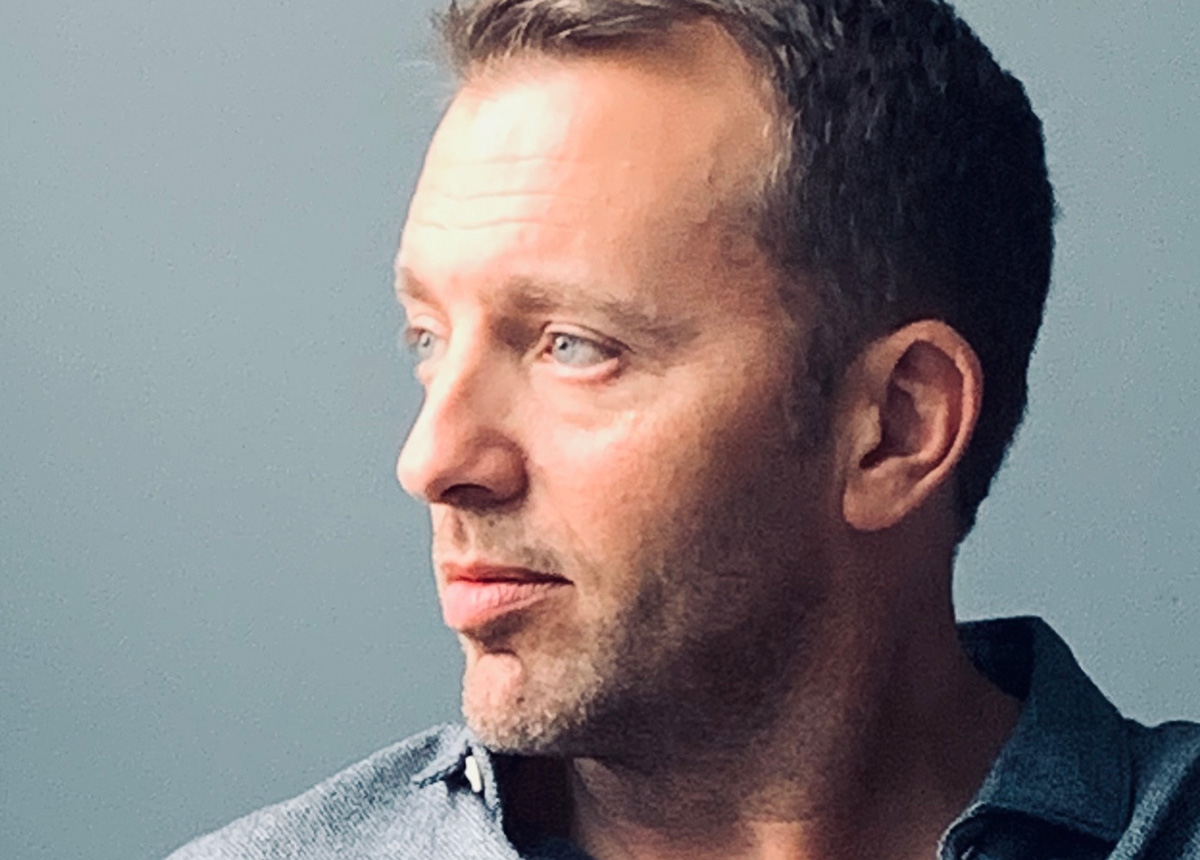
Longtime Washington Blade Editor Kevin Naff will be inducted into D.C.’s Society of Professional Journalists Hall of Fame in June, the group announced this week.
Hall of Fame honorees are chosen by the Society of Professional Journalists’ Washington, D.C., Pro Chapter. Naff and two other inductees — Seth Borenstein, a Washington-based national science writer for the AP and Cheryl W. Thompson, an award-winning correspondent for National Public Radio — will be celebrated at the chapter’s Dateline Awards dinner on Tuesday, June 9, at the National Press Club. The dinner’s emcee will be Kojo Nnamdi, host of WAMU radio’s weekly “Politics Hour.”
“I am tremendously honored by this recognition,” Naff said. “I have spent a lifetime in the D.C. area learning from so many talented journalists and am humbled to be considered in their company. Thank you to SPJ and to all the LGBTQ pioneers who came before me who made this possible.”
Naff joined the Blade in 2002 after years in print and digital journalism. He worked as a financial reporter for Reuters in New York before moving to Baltimore in 1996 to launch the Baltimore Sun’s website. He spent four years at the Sun before leaving for an internet startup and later joining the mobile data group at Verizon Wireless working on the first generation of mobile apps.
He then moved to the Blade and has served as the publication’s longest-tenured editor. In 2023, Naff published his first book, “How We Won the War for LGBTQ Equality — And How Our Enemies Could Take It All Away.”
Previous Hall of Fame inductees include luminaries in journalism like Wolf Blitzer, Benjamin Bradlee, Bob Woodward, Andrea Mitchell, and Edgar Allen Poe. The Blade’s senior news reporter Lou Chibbaro Jr. was inducted in 2015.
Maryland
Supreme Court ruling against conversion therapy bans could affect Md. law
Then-Gov. Larry Hogan signed statute in 2018
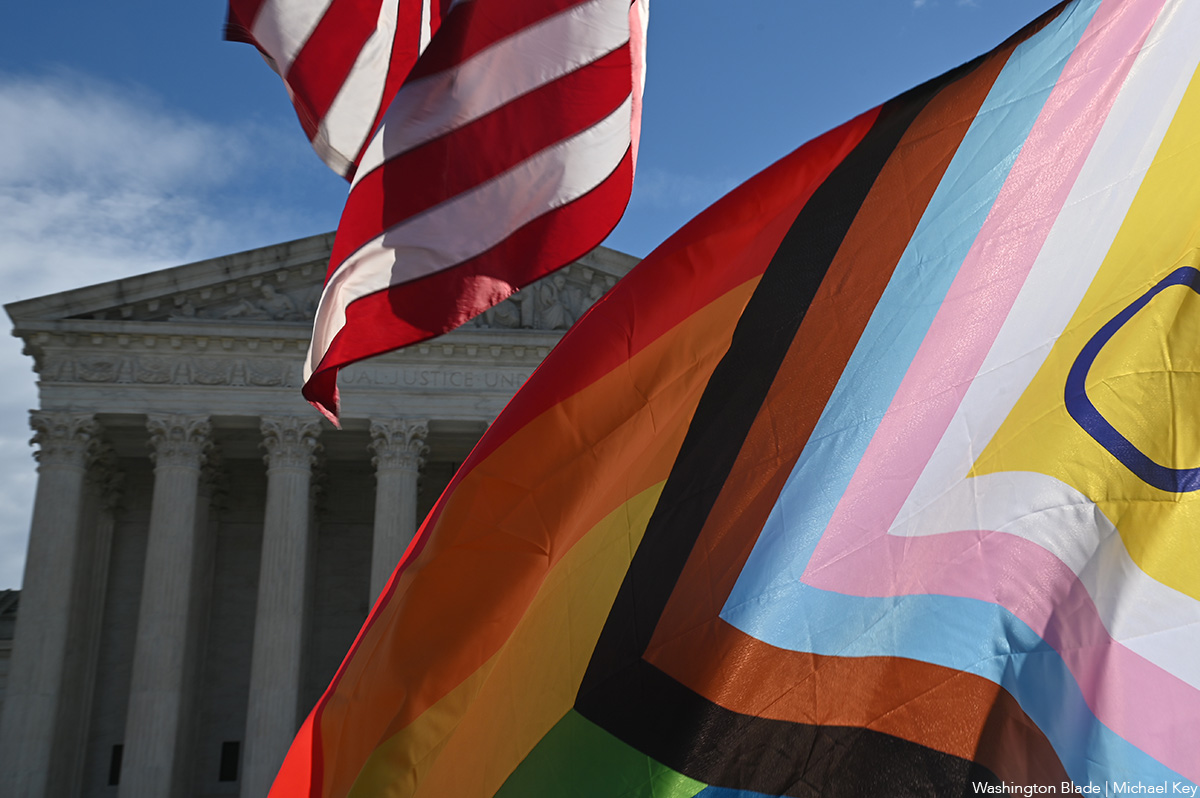
By PAMELA WOOD, JOHN-JOHN WILLIAMS IV, and MADELEINE O’NEILL | The U.S. Supreme Court on Tuesday ruled against a law banning “conversion therapy” for LGBTQ kids in Colorado, a ruling that also could apply to Maryland’s ban on the discredited practice.
An 8-1 high court majority sided with a Christian counselor who argues the law banning talk therapy violates the First Amendment. The justices agreed that the law raises free speech concerns and sent it back to a lower court to decide whether it meets a legal standard that few laws pass.
Justice Neil Gorsuch, writing for the court’s majority, said the law “censors speech based on viewpoint.” The First Amendment, he wrote, “stands as a shield against any effort to enforce orthodoxy in thought or speech in this country.”
The rest of this article can be read on the Baltimore Banner’s website.

Mayor Bowser signs bill requiring insurers to cover PrEP

JD Vance to travel to Hungary next week

Pam Bondi ousted as attorney general

VIDEO: Gay journalist detained for booing Trumps at ‘Chicago’ opening night

Idaho Gov. signs harshest anti-trans bathroom bill in the country

‘Out for McDuffie’ event held at D.C. gay bar

‘Jonah’ an undeniably compelling but unusual memory play

The Oscar-losing performance that’s too good to miss

Thousands attend ‘No Kings’ protests in D.C.