National
White House endorses delayed ‘Don’t Ask’ repeal
Changes would take hold after Pentagon completes its study

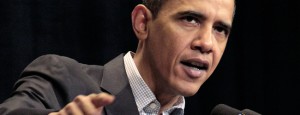
President Barack Obama's administration endorsed Monday a path to repeal the law that prohibits gays, lesbians and bisexuals from serving openly in the U.S. armed forces. (Photo courtesy of DNC)
The White House has endorsed an approach to ending “Don’t Ask, Don’t Tell” whereby legislation Congress passes to repeal the law would not become effective until after the Pentagon completes its study on the issue.
In a letter Monday, Director of the Office of Management & Budget Peter Orzag writes that an amendment proposed by supporters of “Don’t Ask, Don’t Tell” repeal adheres to the Pentagon’s request to finish its study on the issue at the end of the year and therefore is supported by the Obama administration.
Orzag says that the Pentagon review would be “ideally” completed before Congress takes action on the issue, but notes the administration “understands that Congress has chosen to move forward with the legislation now and seeks the administration’s views on the proposed amendment.”
“Accordingly, the administration is of the view that the proposed amendment meets the concerns raised by the Secretary of Defense and the Chairman of the Joint Chiefs of Staff,” Orzag says.
Orzag also says in the letter that he understands the amendment would ensure implementation of repeal is consistent with “standards of military readiness, effectiveness, unit cohesion, recruiting and retention.”
Additionally, the amendment would “guarantee” the Pentagon has in place necessary policies and procedures to implement an end to the law. The measure would allow for the “critical need” to allow members of the U.S. armed forces to share their “concerns, insights and suggestions” about implementing the repeal process, according to the letter.
“The administration therefore supports the proposed amendment,” Orzag writes.
Notably, the proposed amendment lacks non-discrimination language and would return authority on discharging LGBT service members to the Pentagon.
The OMB letter came in response to another letter earlier in the day from repeal supporters in Congress — Rep. Patrick Murphy (D-Pa.), Senate Armed Services Committee Chairman Carl Levin (D-Mich.) and Sen. Joseph Lieberman (I-Conn.) — who asked the administration to support their proposed amendment.
The lawmakers’ letter says that they have created a proposal that “puts a process in place to repeal ‘Don’t Ask, Don’t Tell,’ once the working group has completed its review” and the president and Pentagon leaders “certify the repeal can be achieved consistent” with the standards of the military.
“We appreciate the input that you and the Pentagon have provided throughout this process and request the administration’s official views on our legislative proposal,” the lawmakers write.
In the House, supporters of repeal were anticipating Murphy to introduce an amendment to the floor this week that would attach repeal of “Don’t Ask, Don’t Tell” to the fiscal year 2011 defense authorization bill.
Later this week, the Senate Armed Services Committee is scheduled to markup the legislation and expected to consider a similar amendment.
Supporters of repeal previously said they were a few votes shy of passing repeal out of the Senate Armed Services Committee. It wasn’t immediately clear whether the OMB letter would move additional committee members to favor repeal, but the letter could serve to bolster these efforts.
Advocacy groups hailed the OMB letter for outlining an administration-backed path to passing repeal this year.
In a statement, Human Rights Campaign President Joe Solmonese said Monday the new support from the administration means people rallying against “Don’t Ask, Don’t Tell” are “on the brink of historic action to both strengthen our military and respect the service of lesbian and gay troops.”
“Today’s announcement paves the path to fulfill the president’s call to end ‘Don’t Ask, Don’t Tell’ this year and puts us one step closer to removing this stain from the laws of our nation,” Solmonese said.
Aubrey Sarvis, executive director of the Servicemembers Legal Defense Network, called the agreement a “dramatic breakthrough.”
“The path forward crafted by the president, Department of Defense officials, and repeal leaders on Capitol Hill respects the ongoing work by the Pentagon on how to implement open service and allows for a vote this week,” Sarvis said.
While Sarvis said support from the administration would help ensure a winning vote, he said “we are not there yet” and “votes still need to be worked and counted.”
Alex Nicholson, executive director of Servicemembers United, said Monday’s letter was “long awaited, much needed, and immensely helpful.”
“We have been making the case to White House staff for more than a year now that delayed implementation is realistic, politically viable, and the only way to get the defense community on board with repeal, and we are glad to see the community and now the administration and defense leadership finally rally around this option,” he said.
The endorsement from the administration prompted at least one social conservative group to take action. On Tuesday, the Family Research Council planned to hold a conference call with media to “release new national polling on homosexuals in the military” and discuss a new ad campaign “to protect the military.”
An announcement from Family Research Council says Tony Perkins, the organization’s president, would also discuss “grassroots outreach in the lead up to this week’s expected debate and votes in Congress.”





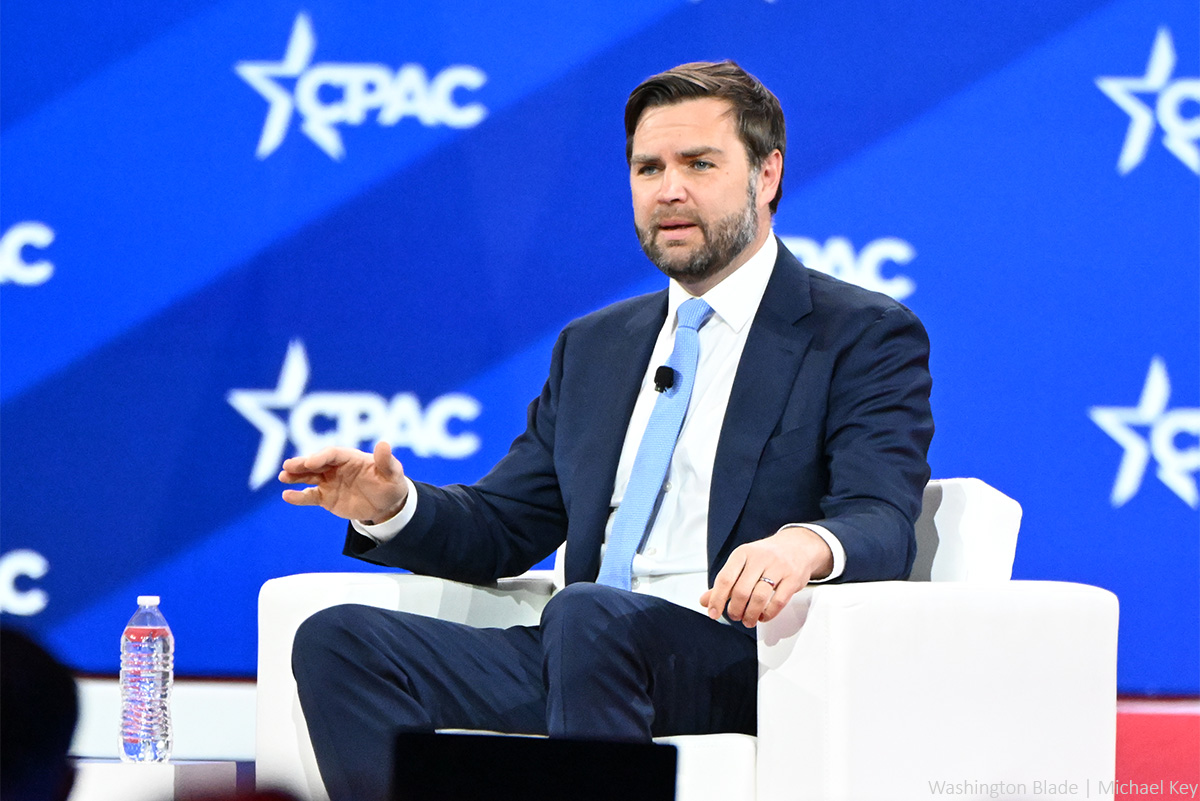
Vice President JD Vance and his wife, second lady Usha Vance, will visit Hungary next week.
An announcement the White House released on Thursday said the Vances will be in Budapest, the Hungarian capital, from April 7-8.
JD Vance “will hold bilateral meetings with” Hungarian Prime Minister Viktor Orbán. The announcement further indicates the vice president “will also deliver remarks on the rich partnership between the United States and Hungary.”
The Vances will travel to Hungary less than a week before the country’s parliamentary elections take place on April 12.
Orbán, who has been in office since 2010, and his Fidesz-KDNP coalition government have faced widespread criticism over its anti-LGBTQ crackdown.
The Associated Press notes polls indicate Orbán is trailing Péter Magyar and his center-right Tisza party.

President Donald Trump removed Attorney General Pam Bondi from her post Thursday, following growing criticism over how she and the Department of Justice handled a range of issues, including matters related to sex offender and Trump ally Jeffrey Epstein.
Trump announced Bondi’s removal on Truth Social, where he also said Todd Blanche will serve as acting head of the Justice Department.
“Pam Bondi is a great American patriot and a loyal friend, who faithfully served as my attorney general over the past year,” Trump wrote on the platform. “Pam did a tremendous job overseeing a massive crackdown on crime across our country, with murders plummeting to their lowest level since 1900.”
Trump was seen as recently as Wednesday with the now-former attorney general at a Supreme Court hearing on citizenship.
The decision contrasts with Trump’s previous public praise of Bondi, the 87th U.S. attorney general and former 37th attorney general of Florida, who served in that role from 2011-2019 before joining the Trump-Vance administration. He has frequently lauded her loyalty and said he speaks with her often. Bondi was also one of president’s defense lawyers during his first impeachment trial.
Privately, however, Trump had grown frustrated that Bondi was not “moving quickly enough” to prosecute critics and political adversaries he wanted to face criminal charges, according to multiple sources. The New York Times reported that her inability to charge former FBI Director James B. Comey and New York Attorney General Letitia James with any crimes is a large factor in the president’s choice to fire her from the government’s primary law enforcement agency.
The move comes as Trump has sought to minimize public turmoil within his administration, avoiding the perception of a revolving-door Cabinet that defined his first term.
Lee Zeldin, a former Republican congressman from New York who unsuccessfully ran for governor, has emerged as a leading contender to lead the Justice Department. He has been one of Trump’s most reliable allies.
“He’s our secret weapon,” Trump said of Zeldin in February during a White House event promoting the coal industry, adding, “He’s getting those approvals done in record-setting time.”
Bondi has also growing faced scrutiny from Congress.
The House Oversight Committee recently subpoenaed her to testify about the department’s handling of certain files, where she declined to answer key questions during a contentious House Judiciary Committee hearing in February.
The Tampa native has a long history of opposing LGBTQ rights through her roles in government. As Florida attorney general, she fought against the legalization of same-sex marriage, arguing it would cause “serious public harm,” pushing forward a legal battle that cost taxpayers nearly half a million dollars. She also asked the Florida Supreme Court to overturn a lower court ruling that found the state’s same-sex marriage ban unconstitutional.
More recently, Bondi established a “Title IX Special Investigations Team” within the Justice Department focused on restricting transgender women and girls from participating in women’s and girls’ sports teams and accessing facilities aligned with their gender identity. She also told Children’s Hospital of Philadelphia to turn over the medical records of anyone under 19 who received gender-affirming care.
Her removal follows Trump’s decision last month to oust another controversial female Cabinet figure, Kristi Noem.
The White House
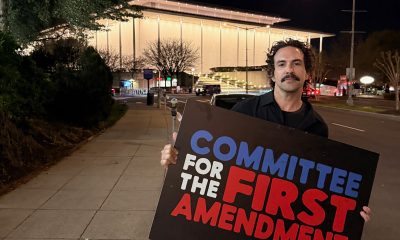
VIDEO: Gay journalist detained for booing Trumps at ‘Chicago’ opening night
Eugene Ramirez booed first family at Kennedy Center
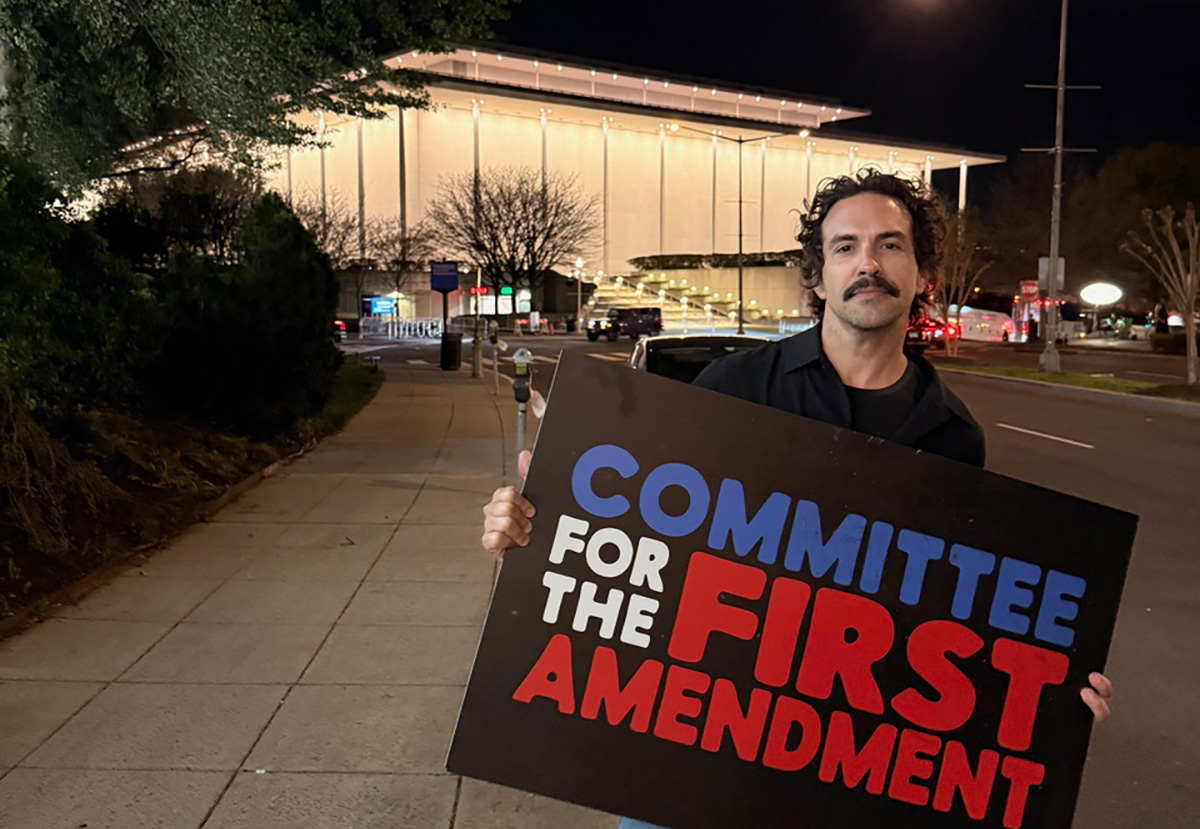
President Donald Trump and first lady Melania Trump attended the opening night of “Chicago” at the John F. Kennedy Center for the Performing Arts on Tuesday. They were greeted by a mix of cheers, applause, and some audible boos.
Among them was Eugene Ramirez, a gay Washington resident, who later shared his account of the night after being briefly detained by security for booing the president and giving a thumbs-down gesture — an expression of what many would call a textbook definition of constitutionally protected speech to criticize the government.
Ramirez attended the opening night performance with a group of friends, hoping to catch a final show before the center undergoes two years of major changes under Trump oversight. The musical, based on a 1926 play of the same name, has become synonymous with Broadway success.
With music by John Kander, lyrics by Fred Ebb, and a book by Ebb and Bob Fosse, “Chicago” has cemented itself as a cultural staple — known for its signature Fosse choreography, stripped-down staging, and sleek, campy aesthetic. The story follows Roxie Hart and Velma Kelly, women who murder their husbands but — with the help of the manipulative, charismatic, and narcissistic attorney Billy Flynn — walk away scot-free.
It remains the longest-running American musical in Broadway history, and its 2002 film adaptation famously won the Academy Award for Best Picture. On this night, however, the production also became the backdrop for a very modern moment of political protest.
“I accompanied five friends to opening night of ‘Chicago’, as a way to enjoy a final performance in the Kennedy Center as we know it,” Ramirez began to recount to the Washington Blade, describing the moment his group settled into their seats inside the ornate Opera House theater.
Just before the performance began, the twice impeached president and first lady appeared in the balcony box, drawing immediate attention from the audience below. Theatergoers stood, cheered, clapped, and waved, while Ramirez made a different choice.
While accounts of the crowd’s reaction have varied, Ramirez said his response was intentional, immediate, and within his rights. Moments after booing and giving a thumbs-down while recording on his iPhone, security intervened.
The video of Ramirez booing the Trump’s is here:
“Within moments, the director [of security] and another guard approached and escorted me to a side area where several other security guards were waiting,” he said. “I was detained until everyone was seated and the lights dimmed.”
As he was escorted away, Ramirez said his instincts as a journalist kicked in. A former lead anchor for Sinclair’s national evening news broadcast, he said the situation immediately felt off — or more aptly put — as if he could see the strings being pulled from someone attempting to control the narrative.
“Journalism is a vocation, not just a job. I immediately knew there wasn’t just an uncomfortable interaction with security,” he said. “The Kennedy Center is a federally funded cultural institution, and being questioned about speech related to the president in that setting felt like something the public should know about.”
Ramirez explained the difference between a standard visit by a public official and this performance: the president’s appearance wasn’t just ceremonial; it was very clearly a media moment.
“The White House press pool was there, and it was clear this was an effort to manage the president’s image in the media,” Ramirez continued. “The irony was not lost on me that this was happening on opening night of ‘Chicago’, a musical about manipulating the press to shape public perception.”
According to Ramirez, the explanation he received from Kennedy Center Director of Safety and Security Karles C. Jackson Sr., was brief, but illuminating.
“He said, ‘they don’t want booing,’ and even called out my thumbs-down gesture. He never clarified who ‘they’ were, but whether it was the administration or the Kennedy Center, the distinction felt meaningless,” he explained. “Mr. Jackson ultimately told me he was just trying to do his job, shook my hand, and allowed me to return to my seat once the lights dimmed and the overture started playing.”
Ramirez said he didn’t blame the guard individually, noting the broader context of the Kennedy Center’s uncertain future and the pressures staff were under.
“With the center closing in the coming months, some of these security guards being pressured to restrict our freedom of speech may only have a few weeks of work left.”
He believes the decision to remove him was driven less by disruption than optics, particularly given the presence of the press.
“It was very clearly about protection — whether protecting the president from visible dissent, or his image before the media present. There was no disruption as almost everyone was standing and reacting loudly to the arrival of the president and first lady, with cheers, applause, and hand gestures. The difference was that my reaction, unlike most, was negative.”
Drawing on his experience covering public officials, Ramirez said the incident felt more about controlling perception than security.
“Usually, law enforcement may monitor or intervene if there’s a disruption, but here there was no disruption at all. Simply expressing dissent in a public, cultural space drew the attention of security. It made it feel less like a matter of decorum and more like an effort to control the narrative around the president,” he said. “It’s about what happens when dissent is treated as disruption rather than a right.”
“The show hadn’t started. I threatened no one. Billy Flynn would have approved of the optics. The rest of us should be paying attention.”
Ramirez framed the incident as part of a broader constitutional concern, one that is plaguing the Trump-Vance administration as they continue to reject rules and normalcy set forth by other reserved presidents.
“Being singled out by security at a federally funded institution for expressing dissent shouldn’t be brushed off; it undermines the First Amendment,” he said, looking at it slightly distanced from it now. “Being of Cuban heritage, and a journalist, it’s a right I’m not willing to give up readily.”
“Publicly funded cultural institutions should allow visible dissent, even in politically charged moments,” he added. “Of course, I understand the need to manage disruptions during a performance, but that was not the case here.”
The themes of “Chicago”, a long-running satire about media manipulation and public perception, added another layer of irony to the experience, Ramirez explained.
“The satire truly leapt off the stage! A show about controlling the narrative, manipulating the press, and covering up truths by leaning on showmanship and distractions. The show is decades old, but could’ve been written today. We’re being razzle-dazzled daily and it’s getting harder to tell fact from fiction, no matter where you get your news.”
He, being gay, also acknowledged how hard it must have been for the performers on stage, assuming that at least some in the cast were also members of the LGBTQ community — and artists — two things Trump doesn’t always get along with.
“It was not lost on me that many of the actors on that stage, that the president and first lady presumably applauded, are members of the LGBTQ community which this administration has rolled back protections for under the guise of religious liberty and free speech, resulting in blatant discrimination.”
He pointed to a particular number that felt surreal given the circumstances.
“Its ‘Razzle Dazzle’ number celebrates keeping audiences off balance; at its climax, a massive American flag descends as the song celebrates blinding audiences to what is real. Watching that scene after being detained for a thumbs-down was surreal.”
Ramirez said the show’s closing lines were especially sharp given the presidential audience and what he just experienced.
“At the end of the show,
Velma says: ‘You know, a lot of people have lost faith in America.’
Roxie replies: ‘And for what America stands for.’
Velma: ‘But we are the living examples of what a wonderful country this is.’
Roxie: ‘So we’d just like to say thank you and God bless you.’
They had both just gotten away with murder!”
His closing lines, however, were a bit more pointed than “scintillating sinners” Roxie Hart and Velma Kelly’s were in the show.
“Democracy only works when citizens are allowed to boo,” he said. “Tuesday night at the Kennedy Center, ‘Chicago’ made that point better than I ever could.”
The Blade reached out to the Kennedy Center but did not receive a comment back.

Women’s FEST returns to Rehoboth Beach next week

Belarusian lawmakers approve bill to crackdown on LGBTQ rights

Calendar: April 3-9

How new barriers to health care coverage are hitting D.C.

Kenyan advocacy groups launch LGBTQ voter mobilization campaign

‘Out for McDuffie’ event held at D.C. gay bar

‘Jonah’ an undeniably compelling but unusual memory play

The Oscar-losing performance that’s too good to miss

Thousands attend ‘No Kings’ protests in D.C.