National
Solmonese to step down as head of HRC
Source denies reports of sweeping shakeup
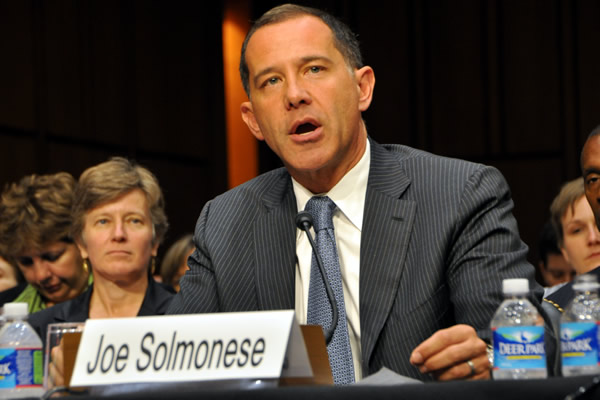
Joe Solmonese, president of the Human Rights Campaign (Washington Blade photo by Michael Key)
Joe Solmonese, who has served for more than six years as president of the Human Rights Campaign, the nation’s largest LGBT civil rights advocacy group, will step down from his job when his current contract ends on March 30, 2012, HRC officials announced last week. The news of Solmonese’s departure was first reported by Pam’s House Blend.
In a statement released Aug. 27, co-chairs of the board of directors of HRC and its sister organization, the HRC Foundation, said Solmonese will remain as head of both organizations “until the completion of his contract to ensure a smooth leadership transition.”
They also announced the formation of a search committee for Solmonese’s replacement to be co-chaired by board members Joni Madison of North Carolina and Dana Perlman of Los Angeles.
“Joe Solmonese is an outstanding leader,” said Anne Fay, who co-chairs the HRC Foundation board. “While we will miss his extraordinary leadership, we enter this next phase, thanks to Joe, in the best place the organization has ever been. Not only has our community secured historic victories, but our membership is larger and more active than any time in our history, and our financial health is secure even in these difficult economic times.”
HRC spokesperson Michael Cole-Schwartz said the combined revenue for HRC and the HRC Foundation for the fiscal year ending March 31, 2011 was $39.8 million. He said the two groups have about 150 employees.
Sources familiar with HRC have speculated that several LGBT movement leaders would likely emerge as candidates for Solmonese’s replacement, including Chuck Wolfe, executive director of the Gay and Lesbian Victory Fund; Brian Ellner, an HRC consultant who coordinated HRC’s efforts to help pass New York’s same-sex marriage law; Chad Griffin, head of the California-based organization that initiated the lawsuit to overturn Proposition 8; and Sean Maloney, one of former President Bill Clinton’s openly gay White House aides who later worked for former New York Gov. David Paterson.
Solmonese has received mixed reviews by LGBT activists during his tenure as head of HRC, which began in 2005. Disagreements over his and HRC’s policies and activities appear to reflect divisions within the LGBT movement.
Supporters and others familiar with the group say Solmonese has worked well in navigating HRC and its LGBT rights agenda during a hostile Bush administration and during a supportive Obama administration, using behind-the-scenes political skills to prod allies in Congress and the White House to move its agenda forward.
Critics say he and HRC have been too closely aligned with the Democratic Party and Democratic congressional leaders, which they say have failed to adequately advance LGBT legislation, such as the Employment Non-Discrimination Act (ENDA) and LGBT-supportive immigration legislation while Democrats controlled the House of Representatives.
The statement released by the HRC board co-chairs says that under Solmonese’s leadership, HRC expanded its public outreach programs, including the start of its Healthcare Equality Index, which, among other things, assesses the sensitivity of hospitals in caring for LGBT people.
HRC and the HRC foundation launched or expanded other important programs during Solmonese’s tenure, the board statement says, in the area of outreach to religion and faith communities, schools programs promoting fair treatment of LGBT youth, and a family and children initiative to open adoption agencies to LGBT parents.
In the area of legislation, the board statement said Solmonese played a key role in steering HRC’s opposition to the Federal Marriage Amendment, a proposed constitutional ban on same-sex marriage. They also note that under his tenure, Congress passed a hate crimes law with protections for LGBT people and repealed the “Don’t Ask, Don’t Tell” law barring gays from serving openly in the military.
The statement notes that during his tenure, the Obama administration put in place a number of administrative directives and policy changes favorable to LGBT people, including a policy banning discrimination against federal government workers based on gender identity.
Dana Beyer, executive director of the transgender advocacy group Gender Rights Maryland and a former HRC board member, said Solmonese alienated many in the transgender community and in the LGBT community in general in 2007 when he declined to oppose a decision by House Democratic leaders to remove protections for transgender people from ENDA.
Then Speaker of the House Nancy Pelosi (D-Calif.), a longtime supporter of LGBT rights, and Rep. Barney Frank (D-Mass.), who’s gay, said they determined at the time that ENDA couldn’t pass in the House if a transgender provision remained in the bill. The House passed a so-called “gay only” version of the bill that year over strong objections from a coalition of dozens of LGBT groups from across the country. Pelosi and Frank said they would introduce a separate bill with transgender protections at a later date, when support for such a bill could be lined up.
Solmonese said it would have put HRC in an untenable position to oppose a major gay rights bill backed by longtime LGBT rights supporters in the House. The bill died when the Senate did not bring it up for a vote.
Solmonese and HRC changed their position on the bill the following year, saying the organization would no longer support ENDA without a provision protecting transgender people from job discrimination.
But Beyer and other LGBT activists said HRC’s earlier position left deep scars within the transgender community, which felt abandoned by HRC.
Others have said the LGBT movement as a whole was divided over HRC’s position, with many in the movement – including D.C.’s Gay and Lesbian Activists Alliance and the Gertrude Stein Democratic Club – supporting an incremental approach of passing a sexual orientation-only version of ENDA while continuing to push hard for adding a transgender provision as soon as possible.
Those holding that view said they favored a fully inclusive ENDA but recognized such a bill could not pass at the time.
Beyer said that in addition to the ENDA flap, many LGBT activists believe HRC is devoting too much of its resources to marriage equality, including the repeal of the Defense of Marriage Act, at the expense of other legislation, such as a trans-inclusive ENDA. Beyer argues that ENDA would help many more LGBT people than those interested in getting married.
“Many of us are hoping HRC will change its direction on some of these issues under a new president,” she said. “But the president is really nothing more than a reflection of the board of directors,” she said. “If the board of directors doesn’t want to change the direction of the organization, it doesn’t matter who the next president is.”
Richard Socarides, president of the national LGBT advocacy group Equality Matters, said Solmonese has performed well in advancing the LGBT agenda.
“He has been there when some very important gains took place,” he said. “And I think he did a tremendous job building the organization.”
Socarides said he disagrees with some critics who say HRC failed to do enough to push ENDA or is placing too much emphasis on marriage equality.
“I don’t think they can be blamed for the failure to pass any particular piece of legislation just as they can’t take all the credit for the legislation that has passed,” he said.
“But what I have said before is that as an organization, they have not sufficiently leveraged their power to bring about change more quickly,” Socarides said. “They are a key part of the Washington establishment but they seem to seek change within existing structures. They are very reluctant to rock the boat.”
Rick Rosendall, vice president of D.C.’s Gay and Lesbian Activists Alliance, and Bob Summersgill, GLAA’s former president, each said HRC under Solmonese’s leadership has provided strong support for the efforts by D.C. activists in passing a same-sex marriage law. The two said Solmonese also arranged for HRC to devote considerable resources to fight efforts by members of Congress to attach anti-gay riders to the city’s annual appropriations bill. Congress must approve the city’s annual budget under the city’s limited home rule charter.
Summersgill and Rosendall noted that HRC, among other things, helped to line up support to defeat proposals by Republican lawmakers to ban same-sex couples from adopting children in the city.
Lateefah Williams, president of the Gertrude Stein Democratic Club, said she, too, appreciated Solmonese’s support for D.C.’s marriage equality campaign, noting that he directed HRC to provide a full-time field organizer to help local activists build support in the community for the same-sex marriage bill.
Williams said she also shares the views of some that HRC should broaden its support for transgender rights initiatives as well as efforts to support programs aimed at minorities within the LGBT community, such as blacks and Latinos, and youth.
“I wish Joe well,” she said.
News of Solmonese’s departure was first reported by the blog Pam’s House Blend last week. The blog cited unnamed sources as saying his departure may be part of a sweeping staff shakeup initiated by the HRC board and that news of his leaving came about under less than amicable circumstances.
Other sources familiar with HRC told the Blade that account was inaccurate. One source familiar with the group characterized as “complete fiction” claims of a staff shakeup as well as claims by some that HRC may already have lined up a successor for Solmonese.
“This is about as normal and straight forward as it gets,” said the source. “He’s giving them six months advance notice. They’re going to launch a replacement process. The organization will go through that and come out with a successor.”
In a letter to HRC volunteers across the country, Solmonese discussed the timing of his decision to leave the group.
“While there may never be an ideal time, this moment seems right for me and my family,” he said. “In addition to our unprecedented victories, the health and future of the Human Rights Campaign has never been more robust,” he said. “My successor will lead a thriving organization despite the recent economic challenges.”




Florida
Fla. Senate passes ‘Anti-Diversity’ bill that could repeal local LGBTQ protections
Bipartisan coalition urges Florida House to reject ‘extremism’ measure

The Florida Senate on March 4 voted 25-11 to approve an “Anti-Diversity in Local Government” bill that critics have called a sweeping and extreme measure that, among other things, could repeal local LGBTQ rights protections.
According to Equality Florida, a statewide LGBTQ advocacy organization, if approved by the Florida House of Representatives and signed by Republican Gov. Ron DeSantis, the bill “would ban, repeal, and defund any local government programming, policy, or activity that provides ‘preferential treatment or special benefits’ or is designed or implemented’ with respect to race, color, sex, ethnicity, sexual orientation, or gender identity.”
In a March 4 statement, Equality Florda added that the bill would also threaten city and county officials with removal from office “for activities vaguely labeled as DEI,” with only limited exceptions.
The Florida House was scheduled to vote on the bill on Monday, March 9, with opponents hopeful that a broad coalition of both Democratic and Republican lawmakers would secure enough votes to defeat the bill.
“Once again, Gov. DeSantis and Florida lawmakers are advancing one of the most sweeping and extreme bills in the country — this time threatening decades of local progress supporting diverse communities, including the LGBTQ community,” said Equality Florida Senior Political Director Joe Saunders. “This legislation is a sledgehammer aimed at cities and counties that recognize and address the diversity of the people they serve,” he said.
Among the LGBTQ organizations that could be adversely impacted by the bill is the highly acclaimed Stonewall National Museum, Archives and Library located in Fort Lauderdale.
Robert Kesten, the Stonewall organization’s president and CEO, told the Washington Blade the organization receives some funding from Broward County, in which Fort Lauderdale is located, and the city of Fort Lauderdale has provided support by purchasing tables at some of the museum’s fundraising events.
“Based on this legislation, hose things would be gone,” he said. “We also are based in a government building. So, we don’t know what potential side effects that could have.” He noted that the building in question is owned by Broward County and leased by Fort Lauderdale, with the bill’s vaguely worded provision making it unclear whether Stonewall would be forced to leave its building.
“It’s unknown, and we’re really in unchartered waters,” he said.

U.S. Capitol Police on Thursday arrested 13 HIV/AIDS activists in the Cannon House Office Building Rotunda.
The activists — members of Housing Works, Health GAP, and the Treatment Action Group — joined former PEPFAR staffers in demanding full funding of the program that President George W. Bush created in 2003. They chanted “AIDS cuts kill, PEPFAR now!” and unfurled banners from the Rotunda’s second floor that read “Trump and (Office of Management and Budget Director Russell) Vought kill people with AIDS worldwide,” “Over 200,000 deaths since January 2025,” and “Hands off PEPFAR” before their arrest.
(Washington Blade video by Michael K. Lavers)
This protest is the latest against the Trump-Vance administration’s HIV/AIDS policies since it took office.
Secretary of State Marco Rubio on Jan. 28, 2025, issued a waiver that allowed PEPFAR and other “life-saving humanitarian assistance” programs to continue to operate during a freeze on nearly all U.S. foreign aid spending. HIV/AIDS service providers around the world with whom the Washington Blade has spoken say PEPFAR cuts and the loss of funding from the U.S. Agency for International Development, which officially closed on July 1, 2025, has severely impacted their work.
The State Department last September announced PEPFAR will distribute lenacapavir in countries with high prevalence rates. Zambia is among the nations in which the breakthrough HIV prevention drug has arrived.
The New York Times last summer reported Vought “apportioned” only $2.9 billion of $6 billion that Congress set aside for PEPFAR for fiscal year 2025. (PEPFAR in the coming fiscal year will use funds allocated in fiscal year 2024.)
Bipartisan opposition in the U.S. Senate prompted the Trump-Vance administration last July withdraw a proposal to cut $400 million from PEPFAR’s budget. Vought on Aug. 29, 2025, said he would use a “pocket rescission” to cancel $4.9 billion for HIV/AIDS prevention and global health programs and other foreign aid assistance initiatives that Congress had already approved.
The White House in January announced an expansion of the global gag rule to ban U.S. foreign aid for groups that promote “gender ideology.” President Ronald Reagan in 1985 implemented the original regulation, also known as the “Mexico City” policy, which bans U.S. foreign aid for groups that support abortion and/or offer abortion-related services. The Council for Global Equality and other groups say the expanded rule will adversely impact HIV prevention efforts around the world.
A press release that Housing Works and Health GAP issued on Thursday notes more than $977 million “in appropriated PEPFAR funding for HIV prevention and treatment was unspent by the end of fiscal year (FY) 2025 — triple amount unspent at the end of FY 2024.”
“Activists predict this backlog will worsen rapidly in FY 2026 unless Congress immediately reasserts its Constitutionally-mandated oversight authority,” notes the press release.
The press release also indicates funding for the Centers for Disease Control and Prevention’s PEPFAR programs “will run out” by April 1 because “only 45 percent of their FY26 funding has been transferred from the State Department.
“Unless funding is transferred immediately, CDC’s global HIV programs across sub-Saharan Africa, Asia and the Caribbean will grind to a halt,” notes the press release.
The activists demanded Trump, Vought, Rubio, and Congress do the following:
- Activists are calling for full obligation of appropriated PEPFAR funds and rejection of growing political interference in global and domestic HIV programs
- Immediately release already-appropriated, unobligated PEPFAR funds
- Break the blackout on PEPFAR data, so Congress and people with HIV know how funding is being spent and can program based on data
- Activists are calling for full obligation of appropriated PEPFAR funds and rejection of growing political interference in global and domestic HIV programs.
“PEPFAR has saved more than 26 million lives and changed the trajectory of an epidemic,” said Housing Works CEO Charles King. “However, the Trump administration’s decision, over the objection of Republicans in Congress, to freeze PEPFAR funding has caused decades of progress to come undone and has been a death sentence for people with HIV relying on life-saving treatment. The U.S. must immediately restore PEPFAR funding and regain our standing in the global fight against HIV.”
King is among the activists who were arrested.
(Washington Blade video by Michael K. Lavers)
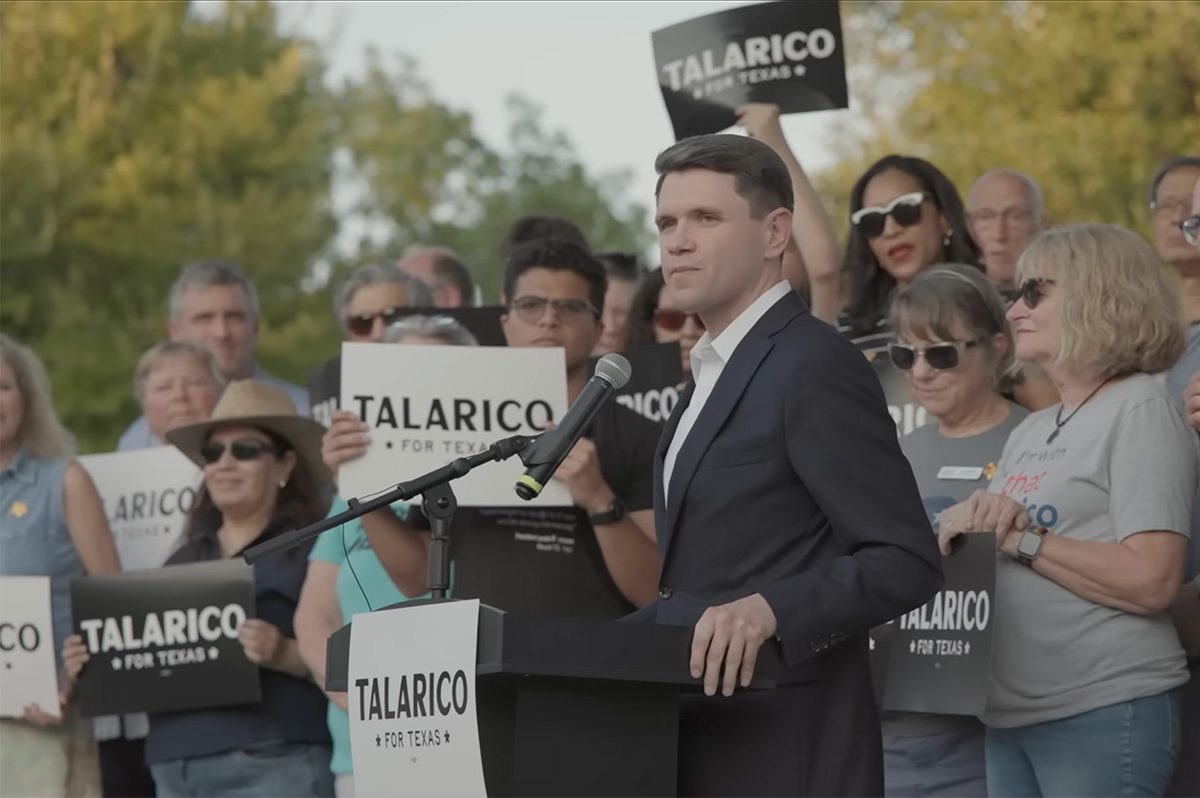
Texas state Rep. James Talarico won a hard-fought primary Tuesday to become the state’s Democratic nominee for U.S. Senate, defeating U.S. Rep. Jasmine Crockett in one of the year’s most closely watched and competitive Democratic contests.
Talarico, a Presbyterian seminarian and three-term lawmaker from Round Rock, was declared the winner by the Associated Press early Wednesday morning after a closely tracked vote count that drew national attention.
“Tonight, the people of our state gave this country a little bit of hope,” Talarico told the AP. “And a little bit of hope is a dangerous thing.”
With 52.8% of the vote to Crockett’s 45.9%, Talarico secured the nomination outright, avoiding a runoff and capping months of sharp contrasts between the two candidates over strategy, messaging, and how best to compete statewide in Texas. Democrats hope the competitive primary — and the relatively narrow margin — signals growing momentum in a state that has not elected a Democrat to the U.S. Senate since 1988.
Talarico has long expressed support for the LGBTQ community, a position he highlights prominently on his campaign website. Under the “Issues” section, he directly addresses assumptions that might arise from his faith and background as a seminarian in a deeply conservative state.
“My faith in Jesus leads me to reject Christian Nationalism and commit myself to the project of democracy,” his website reads. “Because that’s the promise of America: a democracy where every person and every family — regardless of religion, race, gender, sexual orientation, or any other difference between us — can truly be free and live up to their full potential.”
Crockett struck a conciliatory tone following her defeat, emphasizing party unity ahead of November.
“This morning I called James and congratulated him on becoming the Senate nominee,” Crockett told Politico. “Texas is primed to turn blue and we must remain united because this is bigger than any one person. This is about the future of all 30 million Texans and getting America back on track.”
Talarico also drew national attention earlier in the race when “Late Show” host Stephen Colbert said he was initially unable to air an interview with the state legislator due to potential FCC concerns involving CBS. The episode sparked a broader political debate.
Brendan Carr, chair of the Federal Communications Commission, appointed by President Donald Trump, told reporters the controversy was a “hoax,” though he also acknowledged Talarico’s ability to harness the moment to build support as an underdog candidate. The interview was later released online and garnered millions of views, boosting Talarico’s national profile.
In November, Talarico will face the winner of the Republican primary between incumbent Sen. John Cornyn and Texas Attorney General Ken Paxton, who have been locked in a bruising GOP contest. Rep. Wesley Hunt was also in the Republican primary field. The GOP race is expected to head to a May runoff.
In a joint statement, Senate Minority Leader Chuck Schumer and Democratic Senatorial Campaign Committee Chair Kirsten Gillibrand praised Talarico’s victory and framed him as a candidate capable of broad appeal.
“As an eighth-generation Texan, former middle school teacher, and Presbyterian seminarian, James will be a fighter for Texans from all walks of life and of all political stripes,” they said. “In November, Texans will elect a champion for working people: James Talarico.”

Intense doc offers transcendent treatment of queer fetish pioneer

In D.C. comedy, be sure to shop local

Comings & Goings

Liza Minnelli makes surprise appearance at GLAAD Media Awards

Fla. Senate passes ‘Anti-Diversity’ bill that could repeal local LGBTQ protections

Peter Thiel’s expanding power — and his overlap with Jeffrey Epstein

13 HIV/AIDS activists arrested on Capitol Hill

Va. lawmakers consider partial restoration of Ryan White funds

Md. Commission on LGBTQIA+ Affairs released updated student recommendations

35 years after ‘Truth or Dare,’ Slam is still dancing
-

 National4 days ago
13 HIV/AIDS activists arrested on Capitol Hill
-
National5 days ago
Peter Thiel’s expanding power — and his overlap with Jeffrey Epstein
-
Virginia5 days ago
Va. lawmakers consider partial restoration of Ryan White funds
-
Maryland5 days ago
Md. Commission on LGBTQIA+ Affairs released updated student recommendations