Health
The harsh truth about HIV phobia in gay dating
HIV and stigma remain baked into queer dating culture

Uncloseted Media published this article on Dec. 9.
This story was produced with the support of MISTR, a telehealth platform offering free online access to PrEP, DoxyPEP, STI testing, Hepatitis C testing and treatment and long-term HIV care across the U.S. MISTR did not have any editorial input into the content of this story.
By SAM DONNDELINGER | In his room, 19-year-old Cody Nester toggles between Grindr profiles on his phone.
As he senses chemistry with a match, he knows he has to flag something that could be a deal breaker.
“Did you see on my profile that I’m HIV positive?” he writes.
The reply arrives instantly.
“You’re disgusting. I don’t know why you’re on here.” Seconds later, the profile disappears, suggesting Nester is blocked.
“He went out of his way to say that. People could at least be more aware, ask questions, and understand the reality [of living with HIV] instead of attacking us,” Nester told Uncloseted Media.
“I would say 95 percent of people respond that way,” says Nester, who lives in Hollywood, Fla., and works at a Mexican restaurant. “The entire conversation is going fine. They’re down to meet up and then right when I mention [HIV], it’s always, ‘Oh no, never mind.’”
Some other messages he’s received include:
“You’ll never get anything in your life.”
“Why don’t you die?”
“Why are you on here?”
More often, it’s silence, a cold “No” or a sudden block.
“It’s like you’re a white fish in a school of black fish,” he says. “You’re immediately the odd one out.”
Even though Nester’s undetectable status makes it impossible for him to transmit HIV to partners during sex, he experiences stigma around HIV, something which nearly 90 percent of Americans agree still exists, according to a 2022 GLAAD report. And a survey shared in 2019 found that 64 percent of respondents would feel uncomfortable having sex with someone living with HIV, even on effective treatment. The emotional cost of this stigma is a significant barrier to intimacy and can result in a loss of self-esteem, fear of disclosure and suicidal thoughts.
What the science says — and why it doesn’t seem to matter
“The fear comes from antiquated ideas around HIV,” says Xavier A. Erguera, senior clinical research coordinator at University of California, San Francisco,’s Division of HIV, Infectious Diseases & Global Medicine. “A lot of people who are newly diagnosed still fear it’s a death sentence. Even though we have medications now to treat it effectively, and it’s basically a chronic condition, people haven’t caught up.”
Since 1996, antiretroviral therapies have developed to where they can suppress the virus to levels so low that it is undetectable in the blood, and thus not able to be transmitted to sexual partners. This is known as Undetectable = Untransmittable, or U=U. According to a Centers for Disease Control and Prevention report from 2024, 65 percent of HIV-positive cases are virally suppressed.
Another line of defense is pre-exposure prophylaxis (PrEP), which reduces the risk of acquiring HIV from sexual intercourse by roughly 99 percent when taken as prescribed. Approved by the Food and Drug Administration in 2012, the medication launched as a once-a-day pill and was hailed as a breakthrough as it transformed the sex lives of gay men, which had been shaped by decades of fear about HIV complications and about where AIDS came from.
“Internal logic doesn’t reflect what we know scientifically,” says Kim Koester, associate professor in the Department of Medicine at UCSF. “I was very optimistic when PrEP came out. The drug works, so why wouldn’t everyone use it?”
Even with PrEP use on the rise, less than 600,000 Americans used it in 2024, and Koester says skepticism and judgments about taking the drug persist.
“The phobia is pervasive,” Koester told Uncloseted Media. “People believe that others get the disease because of their lifestyle. … PrEP was supposed to be the antidote to the threat of HIV, reduce the anxiety, and make you more open to who you are and the sex you want. It’s supposed to be liberating. It is part of the answer. But it’s not enough. We don’t have enough people using PrEP for it to make the dent in the stigma we need.”
According to a 2023 study of seven informants living with HIV, public stigma stems from problematic views from society that those living with HIV are “a dangerous transmission source,” “disgraceful” and “violators of social and religious norms who have committed deviant behavior.”
Laramie Smith, assistant professor of Global Public Health at the University of California, San Diego, says this stigma is unwarranted and fueled by misunderstanding:
“With today’s treatments, it shouldn’t be a life-altering identity shift. It should be no different than, ‘I have diabetes.’ If you’re virally suppressed, it shouldn’t matter whether you’re friends with someone, whether you’re sleeping with someone — the science shows us that.”
How HIV phobia shows up online
Nester, who contracted HIV last year from a Grindr hook-up who insisted he was negative, says he is just starting to accept his diagnosis. “I didn’t go back on the apps for a long time after that. It messed with my mental health … realizing I’d have to take medication for the rest of my life.”
Since he started dating again this year, returning to apps like Grindr and Sniffies, he has faced a new normal. He tries to do everything “right” and disclose his status early. Even on his Grindr profile, he identifies as “poz,” slang for HIV-positive.
Still, he says most people ghost him once they find out. “The second I bring it up, it’s ‘No,’” says Nester. “The amount of discrimination you get … it’s always the same pattern. … People don’t know, and they don’t want to know. It messes with you.”
This discrimination may be fueled by a deprioritization of HIV awareness programs across the country. Earlier this month, the U.S. State Department did not commemorate World AIDS Day for the first time in 37 years. HIV prevention programs have been slashed, especially in conservative districts, and only 25 states and D.C. require both HIV and sex education. In many states, health curricula often lag behind current science and omit teaching about PrEP, gay sex and concepts like U=U. Research shows that Gen Z is currently the least educated generation about HIV.
“I could go all day explaining HIV, but people don’t want to listen,” says Nester, who is part of Gen Z. “People don’t want to learn about it; they just want to avoid it.”
HIV anxiety and public stigma shaped by history
Even in more progressive areas, stigma still exists. Damian Jack, a 45-year-old from Brooklyn, remembers sitting in an exam room in 2009 as a doctor explained how low his T-cell count was, which is a hallmark of HIV infection.
“I started hysterically crying,” he told Uncloseted Media. “HIV meant death. That’s what I thought.”
In 1981, when Jack was 1 year old, the first reports of a mysterious and deadly immune deficiency syndrome, which would later be named AIDS, appeared in the U.S. Growing up, Jack saw countless terrifying images of men on their deathbeds with Kaposi sarcoma, the purple lesions the media once called “gay cancer.” Public misinformation and fearmongering spread ideas that AIDS was a disease that “only gay men and drug users get.” And politicians often equated it with homosexuality and moral failure, calling it a “gay plague.” It wasn’t until September 1985, four years after the crisis began and thousands had died, that President Ronald Reagan first publicly mentioned AIDS.
Decades later, the emotional residue of that era and the shame associated with the virus lingers.
Hours after learning of his diagnosis, Jack faced his first encounter with rejection. He already had a date planned that night, and his doctor and friends encouraged him to go.
They had a great time until the date asked him: “Are you negative or positive?”
He told the truth.
“It was just understood there wouldn’t be a second date,” says Jack. “I remember thinking, ‘This is how dating is going to be now.’ I felt so anxious telling guys. It followed me everywhere. I don’t think that anxiety ever truly goes away.”
The emotional impact of HIV stigma
For those who are HIV-negative, experts say that “stigma’s whole design is to ‘other.’”
“The ‘us versus them’ creates that false sense of safety when it comes to HIV,” says Smith. “If I can believe that someone did something to deserve their diagnosis, and I’m not that [kind of person], then I’m safe.”
This othering is painful and can lead to shame, fear and isolation, and it is linked to a higher risk of depression and anxiety.
“If I’m undesirable, and that’s what those messages are communicating, that threatens your sense of safety, your sense of belonging and the fundamental desire we all have to be loved,” Smith says. “And that starts to reinforce the thinking that ‘I am not worthy. This virus that I have means that I’m not lovable. I am not safe showing up among other men.’”
“I pretend it doesn’t hurt, but some things do sting a little bit,” Nester says. “You start thinking, ‘Am I really that disgusting? Am I really that singled out?’”
When public stigma turns inward
“Internalized stigma is what occurs when applying the stereotypes about who gets HIV, the prejudice, the negative feelings, onto yourself,” says Smith.
In 2024, 38 percent of people living with HIV reported internalized stigma. And studies show that it can predict hopelessness and lower quality of life, even when people are engaged in care or virally suppressed.
Internalized stigma can also affect how people practice safe sex and communicate about the virus. A 2019 survey of men who have sex with men found that individuals who perceived greater community-level stigma were less likely to be aware of — and use — safer-sex functions available on dating apps, such as HIV-status disclosure fields, as well as sexual health information and resources.
“[HIV phobia] is probably the most intense, subvert bigotry I think you could experience,” Joseph Monroe Jr., a 48-year-old living in the Bronx, told Uncloseted Media.
On dating apps, men have messaged him things like, “You look like you’ve got that thing” and “Go ahead and infect someone else.”
Monroe has also dealt with misinformed people who rudely opine about how he contracted the virus: “Who fucked you? That’s how you got it, right?” people will say to him.
“You end up internalizing all these stereotypes about who gets HIV — that you were promiscuous, that you didn’t care about yourself, that you did something wrong,” says Smith. “You carry that in, and then you have to relearn: ‘No, I didn’t. This is just a health condition.’”
What HIV acceptance looks like and raising awareness
For those living with HIV, acceptance feels far away.
“You’re living under this threat of HIV and the threat that others find you threatening. It inhabits you socially and sexually,” Koester says. “People are hunkering down. Not putting themselves out there and having a mediocre quality of life. To have a sense of empowerment, you have to be legitimate and seen in the world and it’s hard to do that with the stigma that exists.”
Researchers say the path forward lies as much in conversation as in medicine.
Koester says she talks about HIV and PrEP anywhere she can, including in salons, cafes and restaurants. “Whenever I get into a cab with someone, I’m going to bring up HIV so the driver gets accustomed to hearing about it. … We have a long way to go in terms of exposure and awareness and every little bit helps.”
Part of this lies in increasing awareness through targeted marketing campaigns. PrEP is still profoundly misunderstood outside major urban centers, with uneven uptake among minority groups and usage gaps in the Bible Belt. And a 2022 U.S. survey found that 54.5 percent of people living with HIV didn’t know what U=U meant, and less than half of Americans agree that people living with HIV who are on proper medications cannot transmit the virus.
While eradicating stigma is slow, there is hope for acceptance.
Years after Jack’s diagnosis, in 2021, he told a man he was on a third date with that he was HIV-positive but undetectable. His date’s reply was almost casual:
“Oh — is that it? I thought you were going to say you had a boyfriend or something. I’m on PrEP. You’re fine.”
“It felt so good to hear him say that and accept me,” says Jack. “I was like, ‘This is my person. You’re my person.’” One year later, they got married.
Back in Florida, 19-year-old Cody Nester isn’t feeling this acceptance. He still scrolls past profiles that read “Only negative guys” and tries to ignore the hateful messages.
“It still hurts, but I know it’s coming from fear,” he says. “I wasn’t too informed about HIV before I got it. … When I got it, I really jumped into the rabbit hole and began to learn. I really do think [HIV and stigma] is because people are not knowledgeable. … When people don’t know details, they tend to get scared.”
Additional reporting by Nandika Chatterjee.



Health
United States Conference on HIV/AIDS grapples with federal budget cuts
Annual gathering is largest of its kind in the country

Advocates, public health experts, and healthcare providers gathered for the United States Conference on HIV/AIDS on Sept. 17 in Anaheim, Calif.
The conference is the largest of its kind in the nation and came amid a wave of new challenges for HIV research and treatment. Since the beginning of the second Trump-Vance administration, federal spending cuts have targeted HIV/AIDS programs, including the gutting of the U.S. Agency for International Development and proposed cuts to PEPFAR, which supports HIV testing and treatment globally, in 2025.
Last year, Congress maintained funding for HIV programs after proposed cuts faced opposition from advocacy groups and bipartisan criticism. Yet, this year Congress has proposed similar cuts to many of the same programs, which would cut nearly one billion dollars in HIV funding. The majority of the cuts would impact HIV prevention and outreach, which includes ending nearly all Centers for Disease Control and Prevention HIV prevention activities.
“If we continue down this path,” said Jeremiah Johnson, the executive director of PrEP4ALL, an advocacy group that supports expanding access to HIV prevention. “We’re going to see more people falling off treatment. We’re going to see more wait lists. That’s going to lead to more people dying from AIDS-related complications.”
Cuts and challenges
The funding cuts loomed over the conference and inspired protest from activists.
On the first day of USCHA, activists with Save HIV Funding organized a mock funeral outside the convention center. Advocates living with HIV wrote eulogies for themselves, meant to show the consequences of diminished access to treatment. Then activists marched through the conference carrying fake coffins.
Johnson, who helped organize the protest, said that “the Trump administration has eviscerated global aid … and the fears that many of us are just talking about hypothetically for ourselves at the moment are already happening [internationally]. And so we wanted to place that front and center at this conference.”
The attacks on funding for HIV research and outreach come at a complicated time for the movement to end the AIDS epidemic. While options for prevention and treatment have never been more accessible, such as PrEP and antiretroviral therapy, there have been some concerning upticks in infections, particularly among communities of color.
Southern states account for the majority of new HIV infections in the country, despite making up only 38 percent of the population. And these infections impact disproportionately Black and Latino communities. According to the CDC, even as overall HIV infections decreased from 2018 to 2022, diagnoses of HIV among Latinos grew by 17 percent, with a majority of this increase happening in the South.
Stigma is still the biggest barrier for people seeking out HIV treatment, said Guillermo Chacón, president of the Latino Commission on AIDS.
“The progress that we [made] in the past two years has been demolished,” he said.
Chacón blames the federal government for stigmatizing HIV treatment by using harmful rhetoric about queer people.
“The level of homophobia and transphobia right now is even higher because it has been used as a political message to create fear and division in our country,” he said.
Chacón believes that research and outreach must be done to reverse the rising HIV infections among Latinos. However, this is exactly the type of research that the Trump-Vance administration is targeting most intensely. Research into “health disparities” — why some health problems impact certain communities more than others — has been heavily criticized by the White House, along with other research that it considers “woke” and claims is not supported by science.
Impact felt at conference
The opening plenary for the conference addressed some of the funding challenges the movement was facing but tried to shift the focus to the victories the movement has seen over the years. Speakers highlighted historic successful activist campaigns like ACT UP, and recent improvements in medical care and access to treatment.
Randevyn Pierre, head of U.S. external affairs at ViiV Healthcare, the sponsor of the plenary, took the stage to celebrate the success of the U = U campaign (undetectable viral load =
untransmittable HIV virus), and ViiV’s investment of $33 million in HIV community organizations across the U.S. This comes as the Trump-Vance administration has made moves to end direct funding of community-based organizations, opting to give the funding to state healthcare agencies.
The speakers at the conference discussed reducing stigma for those living with HIV and the joy of living authentically. They also emphasized the diverse groups of people that are impacted by HIV and how they can come together to fight for a cure. Longtime AIDS activist Rae Lewis Thorton exclaimed, “When they tell me there’s a cure to HIV, I’m gonna take off my 4-inch heels and put on gold slippers,” to applause from the audience.
The opening plenary also featured song and dance from a variety of artists, many of whom spoke about how HIV has impacted their own lives and how advocacy has uplifted their spirits. However, the joyous atmosphere at the conference would not last.
On the final day of USCHA, Geri Donenberg, the associate director of AIDS research at the National Institutes of Health, took the stage to address the conference.
As she spoke, phones began to buzz around the room with breaking news: the Trump-Vance administration was drafting an executive order to create an external board to oversee NIH grants and screen them for political content. NMAC CEO Harold Philips took the stage after Donenberg to address the crowd. “It’s up to us,” Philips said, “to hold NIH accountable.” He added that HIV advocates “have supporters inside NIH who are struggling and working to do the right thing. We have to have their back.”
Chants of “stand up, fight back, fight AIDS” erupted from the crowd as Philips spoke. “We do have to fight back. We do have to continue to fight,” Philips replied.
Caleb Kaufman is a California Local News Fellow placed with the Los Angeles Blade. The California Local News Fellowship is a state-funded initiative to support and strengthen local news reporting. Learn more about it at fellowships.journalism.berkeley.edu/cafellows.
Health
AIDS Healthcare Foundation announces 3 million people globally in its care
Los Angeles-based group lauded ‘historic milestone’
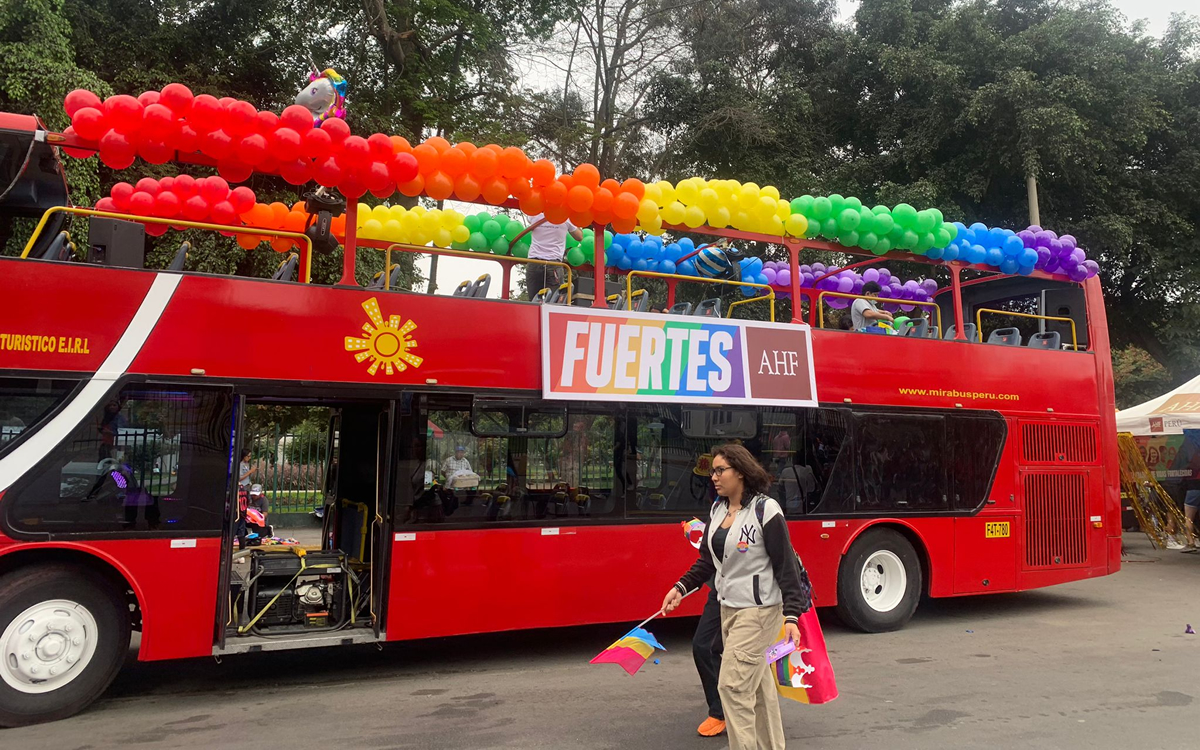
The AIDS Healthcare Foundation, a Los Angeles-based nonprofit group founded in 1987 that has become the world’s largest HIV/AIDS organization, has announced it has three million people in care around the world.
In a statement released on May 26, the organization, known worldwide as AHF, said the latest accomplishment reflects its global commitment to HIV prevention, care, and treatment. It says the accomplishment comes at a time when AHF marks the 25th anniversary of its first global programs launched in South Africa and Uganda in early 2001.
The statement says the three million people in care milestone also comes while the group approaches the 40th anniversary of its founding in 1987.
“Today, AHF provides lifesaving services in 50 countries across Africa, the Americas, Asia, and Europe, supporting millions of people living with HIV through a network of 1,056 global clinics, 79 healthcare centers in the U.S., 67 pharmacies, 96 wellness centers, 26 Out of the Closet thrift stores, outreach programs, and community partnerships,” the statement says.
“This accomplishment is far more than a number — it represents 3 million individuals whose lives have been touched by compassion, commitment, and the belief that healthcare is a human right,” Condessa M. Curley, the AHF board chair, said in a statement. “We extend our deepest gratitude to every member of the AHF team whose dedication made this milestone possible,” Curley said.
The AHF website notes the organization was founded in 1987 in Los Angeles as a network of hospices committed to “fighting for the living and caring for the dying” at a time when there was no effective treatment for HIV/AIDS. A statement on the website says since that time AHF has greatly expanded, converting its hospices into healthcare centers “and building a new paradigm for HIV care both in the United States and around the world.”
The statement adds, “Under the leadership of president and co-founder Michael Weinstein, AHF has grown from a group of friends dedicated to creating dignified hospice care to the largest AIDS organization in the world.” It says Weinstein “has been at the forefront of creating cutting-edge healthcare and advocacy programs and continues to drive the organization forward with the aim of saving more lives around the world.”
The statement announcing the milestone has also come at a time when more than 40 million people worldwide are living with HIV, “while hundreds of thousands continue to die annually from AIDS-related illnesses despite the availability of effective treatment.”
It says AHF’s response has included an expansion of its prevention and public health programs worldwide. In 2025 alone, according to the statement, AHF and its affiliated programs provided nearly five million free HIV tests globally and distributed more than 54 million free condoms, “underscoring the organization’s continued emphasis on both prevention and treatment.”
In D.C. AHF operates health care centers at 1701 K St., N.W., Ste. 400 [202-293-8680], 650 Pennsylvania Ave., S.E., Ste. 310 [202-350-5000], and 1647 Benning Road, N.E., Ste. 300 [202-350-5000].
Cannabis Culture
LGBTQ people, weed, and mental health: what you need to know
Community uses marijuana at much higher rates than general population

Uncloseted Media published this story on May 7.
By SPENCER MACNAUGHTON | In 2025, the global cannabis market size was valued at nearly $103 billion. By 2034, that number is expected to explode by roughly 1,400 percent to more than $1.43 trillion.
In short, as an increasing number of countries legalize marijuana use, everyone is starting to consume a lot more weed. And LGBTQ people tend to use cannabis at much higher rates than the general population. One study found that 55 percent of lesbian and 45 percent of gay young adults use marijuana, compared to about 33 percent and 37 percent, respectively, of their straight counterparts.
As LGBTQ people face a mental health crisis, the mainstream stereotypes that depict weed as an antidote for anxiety, panic and depression aren’t painting the full picture. And that could be exacerbating the mental health struggles so many queer people, and especially youth, face.
Here’s what the research demonstrates about marijuana and its effects on mental health:
- Multiple studies suggest a link between marijuana use and an increased risk of mental health disorders, including schizophrenia, depression and anxiety in individuals who are genetically predisposed.
- One study found that daily marijuana use, especially among younger people, makes some individuals seven times more likely to develop psychosis.
The increase in higher-potency strains of marijuana could pose unknown risks. In 1995, the average content of Tetrahydrocannabinol (THC) in confiscated marijuana was less than 4 percent. In 2022, it was more than 16 percent. Researchers don’t know the full extent of the impact that these higher concentrations can have on mental health and especially on younger people whose brains are still developing.
- A systematic review of studies published between 2013 and 2025 found damning results for the mental health of young cannabis users:
They were 51 percent more likely to experience depression, 58 percent more likely to experience anxiety, between 50 and 65 percent more likely to experience suicidal ideation and 80 to 87 percent more likely to have attempted suicide.
- While the above stats paint a grim picture, there is also some research that suggests benefits of cannabis use:
- A 2025 systematic review found that “medicinal” weed showed some efficacy in relieving withdrawal symptoms of opioid use disorder. THC use has been associated with improvement of post-traumatic stress disorder symptoms, bipolar symptoms and sleep quality.
- Other studies found that THC administered in a controlled setting was associated with a decrease of symptoms and adverse effects for a range of mental health disorders, including schizophrenia, psychotic symptoms, and anorexia nervosa.
Beyond what we pulled from academia, there is an astounding lack of information about the interplay between weed and mental health. As we dive deeper into Mental Health Awareness Month, I hope advocacy organizations, influencers and news outlets ramp up their coverage of this important topic that affects the countless LGBTQ weed smokers, many of whom are already struggling.

Bowser, Office of LGBTQ Affairs announce LGBTQ+ History Month events

PHOTOS: Winchester Pride

Evan Low is not the leader the Victory Fund needs at this moment

Transgender woman elected to Brazilian Chamber of Deputies

Lula, Flávio Bolsonaro to face off in second round of Brazilian presidential election

Vote now! Best Of LGBTQ DC readers’ choice awards

Gay Va. couple hopeful voters will enshrine marriage equality in state constitution

Victory Fund board investigates former staffers’ allegations against CEO Evan Low

LGBTQ community must vote in big numbers

Calif. governor signs 6 pro-LGBTQ bills, vetoes 1
-

 Arts & Entertainment5 days ago
Vote now! Best Of LGBTQ DC readers’ choice awards
-
Virginia4 days ago
Gay Va. couple hopeful voters will enshrine marriage equality in state constitution
-
LGBTQ Non-Profit Organizations4 days ago
Victory Fund board investigates former staffers’ allegations against CEO Evan Low
-
Opinions4 days ago
LGBTQ community must vote in big numbers