
Congress
Eight Democrats break with party as House advances ‘Don’t Say Trans’ bill
Measure not expected to pass in Senate
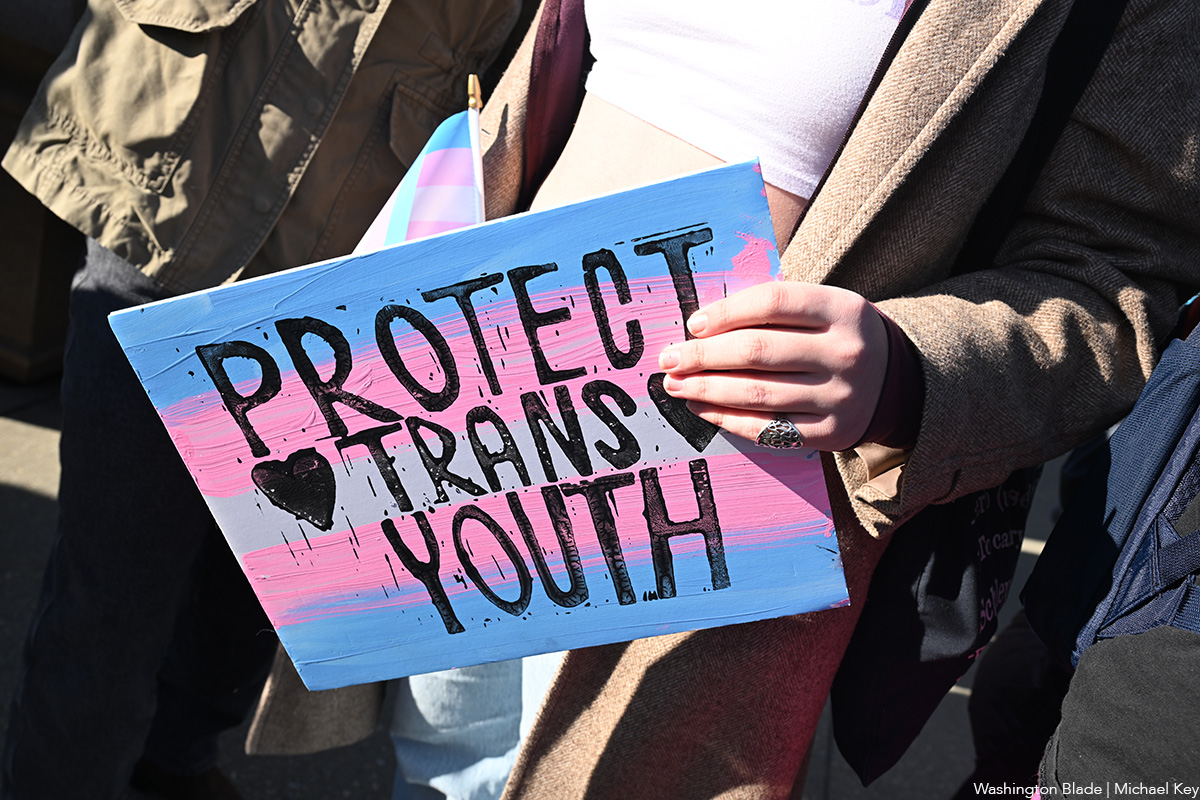
The U.S. House of Representatives passed a federal “Don’t Say Trans” bill on Wednesday, attempting to force teachers to out transgender students nationwide.
The bill, House Resolution 2616, also called the “Stopping Indoctrination and Protecting Kids Act,” would require schools to get parental consent before allowing students to use their preferred, rather than originally assigned, gender markers, pronouns, or preferred name on any school form, and to use any sex-based accommodations, including locker rooms or bathrooms.
The bill amends Section 8526 of the Elementary and Secondary Education Act of 1965, legislation that allows for federal aid to help elementary and secondary education programs — particularly those under its lowest-income Title I-A program — to stop allocating funds to any education that teaches concepts “related to gender ideology.”
This is directly related to Executive Order 14168, also known as the “Defending Women From Gender Ideology Extremism and Restoring Biological Truth to the Federal Government” order, one of President Donald Trump’s first executive orders of his second term. It requires the federal government to recognize only sex assigned at birth and dismiss gender identity rather than sex.
The bill was sponsored by U.S. Rep. Tim Walberg (R-Mich.) and passed by a 217-198 margin. The vote fell mostly along party lines; however, eight Democrats voted for its passage. They were U.S. Reps. Henry Cuellar (D-Texas), Donald Davis (D-N.C.), Cleo Fields (D-La.), Laura Gillen (D-N.Y.), Vicente Gonzalez (D-Texas), Marcy Kaptur (D-Ohio), Marie Gluesenkamp Perez (D-Wash.), and Eugene Vindman (D-Va.).
Proponents of the bill argue a child’s gender identity should be directed by parents at home rather than in public schools.
Critics say this is dangerous and will force students to be outed by their teachers to parents — some of whom may not be supportive of their gender identity — which could lead to violence or possibly conversion therapy.
California Congressman Mark Takano, chair of the Congressional Equality Caucus, spoke on the House floor while the bill was being debated.
“Republicans claim to be the party of small government, but they have no problem bringing the full force of the federal government down against children. The GOP thinks they can legislate transgender people out of existence with this inhumane Don’t Say Trans bill, but all they’re doing is making life worse for a small minority of already-vulnerable children,” Takano said. “I spent 24 years as an educator where I worked with hundreds of high school students and their parents. Most children go to their parents when they need help or are struggling — including transgender children — but not all parents are accepting. The forced outing provision of this bill puts teachers in an impossible situation by requiring them to out trans kids to their parents in certain situations — even if the teacher knows the student will likely face physical abuse. Students like these are who Republicans want to put in immediate physical danger with this bill.”
The Washington Blade talked to Tyler Hack’s, founder and executive director of the trans advocacy organization and Christopher Street Project PAC, following the bill’s passage.
“Most queer kids go to their families when they are figuring out who they are, and then not all queer kids have that option,” Hack told the Blade. “If this became law, it would harm those already vulnerable kids who rely on school as a safe place and might not have a safe place at home.”
They explained this is not about protecting parents’ rights to know what is going on with their children, but rather the weaponization of trans identity that has become a mainstream Republican ideal pushed by the Trump-Vance administration.
“Young people deserve the space to figure out who they are without the federal government interfering in their lives,” they said. “It is beyond the pale, or rather it should be beyond the pale, and has become a norm for Republicans in Congress to villainize kids, because I mean, this bill targets kids, it’s in the name of the bill, and it’s in the implications.”
Hack continued, saying that amid the rising cost of everyday necessities — from gas to groceries — and while the Trump-Vance administration continues to defund programs intended to help the most vulnerable Americans while creating slush funds for political allies, this is not what Congress should be focusing on.
“At a time when people are really struggling, and politicians need to be focused on lowering costs, they’re using queer and trans kids as political pawns,” Hack said. “They want to divide and conquer this country, and we need to stand up against them and unite behind values of inclusion and of trust in our teachers.”
David Stacy, the Human Rights Campaign’s vice president of government affairs, provided a statement to the Blade.
“Trans kids are not a political agenda — they are students who deserve safety and affirmation at school like anyone else,” Stacy said. “Despite the many pressing issues facing our nation, House Republicans continue their bizarre obsession with trans people. HR 2616 does not protect children. It targets them. This bill is cruel, and we’ll continue to fight to ensure it never becomes law.”
The bill will move to the U.S. Senate in the coming days and weeks, but it must first be reviewed by a Senate committee before leadership schedules it for a floor vote, where it will need 60 votes to pass.





2026 Midterm Elections
Democrats take control of Congress in historic rebuke of Donald Trump
‘Voters delivered a resounding message: equality wins’
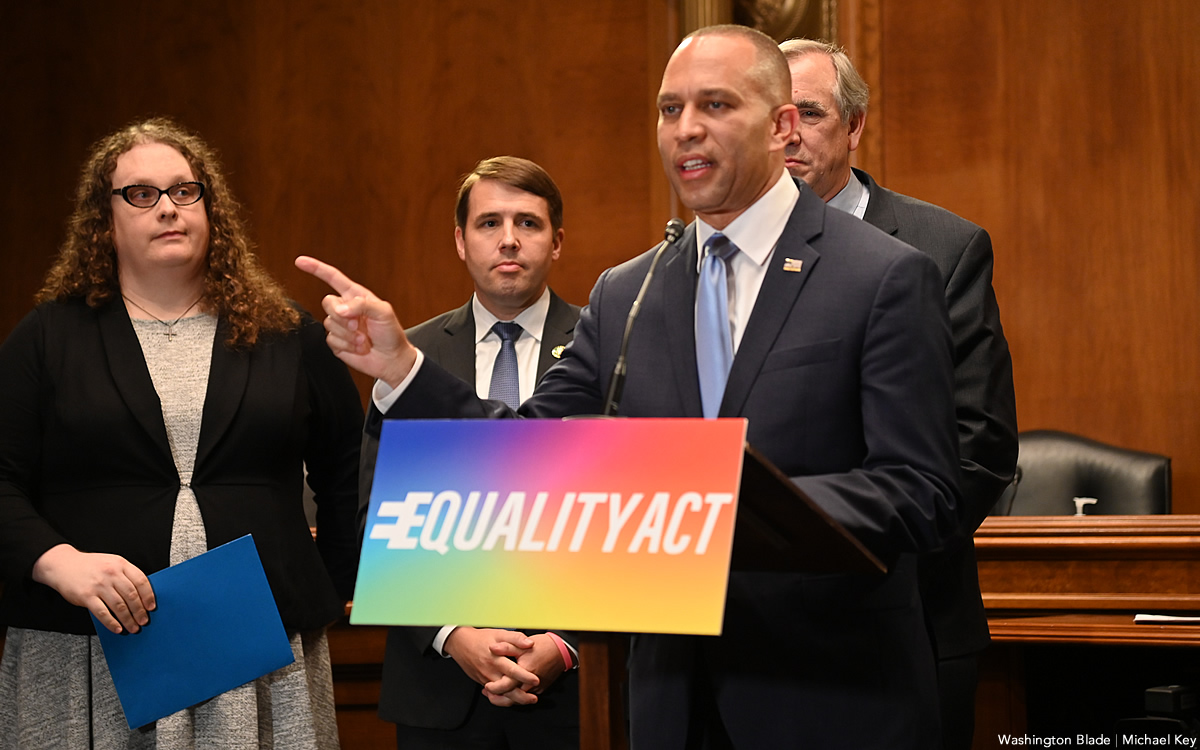
Midterm elections are traditionally viewed as a check on the party in control of the White House. With Republicans holding control of all three branches of government, President Donald Trump was able to advance his agenda with few congressional obstacles.
From getting the United States involved in a war in Iran to imposing tariffs that have increased the cost of everyday goods, Trump has faced mounting criticism over his priorities, including his insistence on pursuing vanity projects in the nation’s capital rather than addressing issues affecting most American voters.
Following the midterm elections, both chambers of Congress will now be controlled by the Democratic Party.
Affordability was a key issue in this year’s midterms. As Americans watched Trump receive a brand-new Air Force One from a foreign government and continue a war that has directly affected everyday costs, particularly gasoline and groceries, voters delivered a devastating and historic rebuke to the president and his party.
Republicans spent $305 million on advertisements, compared with $256 million spent by Democrats, in competitive Senate, House and gubernatorial races between Oct. 23 and 29, according to The Washington Post, which analyzed data from AdImpact, a political advertising tracking firm.
Republican attempts to use LGBTQ issues as culture-war talking points appeared to be less effective in 2026 than they were in 2024.
This year’s advertisements targeting transgender people primarily focused on two policies: transgender athletes’ participation in women’s and girls’ sports and gender-affirming medical care, particularly surgery, for minors.
Despite Republican efforts to make LGBTQ identity a political liability, the midterm elections resulted in a historic number of LGBTQ candidates being elected to federal office.
Chris Pappas, the senator-elect from New Hampshire, will become the first openly gay man elected to the U.S. Senate, joining Sen. Tammy Baldwin (D-Wis.), an out lesbian who has held her seat since 2012. Meanwhile, a record number of LGBTQ representatives have been elected and reelected to the U.S. House. They include Sarah McBride, the first openly transgender member of Congress, who retained Delaware’s seat; JD Ford, who flipped Indiana’s seat; and Cait Conley, who defeated incumbent Mike Lawler.
Following the election results, LGBTQ advocacy groups celebrated Democratic victories and the election of several LGBTQ candidates.
The Human Rights Campaign (HRC), the largest LGBTQ advocacy organization in the United States, issued a statement following Democrats’ securing control of both chambers of Congress.
“Tonight, voters delivered a resounding message: equality wins. After two years of MAGA Republicans waging a culture war, wasting taxpayer dollars attacking LGBTQ+ people, and spending $340 million on anti-trans ads while families suffered, voters have had enough,” said HRC President Kelley Robinson.
“In a historic rebuke, voters didn’t just reject LGBTQ+ hate, they have elected a historic number of LGBTQ+ elected officials. Chris Pappas is the first-ever out gay man elected to the U.S. Senate, and JoAnna Mendoza, Cait Conley, and Jeremy Moss will join Sarah McBride, who won by a huge margin, in the U.S. House — and that’s just the start. Virginia reaffirmed that love is love. Missouri rejected an anti-trans, anti-abortion ballot measure. And we are seeing victories up and down the ballot across the country,” she added. “The message from LGBTQ+ voters could not be any more clear: Our rights are not up for debate, our community will not be a political punching bag, and we are not going anywhere.”
Emily Wagner, a communications official with the Transgender Freedom Alliance, also weighed in on the results, arguing that the relentless anti-transgender advertising Republicans ran across the country failed to deliver the electoral results they sought.
“Massive anti-trans spending failed to prevent important Democratic victories. Republicans spent nearly $400 million on anti-trans ads altogether—and still lost key races to candidates who pushed back,” Wagner said in an email. “These victories reinforce TFA’s research: candidates can answer attacks effectively by speaking confidently about shared values, addressing voters’ concerns, and challenging their opponents’ priorities without abandoning transgender people.”
There were early predictions that a Democratic “blue sprinkle,” or even a modest wave, could serve as a check on Trump’s power by installing Democratic lawmakers in a Congress over which he had previously exercised significant influence. Instead, the results amounted to a blue tsunami.
Democrats won several states Trump carried by double digits in 2024, as voters voiced their disapproval of the president.
Democrats flipped seven previously Republican-held seats, including in Iowa, Kansas, Maine, North Carolina, South Carolina, Ohio and Texas. Some of those states had gone decades without electing a Democratic leader.
The seismic shift in federal power has also prompted changes in Republican leadership. Speaker Mike Johnson (R-La.) told his staff during a phone call Wednesday morning that he will not remain Republican leader in the new Congress, according to four sources on the call cited by NBC News. Republicans are scheduled to hold an internal election to select their candidate for the position next week, on Nov. 10.
With control of the House and expanded oversight powers, more LGBTQ Democrats could also be positioned to take on leadership roles in the new Congress.
Incumbent Congressman Robert Garcia (D-Calif.) is poised to become chair of the House Oversight Committee, giving him greater authority to investigate the Trump-Vance administration, subpoena officials and oversee federal agencies.
Garcia responded to the confirmation of Democratic control with a two-word statement: “Lawyer up.”
2026 Midterm Elections
Democrats projected to win Senate majority, opening door to LGBTQ legislation
U.S. Sen-elect Chris Pappas (D-N.H.) is gay
The U.S. Senate has flipped to Democratic control.
Democrats will control of the Senate after flipping the minimum four Republican-held seats, giving the party control of both chambers of Congress and a majority in the legislative branch, according to NBC.
The Senate, the upper legislative body, holds 100 seats, two for every state, and oversees several important functions of the federal government, including confirming judicial and Cabinet appointments.
There will now be two openly LGBTQ members of the Senate: freshly elected Chris Pappas of New Hampshire, who is gay, and Tammy Baldwin of Wisconsin, who is a lesbian.
With greater control over federal legislation, Democrats could have an opportunity to advance measures such as the Equality Act, which would expand federal protections against discrimination based on sexual orientation and gender identity.
During the campaign, President Donald Trump repeatedly referred to South Carolina Democratic Senator-elect Annie Andrews using the anti-transgender slur “Tranny Annie,” while emphasizing culture war issues, including trans participation in sports and gender-affirming care.
Democrats, meanwhile, have centered their campaigns on the growing affordability crisis as somatic issues, including the Ukrainian-Russian war, Palestinian-Israeli war, and the war in Iran.
2026 Midterm Elections
Democrats poised to flip House, opening door for expanded LGBTQ leadership
Robert Garcia among potential committee chairs in new Congress
The U.S. House of Representatives is projected to flip to Democratic control.
According to the Associated Press, Democrats are moving toward control of the House after defeating six Republicans in key battleground races.
While several major questions remain about how Democrats will lead beginning in 2027, their control of the chamber will expand their oversight powers, allowing them to pursue efforts to check an executive branch that has operated with little congressional oversight over the past two years.
With control of the House and expanded oversight powers, more LGBTQ Democrats could be positioned to take on leadership roles in the new Congress.
Incumbent Congressman Robert Garcia (D-Calif.) is poised to become chair of the House Oversight Committee, where he would have greater authority to investigate the Trump-Vance administration, subpoena officials and oversee federal agencies.
Garcia sent out a two word statement following the confirmation of the Democratic Party’s control: “Lawyer up.”
U.S. Rep. Mark Pocan (D-Wis.) could gain a leadership position on the House Appropriations Committee, which has authority over government funding. Such a position could allow him to put roadblocks in the way of much of the Republican agenda, including many projects Trump has personally spearheaded while in the Oval Office.
Some political strategists, like those at Newsweek, have said a third Trump impeachment could be on the table. However, convicting President Donald Trump in a Senate trial would require a two-thirds majority, an outcome that remains uncertain.
These midterm elections have been rife with personal attacks, gerrymandering at the behest of Trump, and heightened political tensions across the country. Republicans have campaigned on the idea that voters are effectively voting for Trump, while also focusing heavily on transgender issues. Meanwhile, many Democrats have pushed back by centering their campaigns on the growing affordability crisis as the war with Iran continues.

Out actor on his 25-year love affair with ‘Mamma Mia’

Comings & Goings

Stephen Miller, key architect of anti-LGBTQ policies, named White House chief of staff

Escritora trans venezolana reivindica una fe sin exclusiones ante la visita del papa a Sudamérica

Baltimore lawmaker’s ex-treasurer charged with theft of $87K in campaign cash

Meet the talented makeup artist behind Broadway’s ‘Rocky Horror’

Australia’s first gay state governor takes office

Michigan Senate race puts two sharply different LGBTQ records head to head

Sarah McBride returns to Congress after historic first term

Election watch parties to take place throughout DMV
-

 a&e features4 days ago
Meet the talented makeup artist behind Broadway’s ‘Rocky Horror’
-
Australia5 days ago
Australia’s first gay state governor takes office
-
2026 Midterm Elections5 days ago
Michigan Senate race puts two sharply different LGBTQ records head to head
-
2026 Midterm Elections4 days ago
Sarah McBride returns to Congress after historic first term