Opinions
Marriage fight consistent with MLK’s ideals
Opposition runs counter to tenets of Civil Rights Movement

By Joy Freeman-Coulbary
Last month, we celebrated Martin Luther King Jr.’s birthday, commemorating his visionary spirit and legacy. We are now wrapping “Black” History Month in which we celebrate the significant accomplishments and contributions of African Americans to American culture, a keystone of which is King’s non-violent Civil Rights Movement for equality. King and his movement eviscerated the very tenants of separate but equal.
Therefore, in the spirit of Black History Month and the moral principles and imperatives of the Civil Rights Movement, what better overture than to become a society that embraces civil rights for all by recognizing the right of same-sex couples to marry? King’s society would be one of equality—a sex-positive utopia that embraces diversity in all its forms.
Same-sex marriage and interracial marriage have historic parallels in gaining public support and legal recognition. At one point interracial marriage—the legality of which was birthed during the Civil Rights Movement—was considered taboo, illegal, and indeed un-American and a sacrilege. That was until Richard and Mildred Loving—a white man and black woman from Virginia—put their loving to the test by taking their case to the Supreme Court, which 1967 overturned laws barring interracial marriage.
While interracial marriage is now recognized in every state, and no longer considered taboo by the vast majority of Americans, the fight for same-sex nuptials is still seemingly an uphill battle. According to NPR, “New York’s legalization of same-sex marriage effectively doubled the number of Americans living in states where gays can marry.” However with legal challenges afoot, the legalization of same-sex marriage “may hinge on the Supreme Court.”
Meanwhile, New Jersey Gov. Chris Christie last week vetoed a same-sex marriage bill and opponents in Maryland are gearing up for a referendum fight in November if the General Assembly passes a bill as expected.
As someone who has had two heterosexual marriages, I find it laughable that social conservatives who oppose same-sex marriage think that heterosexuals are better equipped to honor and uphold the civil institution of marriage any more than same-sex couples. With the high rates of infidelity, divorce and acrimony among heterosexual married couples, the institution has already lost much of the sanctity those in opposition protest to uphold.
From news coverage, many of those opposing the legalization of same-sex marriage in Maryland appeared to be the religiously faithful and many African Americans. A Washington Post poll confirms that a slim majority of African Americans in Maryland oppose same-sex marriage, while a vast majority of whites in the state support same-sex unions.
As someone of African-American descent, albeit who opposes labels, I find it highly ironic that such a large contingent of my fellow African Americans would have drifted so far toward social conservatism as to oppose another minority—those who identify as gay and lesbian — having the right to marry and access all of the benefits and rights this institution confers. Such opposition runs counter to the basic tenants of King and the Civil Rights Movement, which emphasized equality and human rights.
Marriage is an institution embedded into the fabric of our culture and society and has assumed broader significance than being a holy Sacrament. As a libertarian and a lawyer, I’d argue that marriage is a contractual matter between individuals that should be free from religious and governmental interference. As a pacifist and civil rights proponent, I’d argue that marriage is a fundamental, universal human and civil right that should not be denied to individuals based upon race, gender or sexual orientation.
So in the spirit of King, Black History Month, and the Civil Rights Movement, let’s continue the progress that Mildred and Richard Loving so bravely began decades ago, and impart the right to marry to all individuals regardless of gender and sexual orientation.




Opinions
Trump’s Cabinet: Dumb, dumber, dumbest, and evil
Corrupt officials working to undo 250 years of progress
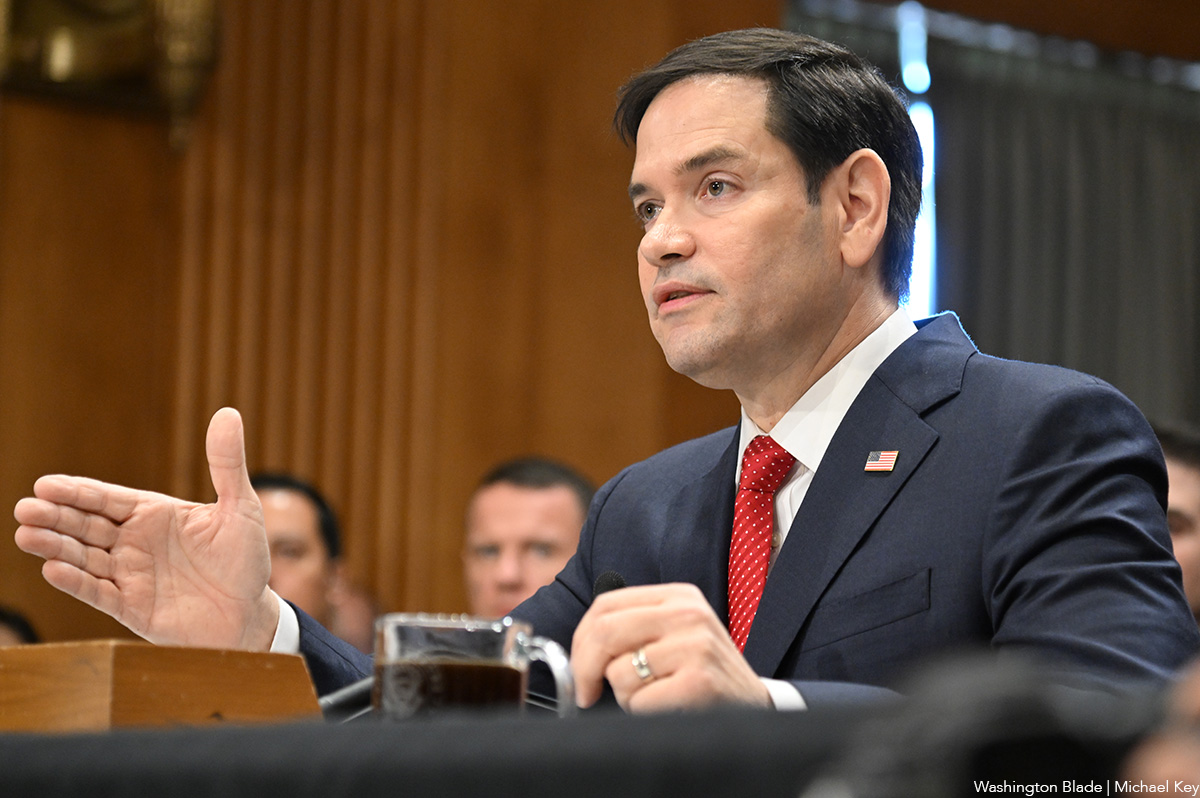
Dumb, dumber, dumbest, and evil. Any of the felon’s Cabinet and close aides could fit these terms depending on the discussion.
You have Commerce Secretary Lutnick saying “no American military were killed in Iran war.” Then it was reported our venal Vice President JD Vance said, “The current hostilities shouldn’t even be called a war, since ‘active combat operations’ ended months ago. Right now, there is no active shooting, Vance insisted. This despite the U.S. and Iran still currently exchanging fire, including around the Strait of Hormuz.
Then the fool-in-chief, the felon in the White House, said about Vance’s comments, “U.S. strikes on Iran are now “intermittent” and a lot of people don’t call it a war. I can understand what he’s saying. I call it a military conflict because it’s small potatoes for us. It’s not a big thing.” All this even though this so called “conflict” has cost U.S. taxpayers more than $37.5 billion and left 18 U.S. service members dead, hundreds injured.
All this after Secretary of State Marco Rubio said, “the Trump administration’s objective in the conflict surrounding the Strait of Hormuz is to restore shipping conditions to what they were before the war with Iran began.” Then self-hating, gay, Secretary of the Treasury, Scott Bessent, chimed in, after two days of meetings with finance ministers from around the world, blaming Ukraine for high oil prices citing “Ukraine’s attacks on Russia’s oil infrastructure as part of the reason for the global energy shock.” These people all belong in an asylum, or jail.
When not talking about the war, as he is losing it badly, the felon-in-chief talks BS at a rally in Texas. Then he talks about redesigning Washington. Lutnick, speaking at a judicial hearing on whether Trump can put his name on the National Monument honoring JFK, said, “Donald Trump is the most credible person in the world” while arguing that the Kennedy Center should bear his name because he’s vowed to raise the funds to renovate it. That, even though the funds were approved by Congress and not raised by Trump. Then Trump’s tariff war on the world, now focused on Canada, which is screwing the American people, and his believing an Executive Order can get the world to call bodies of water like the Gulf of Mexico, and Lake Ontario, by different names. Or that he can change the name of the Department of Defense, to the Department of War, which only Congress can do. With the help of the fascist sycophants around him, he creates chaos in the world.
He has torn down part of the White House, and tries to build an arch. Spent millions and caused the destruction of the reflecting pool. Some of these things will be undone, others will remain, but his name will go down in history, not on buildings, as the worst president ever. People will laugh at him as they move to remove his name from everything they can, just as New Yorkers did when he was first elected, embarrassed to be associated with him.
Now for any sane person looking at, and listening to, this chaos, it is abundantly clear how embarrassing all this is for the country. It is clear he is moving the nation backwards when it comes to the equality and equity we have fought so hard to accomplish. Our country began with us killing, and taking land, from Native Americans. The founders of our nation 250 years ago only recognized white men. They left out women and Black men. We have spent the past 250 years trying to move forward from that beginning. Trying to live up to the statement in the Declaration of Independence that said, “We hold these truths to be self-evident, that all men are created equal, that they are endowed by their Creator with certain unalienable Rights, that among these are Life, Liberty and the pursuit of Happiness.”
We have come a long way, but still have not been able to add women’s equality to our Constitution. But Trump, along with his fascist aides and sycophants in Congress, is trying his best to undo all we have accomplished in those 250 years. Trying either to take away the right to vote, or make it harder to do. They took away the right of women to control their own healthcare, and are making it harder for Black people and the LGBTQ community, to live their lives fully, with dignity and safety. They will accomplish all this, and more, if not enough people come out on Nov. 3 and say, NO MORE. However, if enough decent people vote, we can take back our country, and our future.
Peter Rosenstein is a longtime LGBTQ rights and Democratic Party activist.
Opinions
Gloria Steinem’s life of substance and consequence
Iconic activist never stopped working to make life better for women

Gloria Steinem was an icon, a feminist, a woman of substance and consequence. A rare person who made a difference her entire life; sometimes quietly, sometimes by making noise. She was an incredibly beautiful woman, inside and out.
I heard of Gloria Steinem and admired her for all she was doing. But that was from a distance. I read about her, and saw her on TV. It was 1963 when Steinem wrote and published her undercover Playboy Bunny exposé, “A Bunny’s Tale,” about her going undercover at New York’s Playboy Club. Her account revealed the physical toll, exploitative conditions, and pervasive sexism faced by the women employed there, challenging the magazine’s image of empowerment.
It was 1972 when I first met her in person. That first meeting happened while I was campaigning for Bella Abzug (D-N.Y.) at a street rally. I said “Hello, Ms. Steinem,” and she said “It’s OK to call me Gloria.” I was honored to do so.
Gloria was there to support her friend. Bella had been through a grueling primary against Bill Ryan, after being redistricted out of her seat. She lost, but then Bill died of cancer before the election, and Bella was named the Democratic candidate in the general election for New York’s 20th congressional district. When Bella won that race, I went to work for her full time. It gave me the chance to meet Gloria again a number of times after that, once even with Bella at her apartment. While she was one of the many famous people I met while working for Bella, she was different. She wasn’t Hollywood. She began her career as a reporter, and worked hard for all she believed in. She was a true activist. That was what she saw herself as. She could say she came by the activism gene from her paternal grandmother, Pauline Perlmutter Steinem who Wikipedia reported, “chaired the educational committee of the National Woman Suffrage Association and was a delegate to the 1908 International Council of Women. Also, the first woman to be elected to the Toledo Board of Education and a leader in the movement for vocational education. She helped rescue many members of her family from the Holocaust.”
So yes, in many ways, activism was in Gloria’s genes. She was the one who told me it was OK to call myself a ‘feminist’. That it isn’t only women who can call themselves that, but also men who believed and fought for full social, economic, and political equality of the sexes. She helped me to understand I was brought up by a feminist. My mom, though she never called herself that, was one by dint of how she lived her life, and fought for others.
Gloria never stopped working to make life better for women, and to make sure other women joined her in her activism. In 1969, she co-founded Ms. Magazine. Then in 1971, with Bella Abzug, Betty Friedan and Shirley Chisholm, she founded the National Women’s Political Caucus, which provided training and support for women seeking elected and appointed office. Then in the same year she co-founded the Women’s Action Alliance, which until 1997 supported a network of feminist activists and worked to advance feminist causes and legislation.
Gloria would hold other women to task if they didn’t speak out, even at difficult times, but always with love. In 1986, Bella’s husband Martin died at the young age of 69. We were at the funeral home the night before the funeral, and Bella was sitting with some of us, and saying she didn’t know what she would do without Martin. It had been a true love affair. She was saying things like she didn’t even know where the checkbook was, what their rent was, etc., because Martin handled all that. Well Gloria overheard this and came over and said to Bella, “Don’t you dare say that in public, women look up to you as a feminist, as independent, you can’t say that.” And we all laughed, even Bella, as did Gloria, but she was serious.
Then in the 1990s Gloria helped to establish what she called ‘Take Our Daughters to Work Day.’ She did this to try to have young girls learn about future career opportunities. But her work wasn’t done and in 2005, along with Jane Fonda and Robin Morgan, she co-founded the Women’s Media Center. It is an organization that “works to make women visible and powerful in the media.”
The last time I saw Gloria was at the opening night of “Gloria: A Life,” at Theatre J in D.C. She was 88, as beautiful, and sharp as ever, having just come back from a speaking engagement in some far-off country.
Gloria, the world will miss you, RIP.
Peter Rosenstein is a longtime LGBTQ rights and Democratic Party activist.
Commentary
Anti-science, anti-LGBTQ movements go hand in hand
HHS under RFK Jr. has blocked gender-affirming care for youth

A newborn baby died after contracting measles in Pennsylvania last month, and, as if it wasn’t enough grief for his parents, anti-vax activists are trying to track down and harass his family. Apparently, Gov. Josh Shapiro tangled with Robert F. Kennedy Jr. over his “inaccurate and misleading claims.”
On Aug. 26, RFK Jr., the secretary of the U.S. Department of Health and Human Services, declared that the deaths could be fabricated. We live in peculiar times, when it is government officials, not freaks on the internet, who are spreading conspiracy theories. The new spread of measles in the United States since Donald Trump came to power is one of the most shameful parts of the story of modern American politics, and the tragedy of parents who lost their baby because more and more people refused to vaccinate may seem absolutely unrelated to LGBTQ rights, but actually, there is a pretty solid connection.
Because RFK Jr., the same man who was fighting vaccination, promoted the false idea that vaccines caused autism, and even curated the anti-vaccine organization Children’s Health Defense before going into politics, is also a known opponent of transgender rights. Under his “leadership,” gender-affirming care for trans minors was banned, and there were also created new healthcare guidelines recognizing only two genders.
All around the globe, there is a weird correlation between anti-LGBTQ — particularly anti-trans — ideas and anti-science movements. And it should be clearer to the general public. People who are speaking against LGBTQ rights are not just threatening minorities. They are a danger to everyone.
The Trump-Vance administration is an iconic example of such tendencies.
Trump himself is a known critic of modern scientific studies — for example, believing in the same anti-vax conspiracies that Kennedy promoted, and showing obvious skepticism that global warming exists, despite all the evidence that has been shown by climatologists. And he is also a man who used trans people as boogeymen. Under his command, trans people were kicked out of the military. And even worse, recently he made an extremely chilling statement about the 2026 midterm elections, urging voters to “pretend I’m on the ballot” and vote for Republicans, and while discussing what he says is at stake, he said that if Republicans win, “transgenderism” will “end.” This is an offensive statement at best and genocidal at worst.
And, of course, I think everyone remembers the Department of Government Efficiency (DOGE), which was led by infamous billionaire Elon Musk, who announced to the world that he would destroy the “woke mind virus” that killed his child just because his trans daughter, Vivian Wilson, well, is happy to be a trans person.
DOGE is known not just for cancelling academic research around LGBTQ studies and gender studies. No, this agency abruptly canceled and froze thousands of federal science, research, and health grants, attacking such vital health programs as cancer research, vaccination research, and diabetes research, among others. As you can see, they are not just attacking people who are “affected” by the “mind” virus — they are dangerous to everyone, even if most of the public standing of Musk was around his anti-trans politics and he tried to present himself as a pro-science, pro-progress man by supporting the space industry.
An even more vivid example is the so-called Dark Enlightenment movement.
This extremely reactionary political movement was born in the late 2000s, and originally grew from very democratical classical liberal ideas. Until it became anti-democratic itself. And also often It was created by American software engineer Curtis Yarvin (writing under the pseudonym Mencius Moldbug) and expanded by British philosopher Nick Land. The movement is popular among some Silicon Valley businessmen, and got support from PayPal founder Peter Thiel, and one of their main ideas is that modernity is bad. They are basically obscurantists, who see modern universities as part of “the Cathedral” — a system that, in their opinion, promotes equality and modern science that society doesn’t need. Of course, the movement’s followers are mostly anti-LGBTQ rights, and, as you can see, anti-queerness once again go hand in hand with obscurantism. Unfortunately, the movement got the support of extremely prominent politicians, including U.S. Vice President JD Vance.
In his speech from 2021, Vance proved to be an obscurantist when he claimed that universities are the enemy. He is also a known homophobe and transphobe.
So, why are anti-vaxxers, people who oppose modern scientific studies, and people who hate universities more likely to be queerphobic? Why do the same people who are defending their transphobia by showing that they support common sense actually often show zero such sense when it comes to protecting themselves and their children from measles or decreasing the chances of getting cancer?
We don’t have any statistics or studies that show that all obscurantists are queerphobic, but around the globe, the same dynamic is visible.
In Russian anti-LGBTQ censorship, books about animal biology and zoology have been censored because the censors saw “LGBT propaganda” in them. The famous pro-Putin philosopher Alexander Dugin, who is extremely anti-queer, also speaks up against modernity itself.
In Taliban’s Afghanistan, modern science and LGBTQ rights are attacked at the same time.
Even in the UK, Reform UK is known as the most anti-trans and anti-queer party, and they are facing widespread criticism from scientists and medical experts for promoting climate change denial and anti-vaccine ideas. It doesn’t mean that LGBTQ supporters never believe in conspiracy theories or that progressive politicians always support science.
No, it just means that explicit anti-science and anti-LGBTQ statements often go hand in hand.
I think there are two reasons for this correlation.
First, LGBTQ people are real. You cannot deny that sex is not binary, gender and sex are different, and transition improves the quality of life of actual trans people. Or that same-sex relationships are natural, because even animals have same-sex sexual contacts. To deny it, you need an ideology or a conspiracy theory.
The second reason is that anti-scientific populism and anti-LGBTQ conspiracy theories are popular among the same category of people. It’s a “bundle” of ideas — a trend that conservative voters often adopt together. Studies also show that people who are likely to believe in one conspiracy theory are more likely to believe in another.
But the question is more broad. We don’t speak enough about the harm anti-scientific conspiracy theories and obscurantist politicians around the globe create for mankind in general. Not all people would suffer from a prohibition of hormone therapy, or attacks on same-sex marriage. But anti-global warming ideas, anti-vax advocates, and restrictions on modern research, especially medical research, are potentially dangerous to any human being.
And one of the best things LGBTQ activists could do is just show society that they are being used — that the same people who are stealing LGBTQ rights are also destroying medicine and the environment, and it’s a threat to their own traditional families and future of all kids no less than to queer people.

Trump’s Cabinet: Dumb, dumber, dumbest, and evil

D.C.’s fall theater season is already well underway

More than 150 people detained outside Istanbul courthouse

Gay man sues Delaware AG for not prosecuting partner in domestic violence case

Virginia Anti-Violence Project struggles to fill federal funding gaps

‘Thelma and Louise’ remains landmark of unspoken queer rebellion

Dolly Parton biography puts her hardships into context

PHOTOS: SMYAL Fall Brunch

Fashion icon Bob Mackie dead at 87