Local
D.C. Man charged in murder of gay principal killed
Police say Joel Johnson — charged in 2010 murder of middle school principal — shot in Southeast D.C. while committing armed burglary
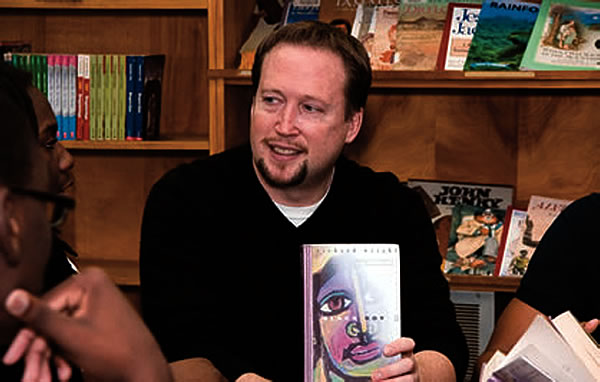
Joel Johnson was one of four charged in the 2010 shooting death of popular Shaw Middle School principal Brian Betts. (Blade file photo)
One of four young men charged in the April 2010 murder of gay D.C. middle school principal Brian Betts was shot to death on Sept. 19 by a man he attempted to rob at gunpoint in the victim’s Southeast Washington apartment, according to D.C. police.
Joel Johnson, 21, died in the apartment from a single gunshot wound to the head 15 months after he was released from prison upon his completion of an 18-month sentence in connection with Betts’ murder.
Montgomery County prosecutors allowed Johnson to plead guilty in 2011 to accessory after the fact, rather than murder, because he wasn’t the one who shot Betts and he cooperated with police and prosecutors.
D.C. police said Johnson and Jaren Holley, 21, each in possession of a handgun, approached a male victim as he was about to enter his apartment on the 4200 block of 1st Street, S.E., about 8:30 p.m. on Sept. 19.
In a statement, police said Johnson and Holley forced their way into the victim’s third floor apartment where the victim and a woman, who was also present in the apartment, lived. The police statement says investigators believe Johnson and Holley were planning to rob the victim.
Once inside, a struggle broke out between Johnson and the man he and Holley attempted to rob, the police statement says.
“During the course of the struggle, the decedent was fatally shot. The other suspect fled the scene,” the statement says.
Members of the D.C. Department of Fire and Emergency Medical Services responded to the scene and determined that Johnson showed no signs of life, according to the statement. It says Johnson was pronounced dead a short time later by a member of the Office of the Chief Medical Examiner.
Police said they apprehended Holley on Sept. 24 and charged him with first-degree burglary while armed.
D.C. police homicide detectives, who were assigned to investigate the case, had not filed any charges against the man who shot Johnson in the apartment. One police source said the investigation would likely determine that the man acted in self-defense.
On the day of the incident, D.C. police identified the dead man as Joel Johnson but didn’t immediately disclose that he was the same Joel Johnson implicated in the Betts murder case. That confirmation came from a spokesperson for the Montgomery County State’s Attorney’s office.
The spokesperson, Ramon Korionoff, told the Blade on Friday that Johnson’s cooperation with police and prosecutors helped authorities obtain a guilty plea of felony first-degree murder from Alante Saunders, the then 19-year-old youth that prosecutors say shot Betts to death inside the bedroom of the popular principal’s Silver Spring, Md., house on April 15, 2010. A judge later sentenced Saunders to 40 years in prison in connection with the Betts murder.
In the weeks following Betts’ murder, Montgomery County police and prosecutors disclosed that Saunders met Betts through a sex chat line that catered to gay men. Police said Saunders contacted Betts through the chat line and expressed an interest in getting together with Betts.
Betts, 42, apparently invited Saunders to his house, police said. As part of a plan to rob Betts, Saunders, Johnson and two others – Deontra Gray and Shariff Lancaster, both 19 — drove to Betts’ house. Prosecutors said Johnson was in the house when Saunders fatally shot Betts in what police described as a “robbery that went bad.”
Police apprehended all four men by tracing their whereabouts when they began making purchases with a credit card they stole from Betts’s houses.
Korionoff said Johnson was sentenced to five years in prison but a judge suspended all but 18 months of the sentence at the recommendation of prosecutors, who persuaded Johnson to plead guilty to the lesser charge as part of a plea bargain arrangement.
Betts had served as principal of D.C.’s Shaw Middle School at the time of his death. D.C. public school officials, who expressed shock and sadness upon learning of his death, described him as a highly acclaimed educator and innovative principal credited with boosting the academic achievement of his school’s students.
On the day Saunders was sentenced to the 40-year prison term an attorney representing Betts’ parents announced that the parents were calling on the U.S. Justice Department to investigate whether Betts’ murder should be classified as an anti-gay hate crime.
In a news conference at the courthouse where Saunders was sentenced, attorney Gloria Allred, who is well known for taking on high-profile celebrity cases, said Betts’ family retained her to explore whether Betts’ murder should be prosecuted under the Matthew Shepard and James Byrd Hate Crimes Prevention Act.
“Brian was a gay man and we believe an investigation should be opened under that law to determine whether a hate crime has or has not been committed by defendant Saunders and if it has whether it is appropriate to proceed with a federal prosecution under that law,” Allred said.
Montgomery County State’s Attorney John McCarthy told reporters at the courthouse that day that his office investigated the possibility that Betts’ murder was a hate crime and could not find evidence to substantiate a hate related motive in the case.
“If we had seen evidence of a hate crime, we would have charged it,” he said.
The Justice Department declined to become involved in the case.
Last week, the Betts family released a statement on Johnson’s death.
“We are deeply saddened that after Joel Johnson was given a second chance to become a productive member of society that he chose to continue to follow a path of crime and self-destruction which ultimately resulted in his death,” the statement says. “The loss of our family member, Brian K. Betts, a beloved educator and inspirational member of the community, has left a void for those who had the privilege to know him that will remain forever. Our sympathy is with the Johnson family at this time.”





District of Columbia
‘Out for McDuffie’ event held at D.C. gay bar
Mayoral candidate cites record of longtime support for LGBTQ rights
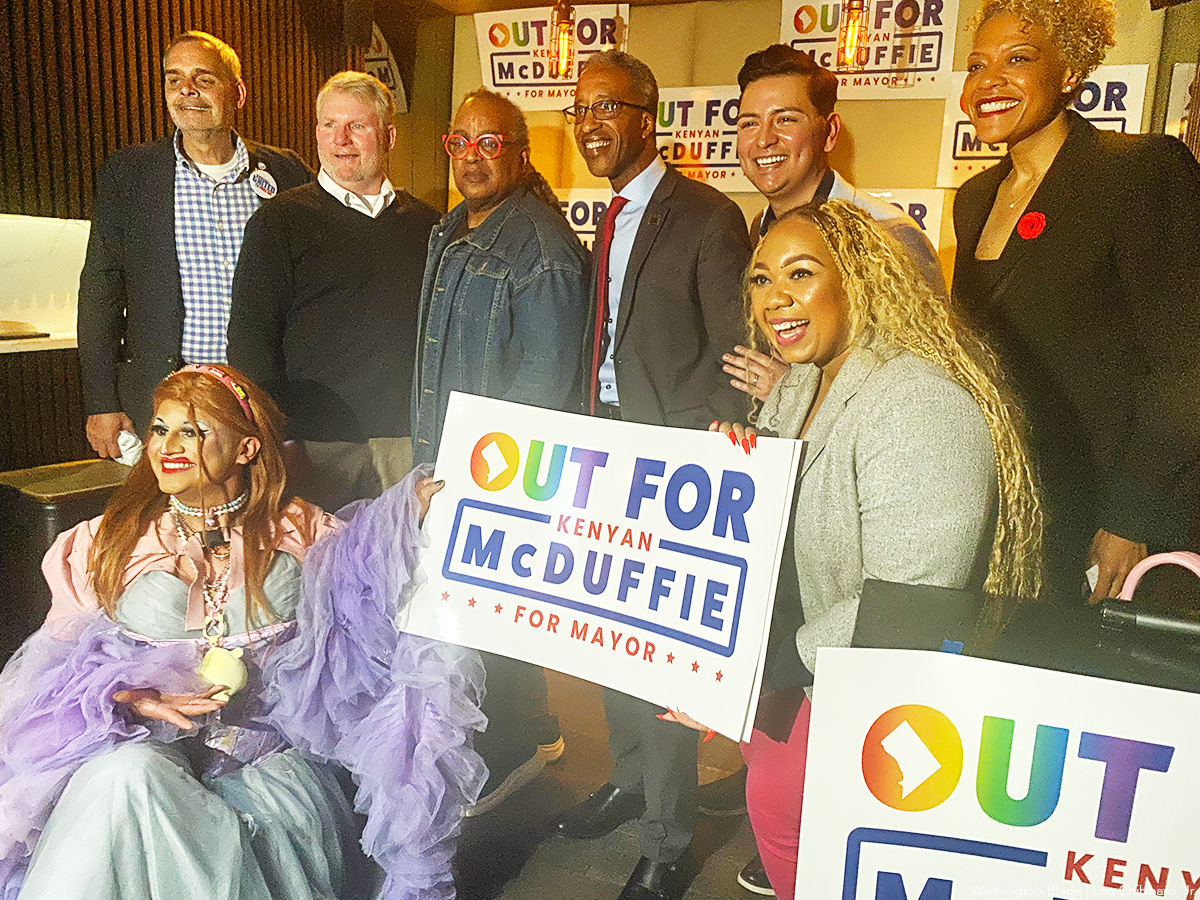
More than 100 people filled the upstairs room of the D.C. gay bar Number 9 on Thursday night, March 26, to listen to D.C. mayoral candidate Kenyan McDuffie at an event promoted as an “Out for McDuffie” meet and greet session.
Several local LGBTQ activists who attended the event said they support McDuffie, a former D.C. Council member, in his run for mayor while others said they had not yet decided whom to vote for in the June 16 D.C. Democratic primary election.
As of March 27, eight other Democrats were competing against McDuffy in the June 16 primary, including D.C. Council member Janeese Lewis George (D-Ward 4), considered McDuffie’s lead opponent. Lewis George also has a record of strong support on LGBTQ issues.
Most political observers consider McDuffie and Lewis George the two lead candidates in the race, with the others having far less name recognition.
The two lead organizers of the Out for McDuffie event were LGBTQ rights advocates Courtney Snowden, a former D.C. deputy mayor in the administration of Mayor Muriel Bowser, and Cesar Toledo, a local LGBTQ youth housing services advocate.
“I’m a candidate for mayor of Washington, D.C. and I’m running for mayor because I love this city,” McDuffie told the gathering after being introduced by Snowden. “And now more than ever we need leadership to take us to the future,” he said, adding that he and his administration would “stand up and fight” against President Donald Trump’s efforts to intervene in local D.C. affairs.
“Our strength is in the 700,000 beautifully diverse residents of Washington, D.C.” he told the gathering. “And as Courtney said, I didn’t just show up and run for mayor and then start saying that I’m going to be an ally for the queer community, for the LGBTQ+ community,” he said, “I’ve lived my entire professional life fighting for justice and fighting for fairness.”
Following his speech, McDuffie told the Washington Blade, “We’re going to fight to protect our LGBTQ+ community every single day. That’s what I’ve spent my career doing, making sure we have a beautifully diverse and inclusive city.”
He remained at Number 9, located at 1435 P St., N.W., for nearly an hour after he spoke, chatting with attendees.
District of Columbia
‘No Kings’ protests set for D.C.
Anti-Trump demonstrations to take place across country on Saturday

As President Donald Trump and his administration escalate rhetoric targeting transgender youth and student athletes, push efforts to restrict voting access for millions of Americans, and pursue foreign policy decisions that critics say bypass congressional authority, organizers across the country are once again mobilizing in protest.
For many LGBTQ advocates, the moment feels especially urgent.
In recent months, activists have pointed to a surge in anti-trans legislation, attacks on gender-affirming care, and efforts to roll back nondiscrimination protections as direct threats to the safety and visibility of queer and trans communities. Organizers say the demonstrations are not just about policy, but about defending the right of LGBTQ people — particularly trans youth and people of color — to live openly and safely.
Thousands of “No Kings” protests are planned nationwide, with multiple demonstrations set to take place in D.C.
One of the primary events, “No Kings Washington,” will be held in Anacostia, an overwhelmingly Black area of D.C. that is often at the center of conversations around racial justice, policing, and access to resources in the nation’s capital.
The protest in Anacostia is focused on what organizers describe as the “power behind the throne,” specifically Stephen Miller, the White House Deputy Chief of Staff for Policy and Homeland Security Advisor. Miller has been closely associated with the administration’s “zero tolerance” immigration policy, including the family separation practice that resulted in thousands of children being separated from their parents at the Southern border.
Activists have also linked immigration enforcement policies to broader concerns about LGBTQ migrants, including queer asylum seekers who often face heightened risks of violence and discrimination both in their home countries and within detention systems.
Anacostia protest details:
Participants are asked to gather starting at 1:30 p.m. on the southeast side of the Frederick Douglass Bridge. The closest Metro station is Anacostia on the Green Line, about an 8-minute walk from the starting point. Organizers strongly encourage attendees to use public transportation, as street parking is limited.
The march will proceed past Fort McNair and conclude near the Waterfront Metro station.
D.C. icon and LGBTQ activist Rayceen Pendarvis is set to speak at the protest around 2 p.m.
Kalorama protest details:
A separate protest will take place earlier in the day in Kalorama, a neighborhood long associated with political power and home to presidents, cabinet officials, and foreign ambassadors. Demonstrators are expected to gather at 10 a.m., with a march running until approximately noon near the intersection of Connecticut Avenue and Kalorama Road.
Arlington/National Mall protest details:
Another group is expected to assemble at Memorial Circle near Arlington National Cemetery at 10 a.m. before crossing the Memorial Bridge into D.C., passing the Lincoln Memorial and continuing on to the Washington Monument. Organizers say the march is intended to defend “American democracy, the rule of law, and a healthy planet.”
Unlike last June — when organizers discouraged large-scale demonstrations in D.C. due Trump’s military/birthday parade — activists are now explicitly calling on people to show up in the nation’s capital and surrounding areas.
The protests also coincide with Transgender Day of Visibility weekend, which includes additional gatherings and celebrations on the National Mall. At the same time, peak bloom for the National Cherry Blossom Festival is expected to draw large crowds to the city. With multiple major events happening simultaneously, officials and organizers anticipate significant congestion, increased traffic, and crowded public transit throughout the weekend.
Organizers are urging participants to plan ahead and come prepared.
“Bring your signs, noisemakers, music, and creative ideas, and gather in joyful, nonviolent protest,” they said. “Children are very welcome.”
For more information, visit nokings.org.
District of Columbia
Gay priest credited with boosting church support for LGBTQ Catholics
Fr. Tom Oddo’s biographer speaks at Dignity Washington event
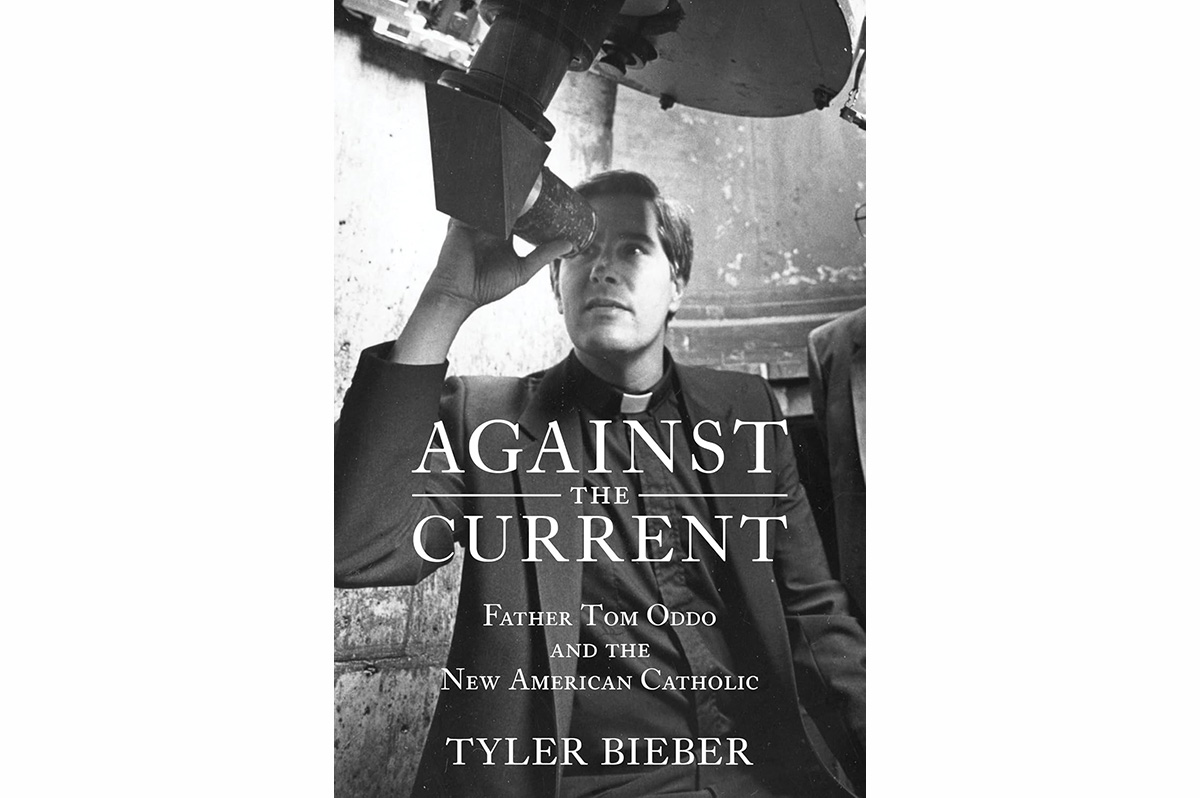
The author of a biography of a U.S. Catholic priest said to have advocated for support by the Catholic Church of gay Catholics in the early 1970s has called Father Thomas ‘Tom’ Oddo a little known but important figure in the LGBTQ rights movement.
Tyler Bieber, author of the recently published book “Against The Current: Father Tom Oddo And the New American Catholic,” told of Oddo’s life and work on behalf of LGBTQ rights at a March 22 talk before the local LGBTQ Catholic group Dignity Washington.
Among Oddo’s important accomplishments, Bieber said, was his role as a co-founder of the national LGBTQ Catholic group Dignity U.S.A. in 1973 at the age of 29.
But as reported in the prologue of his book, Bieber presented details of the sad news that Oddo died in a fatal car crash in 1989 at the age of 45 in Portland, Ore., where he was serving as the highly acclaimed president of the University of Portland, a Catholic institution.
“He was a major figure in the gay rights movement in the 1970s, an unsung hero of that movement,” Bieber told Dignity Washington members, who assembled for his talk in a meeting room at St. Margaret Episcopal Church near Dupont Circle, where they attend their weekly Catholic mass on Sundays.
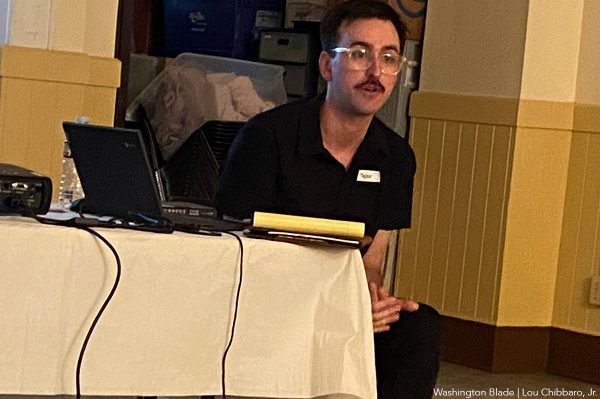
“And Dignity U.S.A. saw intense growth in membership and visibility” during its early years under Oddo’s leadership, Bieber said. “The story of Father Tom and his contemporaries is a story largely untold in the history of the gay rights movement, but one worth knowing and considering,” he said.
As stated in his book, Bieber told the Dignity Washington gathering Oddo was born and raised in a Catholic family on Long Island, N.Y., and attended a Catholic high school in Flushing Queens. It was at that time when he developed an interest in becoming a priest, according to Bieber.
After studying at the University of Notre Dame and completing his religious studies he was ordained as a priest in 1970 and began his work as a priest in the Boston area, Bieber said. It was around that time, Bieber told the Dignity Washington audience, that gay Catholics approached Oddo to seek advice on how they should interact with the Catholic Church. It was also around that time that Oddo became involved in a group supportive of then gay Catholics that later became a Dignity chapter in Boston.
In a development considered unusual for a Catholic priest, Bieber said Oddo in 1973 testified in support of gay rights bill before a committee of the Massachusetts Legislature and collaborated with then Massachusetts gay and lesbian rights advocate Elaine Noble.
In 1982, at the age of 39, Oddo was selected as president of the University of Portland following several years as a college teacher in the Boston area, Bieber’s book states. It says he was seen as a “vibrant and capable administrator who delivered real results to his campus,” adding, “His magnetism was obvious. One student described him as ‘John Kennedyesque’ to the university’s student newspaper.”
Bieber said that although Oddo was less active with Dignity U.S.A. during his tenure as UP president, he continued his support for gay Catholics and what is now referred to as LGBTQ rights.
“For those that knew him prior to his term at UP, though, he represented something greater than an accomplished university administrator and educator,” Bieber’s book states. “He was a new kind of priest, a gay man living and ministering in a world set loose from tradition by the Second Vatican Council,” the book says.
It was referring to the Vatican gathering of worldwide Catholic leaders from 1962 to 1965 concluding under Pope Paul VI that church observers say modernized church practices to allow far greater participation by the laity and opened the way for sympathetic consideration of gay Catholics.

Ghanaian president welcomed to Philadelphia amid backlash over anti-LGBTQ bill

PHOTOS: ‘No Kings’ rally and march

‘Out for McDuffie’ event held at D.C. gay bar

‘Jonah’ an undeniably compelling but unusual memory play

The Oscar-losing performance that’s too good to miss

Menaka Guruswamy celebrated as India’s first openly LGBTQ MP

Pa. House passes bill to codify marriage equality in state law

DeSantis signs emergency bill that restores Fla. ADAP funding

Introducing the Torchbearers Awards honoring queer, trans women and nonbinary people

New IOC policy bans trans women from Olympics
-

 India5 days ago
Menaka Guruswamy celebrated as India’s first openly LGBTQ MP
-
Pennsylvania4 days ago
Pa. House passes bill to codify marriage equality in state law
-
Florida5 days ago
DeSantis signs emergency bill that restores Fla. ADAP funding
-
a&e features4 days ago
Introducing the Torchbearers Awards honoring queer, trans women and nonbinary people