Local
A home for Norman
D.C. couple finalizes family in ‘Adoption Day’ program
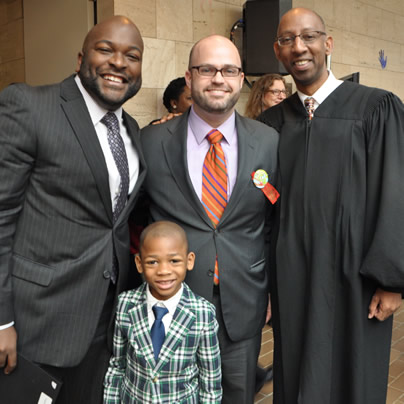
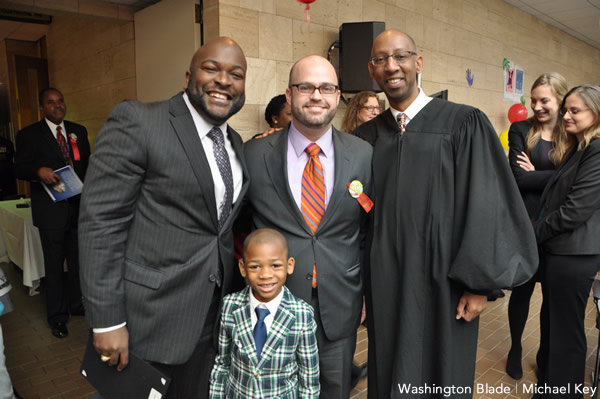
Chad Copeland, Scooter Ward and their son, Norman Moore with Judge Noel Johnson at an adoption day proceeding last weekend in D.C. Superior Court. (Washington Blade photo by Michael Key)
Norman Moore loves “Dora the Explorer,” playing Legos and macaroni and cheese.
“Give him those, and he’d be just fine,” his dad, Chad Copeland, says.
His other dad, Scooter Ward, calls Norman, 5, “quite an actor” and “a big ham.”
He also, “likes to be a teacher,” Ward says. “Loves to show you how to do something.”
The three of them, together since Norman was placed with them as a foster son in January 2011, became a permanent family unit last weekend when Judge Lee Satterfield of D.C. Superior Court signed their adoption decree. Of the 34 children adopted last weekend in D.C., five were to gay male couples.
“It’s ceremonial but also a legal proceeding,” Copeland, 36, a D.C. assistant attorney general, says. “Each family and child is called up and you go up with any close friends or family you have with you and a small speech is made.”
Ward says it was an emotional end to a very long process.
“I was kind of thinking beforehand, ‘Oh, it’s no big deal, he’s been with us almost two years, blah blah blah, but then about an hour into it, I started to get pretty emotional,” he says. “I started to really think about how long the journey has been and even though it’s been relatively smooth in a lot of ways, it’s also been very hard in some ways as well. There were many points along the way where things came up that could have changed the outcome, so knowing we’ve overcome all that was really amazing.”
For his part, Norman, who calls Copeland “Dad” and Ward “Pops,” says he was “happy when the lady called my name.” He also says he “got lots of goodies.”
Copeland and Ward have a D.C. domestic partnership. They met at a Human Rights Campaign fundraiser in Dallas, where they formerly lived (though neither are from Texas). They’ve been together almost seven years and have lived together about five years. After starting their relationship in Texas, Ward moved to Washington for a job in 2006. Copeland followed in 2007. Copeland is adopted himself, so they talked fairly early in their relationship about the possibility of adopting.
Working with D.C.’s Child and Family Services Agency, the couple took a licensing course and within about four months, Norman came to live with them. He had been born in D.C. but the couple declines to go into details about his biological family or situation.
“He was just a pretty normal kid who was in a situation where he could not be cared for the way he needed to be,” Copeland says.
Although there were some long nights and an inevitable adjustment period for everyone, the couple says for the most part, it “just clicked.”
“We were extremely tired,” Ward says. “We’d both been kind of extreme night owls before and we’d suddenly have family and friends calling us at, like, 10 at night and we’d be ready for bed … but in many ways it was a very organic change.”
Ward, 35, took a few weeks off from his job as a project manager for a D.C.-based software company, but Norman had already been in preschool, so neither parent had to give up his career.
Both say their being gay was never an issue in the adoption.
Copeland says he knew from his legal work — he’d worked on cases involving anti-gay Maryland minister Rev. Harry Jackson who’d sued the District — that D.C.’s Human Rights Act of 1977 is solid.
“I fully understood the breadth of protection that exists within the law,” he says. “I didn’t anticipate a problem and we never once had a single problem.”
Ward says he was bracing himself just in case.
“As a bi-racial gay couple, I kind of expected there to be a different layer there or something, some level of strife, but we never had any problems at all. It was almost a bit of a let down — I wanted to be advocate for something, but that says a lot of great things about where we live that it wasn’t.”
There was a chance early on, that Norman may have returned to his biological family.
“That’s usually the initial goal in a foster care situation,” Copeland says. “It would have been very hard because he really is just the sweetest little boy and it was very easy to just get so attached to him. There were certainly moments where we may never have made it to adoption, but our social workers were always there to help us understand the next steps.”
The couple praises the D.C. staff they worked with throughout — social workers LaTasha McKinley and Sarah McDonald and also Mallory Martin of the Children’s Law Center who acted on Norman’s behalf.
It all sounds so perfect — surely there were some struggles for the new family, right?
The couple says the hardest part was the element of so much being unknown at the outset.
“We were just foster parents for a long time,” Ward says. “We had no idea what the next court hearing could bring. There was a lot of pandering and stress and emotion and I don’t want to discount that. There’s a lot of emotion tied to it.”
But it did all work out. The family is in Dallas this week for Thanksgiving with Ward’s family. Copeland is in his native Louisiana and both say their respective parents were quick to welcome Norman as a grandchild.
“He does everything here he’s not allowed to do at home, which is just how it should be at your grandparents’ house,” Ward says with a chuckle.
On Tuesday this week, Norman spent the day hanging out with “Nana,” Ward’s mother. This wasn’t his first plane ride, Copeland has to remind him. His favorite time in Texas so far has been playing with his cousin, Erica. They’ll have Thanksgiving dinner Thursday at Uncle Tim’s.
Since same-sex marriage is legal in Washington, the couple may eventually wed. They have no immediate plans to, though, and say that wasn’t an issue in the process nor would it have been had they been a straight couple.
Norman is in kindergarten and attends a charter school in D.C.
The couple says he’s doing great overall and they’re often amused by, as Ward puts it, his “amazing level of innocence.”
“He’s very happy to have a home,” Copeland says. “He loves us and is a very sweet and happy boy. Happy is the right word in some ways, but it’s also an insufficient word because there are so many more emotions attached to it. You realize you’ve contributed to something bigger. This little boy had so many obstacles in his path. It’s all just sort of humbling and overwhelming at the same time.”





Maryland
Union leader files assault complaint against gay Md. delegate after fight at early-voting site
Del. Gabriel Acevero, Gino Renne accuse each other of starting confrontation
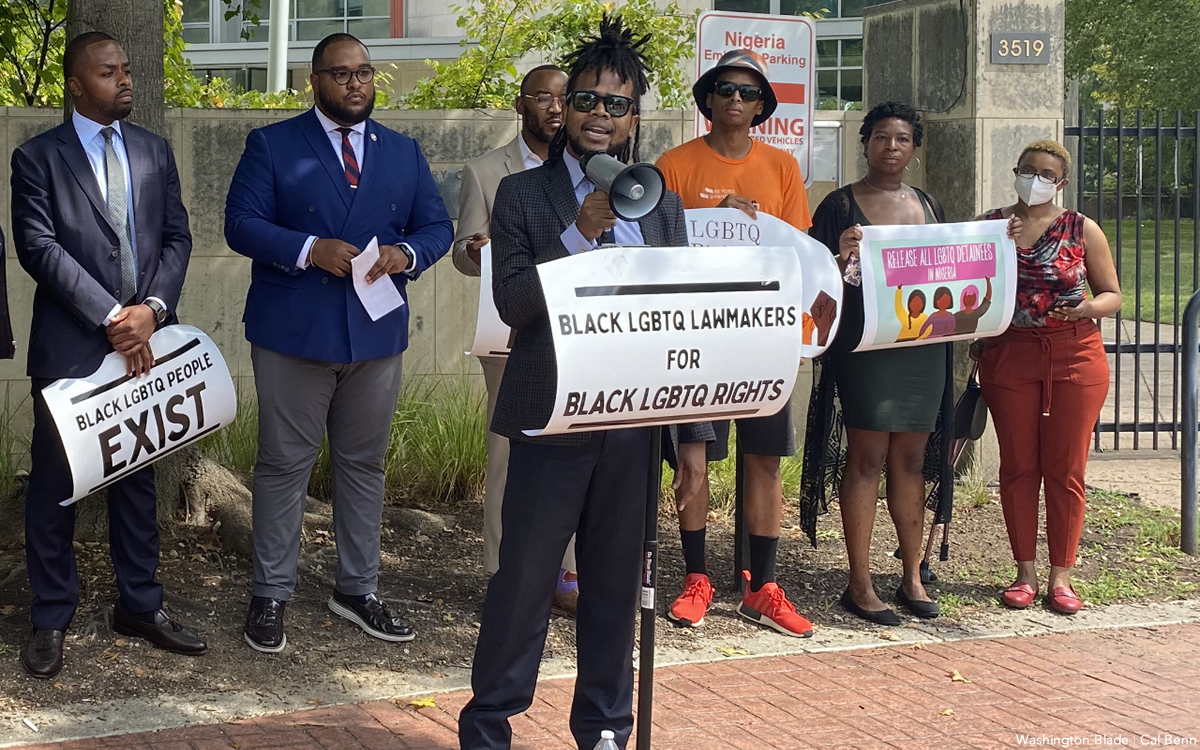
By ANTONIO PLANAS | After a physical confrontation outside an early-voting site Thursday, local union leader Gino Renne filed an assault complaint against Del. Gabriel Acevero, who said he plans to do the same.
Each accuses the other of starting the fight and throwing punches in an incident Thursday at about 6 p.m. at the Bohrer Park Activity Center in Gaithersburg, police said. The park, an early-voting site that day, attracted many candidates and their supporters.
Acevero, 35, is defending his seat representing District 39, which includes Montgomery Village and surrounding areas. The primary is on Tuesday.
The rest of this article can be read on the Baltimore Banner’s website.
Delaware
Delaware guv signs bill to protect children born using assisted reproduction
‘Modernizing laws to better reflect and protect today’s families’

Delaware Gov. Matt Meyer on June 9 signed SB 250, a bill that helps fill the gaps in the state’s parentage law.
SB 250 amends the 2017 Uniform Parentage Act to broaden the state’s legal framework for surrogacy. Prior to SB 250, some children, particularly those born through assisted reproduction or surrogacy, did not have a clear path to a legally recognized relationship with their parents. This created issues around parental decision-making and children’s access to health insurance.
According to the bill’s prime sponsor, Sen. Marie Pinkney, SB 250 ensures that every child in the state has a secure legal relationship with their parents. She said the bill modernizes outdated statutes and strengthens protections for children born through assisted reproduction or surrogacy.
These issues are more likely to affect queer families that rely on assisted reproduction methods to have children. Parentage laws are critical to the well-being of children and the ability of parents to care for them without unnecessary legal barriers.
“Today, we celebrate a victory for all children and families in Delaware. By modernizing its laws to better reflect and protect today’s families, Delaware has set an example for states across the country,” said Jordan Wilson, executive director of COLAGE.
COLAGE is a nonprofit organization dedicated to supporting and empowering youth in LGBTQ+ families through activism and community.
“We are grateful to the many families and advocates who worked tirelessly to advance this legislation, from the bill’s drafters to the COLAGErs who shared their lived experiences directly with lawmakers,” said Wilson.
“Delaware is strongest when the law respects and protects all families,” said Mark Purpura, board member of Equality Delaware, a statewide organization focused on promoting and ensuring dignity, safety, and equality for all LGBTQ+ Delawareans.
The bill’s sponsors and co-sponsors include Sen. Pinkney, Rep. Krista Griffith, Sens. Russ Huxtable, Raymond Seigfried, and David Sokola; and Reps. Alonna Berry, Mara Gorman, Kerri Harris, Eric Morrison, DeShanna Neal, Sophie Phillips, and Cyndie Romer.
Rehoboth Beach
Rehoboth’s ‘Poodle Beach’ to be honored with historical marker
Delaware Public Archives to hold ceremony June 27
The Delaware Public Archives is set to unveil a new State of Delaware Historical Marker recognizing Rehoboth’s Poodle Beach Saturday, June 27, at 9 a.m. The unveiling will take place at the corner of Prospect Street and the South Boardwalk in Rehoboth Beach, Del.
The unveiling ceremony is free and open to the public and will include remarks from members of the community, government officials, and representatives from the Delaware Public Archives.
Located at the southern end of the boardwalk near Queen Street, Poodle Beach is one of the most famous sections of Rehoboth Beach, having served as a gathering place for the LGBTQ community for decades.
The Delaware Public Archives said that, “The marker recognizes the site’s longstanding role in the social and cultural history of both Rehoboth Beach and the State of Delaware.”
The petition to have Poodle Beach recognized with a historical marker was started by a group of Rehoboth Beach residents in June 2020 and was officially approved in December 2020.
Although the origins of where Poodle Beach got its name are unknown, its history can be traced back to du Pont heiress and well-known lesbian Louisa Carpenter. Carpenter and her LGBTQ group of friends would travel to ‘Carpenter Beach’ toward Dewey Beach in the19 30s and ‘40s.
Over time, the beach grew in popularity and began to be used predominantly by gay men in the following decades. It wasn’t until the ‘80s when the beach spread back toward the boardwalk as people stopped making the journey to Carpenter beach.
Poodle Beach was initially called “Lazy Gay Beach” because gay men got tired of walking so far from the boardwalk to get to Carpenter Beach.
There are multiple theories that explain how the name ‘Poodle Beach’ came to be. One of the most popular is the ‘Two cousin theory’ where it is rumored that a pair of cousins would drive up from Maryland and bring their poodle dogs onto the beach.
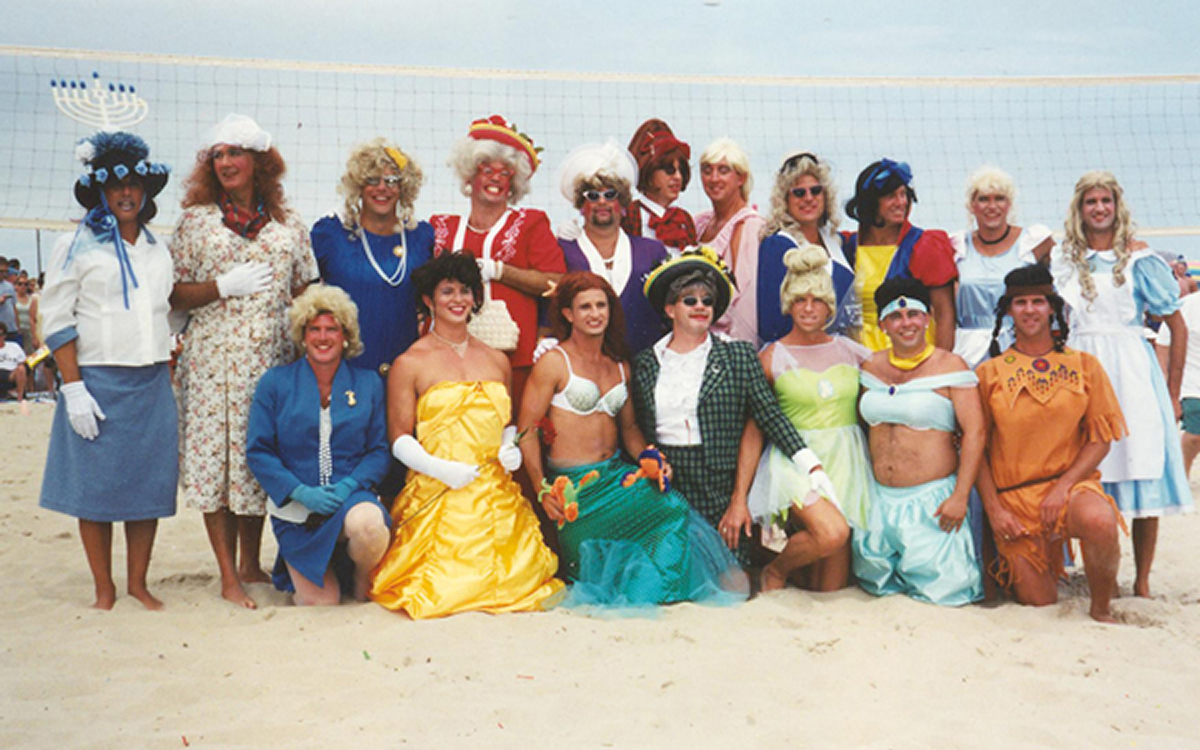
Poodle was also the site of the popular Labor Day weekend drag volleyball games that were started in 1988 and ended with COVID in 2020.

PHOTOS: 2026 Capital Pride Parade

Union leader files assault complaint against gay Md. delegate after fight at early-voting site

‘Feeling Afraid’ explores life of a neurotic stand-up comic

PHOTOS: Baltimore Pride Festival

‘Stop! That! Train!’ is made for fans, but fun for all

War, geopolitical tensions with U.S. overshadow Pride month events

Confronting homophobia at school

Lewis George holds strong lead over McDuffie in D.C. mayor’s race

Netherlands to ban conversion therapy