Advice
Advice: The trouble with apps
Gay couples need several safeguards in place before flirting online

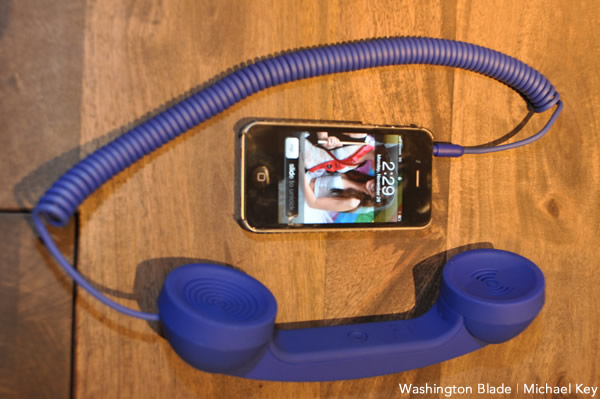
(Washington Blade photo by Michael Key)
Dear Michael,
Thank you for recently addressing hookup apps. While your column focused on single people, I want to know if partnered people can healthily use them.
Ben and I have been dating for several years. At first, we were completely monogamous, but Ben began to resent me for keeping him from having sex with others and we broke up.
I came back into the relationship with an “open” mind, but it seems like Ben has more encounters than I do and prefers to use these apps over having sex with me. He is always on his phone when we’re together and it’s making me feel lousy. I feel like others are getting what I don’t have and what I desperately want: good sex and attention from Ben.
I’ve expressed my feelings with him on this before, but I feel like his desires outweigh his concern for my feelings of jealousy, pain and abandonment. Am I overreacting or is he crossing boundaries that shouldn’t be crossed?
Michael responds:
For partnered people to healthily have an open relationship/use hookup apps, I would say that all of the following must be in place:
Both partners agree to the open relationship. People often hook up behind their partner’s back. That’s not an open relationship, that’s cheating. Dishonesty does not make for a healthy relationship, which requires mutual respect and deserved trust.
The hookups are not damaging the relationship. You can make a great case for why your partner should not be bothered by your sexcapades, such as “It’s just sex,” “I don’t love/care about the other guys,” “You have no reason to feel threatened” and “everyone I know is on this app.” But there’s no getting around the fact that your partner may still be jealous or hurt. If your partner is bothered by your hookups, they are damaging your relationship.
The hookups are not negatively impacting the partners’ sex life with each other. Because newness is exciting, a cute guy on an app will probably register as more alluring than your partner of four years. So if you’re sexually bored with your partner, hooking up with app guy may seem like a great, easy way to add excitement and passion to your life. But going this route makes it unlikely that you will put in an earnest effort to improve sex with your long-term partner. And that’s a big negative impact.
You are able to use the app without getting addicted to it. Good luck avoiding this. As I wrote in my previous column, addiction to hookup apps, once you start using them, is extremely likely, because these apps are inherently addictive.
Handing your question back to you: Do you think that in your relationship, hookup apps are being used in a healthy way?
It is worth your getting clear about why you decided to come back to Ben after breaking up. I do not get any sense that you actually had made your peace with Ben’s desire for a more open relationship, because this issue continues to cause you great distress. Nor, obviously, did the two of you come to any resolution over how to handle this important difference, because it is still a deep fault line down the middle of your relationship.
When you sidestep huge issues, such as how you will structure your relationship, you are just kicking them down the road. Now the day of reckoning is here and you have an important opportunity to figure out your standards around how you do and do not want to live. Is your bottom line a relationship with more together time and less app/hookup time? Letting Ben know what you are willing to live with and what you are not willing to live with will be far more powerful than protesting that your feelings are being hurt or trying to guilt him into changing his behavior, while living with resentment.
But remember that no matter what you would like, Ben may choose to spend as much time on his apps, and hooking up, as he wishes. So you may not get the relationship that you want with Ben.
Michael Radkowsky, Psy.D. is a licensed psychologist who works with gay couples and individuals in D.C. He can be found online at personalgrowthzone.com. All identifying information in the questions has been changed for reasons of confidentiality. Have a question? Send it to [email protected].






Advice
I’m a 64-year-old single gay man and I hate my life
How can I turn things around before it’s too late?

Dear Michael,
I’m a 64-year-old single gay man and I hate my life.
I’ve never had a relationship that lasted more than a few months. I can’t say why. I don’t think I’m defective. I wasn’t unattractive when I was younger (still not bad looking), I think I’m an interesting person to spend time with, but everything always seemed to fizzle out.
Thankfully, I missed AIDS because I came out after people knew what to do. Sometimes I wonder if fear of contracting the virus metastasized into a fear of getting close. I don’t know. I don’t think I’ve consciously kept people away. Consciously I have wanted someone to share my life with, very much.
With my 65th birthday and official senior citizen status approaching, I’ve been taking stock of my life and am coming to the hard realization that I’m never going to find that elusive partner.
I don’t go out anymore because people look right through me, except the ones who have a fetish for older guys. No one’s actually interested in me as me, a unique person rather than what they see on the surface.
I’m tired of my coupled friends. They’re always talking about “we.” Yes, I have become resentful that they have what I want and will never get. I know that’s not admirable but it’s how I feel, secretly, and I am sick of feeling like this when I am around them. So why be around them?
And I’m tired of my friends who are focused on sex all the time. It just all feels like a waste of time. I don’t get anything from a hookup anymore, they’ve been feeling increasingly meaningless. I feel like I’m someone’s momentary opportunity to get off, rather than any kind of real connection.
I’m just sick of the whole chase I’ve been doing for the last 40+ years.
I’m realizing that the whole thing has been pointless, a quest for a partner who is never going to materialize and a lot of diversions along the way that have added up to a despairing feeling that I’ve wasted my life trying to get something that will never happen.
Gay life hasn’t been so gay for me. And I’m officially old, maybe even nearing the finish line. Yes, if you haven’t noticed, I’m getting bitter.
What do I do with this dead end?
Michael replies:
How about looking for a different road to go down?
I’m not going to challenge your belief that you aren’t going to find a partner. I think it’s possible that you could, because there are other guys out there, in your age range, who are looking. But you have no guarantee, especially if you have decided to take it off the table.
So what else can you do with your life? How can you make your remaining time on this earth well-lived?
From your letter, it’s clear what you don’t want to do: Look for a boyfriend, hook up, or spend time with your current friends. Surely there must be more possibilities for your life than those options.
So my advice is to figure out some things you care about and start doing them. Travel? Volunteering? Getting a companion animal? Taking classes? Finding a new career? Those are just a few of the ideas I can come up with, but I don’t know you. What ideas can you generate, that you suspect you’d like to pursue?
In other words, start putting one foot in front of the other and go in some new directions that intrigue you enough to explore.
Sitting around feeling miserable does not help you to get anywhere. It keeps you feeling miserable. Sitting around waiting to feel better does not lead you to feel better. What would help you get to a better place would be to start taking action on your own behalf. Always keep in mind that while you are alive, with your faculties intact, you do have the choice to take this step, over and over and over again.
If you give yourself something (or some things) worthwhile to put your focus on, and do your best to shift your focus there whenever you notice that you are lamenting, I’m hopeful you will create a more fulfilling and meaningful life.
I’m also hopeful that if you are spending time doing things that you actually enjoy and that enrich your life, you may find more satisfying companionship than you are experiencing with your current friend group. (And yes, this could include a romantic relationship if you decide to be open to this possibility.)
A brief reply in an advice column can point you in the right direction, but it is likely not enough to sustain and motivate you through a major life overhaul.
Therefore, I suggest that you find a therapist to help you figure out how to move forward and what to move toward; and also to grieve, and put to rest as best you can, the loss of the life you hoped you would have.
I know that transcending the loss of a huge lifelong dream may seem impossible. But working toward this, as best you are able, would help you.
Relatedly, one more thing that I hope you can address with a therapist is your bitterness. I do understand why you feel so bitter, and I also think that it is torquing your life in a downhill direction.
Michael Radkowsky, Psy.D. is a licensed psychologist who works with couples and individuals in D.C., Maryland, Virginia, and New York. He can be found online at michaelradkowsky.com. All identifying information has been changed for reasons of confidentiality. Have a question? Send it to [email protected].

Michael,
I’m 34, and after being on the dating scene for about 12 years, I’m coming to the conclusion that I don’t want to be in a relationship.
I don’t love hanging out with the same person over and over again. I don’t feel all gooey when I’ve been with someone for a while. I run out of things to say, and also, it just gets boring.
I like my space. I don’t like having to share the bathroom or have someone next to me all night, especially when they want to go to sleep holding me. I know that sounds like heaven to a lot of people but it just feels intrusive to me.
It’s a pain to have to compromise what I want to do. When I want to go someplace on vacation, or try a restaurant, or get up early to go to the gym, or sleep in, I don’t want to have to run that by someone else and get their OK. Life’s short. I want to do what I want to do.
I feel like we are constantly bombarded with the message to date and find a mate, but I don’t really see the point. I don’t think I’m an introvert—I have a lot of friends—but I also like to spend time by myself and not be accountable to anyone.
When I think about marriage, it seems like a very old-fashioned concept, developed for straight people who want to have children. Historically you needed one person to work and another one to stay home and raise the kids. And you needed to stay together to give your kids two parents and a stable home. I get that.
But if I’m not having kids, what’s the point? I don’t need a husband to have sex. I can and do hook up all the time. It’s so easy to find someone online. And I get to have a lot more variety when I’m single than when I’m dating. Even though my relationships are always open, when I am dating someone, I always hook up a lot less, because I have to worry about the boyfriend’s feelings being hurt if I hook up “too much.”
I know I sound unromantic and maybe selfish but this is how I see it.
My friends are all about having a boyfriend. They think I’m being ridiculous. Can I get another opinion?
Michael replies:
You make great points. Relationships do require us to give up some of our independence. They can feel stifling at times. And when the excitement of a new partner fades, things will at times feel “boring” in all sorts of ways, including sex. You can choose to avoid all of this by remaining single.
But relationships also give us tremendous overlapping opportunities to grow, including:
Being pushed to develop a clear sense of self: When we must constantly decide what we are willing to do or not do as part of a couple; and when our partner inevitably and frequently has interests, values, and priorities that conflict with ours, then we are challenged, over and over, to decide what is most important to us and how we want to live our lives.
Frequent opportunities to build resilience: All those old issues from our past that get us upset or riled up? We have to work through them so that we can stay (pretty) calm rather than losing our minds when our buttons are pressed.
Improving our ability to have hard conversations – and without rancor: Unless we’re able to disagree, speak up, or confront when it’s important to do so, we are going to twist ourselves into a pretzel striving to accommodate the other person. And being able to engage in tough talks in a loving way is necessary if we want to have a loving relationship.
Becoming a more generous person: You wrote that you like to have things your way. But part of life, whether or not we are partnered, involves being thoughtful, considerate, and willing to put someone else first at times. Great relationships require us to do all of these things regularly—and many of us find that contributing to the happiness of someone we care about can increase our own happiness.
Besides these ongoing challenges, relationships give us the experience of someone knowing us deeply, and knowing someone deeply. There can be great comfort in going through life with someone with whom we have this intimate connection, along with ongoing shared experiences of trust, support, comfort, and love. Long-term companionship is also an adventure: Can we keep the relationship vibrant and fun as we both keep changing over time?
If you choose to remain single: Many people play their friendships on the easy setting, keeping things pleasant, on-the-surface, and non-confrontational; and cutting people off when things aren’t going well. Hanging in there to deal with the rough stuff can lead to deeper, longer friendships, and plenty of personal growth.
I do have a question for you: I am curious what sort of relationships you saw growing up, and what your own relationship experiences have been.
Intimate relationships aren’t for everyone, and you get to decide what is right for you. But if your negative view of relationships is influenced by having witnessed or experienced intrusive or just plain awful relationships, maybe you want to do some work (therapy, for example) to heal from this stuff, rather than letting your past limit your future. A healthy relationship means being part of a couple while also remaining a vibrant individual, not being stifled, bored, and losing your independence.
(Michael Radkowsky, Psy.D. is a licensed psychologist who works with couples and individuals in D.C., Maryland, Virginia, and New York. He can be found online at michaelradkowsky.com. All identifying information has been changed for reasons of confidentiality. Have a question? Send it to [email protected].)
Advice
My family voted for Trump and I cut off contact
Now my father is ill and I don’t know what to do

Dear Michael,
I stopped talking to my family last year because they all voted for Trump. It’s not like they didn’t know whom they were voting for — they’d already had four years of seeing him in action.
I decided that I couldn’t remain in contact with people whom I felt wanted to take away my rights as a gay man. That is what they essentially did by voting for Trump.
They had come to my wedding in 2012, they had welcomed my husband and me into their homes for the holidays for our entire relationship, so I couldn’t believe how little they actually cared about me and my community. I was profoundly hurt.
They’ve reached out but I have been too angry at their hypocrisy to engage in more than a perfunctory way. I miss them, sure, but as I’ve watched our community be attacked, I just get so angry that I don’t want to talk. I certainly don’t want to hear them justify bigotry and hatred.
Now one of my siblings has reached out to let me know that my father’s health is rapidly declining. I’m wondering if I should rethink my decision and reach out to him, maybe even visit, before he dies.
But then I think of ICE’s attack on our country and the removal of the Pride flag from Stonewall and I don’t want to talk to people who support what is happening to vulnerable, marginalized people and the LGBTQ community.
My father was a good father to me. Even when I first came out to him, he was loving and supportive. I can’t square his behavior personally toward me with his support of this regime. The hypocrisy makes me so angry. How could he purport to love me and then vote against my freedoms?
I would love some suggestions about how to square my two opposing viewpoints.
Michael replies:
Many years ago, a great mentor taught me that the one thing you can count on in a relationship is learning to tolerate disappointment: Both being a disappointment, and being disappointed in the other person. This is true for love relationships and it’s also true for other significant relationships. All of us are different in some major ways and so we are bound at times to disappoint our loved ones in major ways, and to be disappointed by them in major ways.
That is why I’m not a fan of purity tests. To expect that someone must think like you (much less vote like you) in order for you to have a relationship with them is unrealistic, impractical, and sometimes damaging.
Of course, a person may hold some beliefs that give you reason not to want to have any connection to them. But is that the case here?
From your description, your family has always been loving and supportive of you as a gay man. That is no small thing. They seem to care about you enough to have continued to reach out, even though you have stopped talking to them.
Perhaps they had some other reasons for voting as they did, other than to roll back LGBTQ rights and to attack immigrants.
Instead of wondering how they could be so hypocritical, how about talking with them and striving to understand their choices? I don’t know what they will say, and you may hear different answers from your various family members. But at least you will get some clarity, rather than presuming that they made their voting choices from a place of malice. Then you will be in a better position to decide if you want a relationship going forward.
Another point to consider: Very few things are set in stone. Even if your family made their voting choices based on holding positions that you neither like nor respect, they may be open to shifting their views over time. One way to perhaps influence their thinking is by engaging with them, sharing your thoughts, and asking them to consider the possible consequences of their actions. If you choose to re-engage with them, two points to consider:
First, don’t expect that you will change their minds. You can advocate for what you want, but you have to let go of the results.
Second, they are more likely to consider your points if you do not approach them from a judgmental, self-righteous stance.
Many years ago, when I was newly a vegetarian, I was eager to challenge and “educate” friends who weren’t following my dietary ideas. Guess what? It didn’t work. Then I got some great advice: A great way to influence others to consider eating fewer animals was to serve them delicious vegetarian food.
The same point is true here. We can’t beat people over the head to agree with us. But if we approach them with some kindness, rather than with the certainty that we hold the moral high ground, we may help them see a bigger picture.
And sometimes, we too may see a bigger picture.
Michael Radkowsky, Psy.D. is a licensed psychologist who works with couples and individuals in D.C., Maryland, Virginia, and New York. He can be found online at michaelradkowsky.com. All identifying information has been changed for reasons of confidentiality. Have a question? Send it to [email protected].

Ghanaian lawmakers approve anti-LGBTQ bill

‘The Stranger’ queers an existentialist classic

Nine Russian LGBTQ groups deemed ‘extremist’ banned

D.C. Pride flag raising ceremony set for June 1

Still marching: Rev. Troy Perry and the ongoing fight for liberation

Bree Fram’s congressional campaign ends but her fight continues

Peppermint made her mark on ‘Drag Race.’ Now, her advocacy is front and center

Why this Black Pride, I ranked Janeese Lewis George #1 for D.C. mayor

From Media Matters to massive queer ragers: the rise of Tara Dikhof

Man accused of threatening to shoot D.C. bar employee after making anti-gay slurs
-

 2026 Midterm Elections3 days ago
Bree Fram’s congressional campaign ends but her fight continues
-
Celebrity News4 days ago
Peppermint made her mark on ‘Drag Race.’ Now, her advocacy is front and center
-
Opinions4 days ago
Why this Black Pride, I ranked Janeese Lewis George #1 for D.C. mayor
-
a&e features4 days ago
From Media Matters to massive queer ragers: the rise of Tara Dikhof