National
Hagel pledges to move ‘expeditiously’ on benefits for gay troops
Defense secretary nominee addresses ongoing Pentagon review
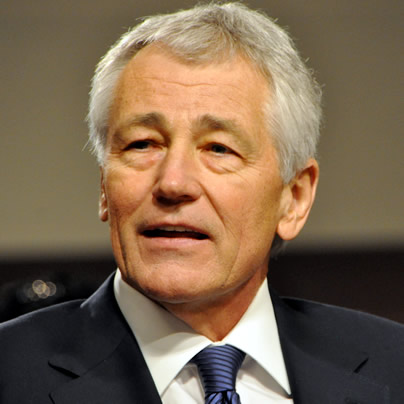
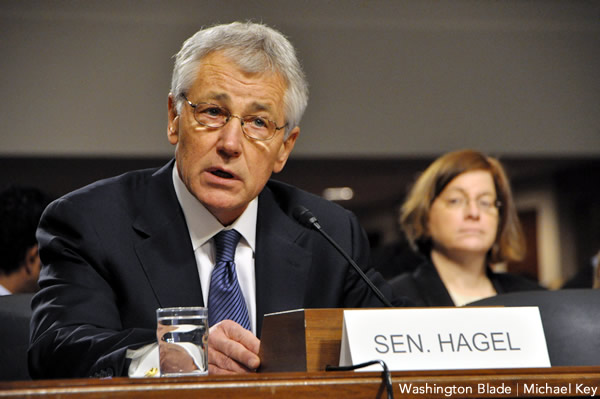
Defense secretary nominee Chuck Hagel faced his confirmation hearing before the Senate on Thursday. (Washington Blade photo by Michael Key)
Former Sen. Chuck Hagel has pledged to “move forward expeditiously” on the issue of extending partner benefits to gay service members if confirmed as defense secretary.
During his confirmation hearing on Thursday before the Senate Armed Services Committee, the Nebraska Republican reiterated his support for open service and said he would do “everything possible” to extend equal benefits to all military families.
“As I’ve discussed with many of you in our meetings, I am fully committed to implementing the repeal of ‘Don’t Ask, Don’t Tell’ and doing everything possible under current law to provide equal benefits to the families of all, all our service members,” Hagel said in his opening statement.
In written responses to committee questions made public on the same day as the hearing, Hagel promised to move “expeditiously” in response to an inquiry on whether he would ensure that the report from the Pentagon benefits review group is expedited and sent to Congress.
“If confirmed, I will work closely with the Department of Defense civilian and military leadership to move forward expeditiously on this issue and will inform the appropriate Congressional committees of decisions as they are made,” Hagel writes.
The U.S. military is prohibited from offering major partner benefits — such as health and pension benefits — to gay troops because of the Defense of Marriage Act and other laws, but other benefits — like military ID cards, joint duty assignments, access to family programs, legal services and housing — could be extended administratively at any time under secretarial directive.
Since the time “Don’t Ask, Don’t Tell” was lifted in September 2011, Pentagon officials have consistently said they’ve been reviewing the benefits that could be extended to gay service members. However, no action has been taken.
Hagel addressed this ongoing review at the Pentagon in response to a question on the status of this report and when the group is expected to produce it.
“I understand that this review is not taking the form of a report, per se, but has involved assembling detailed information on individual benefits (including whether each such benefit might be made available under current law, and options for how to do so) to support decision making by the senior civilian and military leadership of the Department, and also that those decisions are currently under active consideration,” Hagel wrote. “If confirmed, I will review the work that has been undertaken during the course of the benefits review and will work closely with the Department of Defense civilian and military leadership to move forward expeditiously on this issue.”
Allyson Robinson, executive director of the LGBT military group OutServe-SLDN, praised Hagel for promising leadership on issues important to gay service members.
“After two years of equivocation and delay by Pentagon leadership, it is gratifying to see Sen. Hagel show the kind of clear, unambiguous support for our service members and their families we saw today,” Robinson said. “It is an historic day when issues critical to gay and lesbian service members and their families take center stage in a confirmation hearing for Secretary of Defense.”
But LGBT issues related to the military received scant attention during the question-and-answer portion of the hearing, which lasted about eights hours. Republican committee members, such as Sens. Lindsey Graham (R-S.C.) and Ted Cruz (R-Texas), instead focused on past comments Hagel made suggesting that he’s anti-Israel and is lenient on Iran. Democratic senators like Tim Kaine (D-Va.) and Joe Manchin (D-W.V.) drew attention to the fact that Hagel would be the first secretary of defense who once served as an enlisted soldier in the Army.
Other members asked him about military programs important to their states, such as Sen. Angus King (I-Maine), who asked Hagel about his commitment to naval programs and cyber warfare.
But in some portions, LGBT issues were referenced. Sen. Kirsten Gillibrand (D-N.Y.) said she needs a “strong commitment” from Hagel that he’ll work to extend partner benefits for gay service members —in addition to confronting sexual assault against women, referencing reports that there are 19,000 such incidents in the military each year — and said the status quo won’t be acceptable.
“Well, you have my complete commitment on that,” Hagel said. “I’ve made that commitment to members of the committee that I’ve spoken to. I mentioned that point in my opening statement, if you recall.”
Gillibrand said she had already spoken to Hagel privately about these issues and was submitting a question to him for the record.
Another point of discussion relevant to LGBT service members took place when Sen. Mark Udall (D-Colo.) asked about the “conscience” provision that was signed into law as part of the Fiscal Year 2013 Defense Authorization Act and whether Hagel would ensure that language won’t lead to discrimination against gay troops.
“Absolutely,” Hagel replied. “I will faithfully and diligently enforce our laws. All men and women deserve the same rights, and I can assure you that would be a high priority.”
But that response seemed to trouble Sen. Roger Wicker (R-Miss), who followed up at the start of his questioning by asking Hagel whether he believes a military chaplain can opt out of officiating over same-sex weddings. Hagel at first noted that same-sex marriage is legal in nine states, but Wicker sought additional clarification over whether a chaplain could bow out of those ceremonies.
“Certainly,” Hagel replied. “But what we don’t want, though — Sen. Udall’s point is — someone being denied to be married in a chapel or a facility.”
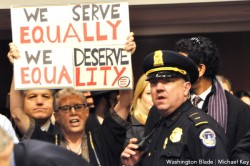
Protester at the Senate Armed Services Committee hearing (Washington Blade photo by Michael Key)
Prior to the start of the hearing, a female protester apparently affiliated with GetEQUAL held a sign, reading, “We Serve Equally; We Deserve Equality,” and shouted at Hagel to make good on his promise to extend partner benefits to gay troops. She was escorted out by Capitol Police.
The issue of outstanding benefits for gay troops has received significant attention recently in the wake of a spousal club at the Fort Bragg Army base in North Carolina refusing to admit Ashley Broadway, the spouse of lesbian soldier Lt. Col. Heather Mack. The club, which initially said Broadway was unable to join because she lacked a military ID, ultimately granted Broadway full membership.
Still, groups such as OutServe-SLDN and the Human Rights Campaign have called on outgoing Defense Secretary Leon Panetta to take action on the benefits issue before his retirement.
Earlier this week, Sens. Gillibrand and Jeanne Shaheen, who are both members of the Senate Armed Services Committee, wrote a letter to Panetta asking him to “extend as many benefits as possible to LGBT members’ families.”
“Repeal of ‘Don’t Ask, Don’t Tell’ was a critical step to ensuring our military retains all the best and brightest and does not discriminate against any Americans,” the senators write. “But, the lack of equal benefits undermines those service members whose families are denied the programs offered for military families.”
Hagel’s questionnaire responses build off a commitment he expressed earlier in a Jan. 14 letter to Sen. Barbara Boxer in which he said he supports “Don’t Ask, Don’t Tell” repeal and would “do everything possible to the extent permissible under current law to provide equal benefits to the families of all our service members.”
After the hearing, OutServe-SLDN’s Robinson expressed disappointment in a statement that the issue of non-discrimination for LGBT service members wasn’t addressed. Gay service members currently have no recourse outside of their chain of command for claims of discrimination or harassment based on sexual orientation.
“It’s time for our nation’s military leaders to send a clear message that relegating LGBT service members to second-class status is no longer acceptable,” Robinson said. “If Sen. Hagel is confirmed, he must use his authority to ban discrimination and guarantee equal opportunity for lesbian, gay, bisexual, and transgender members of the military.”
The Hagel nomination has been controversial within the LGBT community because of his poor voting record on LGBT issues while a U.S. senator from Nebraska and because he called then-ambassadorial nominee James Hormel in 1998 “openly aggressively gay.” Hagel has since apologized for the anti-gay remarks and the former ambassador supports his confirmation.
UPDATE: This posting has been edited for clarity and updated with additional comments from Hagel and senators.



The White House
Trump budget would codify expanded global gag rule
Funding for LGBTQ health programs around the world would also be cut

The Trump-Vance administration’s fiscal year 2027 budget would codify the expanded global gag rule and eliminate funding for LGBTQ-specific programs in global health initiatives.
“The budget would ensure no funding supports abortion, unfettered access to birth control, and also eliminates funding for circumcision and lesbian, gay, bisexual, transgender, and queer services to better focus funds on life-saving assistance,” reads the proposed budget the White House released on April 3. “The United States should not pay for the world’s birth control and therapy.”
The proposed budget includes four examples of “eliminated activities.”
- In the last administration, PEPFAR funded health workers who performed over 21 abortions in Mozambique
- Promoting reproductive health education and access to birth control and other harmful programs couched under ‘family planning’ in Ghana
- A supply chain “control tower” to provide a “holistic commercial of the shelf solution” on the Office of Population and Reproductive Health (PRH)
- Promoting health equity and providing condoms and contraception in Kenya.
President Ronald Reagan in 1985 implemented the global gag rule, also known as the “Mexico City” policy, which bans U.S. foreign aid for groups that support abortion and/or offer abortion-related services.
Trump reinstated the rule during his first administration. The Biden-Harris administration shortly after it took office in January 2021 rescinded it.
The Trump-Vance White House earlier this year expanded the global gag rule to ban U.S. foreign aid for groups that promote “gender ideology.” The expansion took effect on Feb. 26.
US funding cuts have devastated global LGBTQ rights movement
The Trump-Vance administration after it took office in January 2025 moved to dismantle the U.S. Agency for International Development, which funded LGBTQ and intersex rights groups around the world. USAID officially shut down on July 1, 2025.
Secretary of State Marco Rubio in March 2025 announced the State Department would administer the 17 percent of USAID contracts that had not been cancelled. Rubio issued a waiver that allowed PEPFAR and other “life-saving humanitarian assistance” programs to continue to operate during the U.S. foreign aid freeze the White House announced shortly after it took office.
The global LGBTQ and intersex rights movement has lost more than an estimated $50 million in funding because of these cuts. The Washington Blade has previously reported PEPFAR-funded programs in Kenya and other African countries have been forced to suspend services and even shut down.
The Trump-Vance administration has signed healthcare-specific agreements with Kenya, Uganda, and other African countries through its American First Global Health Strategy. Advocacy groups with whom the Blade has spoken have expressed concern these partnerships will result in further exclusion and government-sanctioned discrimination based on sexual orientation or gender identity.
The proposed fiscal year 2027 budget includes $5.1 billion for “global health to end the previous administration’s abuse of these programs and to execute (the State Department’s) newly released America First Global Health Strategy.” This figure represents a $4.3 billion cut from the previous year.
“The president’s new vision of bilateral health assistance eliminates bloated Beltway Bandit contracts, does more with fewer dollars, and transitions recipient countries to self-reliance,” reads the proposed budget. “The budget would also eliminate disease-specific accounts and provide the department crucial agility to address the actual needs of each recipient country — across HIV/AIDS and other infectious diseases such as malaria, tuberculosis, and polio — to strengthen global health security and protect Americans from disease.”
“The budget would focus on new compacts that unify funding, achieving economies of scale in both implementation and oversight,” it adds. “Under the prior administration, only about 40 percent of PEPFAR funds supported actual service delivery, including medications, testing, commodities, and health workers, with the remaining 60 percent wasted on duplicative administrative costs, unwieldy supply chains, and layers of endless bureaucracy. The new AFGHS (America First Global Health Strategy) compacts would improve efficiency, cut red tape, and dismantle the bloated ecosystem of foreign assistance profiteers.”
The Council for Global Equality on April 3 reiterated its criticism of the expanded global gag rule, and urged Congress to reject the proposed budget.
“We won’t mince words: people are dying because of this policy,” said the Council for Global Equality in a statement. “Making this policy permanent will only ensure that U.S. foreign assistance discriminates against those who need services the most, all while forcing people around the world to adhere to the Trump administration’s extremist, ideological agenda that denies the very existence of transgender, nonbinary, and intersex persons.”
“We will not be silent as Trump threatens to upend decades of bipartisan foreign assistance programs to appease his extremist base,” added the group. “We call on Congress to immediately reject this budget and block implementation of the expanded global gag rules.”
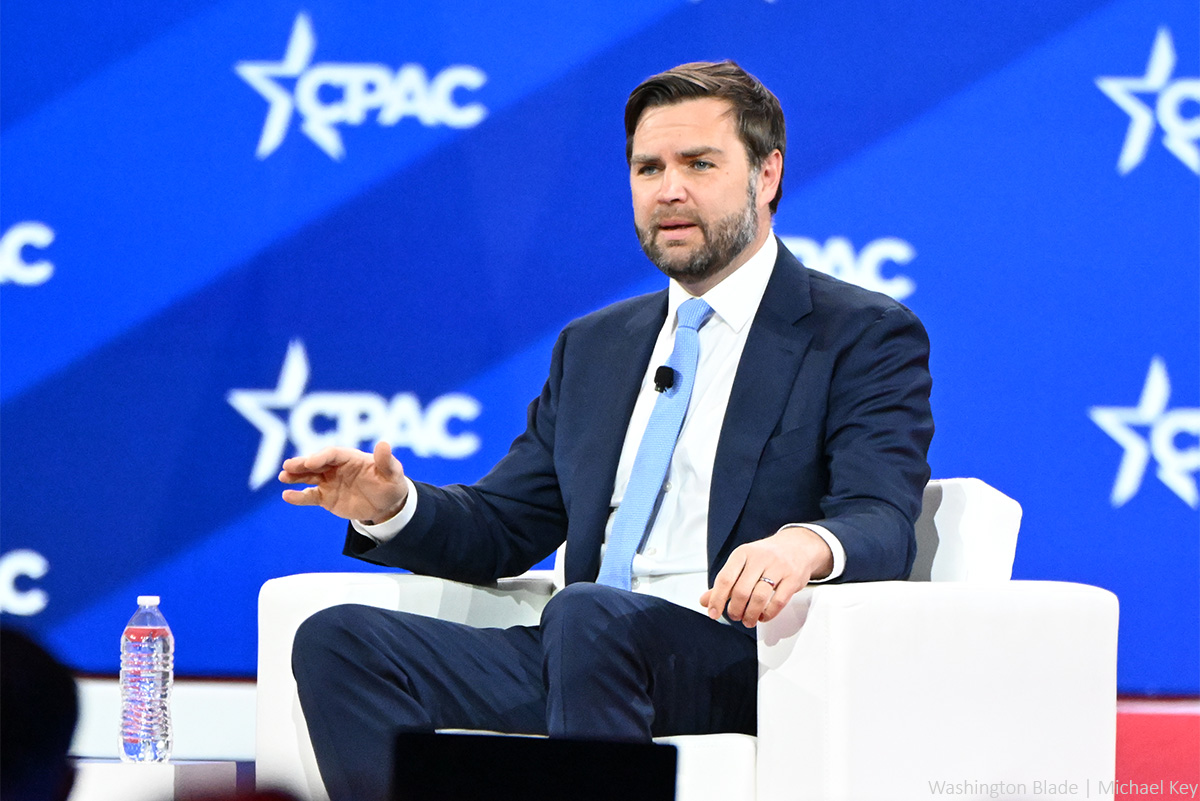
Vice President JD Vance and his wife, second lady Usha Vance, will visit Hungary next week.
An announcement the White House released on Thursday said the Vances will be in Budapest, the Hungarian capital, from April 7-8.
JD Vance “will hold bilateral meetings with” Hungarian Prime Minister Viktor Orbán. The announcement further indicates the vice president “will also deliver remarks on the rich partnership between the United States and Hungary.”
The Vances will travel to Hungary less than a week before the country’s parliamentary elections take place on April 12.
Orbán, who has been in office since 2010, and his Fidesz-KDNP coalition government have faced widespread criticism over its anti-LGBTQ crackdown.
The Associated Press notes polls indicate Orbán is trailing Péter Magyar and his center-right Tisza party.

President Donald Trump removed Attorney General Pam Bondi from her post Thursday, following growing criticism over how she and the Department of Justice handled a range of issues, including matters related to sex offender and Trump ally Jeffrey Epstein.
Trump announced Bondi’s removal on Truth Social, where he also said Todd Blanche will serve as acting head of the Justice Department.
“Pam Bondi is a great American patriot and a loyal friend, who faithfully served as my attorney general over the past year,” Trump wrote on the platform. “Pam did a tremendous job overseeing a massive crackdown on crime across our country, with murders plummeting to their lowest level since 1900.”
Trump was seen as recently as Wednesday with the now-former attorney general at a Supreme Court hearing on citizenship.
The decision contrasts with Trump’s previous public praise of Bondi, the 87th U.S. attorney general and former 37th attorney general of Florida, who served in that role from 2011-2019 before joining the Trump-Vance administration. He has frequently lauded her loyalty and said he speaks with her often. Bondi was also one of president’s defense lawyers during his first impeachment trial.
Privately, however, Trump had grown frustrated that Bondi was not “moving quickly enough” to prosecute critics and political adversaries he wanted to face criminal charges, according to multiple sources. The New York Times reported that her inability to charge former FBI Director James B. Comey and New York Attorney General Letitia James with any crimes is a large factor in the president’s choice to fire her from the government’s primary law enforcement agency.
The move comes as Trump has sought to minimize public turmoil within his administration, avoiding the perception of a revolving-door Cabinet that defined his first term.
Lee Zeldin, a former Republican congressman from New York who unsuccessfully ran for governor, has emerged as a leading contender to lead the Justice Department. He has been one of Trump’s most reliable allies.
“He’s our secret weapon,” Trump said of Zeldin in February during a White House event promoting the coal industry, adding, “He’s getting those approvals done in record-setting time.”
Bondi has also growing faced scrutiny from Congress.
The House Oversight Committee recently subpoenaed her to testify about the department’s handling of certain files, where she declined to answer key questions during a contentious House Judiciary Committee hearing in February.
The Tampa native has a long history of opposing LGBTQ rights through her roles in government. As Florida attorney general, she fought against the legalization of same-sex marriage, arguing it would cause “serious public harm,” pushing forward a legal battle that cost taxpayers nearly half a million dollars. She also asked the Florida Supreme Court to overturn a lower court ruling that found the state’s same-sex marriage ban unconstitutional.
More recently, Bondi established a “Title IX Special Investigations Team” within the Justice Department focused on restricting transgender women and girls from participating in women’s and girls’ sports teams and accessing facilities aligned with their gender identity. She also told Children’s Hospital of Philadelphia to turn over the medical records of anyone under 19 who received gender-affirming care.
Her removal follows Trump’s decision last month to oust another controversial female Cabinet figure, Kristi Noem.

Trump budget would codify expanded global gag rule

D.C. is the place for the Democratic Socialists of America

Key lifestyle changes can help patients cope with diabetes

PHOTOS: The Bonnet Ball

Risking it all for love during World War II

Kristi Noem ‘devastated’ as husband’s alleged fetish spending surfaces

VIDEO: Gay journalist detained for booing Trumps at ‘Chicago’ opening night

Trans-driven ‘Serpent’s Skin’ delivers campy sapphic horror

D.C. not the place for antisemitic Democratic Socialists of America

Pam Bondi ousted as attorney general
-

 The White House5 days ago
Kristi Noem ‘devastated’ as husband’s alleged fetish spending surfaces
-
The White House4 days ago
VIDEO: Gay journalist detained for booing Trumps at ‘Chicago’ opening night
-
Movies4 days ago
Trans-driven ‘Serpent’s Skin’ delivers campy sapphic horror
-
Opinions4 days ago
D.C. not the place for antisemitic Democratic Socialists of America