National
Wyoming DP bill dead
Bill would have extended ‘rights… provided in Wyoming law for immediate family members’ to same-sex partners

Wyoming State Capitol Building (Photo by Babymestizo via Wikimedia Commons)
CHEYENNE, Wyo. — According to the Star-Tribune, a bill that passed out of committee earlier this week that would have extended domestic partnerships to same-sex couples in Wyoming, was voted down before the full house 35-24.
A Senate version of the bill is up for debate soon, but the fate of that bill is now in jeopardy with the House’s rejection.
Lawmakers in the Wyoming House Corporations Committee voted 7-2 to approve a bill that would create a domestic partnership system in the state, after first rejecting a bill that would extend marriage rights to same-sex couples in the state, 5-4.
The bill would have allowed same-sex couples to obtain the “rights, responsibilities, protections and benefits provided in Wyoming law for immediate family members,” according to the text of the bill.



The White House
VIDEO: Gay journalist detained for booing Trumps at ‘Chicago’ opening night
Eugene Ramirez booed first family at Kennedy Center
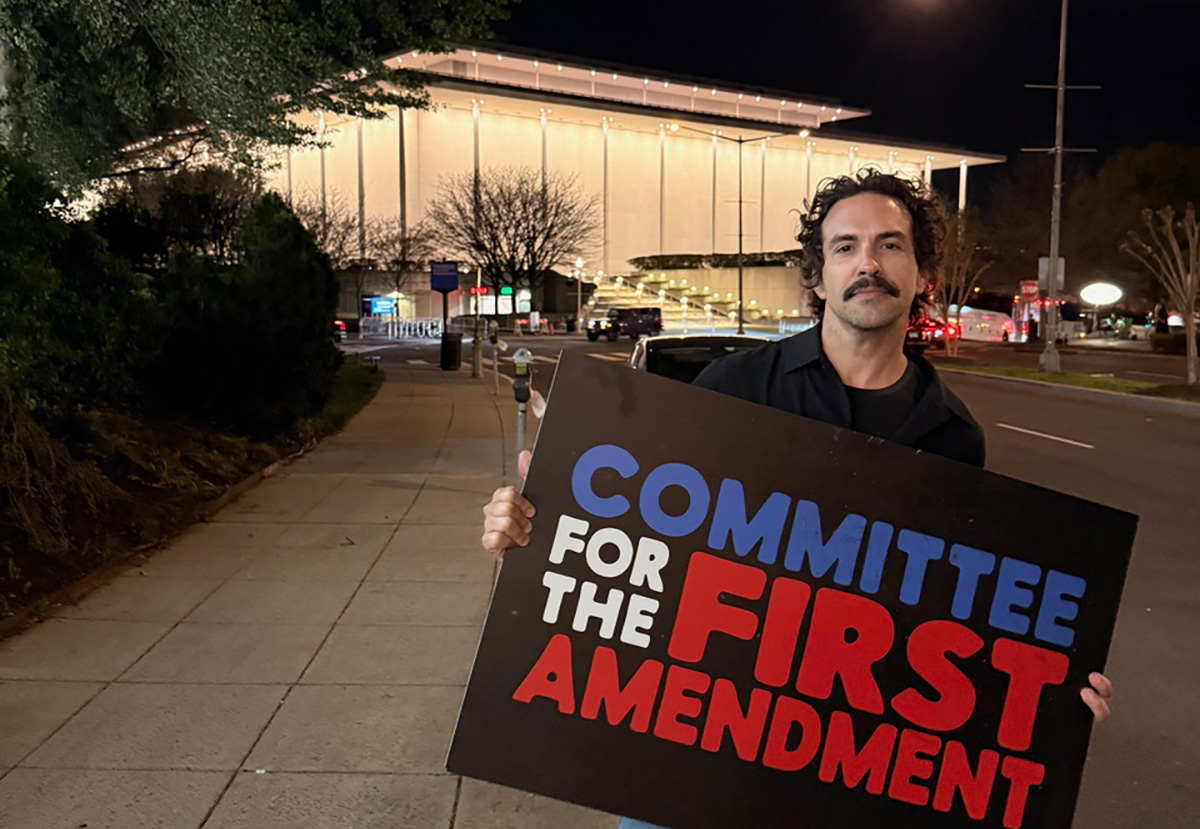
President Donald Trump and first lady Melania Trump attended the opening night of “Chicago” at the John F. Kennedy Center for the Performing Arts on Tuesday. They were greeted by a mix of cheers, applause, and some audible boos.
Among them was Eugene Ramirez, a gay Washington resident, who later shared his account of the night after being briefly detained by security for booing the president and giving a thumbs-down gesture — an expression of what many would call a textbook definition of constitutionally protected speech to criticize the government.
Ramirez attended the opening night performance with a group of friends, hoping to catch a final show before the center undergoes two years of major changes under Trump oversight. The musical, based on a 1926 play of the same name, has become synonymous with Broadway success.
With music by John Kander, lyrics by Fred Ebb, and a book by Ebb and Bob Fosse, “Chicago” has cemented itself as a cultural staple — known for its signature Fosse choreography, stripped-down staging, and sleek, campy aesthetic. The story follows Roxie Hart and Velma Kelly, women who murder their husbands but — with the help of the manipulative, charismatic, and narcissistic attorney Billy Flynn — walk away scot-free.
It remains the longest-running American musical in Broadway history, and its 2002 film adaptation famously won the Academy Award for Best Picture. On this night, however, the production also became the backdrop for a very modern moment of political protest.
“I accompanied five friends to opening night of ‘Chicago’, as a way to enjoy a final performance in the Kennedy Center as we know it,” Ramirez began to recount to the Washington Blade, describing the moment his group settled into their seats inside the ornate Opera House theater.
Just before the performance began, the twice impeached president and first lady appeared in the balcony box, drawing immediate attention from the audience below. Theatergoers stood, cheered, clapped, and waved, while Ramirez made a different choice.
While accounts of the crowd’s reaction have varied, Ramirez said his response was intentional, immediate, and within his rights. Moments after booing and giving a thumbs-down while recording on his iPhone, security intervened.
Above is the video Ramirez took of his booing — eventually leading to his temporary detainment Tuesday night.
“Within moments, the director [of security] and another guard approached and escorted me to a side area where several other security guards were waiting,” he said. “I was detained until everyone was seated and the lights dimmed.”
As he was escorted away, Ramirez said his instincts as a journalist kicked in. A former lead anchor for Sinclair’s national evening news broadcast, he said the situation immediately felt off — or more aptly put — as if he could see the strings being pulled from someone attempting to control the narrative.
“Journalism is a vocation, not just a job. I immediately knew there wasn’t just an uncomfortable interaction with security,” he said. “The Kennedy Center is a federally funded cultural institution, and being questioned about speech related to the president in that setting felt like something the public should know about.”
Ramirez explained the difference between a standard visit by a public official and this performance: the president’s appearance wasn’t just ceremonial; it was very clearly a media moment.
“The White House press pool was there, and it was clear this was an effort to manage the president’s image in the media,” Ramirez continued. “The irony was not lost on me that this was happening on opening night of ‘Chicago’, a musical about manipulating the press to shape public perception.”
According to Ramirez, the explanation he received from Kennedy Center Director of Safety and Security Karles C. Jackson Sr., was brief, but illuminating.
“He said, ‘they don’t want booing,’ and even called out my thumbs-down gesture. He never clarified who ‘they’ were, but whether it was the administration or the Kennedy Center, the distinction felt meaningless,” he explained. “Mr. Jackson ultimately told me he was just trying to do his job, shook my hand, and allowed me to return to my seat once the lights dimmed and the overture started playing.”
Ramirez said he didn’t blame the guard individually, noting the broader context of the Kennedy Center’s uncertain future and the pressures staff were under.
“With the center closing in the coming months, some of these security guards being pressured to restrict our freedom of speech may only have a few weeks of work left.”
He believes the decision to remove him was driven less by disruption than optics, particularly given the presence of the press.
“It was very clearly about protection — whether protecting the president from visible dissent, or his image before the media present. There was no disruption as almost everyone was standing and reacting loudly to the arrival of the president and first lady, with cheers, applause, and hand gestures. The difference was that my reaction, unlike most, was negative.”
Drawing on his experience covering public officials, Ramirez said the incident felt more about controlling perception than security.
“Usually, law enforcement may monitor or intervene if there’s a disruption, but here there was no disruption at all. Simply expressing dissent in a public, cultural space drew the attention of security. It made it feel less like a matter of decorum and more like an effort to control the narrative around the president,” he said. “It’s about what happens when dissent is treated as disruption rather than a right.”
“The show hadn’t started. I threatened no one. Billy Flynn would have approved of the optics. The rest of us should be paying attention.”
Ramirez framed the incident as part of a broader constitutional concern, one that is plaguing the Trump-Vance administration as they continue to reject rules and normalcy set forth by other reserved presidents.
“Being singled out by security at a federally funded institution for expressing dissent shouldn’t be brushed off; it undermines the First Amendment,” he said, looking at it slightly distanced from it now. “Being of Cuban heritage, and a journalist, it’s a right I’m not willing to give up readily.”
“Publicly funded cultural institutions should allow visible dissent, even in politically charged moments,” he added. “Of course, I understand the need to manage disruptions during a performance, but that was not the case here.”
The themes of “Chicago”, a long-running satire about media manipulation and public perception, added another layer of irony to the experience, Ramirez explained.
“The satire truly leapt off the stage! A show about controlling the narrative, manipulating the press, and covering up truths by leaning on showmanship and distractions. The show is decades old, but could’ve been written today. We’re being razzle-dazzled daily and it’s getting harder to tell fact from fiction, no matter where you get your news.”
He, being gay, also acknowledged how hard it must have been for the performers on stage, assuming that at least some in the cast were also members of the LGBTQ community — and artists — two things Trump doesn’t always get along with.
“It was not lost on me that many of the actors on that stage, that the president and first lady presumably applauded, are members of the LGBTQ community which this administration has rolled back protections for under the guise of religious liberty and free speech, resulting in blatant discrimination.”
He pointed to a particular number that felt surreal given the circumstances.
“Its ‘Razzle Dazzle’ number celebrates keeping audiences off balance; at its climax, a massive American flag descends as the song celebrates blinding audiences to what is real. Watching that scene after being detained for a thumbs-down was surreal.”
Ramirez said the show’s closing lines were especially sharp given the presidential audience and what he just experienced.
“At the end of the show,
Velma says: ‘You know, a lot of people have lost faith in America.’
Roxie replies: ‘And for what America stands for.’
Velma: ‘But we are the living examples of what a wonderful country this is.’
Roxie: ‘So we’d just like to say thank you and God bless you.’
They had both just gotten away with murder!”
His closing lines, however, were a bit more pointed than “scintillating sinners” Roxie Hart and Velma Kelly’s were in the show.
“Democracy only works when citizens are allowed to boo,” he said. “Tuesday night at the Kennedy Center, ‘Chicago’ made that point better than I ever could.”
The Blade reached out to the Kennedy Center but did not receive a comment back.
Idaho
Idaho Gov. signs harshest anti-trans bathroom bill in the country
Idaho continues to lead the country in anti-LGBTQ legislation, passing two laws restricting rights this week.
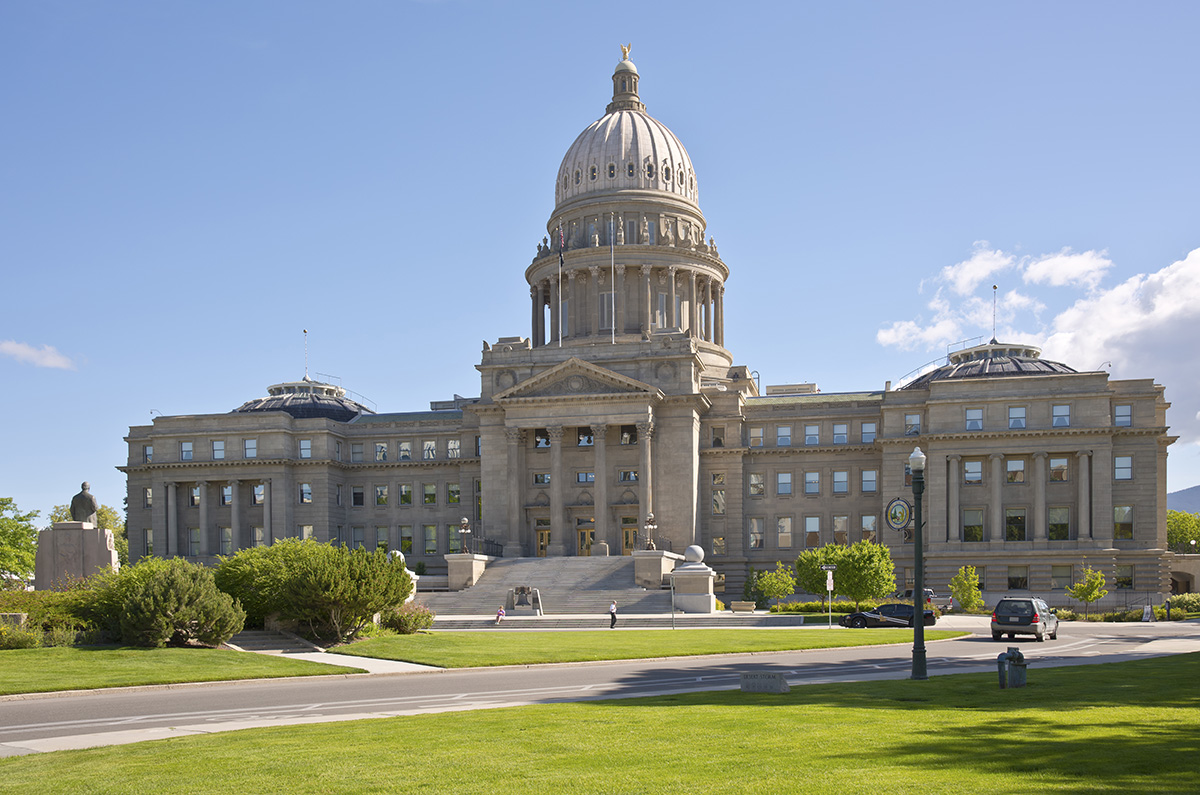
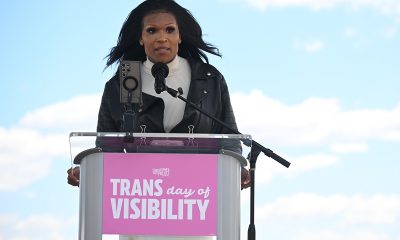
Idaho Gov. Brad Little signed into law a bill that criminalizes transgender people for using bathrooms that align with their gender identity rather than their assigned sex at birth, including in private businesses. Little signed the bill Tuesday afternoon — just as demonstrators rallied on the Capitol steps in Boise for Transgender Day of Visibility.
The law takes effect July 1.
House Bill 752 allows the government to charge people who “knowingly and willfully” enter bathrooms that do not align with their assigned sex at birth with jail time, making this the most restrictive bathroom bill in the nation. The vote had no issue passing in the Republican supermajority-controlled legislature, with 54 ayes and 15 nays in the House and 28 ayes and 7 nays in the Senate.
The bill applies to government-owned buildings and places of public accommodation, including any business (either publicly or privately owned) or space that is open to the public and offers goods, services, or facilities. These include restaurants (bars, cafes), lodging (hotels, motels, inns), entertainment and recreational spaces (gyms, theaters, sports venues, pools), healthcare and service buildings (hospitals, clinics, professional offices), and transportation-related spaces (including airports and bus stations).
A first offense carries a misdemeanor, punishable by up to one year in prison. A second offense, or any additional offense within five years, is a felony, punishable by up to five years in prison.
The bill’s sponsor, Coeur d’Alene Republican Sen. Ben Toews, said it reflects the “common sense realities” that Idahoans have — despite the issue not being “common sense” enough to be included in the state Republican Party’s official platform.
Republican legislators have deemed this, and similar measures restricting bathroom access to a person’s sex at birth, a matter of “protecting privacy and safety,” according to a similar measure passed earlier this year. Yet this claim contradicts statements from officials working to protect safety, as well as available data on the matter — there is no evidence that trans individuals accessing gender-aligned bathrooms are a threat to safety or privacy.
This expansive and invasive legislative action appears to contradict what Gov. Brad Little says he and his party stand for. On his website, Little touts his efforts to remove red tape for Idahoans, saying they have “cut or simplified 95-percent of regulations” since 2019. Signing legislation that effectively requires policing who can use which bathroom runs counter to that goal — and, unlike the transgender bathroom bill, reducing government regulation is part of the party’s official platform.
“We believe the growth of government is unnecessary and has a negative impact on both the conduct of business and our individual lives,” the Idaho Republican Party platform reads. “We endorse the review of all government programs and encourage their assumption by private enterprise where appropriate and workable. Programs which are outside of government’s constitutional obligations, not cost effective, or have outlived their usefulness should be terminated.”
The Idaho Fraternal Order of Police President, Bryan Lovell, wrote a letter to the legislature that having the responsibility to check a person’s sex at birth fall to police “presents significant practical enforcement challenges for law enforcement officers in the field.”
“In many circumstances, there is no clear or reasonable way for officers to make that determination without engaging in questioning or investigative actions that could be viewed as invasive and inappropriate,” the letter said.
Sen. Ron Taylor, a Democrat from Hailey, said House Bill 752 is about discrimination. He said constituents told him they would move out of Idaho if it passed — because it would throw their transgender children in jail.
“Now maybe that’s what some of us want, is to chase a population that’s marginalized out of Idaho,” Taylor said. “But that’s not Idaho. Idaho was founded by a population that was marginalized.”
Idaho’s American Civil Liberties Union (ACLU) went even farther to criticize the Little’s signature on House Bill 752, arguing the legislation does the opposite of its stated goal of reducing risks to the privacy and dignity of every Idahoan.
“The bill does nothing to address real criminal acts, such as sexual assault or voyeurism,” a statement from the organization founded in 1988 read. “As cisgender people who do not conform to rigid gender norms could face accusations, harassment, and arrest for using a public restroom.”
In addition to creating a criminal issue where there was none, the legislation opens up a Pandora’s box of litigation that taxpayers would ultimately have to pay for.
“When public institutions and local businesses are forced to engage in these expensive and unnecessary lawsuits, taxpayers and customers foot the bill,” the ACLU added.
Advocates for sexual health and gender freedom have called this legislation a full assault on transgender people’s right to exist in public, saying bills like this trigger harassment, increase violence against transgender people, and impose criminal penalties for not conforming to traditional gender roles.
Planned Parenthood Alliance Advocates Idaho called the bill “the most extreme anti-transgender bathroom ban in the nation.”
This is not the only anti-LGBTQ action the governor has taken. He signed a bill earlier that morning to fine cities for flying the LGBTQ+ pride flag, which, according to Idaho Capital Sun, was retaliatory action against Boise’s City Council for a vote last year declaring the pride flag and the organ donor flag as official flags — a workaround to a previous state flag ban the Legislature passed last year.
Boise Mayor Lauren McLean said the city had been flying the pride flag for a decade, but will remove it for the time being to prevent a fine that would “ultimately fall on the taxpayers of Boise to shoulder.”
“But let me be clear: Boise’s values have not changed, and they are not defined by any single action taken at the Statehouse,” McLean said after removing the Pride flag from the official pole.
This approach to LGBTQ poltics reflects a broader trend among Republicans in power in the state. In 2020, Idaho became the first state to ban transgender girls and women from competing on sports teams that align with their gender identity, which is currently being challenged in the United States Supreme Court. In 2023, state lawmakers made it a felony for doctors to provide gender-affirming health care to transgender youth. In 2024, lawmakers expanded the ban to apply to taxpayer funds and government property, forbidding Medicaid from covering gender-affirming care.
The White House
Kristi Noem ‘devastated’ as husband’s alleged fetish spending surfaces
Former DHS head ‘blindsided’ by allegations
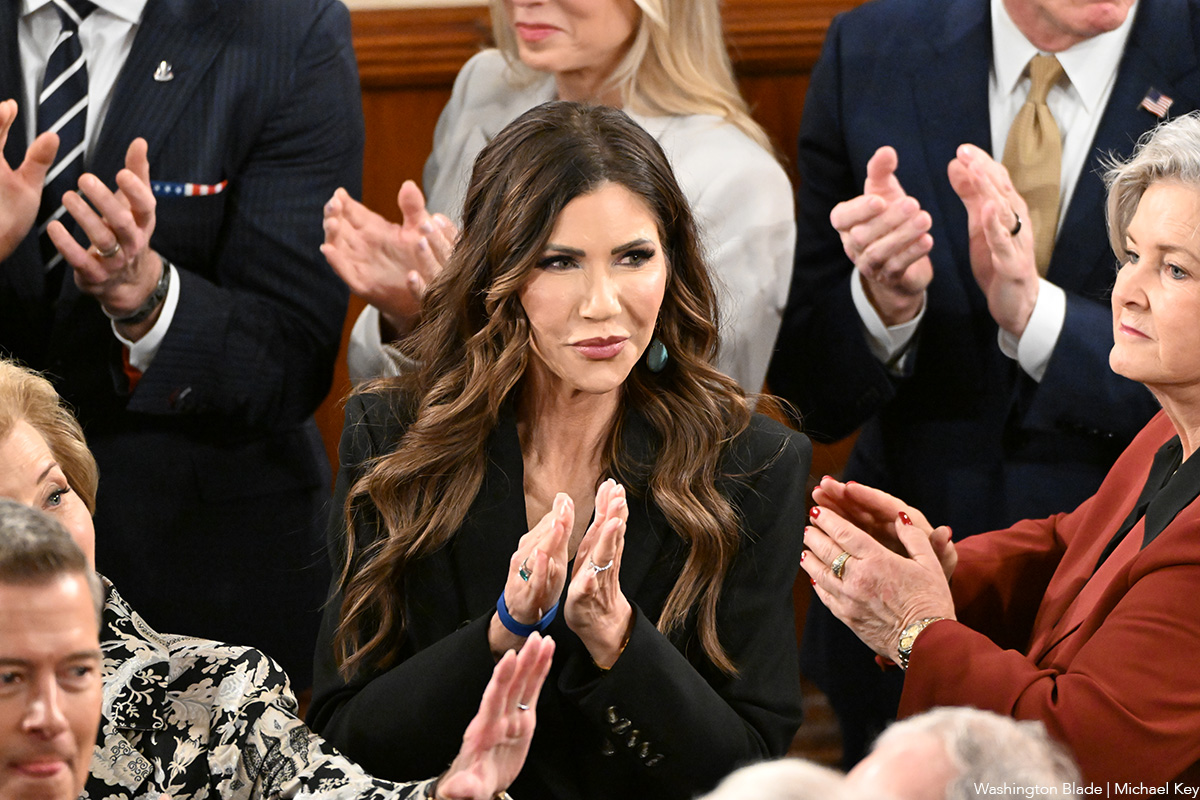
Former Department of Homeland Security Secretary Kristi Noem said she is “devastated” after reports alleged her husband paid large sums to fetish models and shared cross-dressing photos while married to her.
The Daily Mail first reported the story on March 31, accusing 56-year-old Bryon Noem — the former second gentleman of South Dakota and husband to the former DHS secretary — of exchanging hundreds of messages with three women in the “bimbofication” fetish scene. According to the report, he praised their surgically enhanced bodies and was asked to send them money though various online accounts during the 14 months his wife led the nation’s largest federal law enforcement agency.
He sent them at least $25,000 via Cash App and PayPal, according to the story, that also included photos reportedly show him wearing pink shorts and a flesh-colored top with balloons simulating breasts.
When the payments were delayed or failed to be sent, the women would get mad and ignore him, the story reads. At least one woman who didn’t receive money after texting Noem was so disgruntled she posted about his behavior on social media before later deleting it.
The allegations quickly went viral across social media and major news outlets. Representatives for Kristi Noem told the New York Post she was “devastated” and that her family was “blindsided” by the claims, while requesting privacy and prayers.
President Donald Trump, when asked by the Daily Mail, expressed surprise that the Noem family had confirmed the photos’ authenticity.
“They confirmed it? Wow, well, I feel badly for the family if that’s the case, that’s too bad,” Trump told the outlet that broke the story. “I haven’t seen anything. I don’t know anything about it. That’s too bad, but I just know nothing about it.”
Kristi and Bryon Noem met in high school and married in 1992, according to the Daily Mail. They have two daughters, Kassidy, 31, and Kennedy, 29, and a son, Booker, 23.
The controversy comes after Noem’s recent removal from one of the highest-ranking positions in Trump’s Cabinet. Markwayne Mullin was sworn in as Homeland Security Secretary last week, though Noem remains part of the president’s team as special envoy to the Shield of the Americas, a U.S.-led regional security organization focused on coordinating efforts to combat organized crime, drug trafficking, and illegal migration throughout the Western Hemisphere.
Noem’s political career spans more than a decade across state and federal government jobs. She served in the South Dakota House of Representatives from 2007 to 2011, in the U.S. House of Representatives from 2011 to 2019, and as Governor of South Dakota from 2019 to 2025.
She was confirmed as Secretary of Homeland Security during Trump’s second term, serving from 2025 until her removal following widespread backlash over escalating U.S. Immigration and Customs Enforcement operations, which included separating children from their families and two separate fatal shootings of U.S. citizens by ICE officers during protests. Trump reportedly decided to fire Noem from DHS after her congressional hearing related to the deaths, in which she stated that the president had approved a $200 million-plus government-funded DHS advertising campaign that prominently featured her.
The reports about her husband have also reignited speculation about Noem’s personal life, including rumors involving Trump supporting political operative Corey Lewandowski, described by some as the “worst-kept secret in D.C.”
Some accounts suggest Bryon Noem was aware of the alleged relationship — and benefited from it. Political commentator Ryan James Girdusky fueled that speculation during an August 2025 episode of the It’s a Numbers Game podcast, citing what he described as “D.C. gossip” that a top Cabinet official — rumored to be Noem — had privately claimed her husband was gay.
“A reporter walked up to her and said, ‘Why are you having this affair? Why haven’t you met up with your husband? Why aren’t you divorcing your husband?’” Girdusky said on the podcast. “And she blurted out to this reporter, who I know, and said, ‘Oh, my husband’s gay.’”
Unlike the unverified claims surrounding her husband, Noem’s political record on LGBTQ issues is well documented.
In 2024, while serving as governor, her administration canceled a contract with a community health worker organization, resulting in a $300,000 settlement with a transgender advocacy group. The contract had included a roughly $136,000 state-administered federal grant, of which about $39,000 had already been distributed, according to the group’s attorneys.
Noem also championed a series of policies restricting trans rights. She signed executive orders in 2021 barring transgender girls and women from competing on women’s sports teams at public schools and colleges in the state. In addition to using executive authority to enact these policies, she signed legislation into law. She enacted House Bill 1080, which bans age-appropriate, medically necessary health care for trans youth — despite widespread support for such care from major medical associations and global health authorities.
Noem also supported legislation aimed at restricting trans athletes, though she ultimately vetoed one bill, citing potential legal challenges from the NCAA while maintaining support for its intent. Additionally, she signed a Religious Freedom Restoration Act that LGBTQ advocates say enables discrimination under the guise of protecting religious liberty.

VIDEO: Gay journalist detained for booing Trumps at ‘Chicago’ opening night

Idaho Gov. signs harshest anti-trans bathroom bill in the country

Award-winning D.C. chef reaching new culinary heights

Trans-driven ‘Serpent’s Skin’ delivers campy sapphic horror

Now more than ever: the importance of LGBTQ activism

‘Out for McDuffie’ event held at D.C. gay bar

‘Jonah’ an undeniably compelling but unusual memory play

The Oscar-losing performance that’s too good to miss

Thousands attend ‘No Kings’ protests in D.C.