Arts & Entertainment
Law of the land
Same-sex couples plan mass wedding at Baltimore Pride
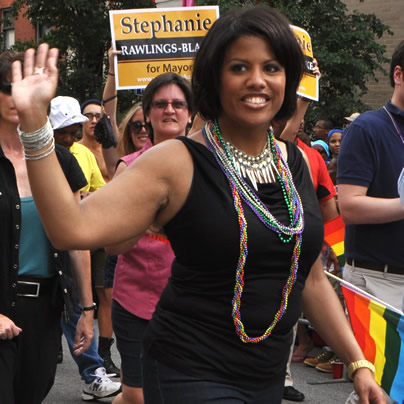
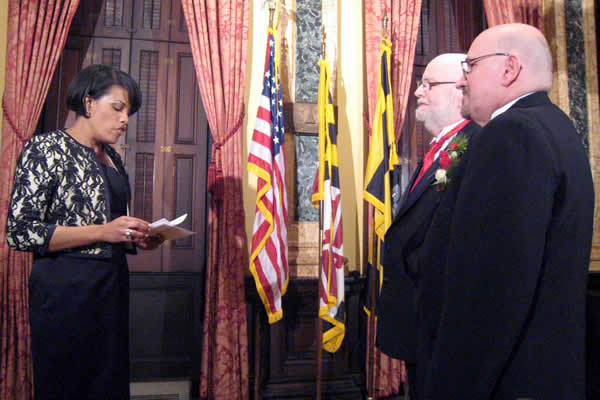
Baltimore Mayor Stephanie Rawlings-Blake will join several LGBT clergy at WeDo Baltimore Sunday for a mass wedding celebrating gay marriage. (Photo courtesy of Baltimore mayor’s office)
The idea of getting married at a public festival like Baltimore Pride may seem daunting and lacking in intimacy for a lot of couples, but for Carrietta Heirs, it’s an important option to provide the LGBT community after years of struggling for marriage equality in Maryland.
“It’s the way we’re validating what we’ve always known — that we have this right,” Heirs says of WeDo Baltimore, a mass LGBT wedding ceremony new to Baltimore Pride that she has organized. “We’ve finally earned this right, so the public should know.”
WeDo Baltimore will host about a dozen LGBT couples during the Baltimore Pride Festival on Sunday in lakeside Druid Hill Park (2600 Madison Ave., Baltimore) to celebrate the passage of marriage rights for same-sex couples in Maryland. Baltimore Mayor Stephanie Rawlings-Blake will lead the event and address the crowd. Rev. Meredith Moise, Father E. Skip Koritzer, Elder Harris Thomas and Rev. Dorothy Harris are among the local faith leaders who will officiate.
Heirs says WeDo Baltimore will be an integral part of Baltimore Pride in the coming years and is not just a one-time event.
“I think for the next couple years it very well may be. This is the month to celebrate,” Heirs says. “I think that this is historical. Today it’s gonna be a hell of a big deal, but in five years from now, I’d like it to be ‘Oh, it’s another wedding.’”
In addition to managing the event, Heirs will marry her partner of nearly 13 years, Tonya Cooke.
“We had a commitment ceremony in 2010. We said that when it became legal we would do it. We didn’t realize it would happen so soon. It really means a lot,” Heirs says. “I’m also so excited for the other couples who are finally able to get married.”
The ceremony will include couples that cannot get married in their own states, some traveling from as far away as Atlanta to share their vows. Heirs is especially touched that a couple that has been together for 50 years will tie the knot at WeDo.
“It was very powerful to find that couple who’s going to be celebrating over 50 years. It gives you chills to think about it. It’s amazing,” Heirs says. “It is so significant for people who have been together over 50 years to be able to stand up and say, ‘Love is love,’ no matter what.”
Baltimore Black Pride Inc., Strapped Up Baltimore, the Gay and Lesbian Community Center of Baltimore, Unity Fellowship Church of Baltimore, SEIU Eastern Regions National Lavender Caucus, Alpha Eta Omega Sorority and the Alpha Alpha DMV Chapter of Beta Phi Omega Sorority are sponsoring the event.
The Baltimore Pride Festival, which includes WeDo Baltimore, will be held from noon-5 p.m. This year’s performers are duo J Pope and Funk Friday, Septimius and Unity. In addition to WeDo, there will also be a “Family Zone” with activities for children to enjoy. For more information on WeDo Baltimore and Baltimore Pride, visit baltimorepride.org.





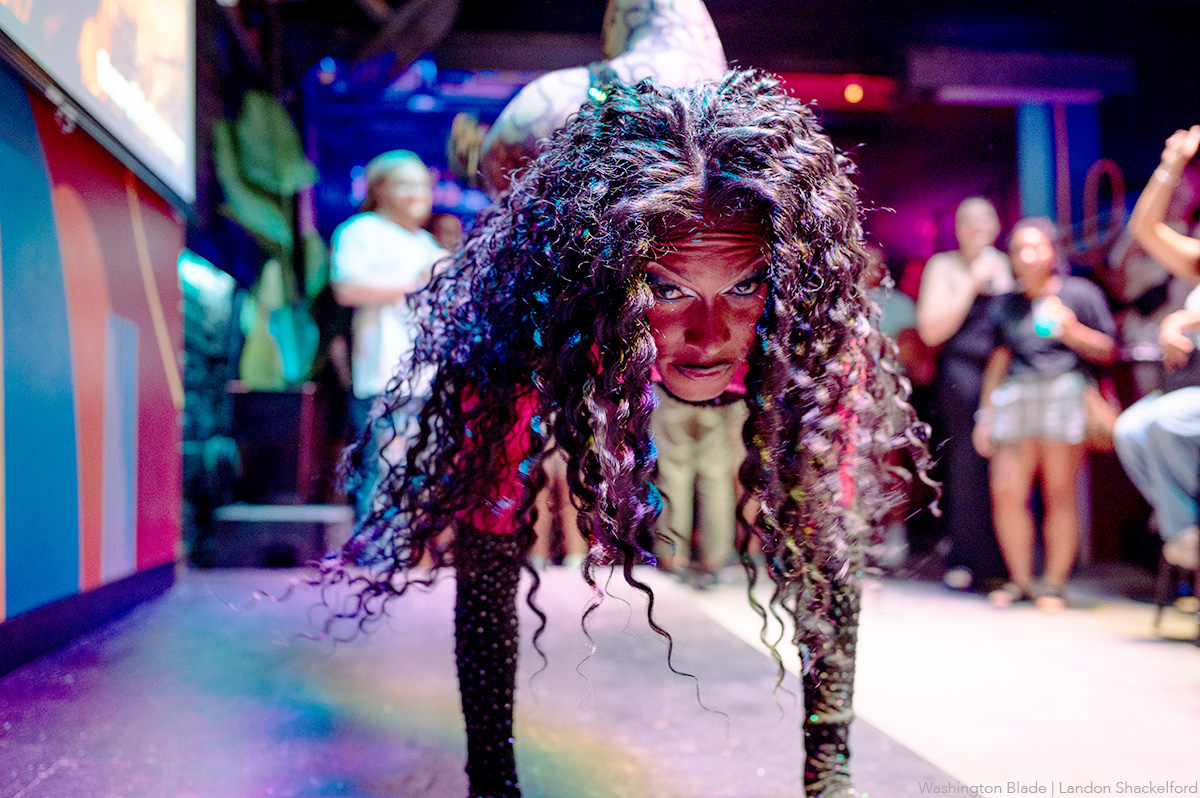
The Petal Release Party and Drag Show was held at Spark Social on Friday, July 31. Performers included Tiara-Missou, Labianna and Darcy de la Cuadra.
(Washington Blade photos by Landon Shackelford)




Celebrity News
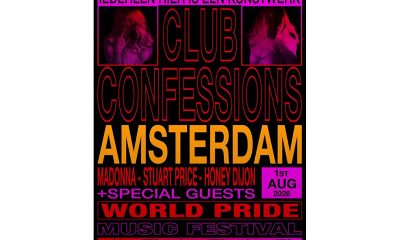
Madonna headlines World Pride Music Festival in Amsterdam
Kylie Minogue made surprise appearance alongside gay icon

AMSTERDAM — Madonna on Sunday headlined the final night of the World Pride Music Festival in Amsterdam.
The gay icon took the stage shortly before 2:30 a.m. local time (8:30 p.m. ET on Saturday) during Club Confessions, a set that MISTR, a telehealth platform that offers free access to PrEP, Doxy PEP, STI testing, and long-term HIV care, organized.
“Mother is here and this is gay heaven,” said Madonna when she took the stage inside Amsterdam’s AFAS Live concert hall that can hold up to 6,000 people.
Stuart Price, who produced Madonna’s 2005 “Confessions on a Dance Floor” album and “Confessions II,” which debuted on July 2, DJed the set.
Kylie Minogue made a surprise appearance. She and Madonna performed a new remix of “Love Sensation” from “Confessions II.”
(Washington Blade video by Michael K. Lavers)
“Throughout my career, I’ve always supported efforts to fight HIV and AIDS, and that fight begins with education and access,” said Madonna in a MISTR press release. “With MISTR, (CEO) Tristan (Schukraft) is expanding access to HIV prevention and sexual healthcare for everyone. Through this work, he’s helping preserve and strengthen LGBTQ+ spaces while investing in the communities and culture that have long sustained us.”
Minogue in an Instagram post thanked Madonna, Price, Schukraft, and MISTR.
Madonna appeared at The Abbey in West Hollywood, Calif., in April. Madonna in June celebrated Pride month with a pop-up performance in New York’s Times Square.
Jake Resnicow and Insomniac produced the World Pride Music Festival that also featured Bebe Rexha and Paris Hilton, among others.
“Pride has always been about bringing our community together,” said Resnicow. “At a moment when too many people are being told to hide or make themselves smaller, gathering openly, joyfully, and without apology matters more than ever. I couldn’t be prouder of what this festival brought to life in Amsterdam — one dance floor, completely free.”
Theater
Reggie White relishing first season as artistic director of Woolly Mammoth
First five shows a reminder that ‘pressure is a privilege’
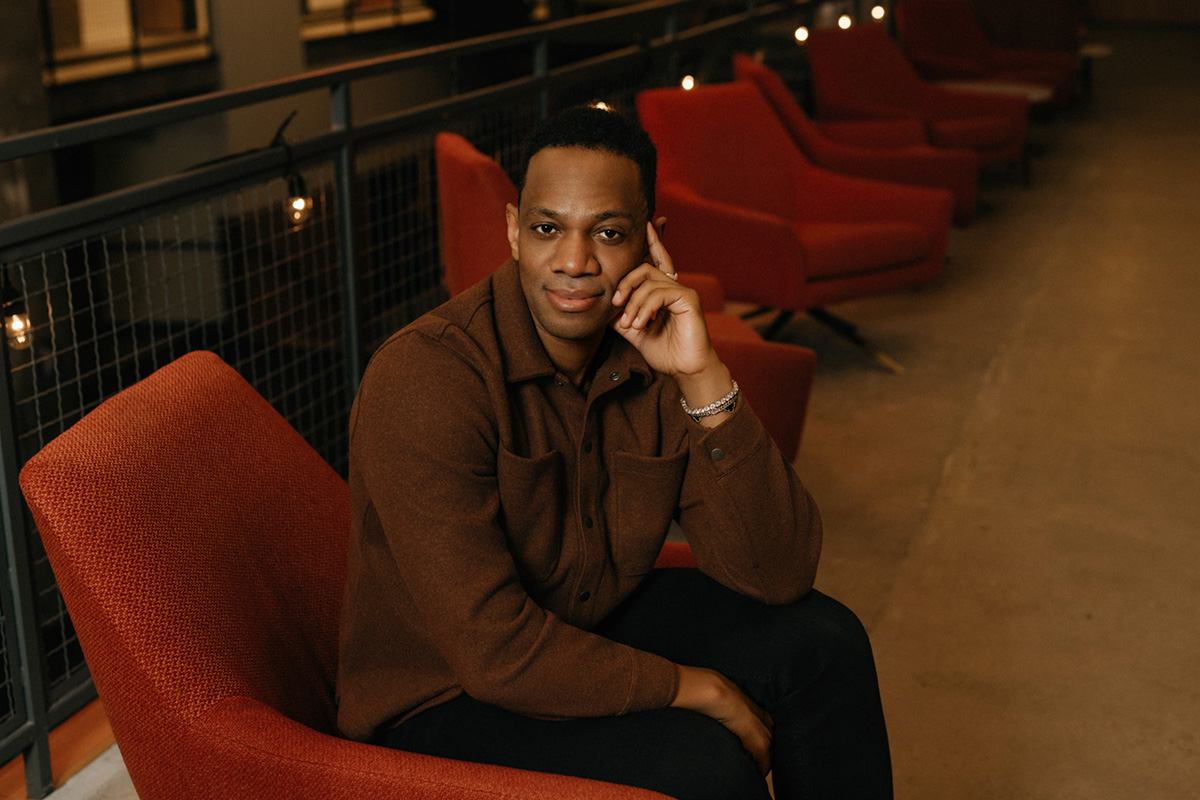
Madly talented and preternaturally energetic, Reggie D. White, 38, is about to launch his first season as artistic director of D.C.’s boundary-pushing Woolly Mammoth Theatre Company.
White brings a lot to the job. As actor, playwright, and director, his varied resume includes a 2019 Broadway acting debut in Matthew López’s Tony Award–winning play “The Inheritance,” his semi-autobiographic play “Fremont Ave.” that opened to acclaim last season at Arena Stage, and a number of exciting regional directing credits.
A longtime admirer of Woolly, the out theater-maker was selected from a pool of candidates before receiving the offer last November and starting work in January. His season of five world premieres kicks off with gay playwright Steve Yockey’s “Venus” (Sept. 9-Oct. 4), a darkly funny study of modern relationships told through two lesbians looking back on their first encounter.
White was introduced to Woolly Mammoth as a pre-law student at Cal State Hayward in the San Francisco Bay Area, long before he foresaw a life in the arts. “As part of a random theater history course, I was assigned to write a paper on a counterculture company called Woolly Mammoth,” he recalls “Strange name. I was like what the hell is that?”
Nineteen-year-old White was intrigued. Research acquainted him with Howard Shalwitz who co-founded Woolly in 1980, and the company’s commitment to living playwrights and new work. He also learned how theater could be used as a tool for difficult conversations and shape the way people thought about social issues by employing imagination and rigor.
“Never in a million years did young me envision that one day I’d be Woolly’s third artistic director in its 46-year history,” says White. “It’s kind of serendipitously insane.”
WASHINGTON BLADE: Was there a moment when the enormity of the job hit you?
REGGIE D. WHITE: After I’d signed my contract and finished all the paperwork, I got my keys and sat in the theater by myself in the dark and thought about what an incredible honor it is to be trusted with what happens in this beautiful space [in D.C.’s Penn Quarter]. I might have cried. Sometimes I have to pinch myself to remember it’s real.
BLADE: Are you curating the upcoming 2026–2027 season?
WHITE: Yes, I am. It’s very rare that an incoming artistic director gets to program their first season, but I was lucky in terms of time. After being hired late last year, I asked Woolly’s managing director Kimberly E. Douglas, if she thought it would be crazy if I programmed the season. She warned me it would be hard.
I invoked tennis legend Billie Jean King’s maxim “pressure is a privilege” and got to work.
These plays [dubbed White’s “first five”] represent both the kind of theater that Woolly can do really well and speak directly to my voice as curator and how I want to contribute to the larger theatrical conversation in the DMV.
Getting here has meant a lot of late nights. But I knew the juice would be worth the squeeze.
BLADE: As a queer artistic director, what makes you unique?
WHITE: When I was playing in “Inheritance” on Broadway, after a performance, U.S. Supreme Court Justice Sotomayer came backstage to meet the cast. She spoke about how her lens on the world as a Puerto Rican woman shapes her decisions. Similarly, because I’m a queer Black man I see through a lens that shapes my work.
I know I’m not the only queer artistic director in town. For me, it influences how I make editorial decisions. Out of this season’s five plays there are explicitly queer characters in four [“Venus,” “Chanukkah Spectacular,” “Ten Grand,” and “Love I Awethu Further”] and I’m directing two [“Venus,” “Ten Grand”].
BLADE: Will we see familiar faces?
WHITE: Every show this season will feature a Woolly Mammoth company member in its cast. Our company also includes designers and directors who we’ll include. I’m invested in continuing to provide a showcase for their work.
BLADE: How do you think queer audiences will receive the season?
WHITE: Very well, I think. For queer people who’ve had to navigate the world subversively and solve problems in unique ways, I think it will be especially interesting. I find theater a potent place for questions.
Like all artistic directors. I’ll show up for the job in my own way. I’m just excited that I’ve been invited to bring the fullness of myself to the role.

PHOTOS: Petal Release Party

Madonna headlines World Pride Music Festival in Amsterdam

Reggie White relishing first season as artistic director of Woolly Mammoth

PHOTOS: Amsterdam Pride Canal Parade

Amsterdam Pride Canal Parade draws hundreds of thousands

‘Heartstopper Forever’ delivers satisfying conclusion

Madonna to perform at World Pride in Amsterdam

BLADE ENDORSEMENT: Susan Stewart for mayor of Rehoboth Beach

PHOTOS: Lambda Legal in the Pines