Arts & Entertainment
Rites of passage
Lesbian coming-of-age story moving, effective

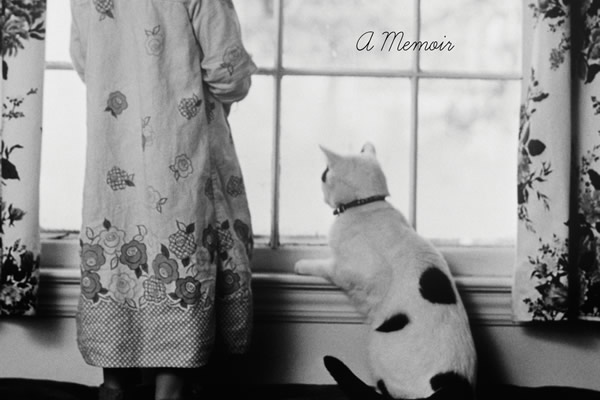
(Image courtesy Gallery Books)
‘Teaching the Cat to Sit: A Memoir’
By Michelle Theall
Gallery Books
$24.99
288 pages
Sometimes, you feel so adrift in your rites of passage.
Unmoored, unanchored, you feel as though you ride each wave alone, emotions and events washing over you until you can’t weather the storm any longer and you need an anchor. That’s when you reach for family or God.
But what if both were denied to you? In “Teaching the Cat to Sit,” Michelle Theall shares her story of standing up instead of standing still.
Al Theall and his wife were sure their second child, born in 1966, would be a boy but — surprise! — they got another daughter. Later, they were even more astounded that their second girl was so different from the first one: unlike her older, popular, outgoing sister, Michelle grew to be athletic, bullheaded and introverted; in fact, aside from the cat, her only friend was a neighbor girl whose parents had scandalously been divorced.
Divorce, of course, was against the teachings of the Catholic Church, the religion that Theall’s mother strictly followed. She was reluctant to even let her daughter play at the Crandall’s house, but reasoned that Theall needed one friend.
That bond ended abruptly when the girl’s father molested Theall.
In high school, Theall had an Evangelical Christian friend, but the girl’s mother thought Theall was a lesbian, and put an end to the relationship. That hurt, because Theall herself didn’t yet realize her sexuality.
After a sweet and almost-accidental love affair with another woman while at college, Theall examined her sexual preferences and felt deeply ashamed. Catholicism taught that being gay was a sin against God. Her parents would not accept her as a lesbian. She tried to be heterosexual, but that wasn’t who she was. So upon graduation from Texas Tech, she moved to Colorado where she chose long-term celibacy and started re-building a relationship with her parents.
Then, after a surprising (and awkward) introduction, Theall fell in love. When she and Jill started their family, she fell in love again with a baby who’d had a rough start in life. They’d hoped to raise their child in Theall’s Catholic faith.
But the church wasn’t having it.
Despite its inherent sadness, “Teaching” is hard to put down because author Michelle Theall is a first-rate storyteller and knows how to keep a reader wanting more. Half of it is about her battle with the Catholic Church for recognition of her partner and their son and, eventually, their search for an acceptable (and accepting) religion. The other half is the memoir of her tumultuous relationship with her parents and her journey to understanding, both of them and herself.
The book works because of its deliberateness and its ultimately empowering message of truth to self. For that, and for the great biography it is, “Teaching the Cat to Sit” is a must-read, especially for those who can relate.



A “No Kings” demonstration was held in Anacostia on Saturday to protest the Trump administration. Speakers at the rally included LGBTQ activist, Rayceen Pendarvis. Following the rally, demonstrators marched across the Frederick Douglass Memorial Bridge.
(Washington Blade photos and videos by Michael Key)




Theater
‘Jonah’ an undeniably compelling but unusual memory play
Studio production draws on scenes from the past, present, and from imagination
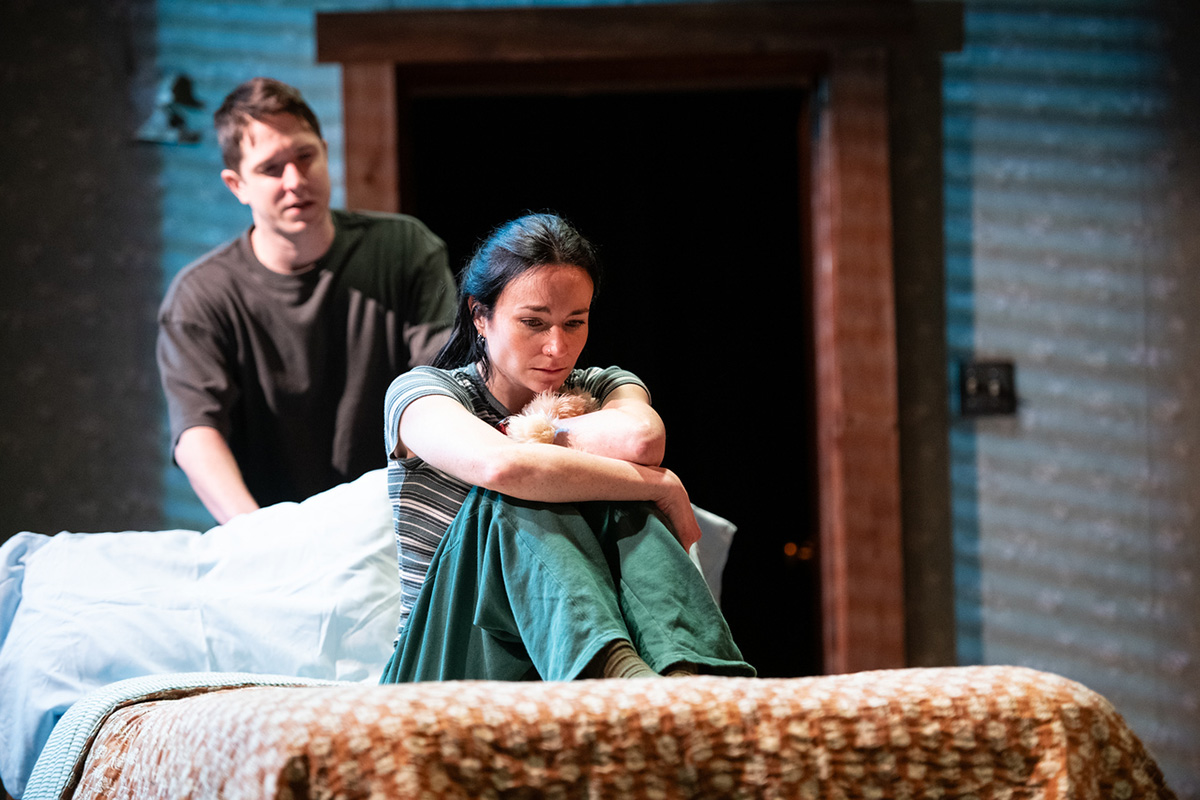
‘Jonah’
Through April 19
Studio Theatre
1504 14th St., N.W.
$55-$95 (discounts available)
Studiotheatre.org
Written by Rachel Bonds, “Jonah” is an undeniably compelling but unusual memory play with scenes pulled from the past, some present, and others seemingly imagined. Despite its title, the play is about Ana, a complicated young woman processing past trauma from the fragile safety of her usually quiet bedroom.
Studio Theatre’s subtly powerful production (through April 19) is finely realized. Director Taylor Reynolds smartly helms an especially strong cast and an inspired design team.
As Ana, out actor Ismenia Mendes radiates a quiet magnetism. She nails the intelligent woman with a hard exterior that sometimes melts away to reveal a warm curiosity and sense of humor despite a history of loss.
When we first meet Ana, she’s a scholarship student at a boarding school where she’s very much on the radar of Jonah, a sensitive day student (charmingly played by Rohan Maletira). Initially reluctant to know him, Ana soon breaks the ice by playfully lifting her shirt and flashing him. It’s a budding romance oozing with inexperience. And just like that, there’s a blast of white light and woosh, Jonah’s gone. Literally sucked out of an upstage door.
Clearly romanticized, the scenes between Ana and Jonah are a perfect memory captured in time that surely must be too good to be entirely true.
“Jonah,” a well-made nonlinear work, is pleasing to follow. Each of Bond’s scenes end with a promise that more will be revealed. And over its almost two hours, Ana’s story deftly unfolds in some satisfying ways, ultimately piecing together like a puzzle.
Next, Ana is a college writing student. She’s alone in her dorm room when volatile stepbrother Danny (Quinn M. Johnson) visits the campus. Growing up in Detroit, Danny was Ana’s protector taking the brunt of her stepfather’s abuse after the untimely death Ana’s mother. Now, he’s sort of a clinging nuisance; nonetheless, they maintain a trauma rooted relationship.
And finally, 40ish and still guarded, Ana is a published writer. While working in her bedroom at a rural writer’s retreat, she’s joined by a nerdy stranger, Steven (Louis Reyes McWilliams). At first annoyed by this fellow writer’s presence, Ana is ultimately won over by his dogged devotion, sincerity, and kind words. What’s more, he’s not unacquainted with abuse, and he’s willing to delve into discussions of intimacy. Again, is it too good to be true?
Chronology be damned, these three male characters come and go, dismissed and recalled. It’s through them that Ana’s emotional journey is reflected. They pursue, but she allows them into her life in different ways for different reasons.
Bonds, whose plays have been produced at Studio in the past (world premiere of “The Wolfe Twins” and “Curve of Departure”), and Reynolds who scored a huge success directing Studio’s production of “Fat Ham” in 2023, are well matched. Reynolds’s successful intimate staging and obvious respect for the script’s serious themes without losing its lighter moments are testimony to that.
Essential to the play is Ana’s bedroom created by set designer Sibyl Wickersheimer. It’s a traditional kind of bedroom, all wooden furniture with a neat and tidy kind of farmhouse feel to it. There are two large window frames with views of darkness. It could be anywhere. The only personal items are writing devices and maybe the lived-in bedding, but other than that, not a lot indicates home.
Movies
The Oscar-losing performance that’s too good to miss
‘If I Had Legs I’d Kick You’ now streaming
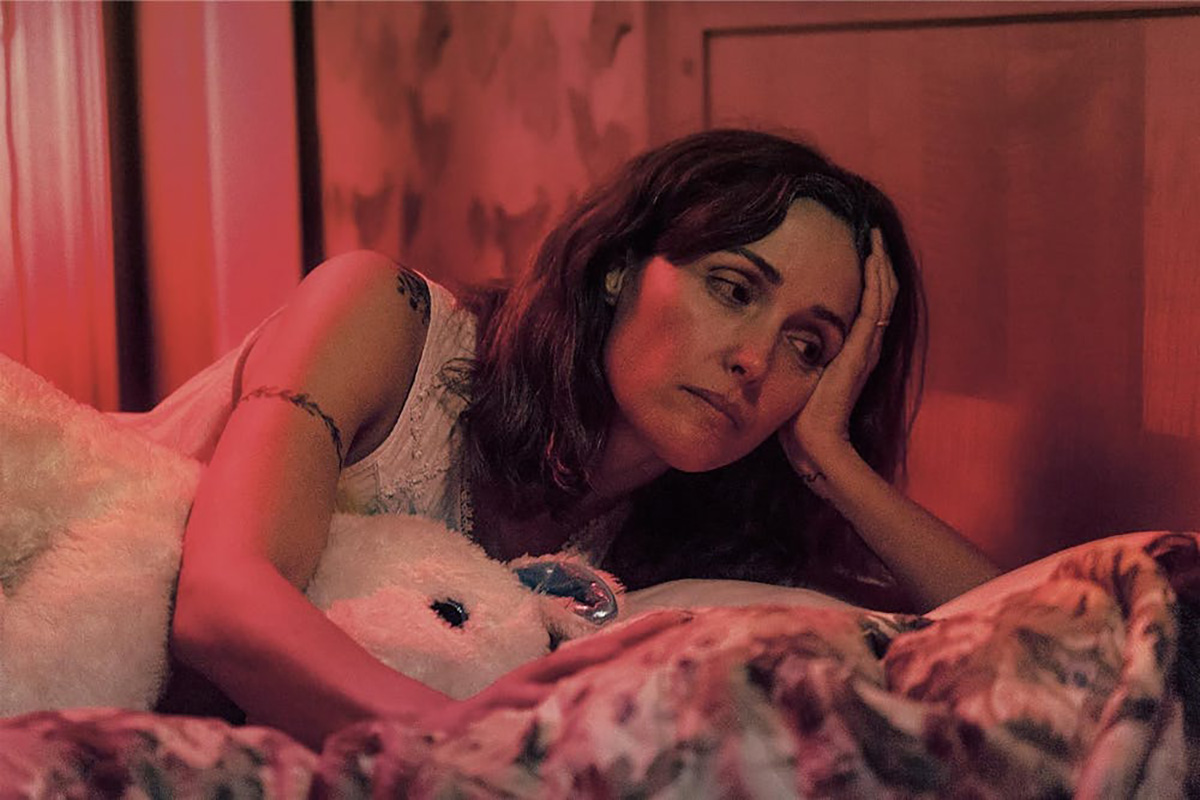
Now that Oscar season is officially over, most movie lovers are ready to move on and start looking ahead to the upcoming crop of films for the standouts that might be contenders for the 2026 awards race.
Even so, 2025 was a year with a particularly excellent slate of releases: Ryan Coogler’s “Sinners” and Paul Thomas Anderson’s “One Battle After Another,” which became rivals for the Best Picture slot as well as for total number of wins for the year, along with acclaimed odds-on favorites like “Hamnet,” with its showcase performance by Best Actress winner Jessie Buckley, and “Weapons,” with its instantly iconic turn by Best Supporting Actress Amy Madigan.
But while these high-profile titles may have garnered the most attention (and viewership), there were plenty of lesser-seen contenders that, for many audiences, might have slipped under the radar. So while we wait for the arrival of this summer’s hopeful blockbusters and the “prestige” cinema that tends to come in the last quarter of the year, it’s worth taking a look back at some of the movies that may have come up short in the quest for Oscar gold, but that nevertheless deserve a place on any film buff’s “must-see” list; one of the most essential among them is “If I Had Legs I’d Kick You,” which earned a Best Actress Oscar nod for Rose Byrne. A festival hit that premiered at Sundance and went on to win international honors – for both Byrne and filmmaker Jane Bronstein – from other film festivals and critics’ organizations (including the Dorian Awards, presented by GALECA, the queer critics association), it only received a brief theatrical release in October of last year, so it’s one of those Academy Award contenders that most people who weren’t voters on the “FYC” screener list for the Oscars had limited opportunity to see. Now, it’s streaming on HBO Max.
Written and directed by Bronstein, it’s not the kind of film that will ever be a “popular” success. Surreal, tense, disorienting, and loaded with trigger-point subject matter that evokes the divisive emotional biases inherent in its premise, it’s an unsettling experience at best, and more likely to be an alienating one for any viewer who comes to it unprepared.
Byrne stars as Linda, a psychotherapist who juggles a busy practice with the demands of being mother to a child with severe health issues; her daughter (Delaney Quinn) suffers from a pediatric feeding disorder and must take her nutrition through a tube, requiring constant supervision and ongoing medical therapy – and she’s not polite about it, either. Seemingly using her condition as an excuse to be coddled, the child is uncooperative with her treatment plan and makes excessive demands on her mother’s attention, and the girl’s father (Christian Slater) – who spends weeks away as captain of a cruise ship – expects Linda to manage the situation on the home front while offering little more than criticism and recriminations over the phone.
Things are made even more stressful when the ceiling collapses in their apartment, requiring mother and child to move to a seedy beachside motel. Understandably overwhelmed, Linda turns increasingly toward escape, mostly through avoidance and alcohol; she finds her own inner conflicts reflected by her clients – particularly a new mother (Danielle Macdonald) struggling with extreme postpartum anxiety – and her therapy sessions with a colleague (Conan O’Brien, in a brilliantly effective piece of against-type casting) threaten to cross ethical and professional boundaries. Growing ever more isolated, she eventually finds a thread of potential connection in the motel’s sympathetic superintendent (A$AP Rocky) – but with her own mental state growing ever more muddled and her daughter’s health challenges on the verge of becoming a lifelong burden, she finds herself drawn toward an unthinkable solution to her dilemma.
With its cryptic title – which sounds like the punchline to a macabre joke and evokes expectations of “body horror” creepiness – and its dreamlike, disjointed approach, “If I Had Legs I’d Kick You” feels like a dark comedic thriller from the outset, but few viewers are likely to get many laughs from it. Too raw to be campy and too cold to invite our compassion, it’s a film that dwells in an uncomfortable zone where we are too mortified to be moved and too appalled to look away. Though it’s technically a drama, Bronstein presents it as a horror story, of sorts, driven by psychological rather than supernatural forces, and builds it on an uneasy structure that teases us with expectations of “body horror” grotesquerie while forcing us to identify with a character whose lack of (presumably) universal parental instinct feels transgressive in a way that is somehow even more disquieting than the gore and mutilation we imagine might be coming at any moment of the film.
And we do imagine it, even expect it to come, which is as much to do with the near-oppressive claustrophobia that results from Bronstein’s use of near-constant close-ups as it does with the hint of impending violence that pervades the psychological tension. It’s not just that our frame of vision is kept tight and limited; her tactic keeps us uncertain of what’s going on outside the edges, creating a near-constant sense of something unseen lurking just beyond our view. Yet it also helps to put us into Linda’s state of mind; for almost the entire film, we never see the face of her daughter – nor do we ever know the child’s name – and her husband is just a strident voice on the other end of a phone call, and the effect places us squarely into her dissociated, depressed, and desperate existence.
Anchoring it all, of course, is Byrne’s remarkable performance. Vivid, vulnerable, and painfully real, it’s the centerpiece of the film, the part that emerges as greater than the whole; and while Oscar may have passed her over, she delivers a star turn for the ages and gives profound voice to a dark side of feminine experience that is rarely allowed to be aired.
That, of course, is the key to Bronstein’s seeming purpose; inspired by her own struggles with postpartum depression, her film feels like both a confession and an exorcism, a parable in which the expectations of unconditional motherly love fall into question, and the burden placed on a woman to subjugate her own existence in service of a child – and a seemingly ungrateful one, at that – becomes a powerful exploration of feminist themes. It’s an exploration that might go too far, for some, but it expresses a truth that those of us who are not mothers (and many of us who are) might be loath to acknowledge.
Uncomfortable though it may be, Bronstein’s movie draws us in and persuades our emotional investment despite its difficult and unlikable characters, thanks to her star player and her layered, puzzle-like screenplay, which captures Linda’s scattered psyche and warped perceptions with an approach that creates structure through fragments, clues and suggestions; and while it may not land quite as squarely, in the end, as we might hope, its bold and transgressive style – coupled with the career-topping performance at its center – are more than enough reason to catch this Oscar “also-ran” before putting this year’s award season behind you once and for all.

The cost of speaking one’s mind

Senegalese president signs bill that further criminalizes homosexuality

Md. lawmakers reaffirm legislative priorities

Supreme Court rules against Colo. law banning conversion therapy for minors

Thousands attend ‘No Kings’ protests in D.C.

Celebrate cherry blossoms the drag way

Lorato ke Lorato: marriage equality, democracy, and the unfinished work of justice in Botswana

Japanese Supreme Court to consider marriage equality

The outrage economy is not the LGBTQ community

Anti-trans visa ruling echoes Nazi regime destroying trans documents
-

 Out & About4 days ago
Celebrate cherry blossoms the drag way
-
Botswana4 days ago
Lorato ke Lorato: marriage equality, democracy, and the unfinished work of justice in Botswana
-
Japan4 days ago
Japanese Supreme Court to consider marriage equality
-
Opinions4 days ago
The outrage economy is not the LGBTQ community