Opinions
Gays behaving badly
Carpetbagging candidates and credit-stealing activists — is this what we fought for?
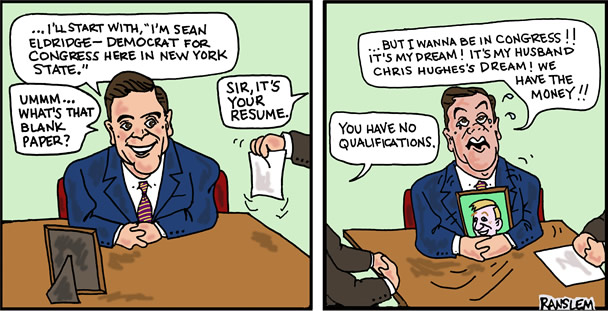
(Washington Blade cartoon by Ranslem)
A squabble broke out at the Equality Forum panel discussion of national politics I moderated last week in Philadelphia.
A woman in the audience objected forcefully after the Victory Fund’s Torey Carter discussed his organization’s controversial endorsement of two gay candidates for Congress.
One is Richard Tisei, a gay Republican from Massachusetts seeking to unseat pro-LGBT (but straight) incumbent John Tierney. The race is dividing LGBT voters and donors, with some saying we should remain loyal to our allies in Congress while others like the Victory Fund see an opportunity to add an openly gay voice to the GOP caucus.
The other race is in New York where the Victory Fund and other LGBT advocates are backing Sean Eldridge over a Republican incumbent who opposes marriage equality. The race is controversial because Eldridge has a thin resume but deep pockets — he’s married to Facebook co-founder Chris Hughes.
The woman at Equality Forum nearly leapt from her seat, angry at the notion of a candidate buying a seat in Congress and questioning whether the LGBT community should play along with such unsavory tactics.
Her frustration is certainly understandable. Eldridge embodies much of what is wrong with our modern political system, which prizes money over achievement. LGBT advocates should reconsider supporting Eldridge’s vanity campaign for Congress from New York’s 19th congressional district.
Or is it the 18th district? It’s hard to keep track of where Eldridge and his wealthy husband — who won the lottery by ending up Mark Zuckerberg’s college roommate as he was creating Facebook — are buying their latest multi-million-dollar home.
We should abandon the term “carpetbagging” and call it “Eldridgeing” because he gives new meaning to the cynical practice of picking up and moving to a new district to buy a seat in Congress.
Eldridge is taking on incumbent Rep. Chris Gibson, a Republican who opposes marriage equality but is a co-sponsor of the Employment Non-Discrimination Act. Of course, no one would mistake Gibson for a gay rights advocate — he earned a zero on HRC’s congressional scorecard — but gay voters and donors should resist lining up behind an alternative just because he’s gay and rich. Surely there’s a viable, experienced Democrat living in the district. We won’t know because anyone contemplating a run was scared off by the Hughes war chest.
In sharp contrast to most newbie politicians, Eldridge shuns the media. He has refused multiple Blade interview requests. Politico last month published a profile of Eldridge and noted that he not only refused its interview requests, but locked the campaign headquarters door when a reporter showed up knocking.
Despite Eldridge’s arrogant approach to campaigning, LGBT voices are embracing him.
“They are young, rich, smart and good-looking. It’s a pretty powerful combination,” Richard Socarides told the New York Times in a predictable display of sycophantic ass kissing.
There’s no disputing they are rich. Hughes’ net worth has been reported to be between $600-700 million. The money came from his connection to Facebook’s Zuckerberg. As the New York Times put it, “For Mr. Hughes, a history and literature student with no programming skills, it later seemed to outsiders a lucky break.”
The couple bought an estate in Garrison, N.Y. along with 80 acres in 2011 for $5 million, the Times noted, quoting Eldridge as saying that’s where they “put down roots.” But just two years later, when the congressional seat in that area appeared out of reach for Eldridge, they bought a new, $2 million spread just north in the 19th congressional district.
Eldridge is just 27 but has a “deep commitment” to public service, according to his bio on Victory Fund’s website. It continues, “He helped lead the successful campaign for marriage equality in New York State in 2011.” That’s almost as ridiculous and brazen as author Jo Becker comparing HRC’s Chad Griffin to Rosa Parks in her new book “Forcing the Spring.”
Much gnashing of teeth followed publication of the book last month. Part of the reason for the backlash is that the book played into a narrative of HRC swooping in at the 11th hour and taking credit for the work of grassroots activists. Many of them have complained (often privately and off the record, fearing retribution) of HRC’s tactics, from Maryland to Maine and California to New York.
We all know the marriage equality movement didn’t start in 2008 with the Prop 8 case and that Griffin is no Rosa Parks. In fact, that case fell far short of its goals; it’s an odd choice for Becker’s grandiose claims.
As gays find increasing acceptance and move openly into the halls of power, we mustn’t forget our own history, as HRC bet wrongly we would in the case of Becker’s book. That history has always been about a shared responsibility for helping each other overcome discrimination and hate. We all stand on the shoulders of a generation of gay men who died and the LGBT survivors who took care of them.
And, as the insightful Maya Rupert of the National Center for Lesbian Rights told our audience at the Equality Forum: We don’t need a gay Rosa Parks. The original belongs to everyone.
Kevin Naff is editor of the Washington Blade. Reach him at [email protected].


Opinions
The latest Supreme Court case erasing LGBTQ identity
Chiles v. Salazar a major setback for movement
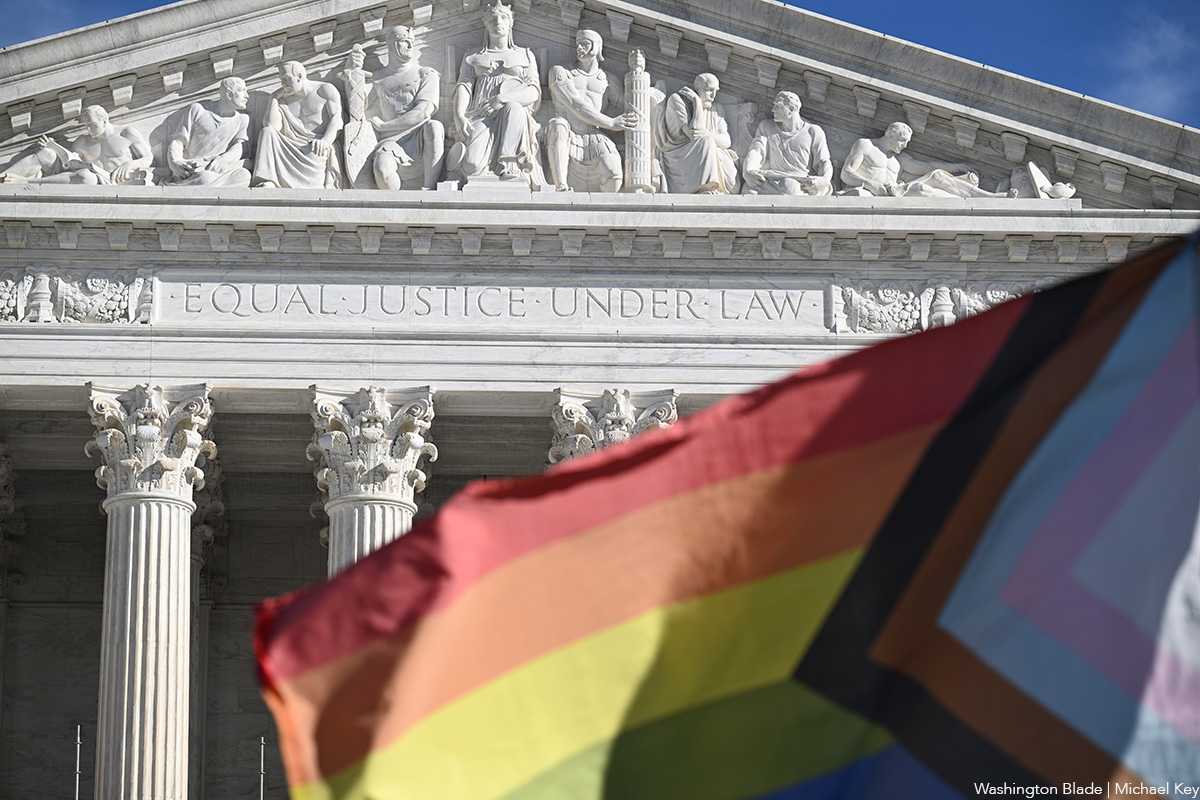
In its recent decision in Chiles v. Salazar, the U.S. Supreme Court invalidated Colorado’s law prohibiting licensed counselors from engaging in efforts to change the sexual orientation or gender identity of minors. The decision, which puts into question similar laws in 22 other states, relied on the First Amendment to hold that the law violates counselors’ free speech rights. But the decision also strikes a blow against LGBTQ dignity, a point the court’s opinion does not even address.
The eight-member majority, which included Justices Elena Kagan and Sonia Sotomayor, who usually side with LGBTQ groups, justified its reasoning by suggesting that the law was one-sided: it permitted treatment that affirms LGBTQ identity but forbade treatment that seeks to change it. But the law is one-sided, as Justice Ketanji Brown Jackson’s lone dissent pointed out, because the medical evidence only supports one side: reams of research show that “survivors of conversion therapy continue to suffer from PTSD, anxiety, and suicidal ideation.” And major medical associations all agree, no evidence demonstrates the efficacy of conversion efforts. This isn’t surprising. Medicine often take sides — some treatments work, and some don’t.
But particularly concerning is the vision of LGBTQ identity that undergirds the majority opinion when compared to the dissent. Justice Jackson’s dissent explains that LGBTQ identity is simply “a part of the normal spectrum of human diversity” — not something to be “cured.” By contrast, for the majority, how best to help LGBTQ minors is “a subject of fierce public debate.” That can hardly be the case if LGBTQ identity stands on equal ground with straight, cisgender identity, or if LGBTQ people are as deserving of safety, rights, and dignity.
Indeed, the LGBTQ rights movement only began in earnest when advocates in the 1960s decided to end the “debate” over gay identity. Until then, community leaders would routinely cooperate with psychiatrists who were interested in researching homosexuality as a medical condition. A new generation of activists, led by Frank Kameny, a key movement founder, began arguing that this got the issue upside down: Rather than wondering if they could be “cured,” LGBTQ people had to assert a right to their identity. As Kameny put it—“we have been defined into sickness.” Only once the case was made that it was society that had to change, and not LGBTQ people, could LGBTQ consciousness, LGBTQ pride and LGBTQ rights develop. Their activism led to the first Pride parade in New York, and the official declassification of homosexuality as a disease in 1973.
The Supreme Court’s conservatives don’t just want to reignite this half-century old medical “debate”; they also treat medical claims that undermine LGBTQ identity very differently from those who support it. Last year, in an opinion backingTennessee’s law that banned gender affirming care for minors, the court sympathetically marched through the reasons Tennessee offered for “why States may rightly be skeptical” of such care, and cited three times, in some detail, to “health authorities in a number of European countries” (that is, some Nordic countries and the UK) that had curbed pediatric care. It failed to mention that most of Western Europe and every major American medical association provides access to this care.
In Chiles, by contrast, the court cites none of the evidence that Colorado amassed that conversion therapy harms LGBTQ children. None of the countries that the court had invoked to justify anti-trans policies allow conversion therapy in their health care systems (indeed, one of them criminalizes such practices). So rather than cite medical evidence, the court simply asked — why trust medical evidence at all? “What if,” asks the court, “reflexive deference to currently prevailing professional views [does] not always end well?” and cites an infamous 1927 Supreme Court case, Buck v. Bell.
In Buck, the Supreme Court embraced eugenic reasoning, backing a eugenic state law that allowed the sterilization of individuals with mental disabilities, on the grounds that such disabilities were hereditary. As Justice Oliver Wendell Holmes opined, “three generations of imbeciles are enough.” Look at what happens when we listen to medical expertise, today’s court seems to say, as an excuse to disregard the LGBTQ-affirming medical evidence they don’t like.
But the court has missed the key lesson of Buck. The law at issue in Buckdiscriminated against a certain group, seeking, through sterilization measures, to erase it from existence. Indeed, LGBTQ people (whom doctors of the day would have referred to as sexual “inverts”) were exactly the kind of people that the eugenic program of Bucksought to eliminate. Conversion therapy seeks similar erasure.
The lesson of the 1960s LGBTQ rights movement remains as relevant today as it was then. Without an unapologetic LGBTQ identity, LGBTQ Pride, LGBTQ rights and the LGBTQ movement itself can all founder. By supporting only the anti-LGBTQ side in this medical saga — and by suggesting that LGBTQ existence is subject to medical debate at all — the court is reaffirming, rather than repudiating, minority erasure.
Craig Konnoth is a professor of law at University of Virginia School of Law.

I was disappointed when the Blade didn’t publish my response to a personal attack on me in a column by Hayden Gise, in last week’s print edition. They did publish it online. To be clear, I have no problem with people disagreeing with my columns and opinions. That is absolutely fair. But when they get into personal attacks, it often means they don’t have enough to say about the ideas they are trying to criticize.
In a recent column ‘Why the Democratic Socialists of America are right for D.C.,’ the author decided to attack me personally. Here is the response I wrote to her column:
“I am responding to a column by Hayden Gise who says in her column she is a transgender, lesbian, Jewish, Democratic Socialist, and supports having the Democratic Socialists of America (DSA) in Washington, DC. She is definitely as entitled to her view on this, as I am to mine. However, I was surprised she clearly felt it important to use the column to attack me personally, without even knowing me. What she didn’t do is respond to the issues in the DSA platform I wrote having a problem with, and which I asked candidates endorsed by the DSA to respond to. 1. Are they for the abolishment of the State of Israel? 2. What is their definition of a Zionist? 3. What is their definition of antisemitism? 4. Will they meet with Zionist organizations? 5. Do they support BDS? One needs to know when a candidate claims they are only a member of the local DSA, according to the DSA bylaws no person can be a member of a local DSA without being a member of the national organization. So Hayden Gise has a little better idea of who I am she should know: I was a teacher and a union member. I worked for the most progressive member of Congress at the time, Bella S. Abzug (D-N.Y.), and supported her when she introduced the Equality Act in 1974, to protect the rights of the LGBTQ community, and have fought for its passage ever since. I have spent a lifetime fighting for civil rights, women’s rights, disability rights, and LGBTQ rights. I have no idea what Hayden Gise’s background is, or what her history of working for the causes she espouses is. But I would be happy to meet with her to find out. But she should know, I take a back seat to no one in the work I have done over my life fighting for equality, including economic equality, for all. So, I will not attack her, as I don’t know her, and contrary to her, don’t personally attack people I don’t know much about.
“I have, and will continue to attack, what the government of Israel is doing to the Palestinian people, and now to those in Lebanon and Iran. I will also attack the government of my own country, and the felon in the White House, and his sycophants in Congress, for what they are doing to our own people, and people around the world, and will continue to work hard to change things. However, I will also continue to stand for a two-state solution with the continued existence of the State of Israel, calling for a different government in Israel. I also strongly support the Palestinian people and believe they must have the right to their own free state.”
I have not heard from Gise, but I hope she knows that since she wrote her column indicating her support for Janeese Lewis George for mayor, her preferred candidate has attended a birthday party to celebrate a person who still refers to gay people as ‘fags.’
We should not personally attack people we don’t know as a way to criticize their views on an issue. Once again, I have no problem with people disagreeing with what I write, and having the Blade publish those contrary columns. But a plea to all who disagree with any columnist, or story: disagree with the issues and refrain from making personal attacks on the writer. That actually takes away from whatever point you are trying to make.
Peter Rosenstein is a longtime LGBTQ rights and Democratic Party activist.
Imagine if researchers found that coffee drinking increased your risk of death by more than 50%. The public health response would be immediate – regulations, warnings, a swift mobilization of policy to match the evidence. We would act, because protecting people from documented harm is what evidence-based policy exists to do.
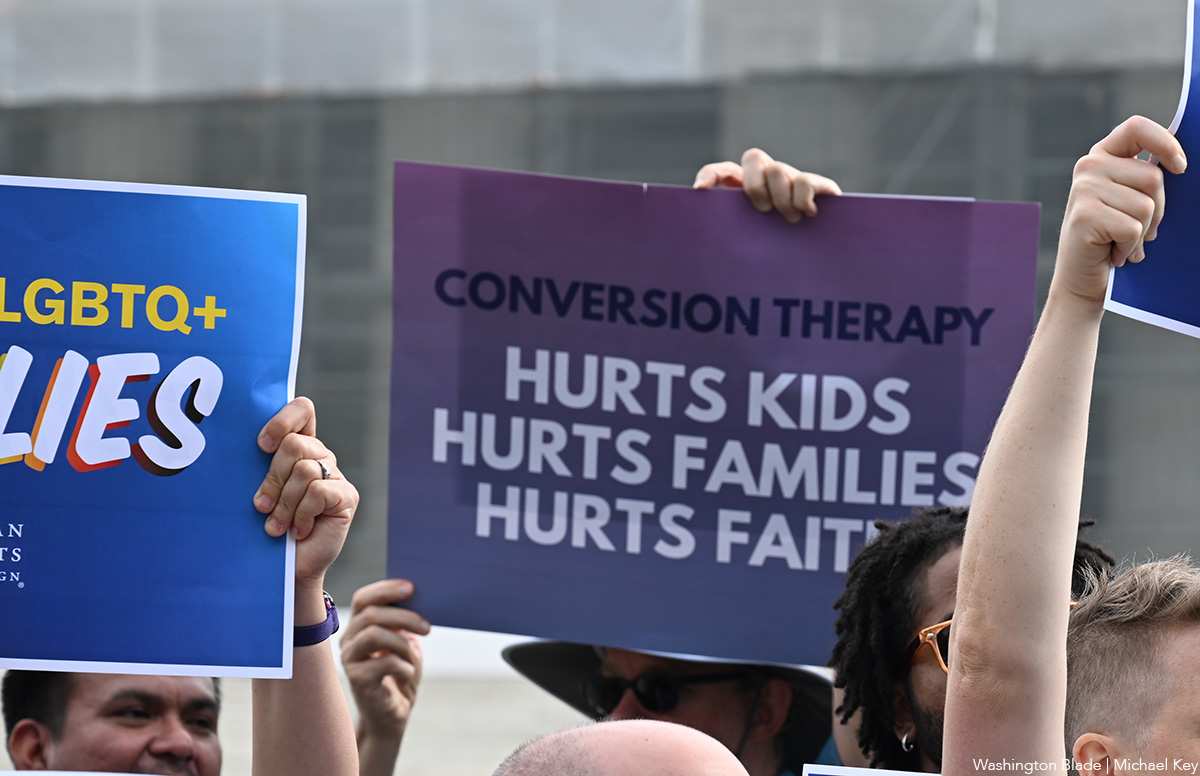
The same logic is why Colorado banned conversion therapy. The science was clear: research from The Trevor Project and others shows that exposure to conversion therapy increases suicidal ideation among LGBTQ+ youth, and more than doubles suicide attempts for transgender youth. Every major medical organization in the country – the American Medical Association, the American Psychological Association, and the American Academy of Pediatrics – has condemned the practice.
Colorado looked at the evidence and did what public health is supposed to do. It intervened.
On March 31, 2026, the Supreme Court struck down that intervention 8-1 in the Chiles v. Salazar case, ruling that conversion therapy is protected speech.
This decision should alarm anyone who believes that science has a role in protecting human lives. The court did not dispute evidence. It did not produce contradicting research or question the methodology of the studies Colorado relied on. Instead, it decided that the ideological underpinnings of conversion therapy deserve more constitutional protection than the children being harmed by it. In doing so, it severed the fundamental link between what science tells us is dangerous and what the law is willing to prohibit.
That severance has consequences far beyond Colorado, as Supreme Court Justice Ketanji Brown Jackson noted in her dissent. More than 20 states and Washington, D.C. have enacted conversion therapy bans. The court majority’s reasoning – that regulating talk-based practices constitutes censorship – hands challengers a blueprint. The scientific consensus that built those protections did not change on March 31, but its power to hold them in place did.
For LGBTQ+ public health researchers like us, this ruling is a reckoning. And a personal one. Both of us came to public health because it offered a way to ask questions that matter: How can we help people live safe, healthy, and happy lives?
As a Ph.D. student and an assistant professor focused on LGBTQ+ health, we have been energized by the possibility that rigorous research could inform policies that protect LGBTQ+ people. The Chiles v. Salazar ruling forces us to recognize something uncomfortable: the possibility of research driving policy is real, but it is not automatic. Evidence reaches policy only when researchers advocate to put it there. As it turns out, scientific evidence itself is not enough.
This means the work of LGBTQ+ health researchers cannot stop at the journal article. It has to extend into the spaces where policy is actually made and public opinion is actually influenced. Researchers must work alongside educators, communicators, and community organizers to make evidence impossible to ignore or misrepresent.
As Sylvia Rivera observed in 1971, “our family and friends have also condemned us because of their lack of true knowledge.” More than 50 years later, misinformation about conversion therapy, gender-affirming care, and LGBTQ+ health still fills the gap that researchers leave when they stay silent.
We also want to say this directly to LGBTQ+ young people: Science has not abandoned you. The evidence of your worth, your health, and your right to be protected is overwhelming and it is not going anywhere. The researchers, clinicians, and advocates who built that evidence are still here and still working to ensure it translates into the protection you deserve.
The Chiles v. Salazar ruling is a serious setback. But it is not the end of the argument.
Science has shown us how conversion therapy causes harm. It has shown us clearly, repeatedly, and with the backing of every credible medical institution in the country. The Supreme Court chose to look away. The only response to that is to make looking away harder. To build a public, cross-sector, science-informed movement that refuses to let evidence be sidelined when lives are on the line.
The evidence is on our side. Now, we have to make sure it counts.
Vincenzo Malo is a Health Services Ph.D. student at the University of Washington’s School of Public Health who studies affirming health systems. Dr. Harry Barbee is an assistant professor in the Johns Hopkins Bloomberg School of Public Health whose research focuses on LGBTQ+ health, aging, and public policy.

Rorschach stages ‘Dragon Play’ in unlikely, raw space

Wagons ho! High-class, head-turning haulers

Judge rescinds stay-away order in Capital Pride anti-stalking case

The latest Supreme Court case erasing LGBTQ identity

Calendar: April 17-23

Lebanese LGBTQ group responds to latest war

La X vuelve al tribunal

Inside the LGBTQ records of Todd Blanche and Markwayne Mullin

Trailblazing trans Brazilian lawmaker refuses to set foot in Trump’s America

Whitman-Walker Health to present ‘Pro Bono Excellence’ award to law firm
-

 Lebanon4 days ago
Lebanese LGBTQ group responds to latest war
-
Noticias en Español5 days ago
La X vuelve al tribunal
-
Federal Government4 days ago
Inside the LGBTQ records of Todd Blanche and Markwayne Mullin
-
Brazil4 days ago
Trailblazing trans Brazilian lawmaker refuses to set foot in Trump’s America