Opinions
Fighting for full equality in Virginia
Marriage isn’t the end of our struggle
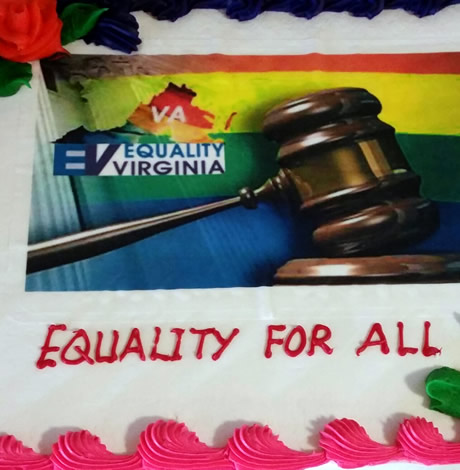

The 2014 Equality Virginia Commonwealth Dinner in Richmond, Va. (Washington Blade file photo by Michael Key)
Love won last week — Virginia’s lesbian and gay couples can now marry the person they love in the place they call home. Couples across Virginia are overjoyed, and we know that the ability to marry is just the beginning.
Marriage equality brings with it all the rights and responsibilities of marriage, including legally adopting the child you have raised for years, accessing your spouse’s medical benefits, and filing taxes jointly with your spouse. Beyond all of these important practical implications, marriage means something much deeper. There is no substitute for marriage, and as of Oct. 6, 2014, the commitment that Virginia’s married same-sex couples have long made to one another is validated under the law.
For the first time in their lives, many Virginians have gotten a glimpse of what equality really means; however, while we have secured the freedom to marry, true equality for Virginia’s lesbian, gay, bisexual, and transgender residents remains unfulfilled. Unfortunately, if you are an LGBT Virginian, you can still be fired from your job, denied housing, or turned away in a restaurant or other business — just for being who you are. If you are a transgender Virginian, you can still be denied necessary medical care — just for being who you are. This is not what true equality looks like.
The good news is that a clear majority of Virginians believe in fairness and equality, and most Virginia residents favor a state law that protects LGBT people from employment discrimination. The business community largely supports workplace non-discrimination because it makes good business sense, improves Virginia’s national reputation, and keeps Virginia competitive. But, despite overwhelming popular support, the majority of Virginia lawmakers continue to favor laws and policies that discriminate against Virginia’s LGBT residents.
While some lawmakers mistakenly say that discrimination based on sexual orientation or gender identity simply “doesn’t happen,” reality paints a different picture. On a national level, an estimated 8-17 percent of lesbian, gay, and bisexual people have reported being denied employment or unfairly fired. That number increases drastically for transgender individuals. Virginia is one of a handful of states where you can marry your same-sex partner, but can then be fired when your boss notices your wedding photo on your desk. As the country moves toward the freedom to marry, we must continue fighting for true equality in the commonwealth.
Even as the majority of businesses have made steps to protect their LGBT employees and believe that LGBT people must be treated with the same respect and dignity as all others, there are still some who think that they should have the so-called “right” to fire somebody, or to refuse service to somebody, based on their sexual orientation or gender identity. There is a word for that: discrimination. No Virginian should be treated differently because of who they are or who they love. It’s our job to make sure that ideal becomes reality.
Equality Virginia is working together with the clear majority of Virginians to bring full equality to the commonwealth. Gaining marriage equality is a tremendous victory and a huge step forward. Couples, families and allies across Virginia have worked hard for years to achieve this. However, until each and every LGBT individual and family in Virginia is treated with respect and dignity in the home, the workplace, the marketplace, and the doctor’s office, our work at Equality Virginia will not be complete.
James Parrish is executive director of Equality Virginia.





For half a century, the arc of LGBTQ progress in America has bent—slowly, imperfectly—toward justice. We fought for visibility, for legal protections, for the right to marry, serve openly, and live with dignity. Each generation built on the courage of the last.
And yet today, that progress is in peril. Across the country, lawmakers are rolling back protections, demonizing LGBTQ people for political gain, and trying to erase us from public life.
Opponents of our equality are working to erase us from the Constitution, and indeed, public life. In moments like this, based on my personal involvement working with one of the most effective leaders for LGBTQ rights I find myself asking a simple question: What would Jeffrey do?
Jeffrey Montgomery—the focus of a new documentary “America You Kill Me” and a long time Michigan activist and founder of the Triangle Foundation—was never content with quiet advocacy or compromise. He was a rabble-rouser, a strategist, and a relentless thorn in the side of powerful bigots. When politicians tried to marginalize LGBTQ people, Jeffrey didn’t politely ask for scraps. He forced the issue.
Jeffrey Montgomery started with his own determined voice and turned it into a movement. His story is living proof that personal courage can spark national conversations about justice and inclusion.
At a moment when the LGBTQ movement again faces hostility and regression, Jeffrey’s playbook offers lessons we would be wise to remember.
First, Jeffrey understood the importance of punching above our weight. In the early days of LGBTQ organizing, our movement was small, underfunded, and politically marginalized. But Jeffrey refused to let opponents see us that way. Through visibility, media savvy, and relentless organizing, he made LGBTQ advocates appear larger, stronger, and more unified than our numbers alone might suggest.
That perception mattered. Political opponents think twice before attacking a movement that looks organized, energized, and capable of mobilizing public pressure. Jeffrey knew that power is partly about reality—but also about what your opponent believes your power to be.
Second, Jeffrey never compromised on the value of our lives. Movements make compromises all the time. Politics often requires it. But Jeffrey understood that some things are not negotiable. The basic humanity of LGBTQ people is one of them. You can’t put our basic rights on the ballot. You don’t tell people to wait their turn. There are no turns. It’s now. It’s always now.
Too often, our opponents frame equality as something to be bargained over—as if the dignity and safety of queer people were a policy preference rather than a fundamental right. Jeffrey rejected that premise entirely.
You can negotiate strategy. You can negotiate timelines. But you cannot negotiate the worth of human lives.
And finally, Jeffrey understood the power of coalition. Today, one of the most effective tactics used against marginalized communities is division. If LGBTQ people can be fractured—by identity, ideology, generation, or strategy—our collective strength weakens.
Jeffrey instinctively resisted that trap. He worked with civil rights groups, labor leaders, faith communities, civic leaders and allies across movements. He understood that the fight for LGBTQ equality was never isolated from the broader fight for justice.
When opponents try to divide us, the answer is not retreat into smaller camps. The answer is to build broader ones.
If Jeffrey Montgomery were here today, he would not be discouraged by the backlash we are seeing. He would recognize it for what it is: the predictable response of those who feel their power slipping away.
And he would remind us that progress has never been linear. It has always required courage, persistence, and a willingness to challenge power directly.
So, when the moment feels uncertain, when the political winds shift against us, and when our opponents try to make us feel small, the question remains a useful one: What would Jeffrey do?
If history is any guide, the answer would be simple. He would make some noise. And making noise, today, means refusing to let fear, fatigue, or false unity quiet us when our lives are on the line.
Sean Kosofsky was director of policy at the Triangle Foundation.
Opinions
D.C. not the place for antisemitic Democratic Socialists of America
Candidates like Janeese Lewis George should reject its endorsement

D.C. is not the place for the antisemitic Democratic Socialists of America (DSA), who advocate for the end of the State of Israel from the ‘river to the sea.’ The candidates they endorse agree to their platform, which includes not talking to any Zionist organizations. Being a Zionist simply means supporting the existence of the State of Israel. It does not mean supporting the war criminal who heads the government, or what he is doing, including murdering innocent Palestinians, or bombing civilians in Iran and Lebanon. As Ron Halber, CEO of the Jewish Community Relations Council of Greater Washington, wrote in a column in DC Jewish Week, the views of the DSA are totally unacceptable.
The Council is non-political, but I am not. I can say one candidate for mayor, Janeese Lewis George, has asked for, and received, the endorsement of the DSA, and by doing so agrees to its antisemitic platform. After her endorsement became public, George tried to ‘privately apologize’ saying she didn’t see the questionnaire submitted by her campaign, rather it was submitted by a staffer. Now George says she is both not antisemitic, and supports Palestinians. Well, that sounds good. But she, and anyone else who accepts the DSA endorsement, has to answer a series of questions: 1. Are you for a two-state solution and the continued existence of the State of Israel, contrary to the position of the DSA? 2. Do you support BDS? 3. What is your definition of a Zionist? 4. What is your acceptable definition of antisemitism? 5. Will you meet with Zionist groups in DC?
Then, we must recognize if one candidate, like George, can go after and accept an endorsement from an antisemitic organization, it gives tacit permission for others to do the same with organizations that might be Islamophobic, racist, homophobic, sexist, or anti-immigrant. All unacceptable. I urge D.C. voters to reject any candidate, for any office, who has the endorsement of the DSA. That is not what we want the leaders of our government to represent.
Thankfully, there are many choices in this year’s Democratic primary elections for every office. There is a race for mayor, congressional delegate, attorney general, Council chair, two D.C. Council at-large seats, additional Council seats, Democratic State Committee seats and ANCs. D.C. political leadership will look very different after this election.
I urge voters to whittle down their choices by first rejecting anyone endorsed by the DSA. The DSA’s platform, aside from being antisemitic, also includes suggestions to ‘Defund the Police.’ That is a slogan some of the candidates running adopted a few years ago, thinking the people wanted it. They quickly found the people of D.C. didn’t want fewer police, they wanted their police better trained, with better community oversight. They wanted to be sure the police were here to protect them, not to harass them. People should know the DSA at one point even withdrew its endorsement from Rep. Alexandra Ocasio-Cortez (D-N.Y.) as she wasn’t strident enough in her opposition to Israel and actually met with a Zionist organization. There are many Zionists like me — a gay, Jewish man — who support the existence of the State of Israel, yet want to see Netanyahu, a war criminal, a murderer, tried for his crimes and in jail, and his government replaced. Zionists who support Palestinians and want them to have their own free state.
As you decide who gets your vote, one way to find out about a candidate is looking at their website. I would suggest you reject any candidate who doesn’t have a strong issues section. The least you can expect of a candidate is to tell you in detail what they intend to do if you elect them. That includes our delegate to Congress, even if they won’t have a vote. If Democrats take back the House of Representatives, we can expect our delegate to once again get a vote in committee, and that can be very important.
In the next couple of weeks, I will make some endorsements and share them with you in the Blade, for anyone who might be interested. They will detail why I endorse a particular candidate. I will not suggest second, third, fourth, or fifth choices. That is for you to decide. No matter who you give your first vote to, even with ranked choice voting, you can still vote for only one person. If you decide to list more choices, make sure the views of your second, and other choices, coincide with those of your first choice.
So here is to an honest election season, one in which we end up with candidates winning who really care about our city, who have proven track records, and who will make us proud. Your job is to VOTE, and I hope everyone will.
Peter Rosenstein is a longtime LGBTQ rights and Democratic Party activist.
Commentary
Is Ghana’s selective justice a human rights contradiction?
Country’s commitment to human rights appears inconsistent

Ghana’s mission to have the United Nations recognize the trafficking of enslaved Africans and racialized chattel enslavement as the gravest crime against humanity is a historic milestone. The resolution adopted on March 25, 2026, with 123 out of about 180 countries in support, marks a major step toward global acknowledgement of the brutality and inhumanity of slavery. A 2022 report by the Equal Justice Initiative, “The Transatlantic Slave Trade,” highlights how during the slave trade, Africans who were enslaved had no rights, freedom, recognition or protection under the law. They had no voice, no bodily autonomy, no respected identity and could be brutally violated with no legal protection. This history represents a grave crime against humanity.
In my opinion, Ghana and the other countries that voted in favor are entirely right to say that such historic events cannot be sanitized or reduced to diplomatic language. Recognition is the first step towards accountability. This matter is important because it is arguably the foundation of the modern-day injustice and inequality people experience, including wealth inequality, racism, sexism, xenophobia, and queerphobia.
The double standard
Yet, despite this important step on the world stage, Ghana’s commitment to human rights appears inconsistent. The same government advocating for justice for enslaved Africans is enacting laws that jeopardies the rights of Africans today. This contradiction between Ghana’s international stance and its domestic policies is at the heart of the discussion.
In February 2026, the Ghanaian parliament formally received the Human Sexual Rights and Family Values Bill. The bill is a grave threat to the rights to nondiscrimination, protection under the law, privacy and freedom of association, assembly, and expression. It expands criminalization of LGBTQ+ people, and anyone associated with them. This Human Sexual Rights and Family Values Bill calls for a three-year imprisonment for anyone who identifies as LGBTQ+, anyone who has gender affirming treatment, anyone who enters into a same-sex marriage or attends a same-sex wedding and anyone who promotes equal rights for LGBTQ+ people. It turns enforcement into a societal obligation rather than just a state function, encouraging people to report anyone who looks suspicious or different. This further legitimizes the brutal attacks on LGBTQ+ people socially, which leaves the people of Ghana with blood on their hands.
Ghana’s proposed and reintroduced anti-LGBTQ+ legislation is said to be among the most restrictive in the world and will result in the inhumane treatment of LGBTQ+ people. It not only further criminalizes consensual same-sex relations but also targets civil society organizations that are perceived to be supporting equal rights for LGBTQ+ people. So, if this law passes, it will be illegal to support equal rights and challenge the inhuman treatment of queer Ghanaians and allies. Is this not a double standard? Ghana seeks justice for the ill-treatment of Africans during the transatlantic slave trade but is actively in the process of seeking to harm its own people.
This is not theoretical harm; it is practical harm. According to the Human Rights Watch, LGBTQ+ people in Ghana already face systemic stigma, discrimination, harassment and violence, often enabled by both legal frameworks and social stigma, resulting in a hostile climate.
Ghana falls short of upholding human rights at home
On the global stage, Ghana is arguing that the dehumanization of Africans through slavery was so severe that it constitutes the gravest possible violation of human dignity. This argument rests on a core principle that reducing people to less than fully human is unacceptable under any circumstances.
Back at home, the state is endorsing laws that do exactly that to LGBTQ+ people. Criminalizing identity, suppressing expression, clamping down on civic space, monitoring and surveilling citizens and advocating for social exclusion. These are elements of dehumanization signaling that some are less deserving of protection, dignity, respect, and justice. That is the definition of a double standard.
Supporters of these laws often frame homosexuality as un-African, but this claim does not hold up under scrutiny. In his article, “The ‘Deviant’ African Genders That Colonialism Condemned”, Mohammed Elnaiem emphasizes that historical and anthropological evidence shows that diverse sexualities and gender expressions existed across African societies long before colonial rule. Ironically, many of the laws used to criminalize LGBTQ+ people today trace directly back to the colonial-era. This is even supported by the African Court, which, in December 2020, through its Advisory opinion, made it clear that these colonial-era laws are discriminatory and perpetuated marginalization. The African Court also called on African states to take action in this regard.
It is no secret that anti-rights actors are actively operating in Ghana and supporting leaders to advance their anti-rights agenda. They are increasingly organized, visible, well-funded, and influential in shaping state policy. The upcoming 4th African Inter-Parliamentary Conference on Family and Sovereignty, scheduled to take place in Accra from May 27-30, 2026, is a clear example of this coordination. The conference endorses the so-called African Charter on Family Values, a deeply contested initiative that frames LGBTQ+ people as a threat to children and positions queer identities as foreign ideologies. This platform is being used to legitimize and advance anti-LGBTIQ+ legislation, restrict comprehensive sexuality education and roll back sexual and reproductive health rights. In this context, the treatment of LGBTQ+ people in Ghana cannot be viewed as isolated policy choices, but rather as part of a broader coordinated anti-rights agenda that normalizes and legalizes discrimination. It fuels increasingly inhumane conditions for queer communities and civil society. Ghana is simultaneously rejecting colonial injustice in one breath while enforcing colonial-era morality laws in another.
There is also a legal inconsistency worth noting. Ghana’s own Constitution guarantees the right to life, protection from violence, the right to personal liberty, the right to human dignity, equality and freedom from discrimination and the right to a fair trial. Yet, in practice these rights are not equally applied to LGBTQ+ individuals. Depriving equal rights to LGBTQ+ persons is the same as what the slave owners did to slaves.
You cannot build a credible human rights position on selective application
To be clear, recognizing slavery as a crime against humanity is not diminished by pointing out this contradiction. Both truths can coexist: the UN resolution is a victory and Ghana’s domestic policies remain deeply troubling. In fact, holding both realities together is necessary if the language of human rights is to mean anything at all. Ghana has taken a powerful stand on the global stage. The question now is whether it is willing to apply that same moral clarity at home.
Bradley Fortuin is a consultant at the Southern Africa Litigation Center and a human rights activist.

Surviving spring cleaning

Iconic Eddie Izzard takes on 23 characters in ‘Hamlet’

How Pepper the courthouse dog helps victims of abuse

Women’s FEST returns to Rehoboth Beach next week

Belarusian lawmakers approve bill to crackdown on LGBTQ rights

Supreme Court rules against Colo. law banning conversion therapy for minors

Senegalese president signs bill that further criminalizes homosexuality

Trans activists gather on National Mall for Transgender Day of Visibility

Md. lawmakers reaffirm legislative priorities

The cost of speaking one’s mind
-

 U.S. Supreme Court4 days ago
Supreme Court rules against Colo. law banning conversion therapy for minors
-
Senegal4 days ago
Senegalese president signs bill that further criminalizes homosexuality
-
District of Columbia4 days ago
Trans activists gather on National Mall for Transgender Day of Visibility
-
Maryland4 days ago
Md. lawmakers reaffirm legislative priorities