Theater
‘Oliver!’ gets a new twist
Arena production is dark yet lively
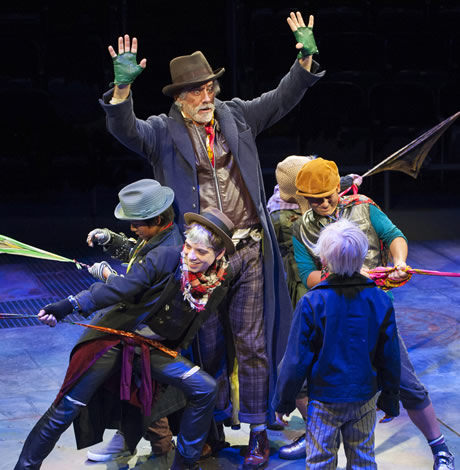
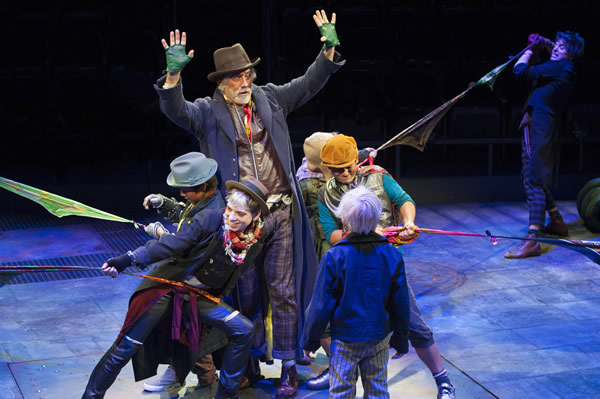
Jeff McCarthy as Fagin and the company of ‘Oliver!’ at Arena Stage. (Photo by Margo Schulman, courtesy Arena)
‘Oliver!’
Through Jan. 3
1101 Sixth St., S.W.
$50-127
202-488-3300
In the run up to Arena Stage’s “Oliver!,” Director Molly Smith promised a production straddling varied London eras and she’s certainly delivered.
Assisted by a dream design team, Smith melds a gloomy world of work houses, child labor, petty thefts with iPhones, urban camping and drugs, smartly showing the ongoing struggle of the city’s have-nots. It’s an exciting approach to the timelessness of a beloved tale.
The first Charles Dickens’ novel successfully adapted for the stage, “Oliver!” follows the travails of young orphan Oliver Twist as he bounces from one fraught-filled situation to the next until finally landing safely into the arms of his long-lost middle-class grandfather thanks to the intrepid intervention of a goodhearted hooker named Nancy.
The show kicks off with “Food, Glorious food” a raucous “Stomp”-inspired number featuring Oliver and a rowdy band of acrobatic orphan boys banging pie pans. Next Oliver is sold to an abusive but fashion-forward family of undertakers. Yet like most staged productions of “Oliver!” things don’t take off until Oliver meets up with the Artful Dodger (the excellent Kyle Coffman), a pickpocket and street kid who invites him to join career criminal Fagin’s band of boy criminals.
With music, lyrics and book by Lionel Bart, “Oliver!” premiered in London’s West End in 1960. The show’s darker moments are buoyed by camaraderie among thieves and an uplifting score that includes “Consider Yourself,” “I’d Do Anything” and the beer hall song “Oom-Pah-Pah.” Arena’s version updates the music and dance and heightens the darkness.
Before the show begins, a lone boom box sitting on an otherwise empty stage serves as a tip that this isn’t “Oliver!” as usual. Under Paul Sportelli’s musical direction, the 13-member orchestra tucked away under the stage adds an urban funk feel to Bart’s familiar score without detracting from recognizable classics. Parker Esse’s athletic choreography is a terrific blend of traditional and street moves.
Oliver is played by Jake Heston Miller, a towheaded fourth grader (but looks younger) from Arlington. Miller’s Oliver is a scrappy kid, making his fighting, running away and bonding with street urchins all the more believable. Yet he’s still exceedingly young and vulnerable especially when singing “Where Is Love?” while resting atop a coffin. And later when Fagin offers him a nightcap, Oliver places the proffered silver flask on his head and crawls into bed.
Talented New York actor Jeff McCarthy’s Fagin is no hideous old skinflint. He’s more a career crook who’s slid into middle age and is making ends meet leading a band of underage moneymakers. His current occupation seems a temporary gig among many shady gigs.
As mohawked Nancy, prostitute and girlfriend to the feared Bill Sikes, Eleasha Gamble is a powerhouse. It’s hard to believe she puts up with Sikes, but alas she’s in love. She’s also a mother figure to Fagin’s wayward boys. She gathers them around story circle style and belts an ode her freewheeling lifestyle with “It’s a Fine life.”
Wade Laboissoniere’s costumes are a mélange of East Village punk — holey leggings and battered kilts — as well as Victorian cutaways and contemporary street clothes. London’s Bobbies look entirely current in their reflective vests, and Stephen Gregory Smith’s hapless Dr. Grimwig is a modern dandy who’d make Vogue’s Hamish Bowles proud.
Though suffused in Dickensian poverty past and present, Smith’s “Oliver!”offers more than a few riches.





Theater
Rorschach stages ‘Dragon Play’ in unlikely, raw space
Out sound designer Madeline ‘Mo’ Oslejsek notes ‘sound is my bag’

‘Dragon Play’
Through May 17
Rorschach Theatre
The Stacks @ Buzzard Point
101 V St., S.W.
$50 ($35 for students and seniors)
Rorschachtheatre.org
Celebrated for its site-specific, immersive productions, Rorschach Theatre puts on plays all over town. The unlikely spots have included greenhouses, church vestibules, closed retail spaces (including a vacant downtown big and tall men’s store) and historic locales like Rock Creek Cemetery’s Adams Memorial.
For its current offering “Dragon Play” (through May 17), a tale of love and longing, Rorschach is using a raw space in The Stacks at Buzzard Point, a new mixed-use neighborhood situated where the Anacostia and Potomac rivers meet.
Out sound designer Madeline ‘Mo’ Oslejsek considers all sites – whether traditional theatrical spaces or not – specific, particularly in terms of sound. She says, “Part of my practice is if you’re creating a soundscape for a theatrical production you’re also working with sound that already exists with the space.”
For instance, The Stacks space comes with its own unique qualities. It’s a large cement room that has a different reverberation, an echo.
“Some sounds (a car, dog bark) are planted or they might just happen. What starts as a live sound might be heard again as something recorded.”
Whip smart with a ready laugh, Oslejsek never set out to be a sound designer. She was going to direct. And now, the 2025 Helen Hayes Award nominee for Outstanding Sound Design (“Astro Boy and the God of Comics” at Flying V,) says, “Sound is my bag. Sometimes it seems that I’m the only one in the room thinking about it.”
As an undergrad studying theater at Ohio Wesleyan University, she was first exposed to sound design, but it didn’t make a big impression.
In grad school at Royal Central School of Speech and Drama, University of London, she was interested in direction. But when students were offered a choice of three more specific tracks to choose from (performance, composition, and scenography, which includes sound design), Oslejsek was swayed.
“An introduction to scenography by the department head radically changed the course of my life,” she says.
What struck her most about sound was the subjectivity: “The core of my practice is that sound has no meaning until it’s experienced. All sound is noise. It’s just a pitch, active, or vocalization. It becomes real when you hear it and apply meaning to it. That’s very exciting to me.”
Today, Oslejsek and partner Caitlin Hooper, an actor and intimacy choreographer, are based in Baltimore but work primarily in D.C.
“It feels good to be in a place where art and queerness in art are celebrated. It’s not like that everywhere, and making that kind of work down the street from this White House where that’s not the vibe, is real resistance. That feels really meaningful.”
Also important to Oslejsek (who identifies alternately as queer and lesbian) is “queer as a practice,” a concept suggesting that a queer identity or practice does not seek to replace other identities but to encompass and bridge them.
“I’m queer because I like women, but the work is more about making room for what everyone in the room hears,” she says. “Never do I want to come into a space thinking I have all the answers. That’s no fun.”
As its title might suggest, Jenny Connell Davis’ play directed by Rorschach’s Randy Baker is filled with magic. “Dragon Play,” blurs the past and present; one world bleeds into the next; and, of course, there are dragons. At 80 minutes with no intermission, the play moves in and out of different timelines; increasingly things start to overlap.
And it’s also about the magic of relationships – all kinds. There’s a line where the dragon girl asks a Texas boy what he dreams about and he replies “you, always you.”
Oslejsek, 30, is touched by those words: “In my little gay heart, I cried. It makes me think of my partner. This play is about the idea of people who strike a match in your heart that never really goes away.”
In creating a layered soundscape, she brings her own brand of magic to the production. Her big goal was “not to play with how we think a dragon might sound, but rather with how does the world sound to a dragon.”
Sometimes sound design takes the lead, but in some productions, sound is purposely subtle or secondary, she says. Either way, sound can be monumental in shaping theater.
Theater
Minimal version of ‘Streetcar Named Desire’ heading to Dupont Underground
Director Nick Westrate on this traveling take on Williams’s masterwork

‘A Streetcar Named Desire’
Produced by The Streetcar Project
April 20-May 4
Dupont Underground
19 Dupont Circle, N.W.
Tickets start at $85.
Dupontunderground.org
An aggressively minimal version of Tennessee Williams’s “A Streetcar Named Desire” is poised to run at Dupont Underground (April 20-May 4), the nonprofit cultural space located in a repurposed, abandoned 1949 streetcar station beneath Dupont Circle.
The Streetcar Project’s production performs in site-specific spaces. It’s almost entirely without design elements. There is no steamy, cramped Vieux Carré apartment. You won’t see Blanche’s battered trunk exploding with cheap finery, faded love letters, and demands for back property taxes, or the familiar costumes.
Co-created by Lucy Owen (who stars as Blanche DuBois) and out director Nick Westrate in 2023, this traveling spare take on Williams’s masterwork about a fragile woman on the margins in conflict with her brutish brother-in-law seems a reaction to necessity. It’s also an exploration of whether, like Shakespeare’s “Henry V,” it can subsist on language alone.
With little distractions (even Blanche’s cultivated southern belle accent has been daringly stripped away), the spotlight shines almost solely on text. “This play holds that,” says Westrate, 42. “I remind the actors that the while there is plenty of movement, language is really the only game in town.”
New York-based Westrate, who’s best known as an esteemed actor with New York and regional credits including Prior Walter in János Szász’s production of “Angels in America” at Arena Stage, describes “Streetcar” as “the most perfect play on earth” but not one he thinks of acting in (“I’m not right for Stanley Kowalski or Mitch”) though he agreed to direct.
“These days if you’re not a not a movie star or an established director, you’re not likely to do “Streetcar.” So, for us, we have to be able to do it with almost nothing, on the New York subway if necessary. And that’s kind of how we built it.”
Westrate first experienced Dupont Underground while attending a staged reading. He was so obsessed with the space as a prospective place to take the production, he found it hard to concentrate. He says, “With its long, curved track and tunnel, Dupont Underground is a terrifying, beautiful room that carries so much metaphorical weight, so much possibility for our production.”
WASHINGTON BLADE: Is finding the right space for this “Streetcar” part of the thrill?
NICK WESTRATE: Whenever I enter a weird room or pass by an abandoned CVS, I try to figure out how we might do the show there, especially places that are dilapidated, architecturally odd, or possibly haunted. And each space we use, lends something to the production. The Rachel Comey store in Soho was a very Blanche coded space. And an artist’s workshop on Venice Beach in California with its huge saws and metal hooks lent raw imagery. The scenes between Blanche and Stanley near the end were absolutely terrifying.
BLADE: More recently that same bare bones production has played in more traditional spaces like the Wheeler Opera House in Aspen and San Francisco’s A.C.T. Is it hard to now go to Dupont Underground?
WESTRATE: Each time we do this we have to crack open the play again because the staging is entirely new, but we’re used to performing in unusual spaces and Dupont Underground rather takes us back to form. As a former streetcar station, it’s the most appropriate space we’ve had yet.
The cast will literally act on streetcar tracks and go without dressing rooms but they’re game, and because they have history and authorship over the work, the sacrifice is more meaningful than if they were just some hired guns.
BLADE: Audiences have an expectation, especially with a work they’re likely to know. How do they react seeing such an unadorned take on Williams’s American classic?
WESTRATE: For the first 10 or 15 minutes, they’re unsure. Then, you can pretty much see the audience members’ brains click in and their imaginations turn on. It’s like they’re scratching an itch that they didn’t even know they had.
BLADE: Did you and Lucy foresee gaining this kind of momentum behind your vision?
WESTRATE: Absolutely not. Lucy had a philosophy that we’ll just walk through open doors. Early on, we were given spaces and artists filled the seats, and increasingly we’ve begun to rent some spaces and attract more regular theatergoers.
We basically sell tickets in order to pay a living wage to artists involved. There isn’t some big institution or commercial producer who’s getting a lot of money from this. Audiences of all types seem to respond to this mode of making theater.
BLADE: In presenting “Streetcar” intermittently, usually with the same cast over three years in wildly varying venues, have you learned more about a piece that you already loved?
WESTRATE: Mostly I’ve come to realize that Blanche is the smartest character I’ve ever read in a play. She’s like Hamlet – tormented by dreams and terrified of death. She’s skilled at wordplay and always ahead of everyone else in the room. Also like Hamlet, people think she’s insane and she uses that to her advantage.
Blanche is certainly the Everest of roles for actresses and watching Lucy sort of break it apart in a different way than you’ve ever seen, and knowing that I’ve helped to facilitate this performance has been one of the great joys of my career.
Theater
Iconic Eddie Izzard takes on 23 characters in ‘Hamlet’
Energized take on role offers accessible way to enjoy Shakespeare
‘The Tragedy of Hamlet’
Through April 11
Shakespeare Theatre Company’s Klein Theatre
450 7th St., N.W.
Tickets start at $90
Shakespearetheatre.org
Eddie Izzard is an icon.
Best known for her innovative standup and film roles, the famed British performer is also a queer activist who over the years has good-naturedly shared details from her decades long trans journey. What’s more, Izzard has remarkably run 43 marathons in 51 days for charity.
And now, Izzard finds a towering new challenge with the worldwide tour of “The Tragedy of Hamlet” (at Shakespeare Theatre Company’s Klein Theatre through April 11), in which she plays 23 characters (Hamlet, King Claudius, Queen Gertrude, the ghost, etc.) in a solo performance running just over two hours.
At a recent performance, Izzard, before slipping into character, appeared on the unadorned stage to say that though infused with comedy, “Hamlet” is definitely a tragedy, a story of a family and country both tearing themselves apart. She also warns that there’ll be a lot of breaking the fourth wall. After all, it didn’t exist in 1600 around the time when “Hamlet” was written.
The play unfolds in flurry of movement and scandal as the Danish prince begins to plot revenge after learning that his father, the old king was conspired against and murdered.
While some of Izzard’s character shifts are shown only by a subtle change in stance or modulation of voice, others are more obviously displayed like court sycophant Polonius walking with a stiff leg and mimed cane, or his ill-fated daughter Ophelia trotting girlishly across the upstage platform.
Delivered downstage at the intimate Klein venue, Izzard’s Hamlet soliloquies are performed with striking clarity. The one actor play is adapted and edited by Mark Izzard (the star’s older brother) and directed by Selina Cadell who successfully fosters the visceral connection between the actor and the house. Directly addressing an audience is something Izzard does exceedingly well. You feel as if she’s looking at/speaking to only you.
Cuts and choices are made that might not please traditionalists. The stabbing of eavesdropping Polonius might prove disappointingly underplayed to some. Whereas, the subsequent satisfying dual/death scene is long and precisely choreographed. Fear not, Izzard doesn’t flag a bit, not even when battling a cough (as was the case on the night of No Kings Day).
Not surprisingly, Izzard leans into the comedy. Her deliciously placed pauses, lines read ironically, and double takes, all gifts of comedy sharpened to perfection over a long career that kicked off as a street performer in the early eighties in London’s Covent Garden.
The play within a play scene finds Hamlet slyly rattling the conscience of King Claudius. As played by Izzard, it’s wickedly delightful and especially good. And the back and forth between the grave diggers done as a clever Cockney and his green assistant is a master class in how to play a Shakespearean clown.
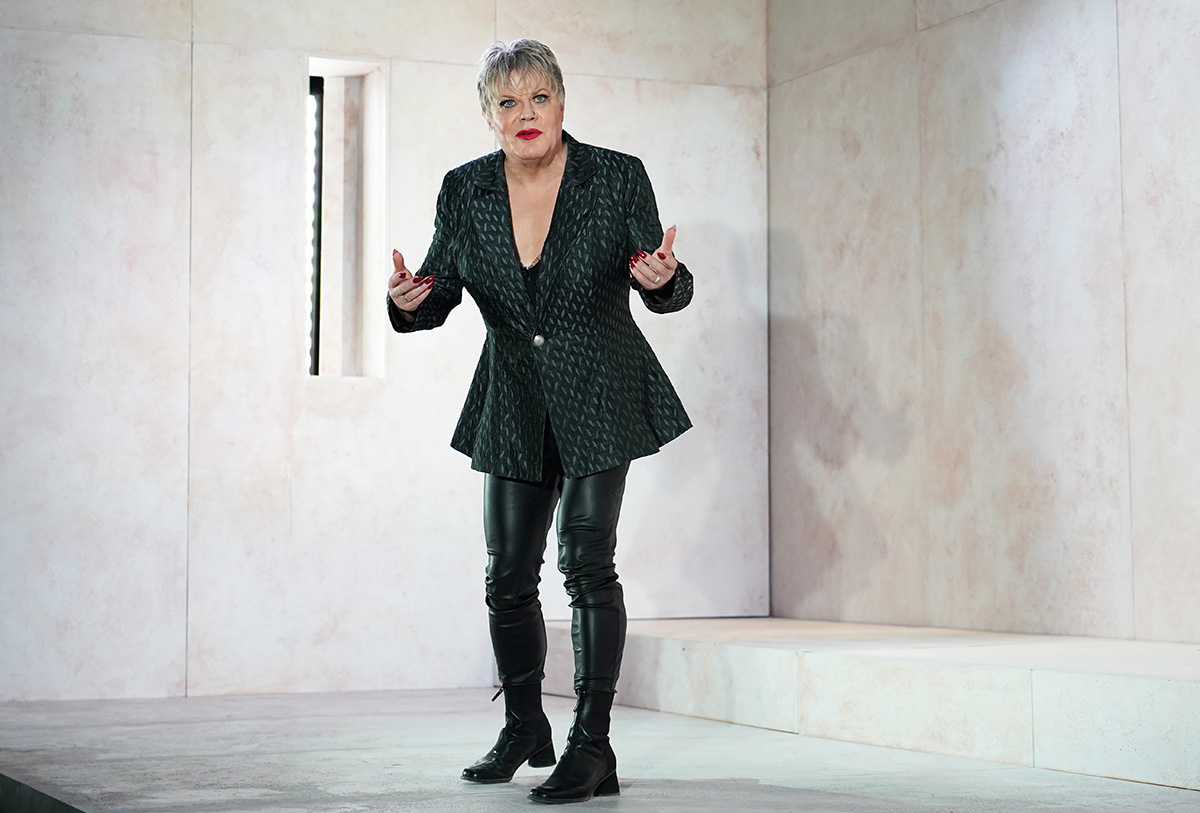
Kitted out in a black peplum jacket over leather leggings and boots, Izzard gives gender fluid shades of contemporary diehard scenester and a Renaissance courtier. (Design and styling by Tom Piper and Libby DaCosta)
Attention has been paid to the blonde high ponytail, crimson lips and matching lacquered nails. The hands are important. Whether balled into fists or fingers fluttering, they’re in use, especially when playing Hamlet’s ex-friends Rosencrantz and Guildenstern (a clever surprise that can’t be spoiled).
Tom Piper’s set is wonderfully minimal. It’s an empty white walled space with three narrow windows that appear cut deeply into stone like those of a castle. These white flats serve as the ideal canvas for lighting designer Tyler Elich’s looming shadows, ghostly green light, and other unexpected flourishes of drama.
Izzard fills the stage. Her presence is huge, and her acting first-rate. At times, you forget it’s a one-person show.
I’d like to say, prior knowledge of the Bard’s best tragedy isn’t necessary to enjoy this fast-paced production. Despite a halved runtime and obscure words replaced with modern equivalents (“tedious old git” Hamlet says of Polonius), familiarity with the play is helpful.
With “The Tragedy of Hamlet,” Izzard secures a place among fellow queer Brits like Miriam Margolyes (“Dickens’ Women”), Sir Ian Mckellan (“Ian McKellen on Stage”), and more recently Andrew Scott (“Vanya”) in the solo players’ pantheon.
Izzard’s energized take on Hamlet is terrific. The way her powerful public persona bleeds into the work without taking over is exciting, and a uniquely accessible way to enjoy Shakespeare.

Rorschach stages ‘Dragon Play’ in unlikely, raw space

Wagons ho! High-class, head-turning haulers

Judge rescinds stay-away order in Capital Pride anti-stalking case

The latest Supreme Court case erasing LGBTQ identity

Calendar: April 17-23

Lebanese LGBTQ group responds to latest war

La X vuelve al tribunal

Inside the LGBTQ records of Todd Blanche and Markwayne Mullin

Trailblazing trans Brazilian lawmaker refuses to set foot in Trump’s America

Whitman-Walker Health to present ‘Pro Bono Excellence’ award to law firm
-

 Lebanon4 days ago
Lebanese LGBTQ group responds to latest war
-
Noticias en Español5 days ago
La X vuelve al tribunal
-
Federal Government5 days ago
Inside the LGBTQ records of Todd Blanche and Markwayne Mullin
-
Brazil4 days ago
Trailblazing trans Brazilian lawmaker refuses to set foot in Trump’s America