Opinions
Orlando attack rocked our world
Despite horror of shooting, love will prevail
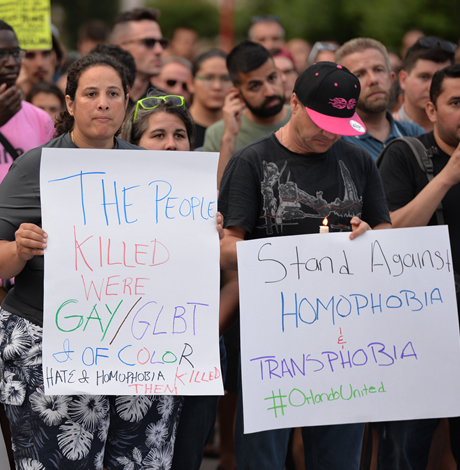
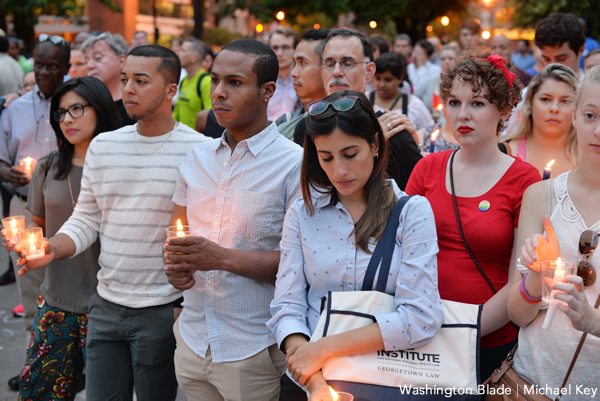
Vigils were held at Dupont Circle following the mass shooting at the Pulse nightclub in Orlando, Fla. (Washington Blade photo by Michael Key)
June was LGBT Pride month, a time when we celebrate values like equality, diversity, inclusion and dignity. As a civil rights attorney, I’ve had the good fortune to spend the majority of my career working on these noble values and against discrimination rooted in ignorance, stereotypes, assumptions, bigotry, fear—and yes, sometimes anger and hate. The horrific tragedy in Orlando rocked my world on many levels, particularly because it threatened these values that I hold so dearly.
I attended several of the vigils held in Dupont Circle for the Orlando victims. At each one, I was struck by the intersectionality of so many different groups coming together—LGBT community members and allies, people from varying racial, ethnic and socio-economic backgrounds, and people of all different faiths as well as some who do not subscribe to any particular set of religious beliefs or simply may be questioning a greater power. It was truly inspiring. I am the youngest, openly gay son in a big, Mexican-American, Catholic, middle-class family of nine children who grew up in Kansas. I realize there is a lot packed into what I just said but viewed another way, it all perfectly describes who I am. And just like me, each victim in Orlando has their own complex, yet inter-connected and perfect story too.
Earlier in my life, I struggled with trying to reconcile parts of who I am, such as my faith and my sexual orientation and, to some extent, being Latino. Many people in the LGBT community have had similar struggles. Society often makes many of us feel that we have to choose which parts we can be, and to whom and when we can share those parts. Even worse, society makes many of us feel that we have to actually reject some of who we are, particularly when we get messages suggesting that being gay is not normal or it makes us bad people. But members of our community are gay and people of color. We are gay and people of faith. And this is not just the reality, it also is normal — and it is good. We have worked so hard to ensure that differences among us are not used as reasons to discriminate. That stereotypes and assumptions are not used to justify bigotry and hate. We cannot let fear and ignorance cripple these efforts now.
I am passionate about these issues. I am so lucky to have found a place to work that not only makes me happy and proud every day, but also allows me to be my full authentic self. I say this because for many in the LGBT community, gay bars and clubs historically have provided the safe space where people could bring their full authentic selves, often for the first time, without fear of judgment, ostracism, or even injury by family members at home, strangers on the street, or law enforcement in their communities.
I remember my first time at a gay nightclub, seeing two men holding hands and later dancing together. It was beautiful and it made me feel welcome, proud and happy. In one article I read, an Orlando resident who frequented the Pulse nightclub stated that the club was where he learned to love himself as a gay man. The recent tragedy threatened this space that had long been viewed as safe and happy, not just in Orlando, but all around the world because it could have happened anywhere.
Here in Washington, D.C., we are fortunate to have many places that are providing help to the LGBT community in the wake of the Orlando shooting massacre. The DC Center for the LGBT Community is providing much of the needed assistance, from hosting a forum attended by hundreds to mourn and discuss the impact of the attack to offering individual and group mental health counseling for people grieving or suffering from prejudice and violence.
Along with countless others, I will continue to work tirelessly to be one of those who not only supports our community during this time of healing, but also advocates for action both to ensure the LGBT community has safe spaces as well as to prevent tragedies like this from happening in the future. While we have accomplished much, we still have a long way to go. Let us all remain hopeful that in the end, kindness, respect, justice—and yes, I daresay even love will prevail.
Louis Lopez is a board member of the DC Center for the LGBT Community.




Commentary
Celebrate Pride in Lost River, a slice of rural heaven
West Virginia LGBTQ getaway hosts events June 12-14
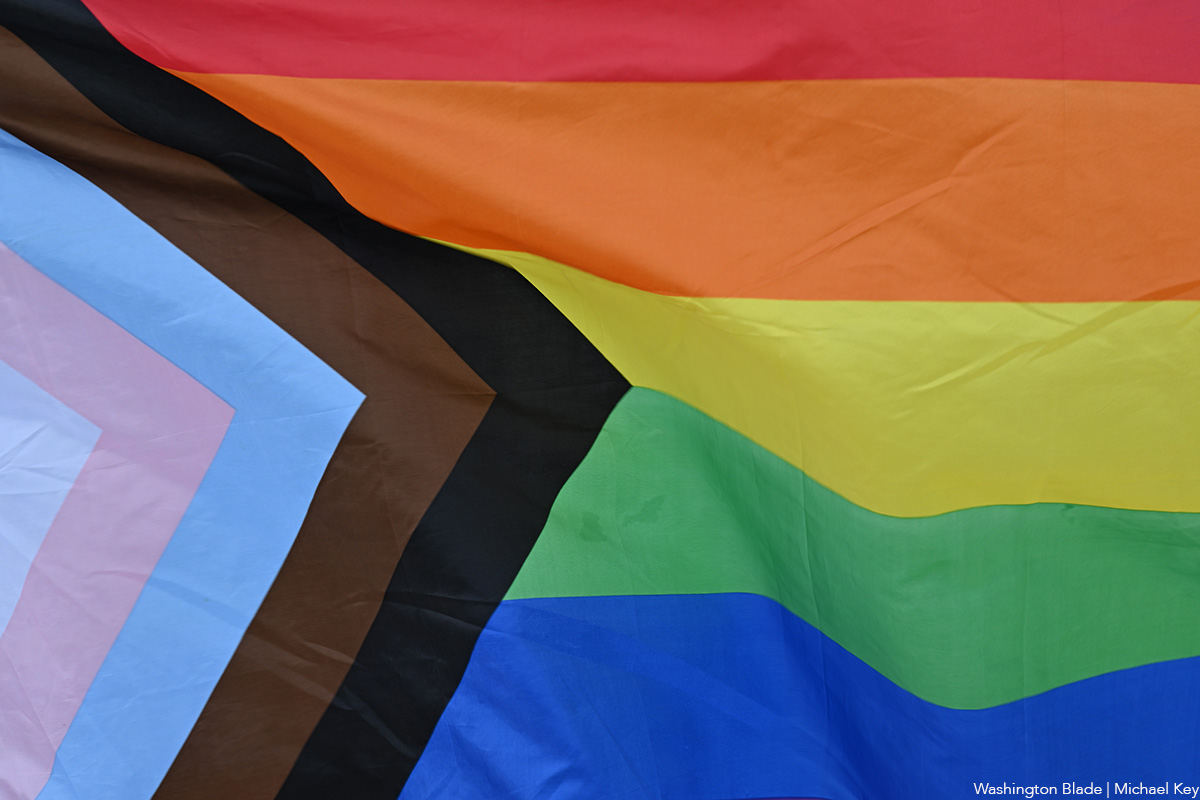
“Country roads, take me home, to the place I belong, West Virginia …” Those immortal lyrics describe one of the best-kept secrets for LGBTQ Washingtonians: Lost River, W.Va.
Less than 2.5 hours from the D.C. metro area, Lost River, in Hardy County, W.Va., is a haven for LGBTQ Mountaineers and our nearby city neighbors. From queer-owned businesses and artwork to a vibrant community of LGBTQ residents, Lost River has been a destination for LGBTQ visitors seeking a mountain getaway for nearly 50 years. For some, our rural community has become home for those who want to trade city life for country living.
Because Lost River welcomes all, we celebrate Pride each year in our slice of heaven.
Lost River Pride Weekend will be held June 12–14, the weekend prior to Capital Pride. If you haven’t been, our Pride is a little different from the urban Pride events most people are used to. In Lost River, forget the multinational corporate sponsors. Instead, think about local talent, grassroots community organizations, and our version of patriotism on full display. Most of all, we welcome people from all walks of life to live authentically as themselves, regardless of where they come from, how they think, or how they love. We truly welcome everyone.
Coincidentally, Lost River Pride Weekend is being held on President Trump’s birthday weekend, including a variety of traffic-jamming events in the D.C. area and the upcoming fight on the White House lawn. Why not come visit Lost River for the day or the weekend (we have some wonderful places to stay) and get a taste of West Virginia living?
While our town has only about 500 people at any given time, we swell to over twice that during Pride weekend. Friday evening includes an intimate cabaret at the Inn at Lost River (whose general store is on the National Register of Historic Places). Our centerpiece, the Lost River Pride Festival, is hosted on Saturday at the local farmers market, followed by an afternoon drag pool performance and an evening performance by the world-renowned Tom Goss at the Guesthouse Lost River. Finally, we finish the weekend with a closing brunch at the Inn to reaffirm our Pride. In between events and throughout the weekend, visitors and locals indulge in local art, restaurants, and more.
We recognize that West Virginia isn’t always seen as welcoming to LGBTQ people. State law does not protect against discrimination based on sexual orientation or gender identity, and cultural stereotypes remain persistent. Additionally, trans girls are prohibited from participating in sports of their affirmed gender in schools. In a state considered one of the most conservative, it can be difficult to see progress.
However, our community exists to prove that progress is possible. In fact, due to the work of statewide groups such as Fairness WV, 21 municipalities have passed local ordinances prohibiting discrimination based on sexual orientation and gender identity, covering more than 13 percent of the West Virginian population. Last year, Lost River Pride sponsored the first-ever equal cash prize for the nonbinary category of the Lost River Classic, a local bike race held annually. There is hope in every corner of our community.
Recently, Lost River Pride was the only West Virginia contingent in the 2025 World Pride Parade, which was held during Capital Pride Weekend. I will always remember our rugged truck coming down 14th Street to a sea of diverse, friendly faces, while waving our state flag and hearing many voices singing “Country Roads” in every remix available (trust me, there are many).
Lost River Pride is one of only a handful of Pride organizations in West Virginia and one of the few structured as a nonprofit. We sponsor the only LGBTQ scholarship in Eastern West Virginia for a graduating senior from a local high school. Moreover, we provide monthly community programming and make frequent donations to local allied nonprofits, including the fire department, food pantry, and schools.
I encourage you to attend Lost River Pride Weekend, especially this year’s Lost River Pride Festival on Saturday, June 13, from 12-4 p.m., at the Lost River Farmers Market (1089 Mill Gap Road, Lost City, W.Va. 26810). Feel free to reach us at [email protected] or visit our website at lostriverpride.org for more information.
Tim Savoy is president of the board of directors of Lost River Pride.
Opinions
Protection should mean protection
Disbelief as court modifies protective order against Pasha

There is a particular kind of disbelief that Black queer women know intimately. It is not always explicit. It shows up in hesitation, in “both sides” framing, and in systems that require us to prove, again and again, that we are worthy of safety.
We see that disbelief happening now with the temporary protection order (TPO) involving an individual, D. Pasha. He is accused of repeatedly harassing staff, board members, and volunteers at the Capital Pride Alliance, which led the organization to ask the court for protection.
The Capital Pride Alliance did not seek this order lightly. They spent over a year documenting his harassment, and several witnesses gave almost two hours of testimony about a pattern of behavior that caused real fear. The organization also spent months working out how to legally protect its staff, volunteers, board, and contractors from this individual.
At first, the Court agreed and issued a stay-away order that included CPA’s office and other locations, setting a clear boundary to protect staff, volunteers, and community members.
But that protection did not last.
After the order was issued, Pasha spoke with a reporter from the Washington Blade and learned that CPA shares office space with the DC LGBTQ Center. It is important to note that he didn’t know this detail before. He then sought an emergency hearing, claiming he needed access to “vital services” from the CPA and DC LGBTQ Center shared offices.
The Court granted it, allowing access with a 24-hour notice to CPA. According to the Court, the modification was based on Mr. Pasha’s claim that denying him entry to the DC Center would prevent him from accessing essential support services provided there. Although CPA objected and highlighted the lack of recent service usage and the availability of alternatives, the Court determined that his stated need for services warranted an exception to the stay-away order.
Let’s be clear about what this means.
There is no record of him accessing services or being at the DC LGBTQ Center in over a year. Numerous organizations across DC provide the same services he cited: food, clothing, computers, Wi-Fi, without placing him in proximity to the people who testified against him.
And yet, the Court modified the order to allow exactly that.
Then it escalated. Following the modification, he sent more than 20 emails and text messages in attempts to gain access to our office space, triggering another emergency hearing. At that second emergency hearing, the court maintained its previous decision, allowing Mr. Pasha continued access to the location.
This is not a technicality. This is a failure of real protection.
The outcome was shaped not just in the courtroom, but in how it was presented afterward.
Recent coverage centered the acceptance of a less restrictive order, while giving the person at the center of this case a platform to define the narrative in his own words. He was described as an LGBTQ activist, quoted at length, and presented with his name, voice, and image, including statements like “I am happy with what we have accomplished so far,” “even if I lose this case, I am glad that I spoke up,” and that “the truth will come out.”
That framing does not exist in a vacuum. It omits important context about the pattern of conduct that led to this case, including the history and the events that followed the Court’s initial order. It also gives weight to claims about access to services that are not reflected in actual usage.
At the same time, the hours of testimony describing a pattern of conduct that caused fear, serious alarm, and emotional distress are reduced to a small part of the story. The individuals who came forward are largely unnamed, unseen, and unheard. The record that was built in court is condensed, while his narrative is expanded.
When one side is given visibility, voice, and narrative, and the other is reduced to summary, that is not balance. It is distortion.
We also need to be honest about who is being asked to bear the consequences of that failure.
Two Black queer women testified. They followed the process. They showed up, told the truth, and trusted the system to do what it is designed to do: protect them.
Instead, the system created a pathway back to proximity, back to fear.
That is not a neutral outcome. It is a choice about whose safety matters most and whose safety can be compromised.
This is not an isolated incident. It reflects a broader pattern in how systems fail Black women, survivors, and LGBTQ+ people, especially at the intersections of those identities.
According to the Human Rights Campaign, data shows that over 60% of bisexual women and more than 40% of lesbian women experience physical violence or stalking.
Violence does not start with homicide. It starts with being dismissed, with being minimized, and with systems that do not act fairly or quickly when harm is reported.
It starts when people question the credibility of Black queer women.
When access is granted to those who cause fear, instead of protection being fully extended to those who experience it.
And it continues when we treat these outcomes as unfortunate, rather than unacceptable.
Capital Pride Alliance believes in access. We invest in it. We help sustain the very services being cited in this case. But access cannot come at the expense of safety, especially when alternatives exist, and risk is known.
The question here is not complicated: what does protection actually mean, and who deserves it?
If a court acknowledges harm but still allows proximity, is that protection?
If Black queer women testify and are still placed within reach of the person they testified against, what message does that send?
We cannot keep calling these systems fair if they keep putting the same people at risk.
Courts need to think about safety in a broader sense, one that reflects real life rather than just following procedures. This means looking at not only direct threats, but also ongoing harassment, intimidation, and the real fear survivors feel when they must share space with someone who has harmed them.
Real changes could include ensuring stay-away orders are enforced even in shared spaces, working with community groups to offer alternative ways to access services, and asking survivors about their safety needs before changing protection orders. Courts should also get training on the experiences of Black queer women and LGBTQ+ survivors, so their voices and realities are at the center of decisions.
Our community needs to work toward real safety and protection. Because visibility without safety is not liberation. Protection that can be so easily undone is not protection at all.
May 28 is LGBTQ+ Domestic Violence Awareness Day.
#SeenAndBelieved is a call to action: recognize the harm, trust survivors, and create systems that truly protect them.
June Crenshaw is COO of the Capital Pride Alliance.
Opinions
Barney Frank, a hero of mine
There’s never been a stronger, smarter LGBTQ advocate in Congress
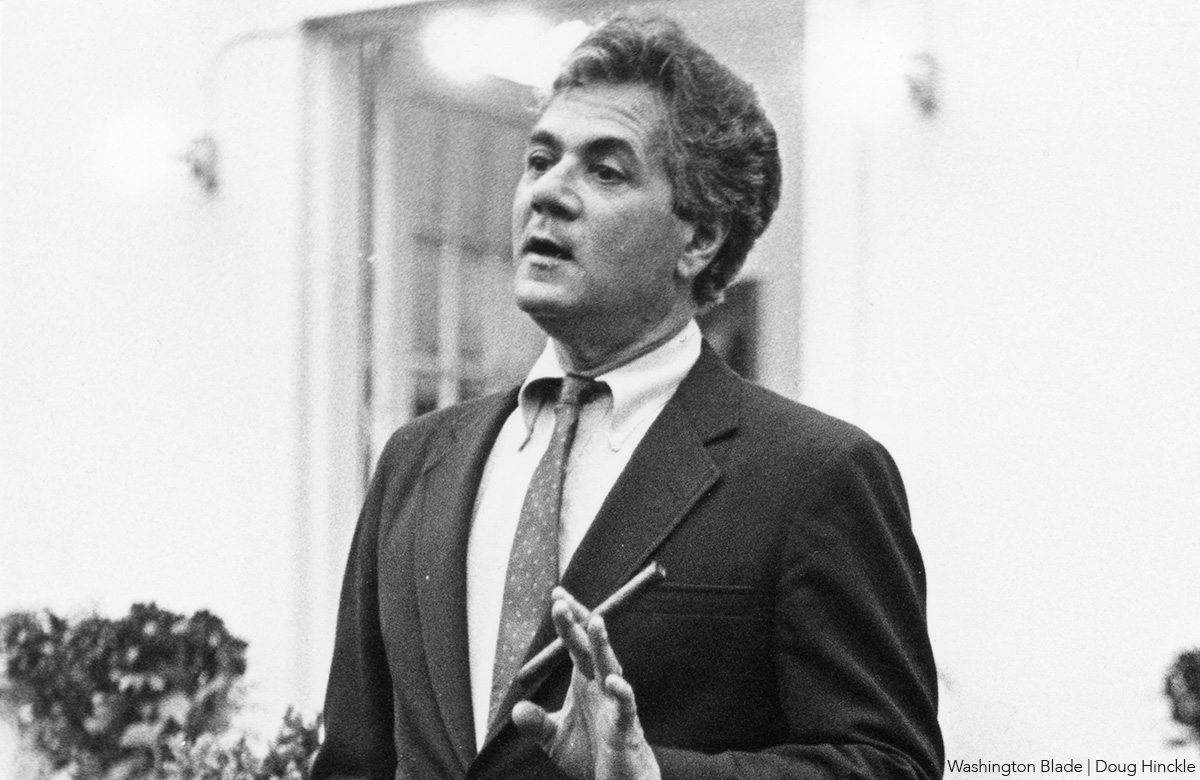
Barney Frank has always been a hero of mine. We grew up in similar circumstances, he in New Jersey, me in upper Manhattan. Both of us knew at a young age we were gay, though that was not a term used when we were young. It was a time when one definitely couldn’t come ‘out’ if you wanted to go into politics.
I met Barney when a mutual friend brought him to brunch at my home in D.C. I had moved to D.C. in 1978 to work for the Carter administration, directing the follow-up to the White House Conference on Handicapped Individuals. That is the term we used back then. I never went back to New York. Barney had been elected to Congress when we met. Neither one of us was publicly out.
Barney Frank is brilliant, and I was honored to meet him. I always enjoy listening to him speak, whether it was at a congressional hearing, or an event we were both attending. Barney was never one for small talk. When we both ended up living in Dupont, he would see me sitting at a coffee shop when he walked by, and simply nod hello, not stopping to chat. If he ever did stop, I always knew it was to suggest something I should be doing, or writing about. Barney has a sparkling wit, when he wants to share it, and knows more about most topics than anyone else. In 2004, 2006, 2008, and 2010, Washingtonian magazine reported that congressional staffers named him the brainiest member of Congress. CBS News reported in 2008 and 2011 that Leslie Stahl and others, referred to him as the smartest guy in Congress. They were right. I had worked for another brilliant member of Congress, Bella S. Abzug (D-N.Y.), but she was out of Congress by the time Barney got there. It would have been fun seeing them work together. I was working for her when she introduced the first Equality Act in 1974. At the time I was deeply closeted.
I ended up coming out in 1984, which was before Barney did. But then I wasn’t running for office. He came out in 1987 and became an even more passionate supporter of the LGBTQ community than he was before. Because now he could make his speeches, and support, more personal. He spoke eloquently trying to pass the Equality Act which didn’t pass the House until after he retired, and then it died in the Senate. I was, and am, a passionate supporter of the Equality Act, and still believe in my lifetime it will pass Congress, and we will have a president who will sign it into law. Hope springs eternal as they say.
Barney is more than just an LGBTQ advocate. He has worked tirelessly on so many issues, in his effort to make life better for all Americans. He recently said the bill he is proudest of, is the Dodd-Frank Wall Street Reform and Consumer Protection Act. It is a sweeping law enacted to overhaul financial regulation following the 2008 financial crisis. Its primary purpose was to end ‘Too big to fail’ bailouts, and protect consumers from abusive financial practices. It was signed into law by President Obama in 2010.
As it has become public that Barney Frank was entering home hospice, and being cared for by his husband Jim, so many of us are looking back at his amazing career. We are recognizing the giant he is, both during his time in Congress, and during his life before, and after. He is the first member of the LGBTQ community who married while in Congress. He is one of the people in our community who really made a difference, and in doing so made so many of our lives better.
Barney has said he is in the process of writing another book on politics, and I already look forward to reading it. I keep visualizing Barney as our community’s Art Buchwald. Those of you who are old enough may remember Buchwald. He was an American humorist, best known for his columns in the Washington Post. He also went into hospice care. But in his case, after five months there, and giving many interviews, he left hospice and wrote another book. It was titled ‘Too Soon to Say Goodbye’ about his five months in hospice. Barney, I am praying I will get to hear you, and see you, on that next book tour.
But if that shouldn’t be, I want to thank you for a life well lived, and all you have done to make my life, the lives of the rest of us in the LGBTQ community, better. We could have never asked for a stronger, or more passionate, advocate.
Peter Rosenstein is a longtime LGBTQ rights and Democratic Party activist.

New Hungarian prime minister takes office

Comings & Goings

Learn more about queer love

Calendar: May 8-14

Va. Supreme Court invalidates Democrat-backed redistricting plan

A reign defined by commitment and human impact

Ukrainian MPs advance new Civil Code without protections for same-sex couples

DOE investigates Smith College’s trans-inclusive policy

Key West Pride’s state funding pulled

PHOTOS: Miss Gay Western Maryland
-

 Arts & Entertainment4 days ago
A reign defined by commitment and human impact
-
Ukraine5 days ago
Ukrainian MPs advance new Civil Code without protections for same-sex couples
-
Federal Government4 days ago
DOE investigates Smith College’s trans-inclusive policy
-
Florida4 days ago
Key West Pride’s state funding pulled