News
U.S. agency to Congress: Pass law against LGBT workplace discrimination
U.S. Commission on Civil Rights details history of anti-LGBT discrimination
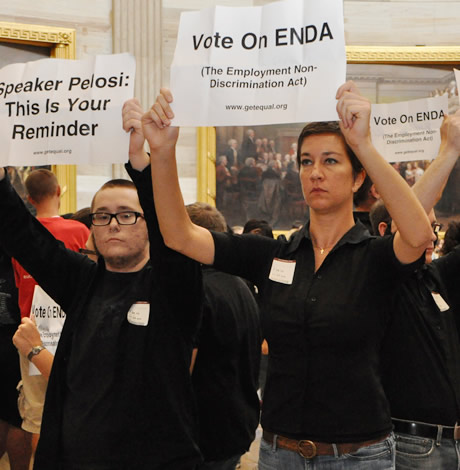
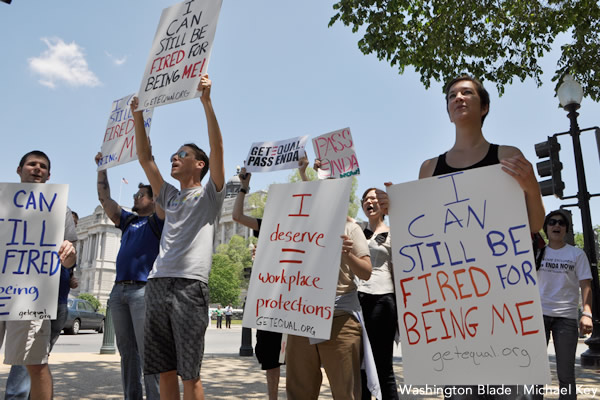
Employment Non-Discrimination protest in May, 2010. (Washington Blade file photo by Michael Key)
An independent, bipartisan U.S. agency is set to deliver to President Trump on Wednesday a report calling on Congress to “immediately enact a federal law” against anti-LGBT workplace discrimination, although lawmakers are unlikely to act any time soon given the current makeup of Congress and the long history of stalling on the issue.
The U.S. Commission on Civil Rights details in the 154-page report the history of discrimination against LGBT people and the lack of non-discrimination protections for LGBT people in federal law, citing a 2015 hearing the agency held on the issue.
“LGBT individuals often face lower wages, increased difficulty in finding jobs, promotion denials, and/or job terminations due to their sexual orientation or gender identity,” the report says. “Studies have found that anywhere from 21 to 47 percent of LGBT adults faced employment discrimination because they were gay or transgender.”
Twenty states and D.C., the report notes, have laws barring anti-LGBT employment discrimination and growing number of courts are interpreting the prohibition on sex discrimination under Title VII of the Civil Rights Act of 1964 to apply to LGBT people. The U.S. Seventh Circuit Court of Appeals, the report notes, this year became the first federal appeals court to determine sexual-discrimination in the workplace amounts to sex discrimination under current federal law.
But the report concludes these measures are insufficient in comparison to an explicit federal non-discrimination law barring anti-LGBT discrimination in the workforce.
“Some federal courts have concluded that the existing federal statutory protection against discrimination based on sex, under Title VII of the Civil Rights Act of 1964, includes within its protection discrimination based on sexual orientation and gender identity,” the report says. “Other federal courts have disagreed. These inconsistent interpretations result in different protections available to individuals based on their jurisdiction, and it is not clear when the Supreme Court will resolve the dispute.”
Efforts to enact LGBT non-discrimination protections in the federal law have stalled for decades. In years past, LGBT advocates have sought to pursue federal non-discrimination protections through passage of the Employment Non-Discrimination Act. But since 2014, the Equality Act, which would amend the Civil Rights Act of 1964 to ensure more comprehensive protections for LGBT people, has been the chosen vehicle.
The report has five recommendations: Congress should “immediately enact a federal law” barring anti-LGBT discrimination in the workforce; U.S. agencies should issue guidance and policies outlining protections for LGBT workers, specifically transgender people; Congress should appropriate funds necessary to enforce civil rights laws; the religious exemption in any LGBT non-discrimination law should be the same as exemptions in existing civil rights law; and federal agencies, such as the U.S. census, should collect data on anti-LGBT workplace discrimination.
The United States Commission on Civil Rights is comprised of eight individuals who serve six-year terms: Four appointed are by the President, and four by Congress. The current chair is Catherine Lhamon, who was appointed by Obama and served during his administration as assistant secretary for civil rights at the Education Department. No Trump appointees serve on the commission.
The conclusions in the report aren’t unanimous. One of the congressionally appointed commissioners, Gail Heriot, a law professor at University of San Diego, disagrees with its conclusions. Another commissioners also appointed by Congress, Peter Kirsanow, a partner at Benesch, Friedlander, Coplan & Arnoff, argues LGBT issues aren’t within the commission’s jurisdiction.
The letter of transmittal indicates the report will be sent to Trump, Vice President Mike Pence, House Speaker Paul Ryan (R-Wis.) and Senate Majority Leader Mitch McConnell (R-Ky.). The Washington Blade sent a request to comment on report to the White House as well as Ryan and McConnell’s office.
In 2000, Trump said in an interview with The Advocate he supports amending the Civil Rights Act of 1964 to include sexual orientation. But Trump has never addressed whether he still supports that idea during his presidential campaign or his presidency, nor whether he’d also support amending the law to include transgender people.
Meanwhile, Trump’s administration has been hostile to LGBT workplace rights. The U.S. Justice Department has argued Title VII of the Civil Rights Act doesn’t apply to gay workers and rescinded an Obama-era memo asserting the law prohibits anti-trans discrimination.


Virginia
Doug Ollivant to face Eugene Vindman in Va. 7th Congressional District
Republican defeated challengers in Tuesday’s primary
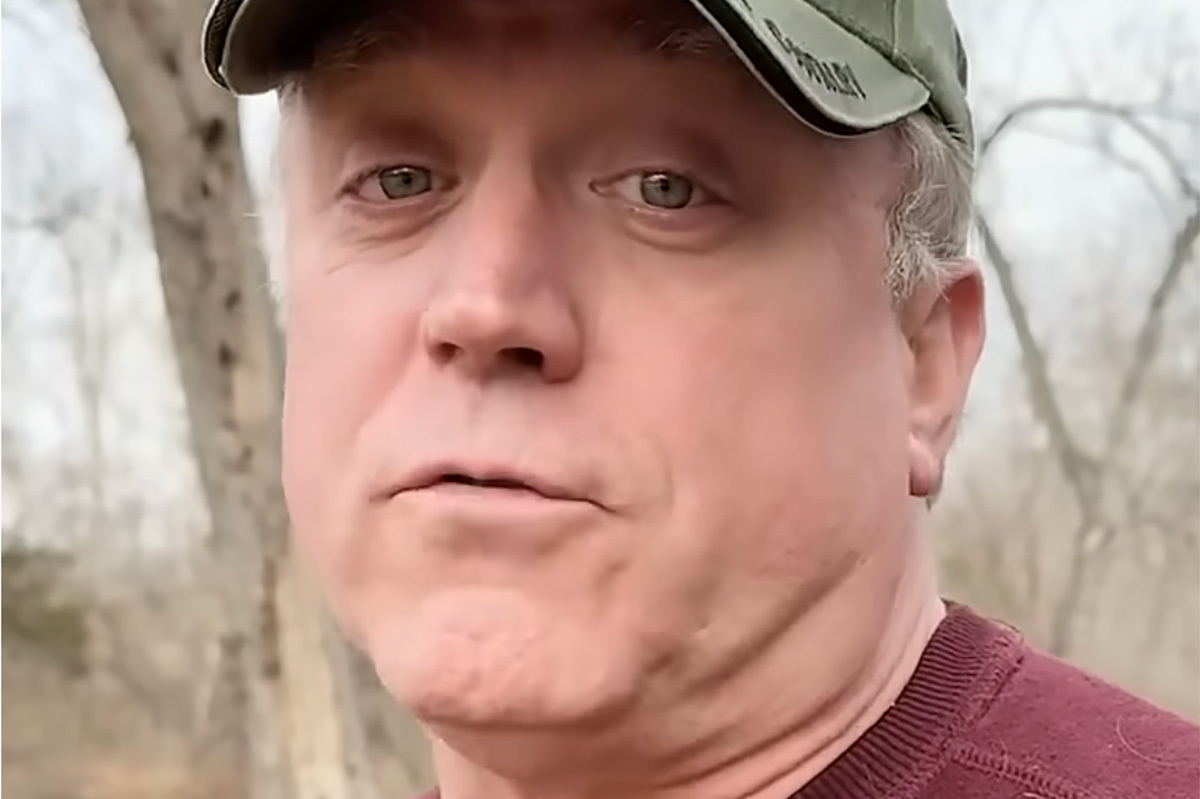
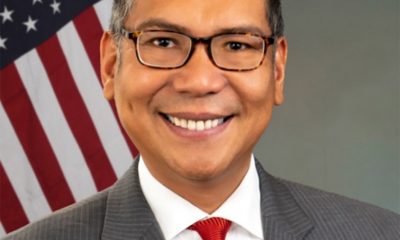
Republican Doug Ollivant will face off against incumbent U.S. Rep. Eugene Vindman (D-Va.) in Virginia’s 7th Congressional District.
Ollivant defeated his Republican opponents in Tuesday’s primary. Vindman ran unopposed.
Vindman in 2024 ran to succeed then-Congresswoman Abigail Spanberger in the U.S. House of Representatives after she ran for governor. Spanberger succeeded Republican Gov. Glenn Youngkin in 2025.
U.S. Sen. Mark Warner (D-Va.) on Tuesday easily won his primary. All other Democratic incumbent members of Congress from Northern Virginia also won their respective primaries.
District of Columbia
LGBTQ advocates optimistic about D.C.’s expected new mayor
Janeese Lewis George cites strong record of support as Council member
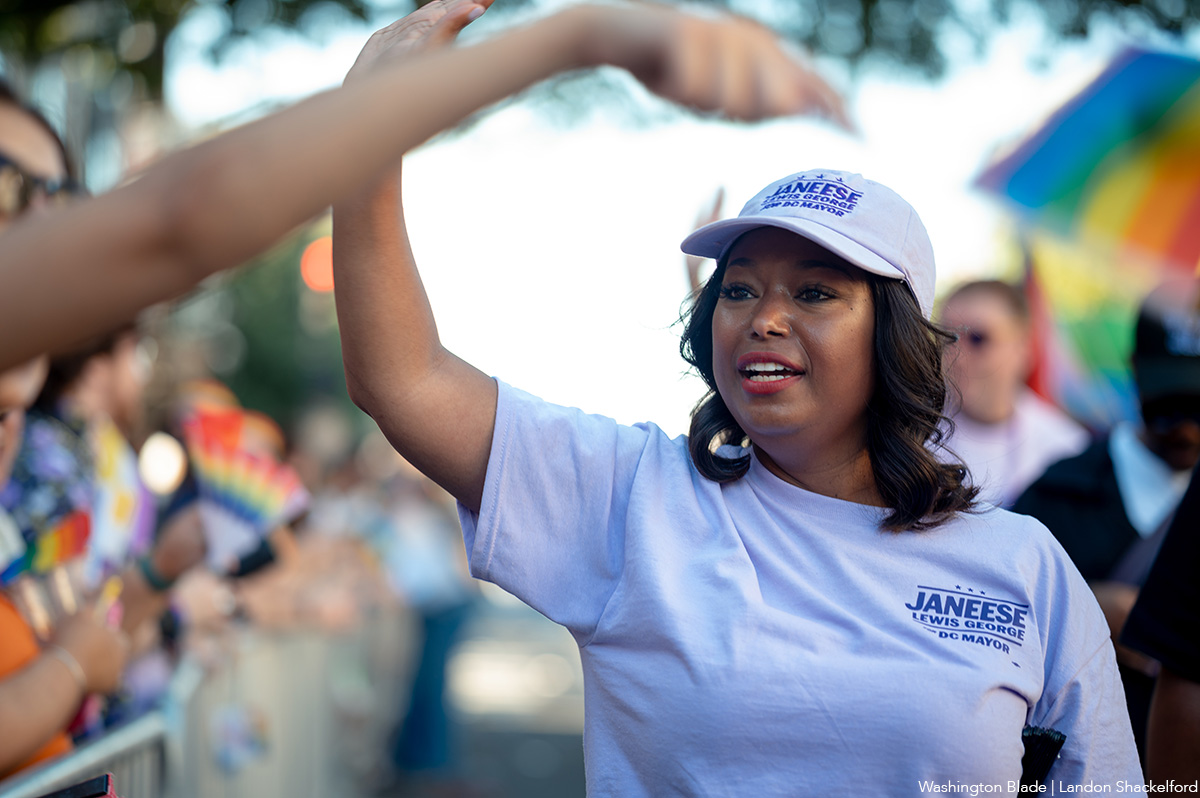
Several prominent D.C. LGBTQ community advocates said they are optimistic that Democratic mayoral nominee Janeese Lewis George, who is expected to easily win election as mayor in the city’s Nov. 3 general election, will continue her strong record of support on LGBTQ issues from her current role as a Ward 4 D.C. Council member.
But most of the seven LGBTQ advocates who responded to an informal Washington Blade survey of community leaders and activists said they would be observing Lewis George’s transition plans for her expected mayoral administration to determine if she will follow through with her campaign promises to put in place policies and funding to strongly support the LGBTQ community.
Lewis George emerged as the decisive winner in the city’s June 16 Democratic primary with 54 percent of the vote in a six-candidate race, with her lead opponent, former D.C. Council member Kenyan McDuffie (D-At-Large) receiving around 37 percent and four lesser-known candidates receiving 4 percent or less.
In a city with an overwhelmingly Democratic electorate, virtually all political observers believe Lewis George will win the November general election to become the city’s next mayor.
In the primary, she received the endorsement of the Capital Stonewall Democrats, the city’s largest local LGBTQ political organization, and received the highest possible candidate rating of +10 from GLAA DC, formerly known as the Gay and Lesbian Activists Alliance of Washington.
With Lewis George, McDuffie, and the four lesser-known candidates in the Democratic primary, including one who identified as bisexual, expressing strong support on LGBTQ issues, LGBTQ advocates acknowledged that most queer voters chose a candidate to support based on non-LGBTQ issues.
And Lewis George’s LGBTQ supporters have said they believe Lewis George received the largest share of the LGBTQ vote based on her outspoken support for social justice related issues, including policies to address the need for affordable housing, which she said impacts LGBTQ people in need, especially queer people of color and transgender residents.
“I think she understands a theory of community and economic development that is both inclusive of LGBTQ people but not exclusive about us,” said Benjamin Brooks, president of GLAA D.C. Brooks also currently serves as interim director of policy for one of the divisions of Whitman-Walker Health, D.C.’s LGBTQ supportive medical clinic and health services organization.
“I think that she represents a change in administration that will see more dollars to public programs that are more pro social,” Brooks said. “We’re going to be looking at who she appoints to the different agencies that we’re interested in and making sure that LGBTQ people are centered in that conversation,” he said.
Brooks added, “We know LGBTQ people were featured heavily in her campaign as organizers and as her staff members. So, I think we should expect to see us included, and she has put out a platform that lifts up all Washingtonians.”
Longtime D.C. gay Democratic activist John Klenert said he, too, will be watching to see if and how Lewis George follows up her campaign promises on LGBTQ issues.
“My number one concern will be with the budgets being what they are in the city, will she continue to fiscally support the Mayor’s Office of LGBTQ Affairs?” he told the Blade. “Number two, will she continue to support the HIV type places like Whitman-Walker,” he said.
Acknowledging that Lewis George has expressed support for these types of programs during the election campaign, Klenert added, “Words are cheap. Let’s see on paper her proposals.”
D.C. gay Democratic activist Peter Rosenstein is among the few LGBTQ activists who publicly raised concern over Lewis George’s status as a Democratic Socialist and member of the controversial Democratic Socialists of America (DSA) national organization.
“I congratulate Ms. George on winning the primary and hope she will do a great job as our next mayor,” Rosenstein told the Blade in a statement. “But the issues I promulgated in the primary still go unanswered,” he said, noting that he is unaware of Lewis George saying whether she disagrees with the DSA’s platform opposing the existence of the state of Israel, not talking to any pro-Israel Zionist organizations, and, among other things, defunding U.S. police departments.
Rosenstein also noted that Lewis Geroge, as far as he knows, has not publicly rebuked one of her supporters who endorsed her for mayor, Ward 8 community activist Jauhar Abraham, who has publicly referred to gay people as “sissies” and “fags” who should not be allowed to teach in the city’s public schools.
“Will she really stand up for the LGBTQ community, or does she agree with those like Jauhar Abraham,” Rosenstein said in his statement. “These are issues she owes the voters answers to.”
Ward 8 gay longtime Democratic and community activist Phillip Pannell, who just won election in the Democratic primary as the city’s Democratic National Committeeman, is among the LGBTQ activists who supports Lewis George’s candidacy for mayor. He told the Blade that Lewis George, while not saying so directly, has made it clear she does not support what he describes as Jauhar Abraham’s anti-gay slurs.
When asked if the Abraham issue as raised by Rosenstein was a concern for him, Pannell said, “No, because I know that Jauhar Abraham’s homophobic statements are in no way in alignment with Janeese Lewis George’s support for our community.”
He added, “You can’t always judge a candidate or basically indict a candidate because of the support of some individuals. There is no way Janeese supports the type of stuff Jauhar spews.”
Like some of the other LGBTQ advocates who spoke to the Blade about Lewis George’s potential impact on the LGBTQ community, Pannell said he is optimistic about her actions as mayor.
“I expect that she will at least maintain the type of support that we are getting under Mayor Bowser if not more so,” he said. “And a good indication of her level of support would be the votes that she has cast in support of our community while she has been a member of the Council,” Pannell said.
Also, like other LGBTQ supporters of Lewis George, Pannell said he is not troubled over her role as a Democratic Socialist. “There are many people who are associated with the Democratic Party who would be very much aligned with Democratic Socialist organizations,” he said. “So that doesn’t bother me at all.”
Ashley Gibbs, who serves as board co-chair of the D.C. LGBTQ+ Community Center, is among the activists who said they are uncertain about Lewis George’s expected impact on the community.
“Certainly, I expect her to win in November given the demographics of D.C.,” she said. “I have to admit I live in Maryland now, so I am less clued into D.C. politics than I used to be,” she added. “So, I think it’s a big unknown. I think we’re just going to have to wait and see what happens and how well Janeese can make things given the federal government.”
David Perruzza, owner of the D.C. LGBTQ bars Pitchers and A League of Her Own, located in the Adams Morgan neighborhood, like other LGBTQ bar owners, said he preferred not to comment on the ins and outs of the race for mayor
But similar to other nightlife related small businesses in the city, including bars and restaurants, Perruzza said he was deeply troubled over what he believed to be Lewis George’s support for ending the so-called tip wage system for bars and restaurants. He said most LGBTQ bar owners believe doing that could force them to go out of business due to excessive labor costs.
Under the tip wage system, which has been in place in D.C. and other cities and states for many years, businesses that employ servers who receive tips can pay them a significantly lower minimum wage called the tip wage compared to the regular minimum wage, which is now $18.40 per hour in D.C. At the initiative of local labor groups, D.C. voters in 2022 approved for the second time Initiative 82, which called for raising the minimum wage for tipped workers to the full minimum wage over a phase-in period of 10 years or more.
Organizations representing local restaurants and bars said most tipped workers make close to if not more than the full minimum wage in tips, and that under the current D.C. law, businesses are required to pay tipped workers the difference if they don’t make the equivalent of the full minimum wage in tips.
They argued that the initial raising of the tip wage from just over $5 per hour to several dollars more an hour created a financial hardship that was forcing many of them to go out of business. The mayor and D.C. Council responded by repealing Initiative 82 and later putting in place in 2025 a compromise law supported by the business owners that brought the tip minimum wage to $10.30 per hour as of July 1, 2026.
The new law calls for the tip minimum wage to increase to 60 percent of the full minimum wage by 2028 and increase incrementally by 5 percent until it reaches 75 percent of the full minimum wage in 2034.
D.C. Council records show that Lewis George voted against the compromise bill when the Council approved it in July of 2025 as an amendment to the city’s Fiscal Year 2026 budget.
Local nightlife advocate and small business owner Salah Czapary, who served as Mayor Bowser’s director of the D.C. Office of Nightlife and Culture from 2022 to 2024, said Lewis George told a group of nightlife business operators and owners during a meeting in May that she opposes yet another ballot measure proposed by the labor advocacy group One Fair Wage that calls for raising the city’s minimum wage for all workers to $25 per hour and for eliminating the subminimum wage for tipped workers.
“I was in the room when she explained to a room full of nightlife small business, arts, and cultural operators that she has spoken with experts in the field,” Czapary told the Blade. He said Lewis George told the gathering that she did not support the latest wage initiative that was attempting to get on the ballot, which was a concern to business owners at the time.
“And I think that’s actually quite impressive for a lawmaker to do when everyone assumes you would support a certain initiative,” he said in referring to Lewis George. “To have one view and then assess the reality that might have changed. And then say that while I agree with the idea of raising the wages — I think most people do — we also don’t live in a vacuum. We have to deal with the realities of the economy,” Czapary said.
“I think D.C., as we know, has been a safe haven for LGBTQ individuals from across the country and has been very progressive on its treatment of LGBTQ people,” he said. “I think we will not expect that to change under our new mayor,” he added. “She was endorsed by many LGBTQ individuals and organizations, and she will continue to build on that progress we’ve made as a city, and we will continue to be that safe haven for people.”
Edmund Morris, president of the D.C. Equality Chamber of Commerce, which he said represents more than 100 LGBTQ+ and allied businesses serving the D.C. Metro area, released a short statement in response to the Blade’s request for comment on the impact his group expects Lewis George to have on the LGBTQ community.
“Janeese Lewis George has emphasized inclusive policies and support for local small businesses, priorities that align with our mission,” the statement says. “We look forward to productively engaging a future administration on how best to support aspiring and active entrepreneurs to flourish in the city that they serve,” it says.
Nick Tsusaki, founder and owner of the D.C. LGBTQ bar Spark Social, said he preferred not to comment on the impact Lewis George will have on policy related to LGBTQ issues. But he said he was impressed by Lewis George’s visits to several LGBTQ bars during the primary campaign.
“I’m really excited for her” he said, “I think she made a point in her last week of campaigning to do like an LGBTQ bar crawl. She came to Spark, to Trade and Bunker,” he said referring to two other D.C. LGBTQ bars. “And really showing dedication to the community in a way that went above and beyond what I had expected –really meeting the community where we’re at.”
He added, “And so, for her to drop in on a Friday night and just talk to – get on the microphone and talk about why she’s excited to fight for our community was really cool to see in an authentic way.”
In response to requests by the Blade and Capital Stonewall Democrats seeking statements from each of the mayoral candidates during the primary campaign, Lewis George submitted these comments, which are excerpted from a longer statement.
“As mayor, I will protect our LGBTQ+ neighbors against federal attacks on their identity, including their health care. … On the Council I have been a strong supporter of pro-LGBTQ+ bills, including making D.C. a sanctuary for people seeking gender-affirming health care as well as addressing discrimination and harassment in nightlife and hospitality…And as mayor, I am prepared to move up and win those fights – a fight for D.C. statehood, a fight for our true economy, and a real opportunity to uplift our Black queer and trans youth.”
Michigan
Progressives score victory as El-Sayed wins Mich. Senate primary
Democratic newcomer will face Rogers in November
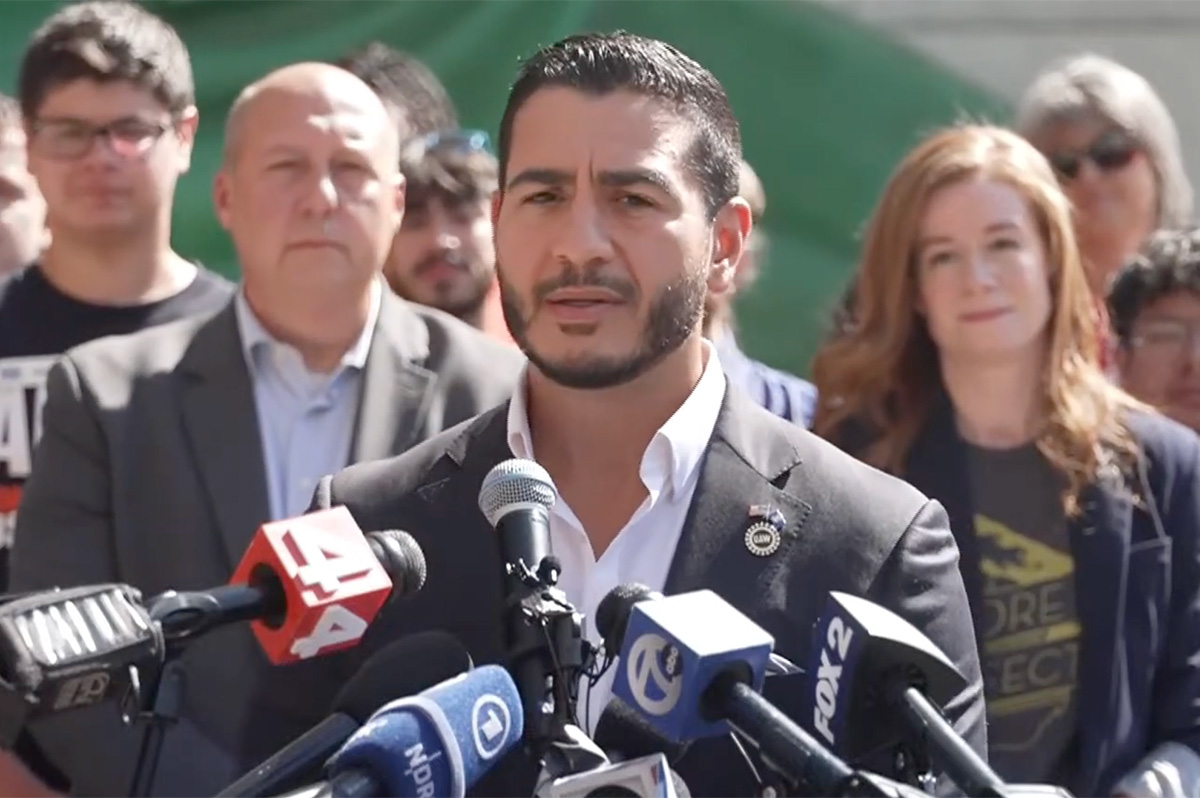
Michigan held its primary on Tuesday, allowing the two major political parties to select their nominees to go head-to-head for the state’s U.S. Senate seat.
NBC News called the Democratic race early, giving the victory to physician Abdul El-Sayed over incumbent U.S. Rep. Haley Stevens (D-Mich.) in an extremely close primary. El-Sayed won 48.5 percent of the primary vote, with Stevens trailing by just one percentage point at 47.5 percent.
Both candidates have campagined on supporting the LGBTQ community through different avenues— for El-Sayed he focused on his past promoting HIV and PrEP funding and research. Stevens focused on her legislative history working to support transgender rights in the state.
This is a major win for progressive Democrats, who have been bearing the brunt of political attacks from President Donald Trump, the Republican Party, and centrist Democrats.
El-Sayed, a former health director in Detroit, ran his campaign largely on making life in the Great Lakes State more affordable amid rising costs. His policies include promoting “Medicare for All,” pushing health policy that targets the regressive efforts of the Trump-Vance administration that rolls back funding for both Women and LGBTQ people, minimizing the growing amount of money in politics, and he was very vocal in his criticism of Stevens for supporting aid to Israel. He was endorsed by two major progressives — U.S. Sen. Bernie Sanders (I-Vt.) and U.S. Rep. Alexandria Ocasio Cortez (D-N.Y.).
Stevens, the four-term congresswoman, is much closer to establishment Democrats on policy than El-Sayed.
During her time in the federal government, she has consistently supported the Equality Act, which would add sexual orientation and gender identity as protected classes under the Civil Rights Act of 1964. She has also emphasized supporting local manufacturing and lowering housing costs in the state.
She was named to Advocates for Trans Equality’s 118th Congressional Champions list for her pro-trans policies and was endorsed by establishment heavy hitters Michigan Gov. Gretchen Whitmer and Senate Minority Leader Chuck Schumer (D-N.Y.).
The contentious race boiled down not only to Michigan affairs but also extended to international conflicts — namely Palestine. (South Africa has filed a case in the International Court of Justice in The Hague that accuses Israel of committing genocide in the Gaza Strip after Oct. 7.) This primary also acted as one of the first major races that pushed back against AIPAC, a lobbying group that works to promote pro-Israel candidates in U.S. elections. The group has been involved in domestic politics since 1954.
AIPAC devoted a massive amount of money to this race.
The Associated Press reported that the pro-Israel lobbying group spent more than $30 million on ads against El-Sayed because of his vocal denunciation of Israel and his continued criticism of its policies towards Palestine.
Michigan has a large Muslim and Arab American population, which could, in part, explain how El-Sayed was able to win.
The Republican side was far less competitive. Former U.S. Rep. Mike Rogers (R-Mich.) ran unopposed and clinched the GOP nomination. He has consistently held anti-LGBTQ positions, going as far as voting multiple times for a federal constitutional amendment to ban same-sex marriage, voting against repealing the military’s “Don’t Ask, Don’t Tell” policy, and supporting efforts to directly target the attempted expansion of Title IX protections to include trans people.
El-Sayed will face off against Rogers in November for Michigan’s Senate seat — one that could have lasting impacts not only on the state’s politics but also on the Republicans’ narrow Senate majority and Trump’s political agenda.

Suzanne Goode is not good for Rehoboth Beach

Continue to engage in community after Pride month

Doug Ollivant to face Eugene Vindman in Va. 7th Congressional District

LGBTQ advocates optimistic about D.C.’s expected new mayor

Progressives score victory as El-Sayed wins Mich. Senate primary

PHOTOS: Amsterdam Pride Canal Parade

Amsterdam Pride Canal Parade draws hundreds of thousands

Reggie White relishing first season as artistic director of Woolly Mammoth

Madonna headlines World Pride Music Festival in Amsterdam

PHOTOS: Petal Release Party
-

 Photos5 days ago
PHOTOS: Amsterdam Pride Canal Parade
-
Netherlands5 days ago
Amsterdam Pride Canal Parade draws hundreds of thousands
-
Theater4 days ago
Reggie White relishing first season as artistic director of Woolly Mammoth
-
Celebrity News4 days ago
Madonna headlines World Pride Music Festival in Amsterdam