
Opinions
Honoring Rehoboth’s Steve Elkins
Town wouldn’t be a gay resort without the Mayor of Baltimore Avenue
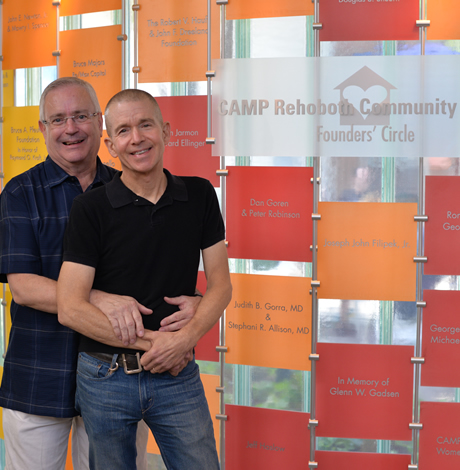
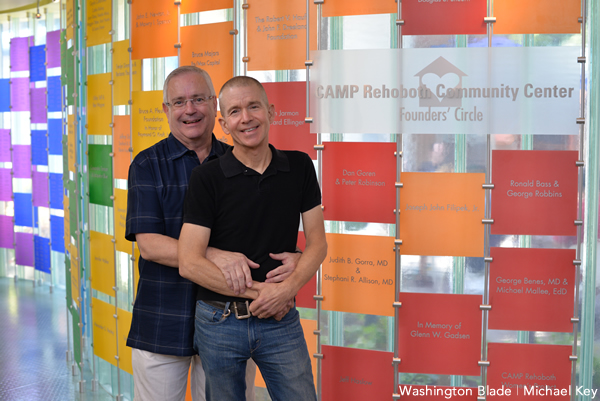
Steve Elkins (left) and his husband Murray Archibald founded CAMP Rehoboth. Elkins died last month at 67 after a battle with lymphoma. (Washington Blade file photo by Michael Key)
Pulling into the parking lot at Epworth United Methodist Church in Rehoboth Beach on Monday, I was directed toward an overgrown field, a makeshift overflow parking area, because the main lot was already full 40 minutes before the start of a memorial service for Steve Elkins.
If you don’t know Steve, then you’ve probably never been to Rehoboth.
Along with his devoted husband Murray Archibald, Steve founded the CAMP Rehoboth community center and served as its executive director for 25 years until his death in March.
The service on Monday served as a moving reminder of Steve’s incredible impact on this community; he played an integral role in Rehoboth’s transformation from sleepy beach town hostile to new gay visitors to the vibrant and inclusive resort town it is today.
Elkins and Archibald saw the need for an LGBT support and advocacy group in Rehoboth around 1989 and early 1990, the two told the Blade at the time of the group’s 25th anniversary in 2015. It was the late 1980s when the Rehoboth Beach Homeowners Association produced a bumper sticker that read, “Keep Rehoboth A Family Town.”
The slogan was an obvious homophobic response to the influx of new gay and lesbian tourists.
“I always said we wanted it to be a family town as well but families come in all sizes, shapes and orientations,” Elkins told the Blade in discussing his and Archibald’s decision to found CAMP Rehoboth.
And therein lies Steve’s genius. As friends and family members recounted during four emotional eulogies on Monday, Steve understood that in order to change minds, you had to meet people where they were. Preaching and yelling wouldn’t do. And so he began the slow and deliberate work of engaging local residents. And training police officers in LGBT sensitivity. And opening a visible, LGBT-identified community center on Baltimore Avenue. The change Steve sought didn’t come overnight. He endured countless setbacks, from the devastation of the AIDS epidemic, to the financial challenges inherent in creating a non-profit, to entrenched anti-gay animus that stymied legislative progress.
Steve understood that you have to put in the time to bring about lasting change. This would not be instant gratification. He was strategic, smart, patient and kind. And ultimately his vision won out as Rehoboth grew into a popular LGBT resort town; mayors and police chiefs went from hostile to supportive; and the Delaware Legislature finally passed marriage equality.
The writer Fay Jacobs delivered a pitch-perfect eulogy that rightly put Steve’s legacy into perspective for the packed church. She declared that most of us wouldn’t be in Rehoboth at all if not for Steve. Her spot-on observation triggered an outpouring of electric applause that filled Epworth.
As Steve and Murray fought for the right of Rehoboth residents and visitors to merely be treated equally under the law, more and more LGBT people flocked to the beach town — first as weekend tourists, and many now as retirees.
Steve’s achievements are well known and documented. But his most lasting impression on me will always be his kindness. In the face of bigotry and discrimination, many of us — myself included — have often responded in anger. That wasn’t Steve’s way. He was always quick with a hug and a smile and eager to invite you inside CAMP’s walls for a chat.
In 2015, Steve talked to the Blade about those early days in Rehoboth. This quote from that interview sums up Steve’s vision and legacy nicely: “The thing I’ve always said is once we actually started talking to one another we all realized that we had the same desire – and that’s to have a safe and inclusive community. And once we started talking about what we had in common we find we have a lot more in common than we have differences.”
Kevin Naff is editor of the Washington Blade. Reach him at [email protected].






Opinions
Is it time for DC to have new congressional representation?
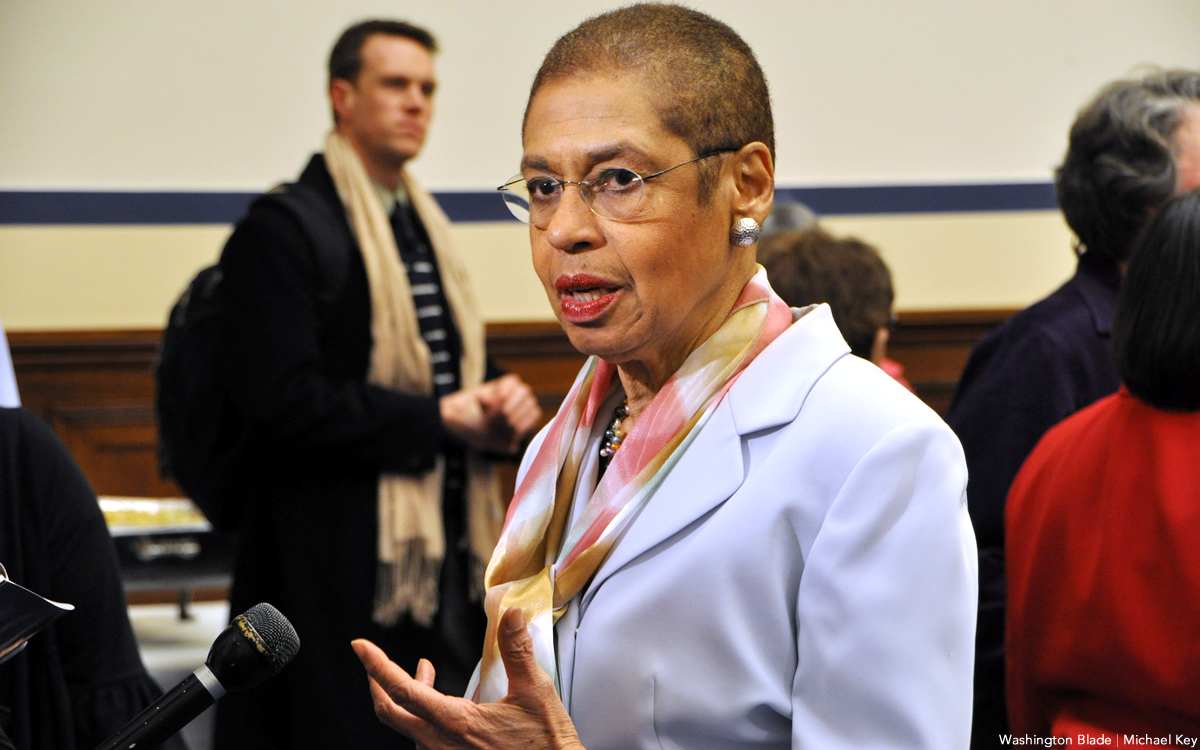
Del. Eleanor Holmes Norton will turn 89 in June
With WorldPride, Supreme Court decisions, military parades in our streets, mayor and City Council discussions about a new football stadium, it is entirely understandable if we missed the real local political story for our future in the halls of Congress. Starting this past May, the whispered longtime discussions about the city’s representation in Congress broke out. Stories in Mother Jones, Reddit, Politico, Axios, NBC News, the New York Times, and even the Washington Post have raised the question of time for a change after so many years. A little background for those who may not be longtime residents is definitely necessary.
Since the passage of the 1973 District of Columbia Home Rule Act, we District residents have had only two people represent us in Congress, Walter Fauntroy and Eleanor Holmes Norton, who was first elected in 1990 after Mr. Fauntroy decided to run for mayor of our nation’s capital city.
No one can deny Mrs. Norton’s love and devotion for the District. Without the right to vote for legislation except in committee, she has labored hard and often times very loud to protect us from congressional interference and has successfully passed District of Columbia statehood twice in the House of Representatives, only to see the efforts fail in the U.S. Senate where our representation is nonexistent.
However, the question must be asked: Is it time for a new person to accept the challenges of working with fellow Democrats and even with Republicans who look for any opportunity to harm our city? Let us remember that the GOP House stripped away millions of OUR dollars from the D.C. budget, trashed needle exchange programs, attacked reproductive freedoms, interfered with our gun laws at a moment’s notice, and recently have even proposed returning the District to Maryland, which does not want us, or simply abolishing the mayor and City Council and returning to the old days of three commissioners or the very silly proposal to change the name of our Metro system to honor you know you.
Mrs. Norton will be 89 years old next year around the time of the June 2026 primary and advising us she is running for another two-year term. Besides her position there will be other major elected city positions to vote for, namely mayor, several City Council members and Board of Education, the district attorney and the ANC. Voting for a change must not be taken as an insult to her. It should be raised and praised as an immense thank you from our LGBTQ+ community to Mrs. Norton for her many years of service not only as our voice in Congress but must include her chairing the Equal Employment Opportunity Commission, her time at the ACLU, teaching constitutional law at Georgetown University Law School, and her role in the 1963 March on Washington.
Personally, I am hoping she will accept all the accolades which will come her way. Her service can continue by becoming the mentor/tutor to her replacement. It is time!
John Klenert is a longtime D.C. resident and member of the DC Vote and LGBTQ+ Victory Fund Campaign boards of directors.
Opinions
Supreme Court decision on opt outs for LGBTQ books in classrooms will likely accelerate censorship
Mahmoud v. Taylor ruling sets dangerous precedent
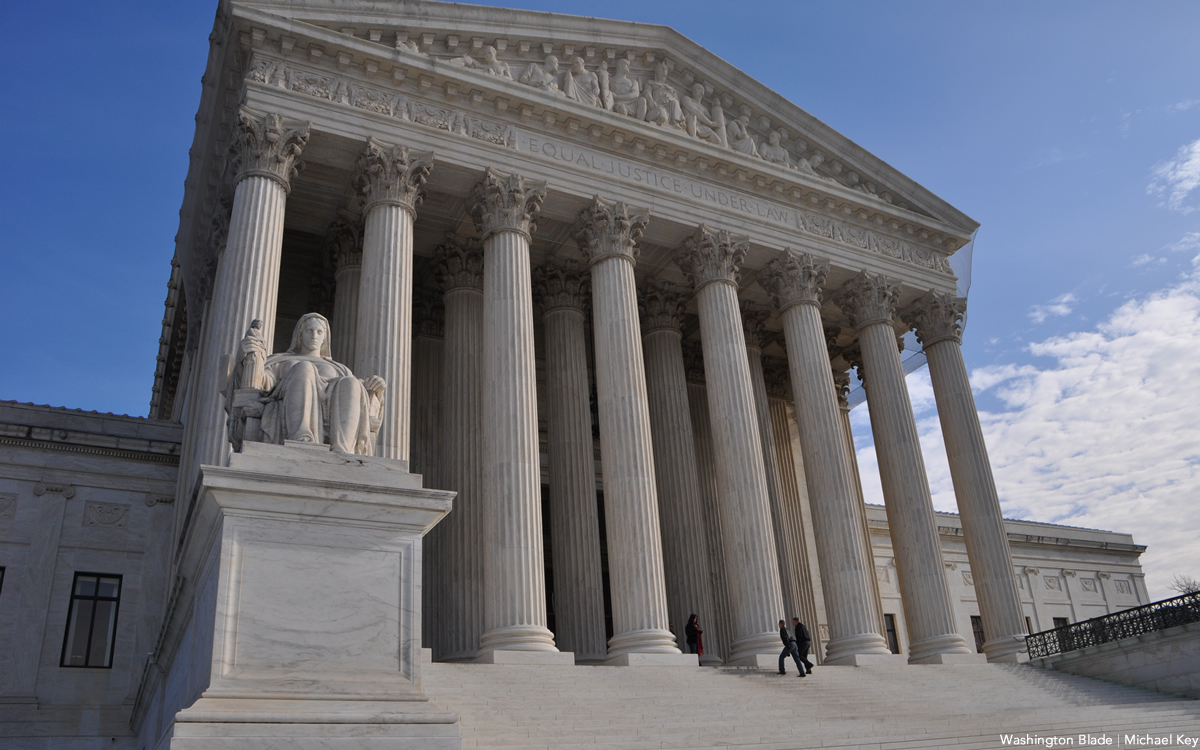
With its ruling Friday requiring public schools to allow parents to opt their children out of lessons with content they object to — in this case, picture books featuring LGBTQ+ characters or themes — the Supreme Court has opened up a new frontier for accelerating book-banning and censorship.
The legal case, Mahmoud v. Taylor, was brought by a group of elementary school parents in Montgomery County, Md., who objected to nine books with LGBTQ+ characters and themes. The books included stories about a girl whose uncle marries his partner, a child bullied because of his pink shoes, and a puppy that gets lost at a Pride parade. The parents, citing religious objections, sued the school district, arguing that they must be given the right to opt their children out of classroom lessons including such books. Though the district had originally offered this option, it reversed course when the policy proved unworkable.
In its opinion the court overruled the decisions of the lower courts and sided with the parents, ruling that books depicting a same-sex wedding as a happy occasion or treating a gay or transgender child as any other child were “designed to present … certain contrary values and beliefs as things to be rejected.” The court held that exposing children to lessons including these books was coercive, and undermined the parents’ religious beliefs in violation of the free exercise clause of the First Amendment.
This decision is the latest case in recent years to use religious freedom arguments to justify decisions that infringe on other fundamental rights. The court has used the Free Exercise Clause of the First Amendment to permit companies to deny their employees insurance coverage for birth control, allow state-contracted Catholic adoption agencies to refuse to work with same-sex couples, and permit other businesses to discriminate against customers on the basis of their sexual orientation.
Here, the court used the Free Exercise Clause to erode bedrock principles of the Free Speech Clause at a moment when free expression is in peril. Since 2021, PEN America has documented 16,000 instances of book bans nationwide. In addition, its tracking shows 62 state laws restricting teaching and learning on subjects from race and racism to LGBTQ+ rights and gender — censorship not seen since the Red Scare of the 1950s.
Forcing school districts to provide “opt outs” will likely accelerate book challenges and provide book banners with another tool to chill speech. School districts looking to avoid logistical burdens and controversy will simply remove these books, enacting de facto book bans that deny children the right to read. The court’s ruling, carefully couched in the language of religious freedom, did not even consider countervailing and fundamental free speech rights. And it will make even more vulnerable one of the main targets of those who have campaigned for book bans: LGBTQ+ stories.
When understood in this wider context, it is clear that this case is about more than religious liberty — it is also about ideological orthodoxy. Many of the opt-out requests in Montgomery County were not religious in nature. When the reversal of the opt-out policy was first announced, many parents voiced concerns that any references to sexual orientation and gender identity were age-inappropriate.
The decision could allow parents to suppress all kinds of ideas they might find objectionable. In her dissent, Justice Sotomayor cites examples of objections parents could have to books depicting patriotism, interfaith marriage, immodest dress, or women’s rights generally, including the achievements of women working outside the home. If parents can demand a right to opt their children out of any topic to which they hold religious objections, what is to stop them from challenging books featuring gender equality, single mothers, or even a cheeseburger, which someone could theoretically oppose for not being kosher? This case throws the door open to such possibilities.
But the decision will have an immediate and negative impact on the millions of LGBTQ+ students and teachers, and students being raised in families with same-sex parents. This decision stigmatizes LGBTQ+ stories, children, and families, undermines free expression and the right to read, and impairs the mission of our schools to prepare children to live in a diverse and pluralistic society.
Literature is a powerful tool for building empathy and understanding for everyone, and for ensuring that the rising generation is adequately prepared to thrive in a pluralistic society. When children don’t see themselves in books they are left to feel ostracized. When other children see only people like them they lose out on the opportunity to understand the world we live in and the people around them.
Advocates should not give up but instead take a page from the authors who have written books they wished they could have read when they were young — by uplifting their stories. Despite this devastating decision, we cannot allow their voices to be silenced. Rather, we should commit to upholding the right to read diverse literature.
Elly Brinkley is a staff attorney with PEN America.
Opinions
Pragmatic presidents invest in America
We need targeted, accountable investment in workforce stability

America may soon elect a president who identifies as LGBTQ. This possibility is no longer far-fetched, nor should it be alarming. What matters far more than who the president is, is whom the president serves.
In America, we care who the president loves because we want to know whether they love the people they represent. Not just the powerful or the visible, but those struggling to contribute more fully. The farmer in Iowa. The single mother in Ohio. The veteran in Houston who sleeps in his truck.
The moral test of any president is whether they recognize that a nation cannot call itself strong when millions of its people are locked out of participating in the economy. This is not sentiment. It is strategy.
We are heading toward a century of global competition where population, productivity, and workforce strength will decide which nations lead. The United States cannot afford to ignore the foundational truth that economic health begins with human stability. Without a well-fed, well-housed, well-prepared workforce, the American economy simply cannot compete.
Today, millions of Americans remain outside the labor force. According to the Bureau of Labor Statistics, roughly six million working-age Americans are not working or actively looking for work. Another 36.5 million live below the poverty line. Many of them lack the basic conditions required to contribute to our modern economy: shelter, nutrition, healthcare, or safety.
The result is predictable. A smaller workforce. Greater dependencies. Stagnant productivity. In 2024, the Congressional Budget Office projected a long-term decline in labor force participation unless structural barriers are addressed. This is not only an economic issue. It is a national security issue.
China and India are investing heavily in their own labor capacity. Meanwhile, we risk squandering ours. This is the backdrop against which the next president, whoever they are, must lead.
The role of government is not to provide individual comfort or cradle-to-grave care; that responsibility rightly belongs to families, communities, and civil society. Its role is to maintain the conditions necessary for every willing individual to contribute productively and invest with confidence. This means access to a safe home. It means access to basic nutrition. It means access to the building blocks of a productive life. Securing for our work forces what the Apostle Paul called diatrophas and skepasmata; or food and a place to sleep. These are not luxuries or favors. They are investments that yield growth in national capacity.
Too often these issues are framed in moral or ideological terms rather than pragmatic business interests. This rhetoric can mask poor planning, inefficiencies, and broken promises that leave communities worse off. Meanwhile these concerns go beyond common sense. They make business sense.
Consider housing. The National Low Income Housing Coalition reports a shortage of more than seven million affordable rental homes for extremely low-income households. This gap affects workforce mobility, job retention, and family stability. In cities with severe housing stress, employers cannot fill jobs because workers cannot live nearby.
Or take hunger. The USDA estimates that more than 47 million Americans live in food-insecure households. Children who are malnourished underperform in school. Adults who skip meals cannot stay focused on work. These are not abstract concerns. They are immediate threats to productivity and growth.
A president who understands this will not be swayed by ideology. They will ask: What strengthens our democracy? What builds a workforce that can out-innovate, out-produce, and out-lead our rivals?
The answer is not more bureaucracy. It is a targeted, accountable investment in workforce stability. Presidents should promote responsible public-private partnerships and remove barriers to full engagement. Communities need to strengthen local support and work with businesses on food, housing, and job training. Businesses recognize the returns on investments in workforce development and inclusive workplaces. Individuals should engage locally, build skills, and participate in practical solutions for community prosperity.
There is precedent. Conservative leaders have long understood that a stable society is a prerequisite for economic freedom. Abraham Lincoln supported land grants and public education. Dwight Eisenhower built the interstate system to connect markets and communities. Ronald Reagan expanded the Earned Income Tax Credit.
The next president should recognize these approaches. It is time to revive a governing vision that puts dignity at the heart of national strategy. That includes all Americans, from skilled professionals to warehouse workers, nurse’s aides, and long-haul truck drivers. Everyone has a responsibility to do their part to keep the economy moving.
This is where leadership matters. Not in posing as a cultural warrior, but in protecting our investments in the people who keep the nation running. A president who cares about this country will not ask what’s needed to make things easier. They will ask what’s needed to help us thrive together. They will help us choose the right way, the hard way, and maybe even the long way because building a competitive economy and a secure nation requires investing in the realities that make that happen.
If the next president can rise to that standard, then identity will matter far less than results. And maybe that is the clearest sign of progress yet.
Will Fries is a Maryland communications strategist with experience in multiple major presidential campaigns.

GenOUT Chorus offers solace, strength to LGBTQ teens

Is it time for DC to have new congressional representation?

UPenn erases Lia Thomas’s records as part of settlement with White House

House Democrats oppose Bessent’s removal of SOGI from discrimination complaint forms

Protests, demands for rights define Pride month in Latin America

Supreme Court upholds ACA rule that makes PrEP, other preventative care free

Activists protest outside Hungarian Embassy in DC

Spanberger touts equality, reproductive rights in Arlington

Two new books on dining out LGBTQ-style

‘Andy Warhol in Iran’ a charming look at intersection of art, politics
-
 U.S. Supreme Court5 days ago
Supreme Court upholds ACA rule that makes PrEP, other preventative care free
-
 District of Columbia5 days ago
Activists protest outside Hungarian Embassy in DC
-
 Virginia4 days ago
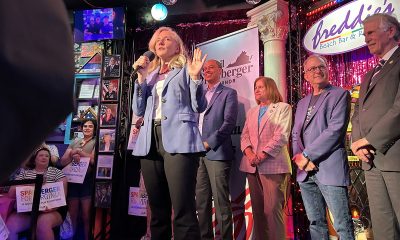
Spanberger touts equality, reproductive rights in Arlington
-
 Books4 days ago
Two new books on dining out LGBTQ-style