News
99 Dems urge State Dept. to recognize citizenship of LGBT couple’s child
Merkley, Harris lead call on Trump administration to drop appeal
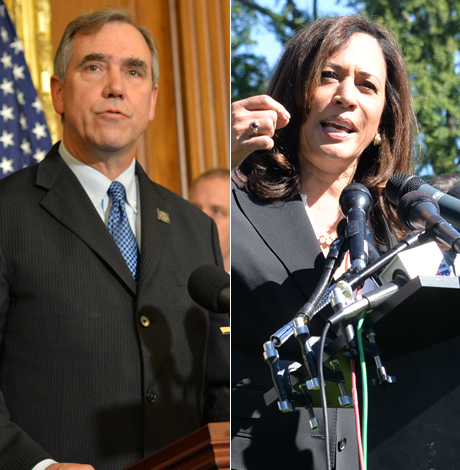
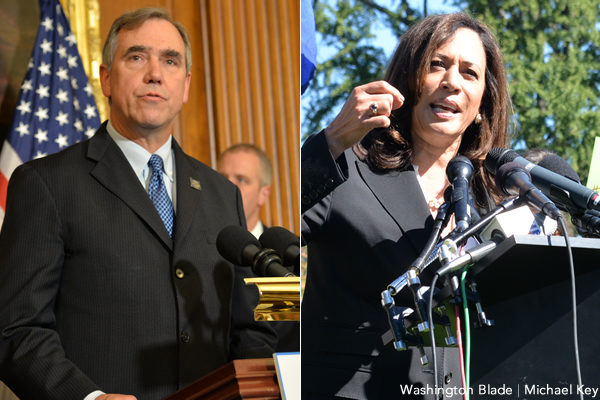
A group of 99 congressional Democrats — 80 in the U.S. House, 19 in the U.S. Senate — are calling on the Trump administration to reverse its policy of refusing to recognize the birthright citizenship of children to LGBT families born overseas via surrogacy methods.
The call come in the form of a pair of letters. Leading the letter in the House is Rep. Deb Haaland (D-N.M.) and the co-chairs of the LGBT Equality Caucus, each of an openly LGB member of Congress, including Rep. David Cicilline (D-R.I.), the most senior openly gay member of the U.S. House. In the Senate, Sen. Jeff Merkley (D-Ore.) and Sen. Kamala Harris (D-Calif.) are leading the charge.
Both letters are dated June 6 and addressed to a Secretary of State Mike Pompeo. The House says the Trump administration policy is “discriminatory and cruel”; the Senate calls it “extraordinary and deeply disturbing.”
“Even in the face of the mounting hardship the policy has created for loving families, your department has gone to great lengths to continue to defend a policy in federal court that separates American families before they reach the U.S. border edge,” the Senate letter says.
The Senate letter refers to the case of Andrew and Elad Dvash-Banks, a married same-sex couple — one an American citizen, and one an Israeli national — who had twin sons through a gestational surrogate in Canada.
The State Department, however, required a DNA test to prove the children were related to the couple to provide them U.S. passports. One child, Aiden, was deemed a citizen because he’s the biological son of Andrew, but the other, Ethan, wasn’t because he’s the biological son of Elad.
The Trump administration continues to refuse to recognize the citizenship of Elad despite the U.S. Supreme Court’s decision 2015 decision in favor marriage equality nationwide, which guarantees all the “constellation of benefits” of marriage to same-sex couples.
In a case against the Trump administration filed by Immigration Equality on the basis that the policy violates the Immigration & Nationality. A federal court ruled against the State Department, but the Trump administration has appealed the decision to the U.S. Ninth Circuit Court of Appeals.
According to the Senate letter, the policy against the couple “is not an isolated case” and addition couples have come forward with similar stories.
“Stories after stories have recently been chronicled of same-sex couples being told by your department that their marriages are, by definition, invalid, and that any children they may have abroad risk becoming stateless,” the letter says. “Every new American parent should focus on celebrating the birth of a child, not be consumed with fear that all members of their family may not be welcomed back home to the United States.”
Both letters call on the Trump administration to change the policy. The Senate letter specifically calls on the Trump administration to “immediately drop” the appeal of the Dvash-Banks case and “make it clear that every U.S. married couple is entitled to the same rights under the U.S. Constitution, no matter whom they love.”
A State Department spokesperson declined to comment in response to the senators’ letter.
“We generally do not comment on our communications with Congress,” the spokesperson said. “Due to ongoing litigation, we have no further comment at this time.”
Joining Merkley and Harris in signing the letter was Sens. Edward Markey (D-Mass.), Chris Murphy (D-Conn.), Patrick Leahy (D-Vt.), Bernie Sanders (I-Vt.), Catherine Cortez Masto (D-Nev.), Dianne Feinstein (D-Calif.), Tom Udall (D-N.M.), Jacky Rosen (D-Nev.), Dick Durbin (D-Ill.), Amy Klobuchar (D-Minn.), Tammy Duckworth (D-Ill.), Chris Coons (D-Del.), Cory Booker (D-N.J.), Maggie Hassan (D-N.H.), Ron Wyden (D-Ore.), Bob Casey (D-Pa.), and Tim Kaine (D-Va.).
Ukraine
Ukrainian MPs advance new Civil Code without protections for same-sex couples
Advocacy groups say proposal would ‘contradict European standards’
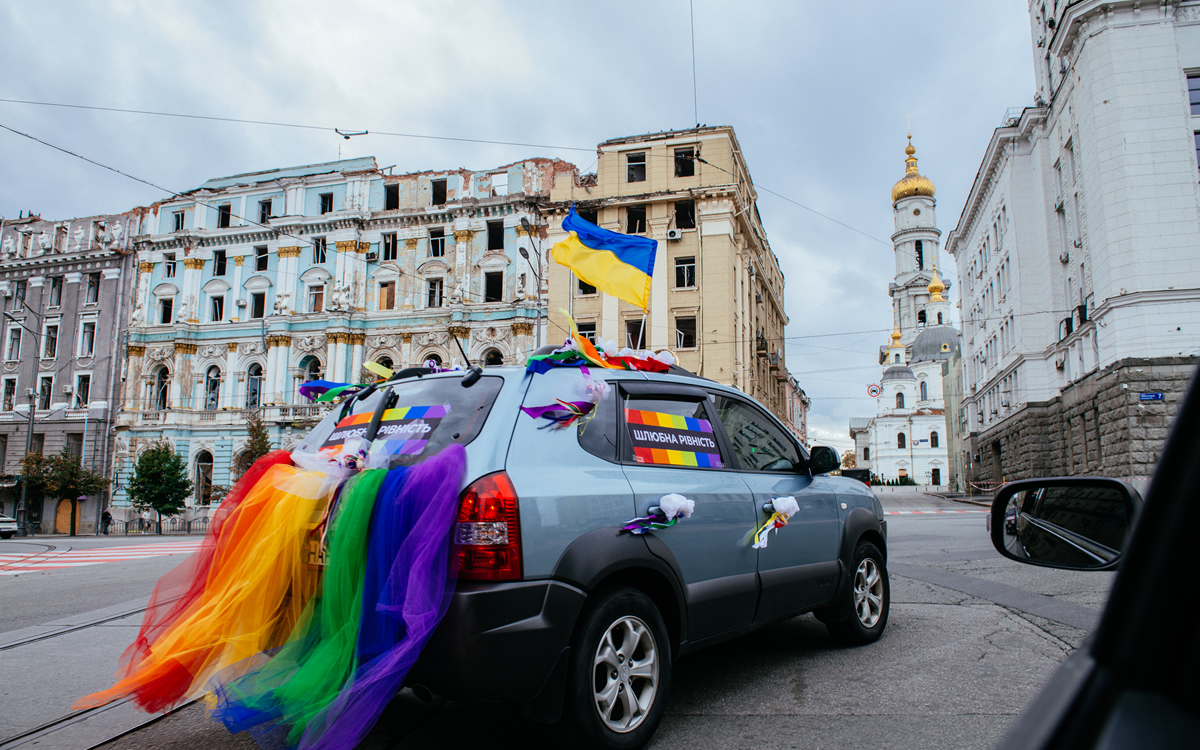
Ukrainian lawmakers have advanced a proposed new Civil Code that does not contain legal protections for same-sex couples.
The Kyiv Independent reported the proposal passed on its first reading on April 28 by a 254-2 vote margin.
The newspaper notes more than two dozen advocacy groups in a statement said some of the proposed Civil Code’s provisions “contradict European standards” and “violate Ukraine’s commitments under its EU accession process.”
“The most worrying provisions are those that make it impossible for a court to recognize the existence of a family relationship between people of the same sex,” the statement reads. “This overturns the already established case law on this issue, and closes the only legal avenue that allows partners to somehow protect their rights in individual cases.”
“Moreover, the draft completely ignores the obligations that Ukraine should have already fulfilled as part of its accession to the EU, as it lacks provisions that would allow people of the same sex to register their relationships,” it adds.
“The provisions also stipulate that all marriages concluded by people who have changed their gender automatically become invalid,” the statement further notes. “This is not just stagnation in the field of human rights or lack of progress on the path to European integration, but an actual setback in the legal sphere.”
Olena Shevchenko, chair of Insight, a Ukrainian LGBTQ advocacy group, in an April 28 Facebook post said the new Civil Code “is a step back on upholding the rights of women and the LGBT+ community in Ukraine.”
The Ukrainian constitution defines marriage as between a man and a woman.
President Volodymyr Zelenskyy in 2022 publicly backed civil partnerships for same-sex couples.
The Ukrainian Supreme Court on Feb. 25 recognized Zoryan Kis and Tymur Levchuk — a gay couple who has lived together since 2013 and married in the U.S. in 2021 — as a family. Ukraine the day before marked four years since Russia began its war against the country.
New York
Gay ICE detainee freed after 150 days in detention
Cayman Islands native taken into custody before green card interview
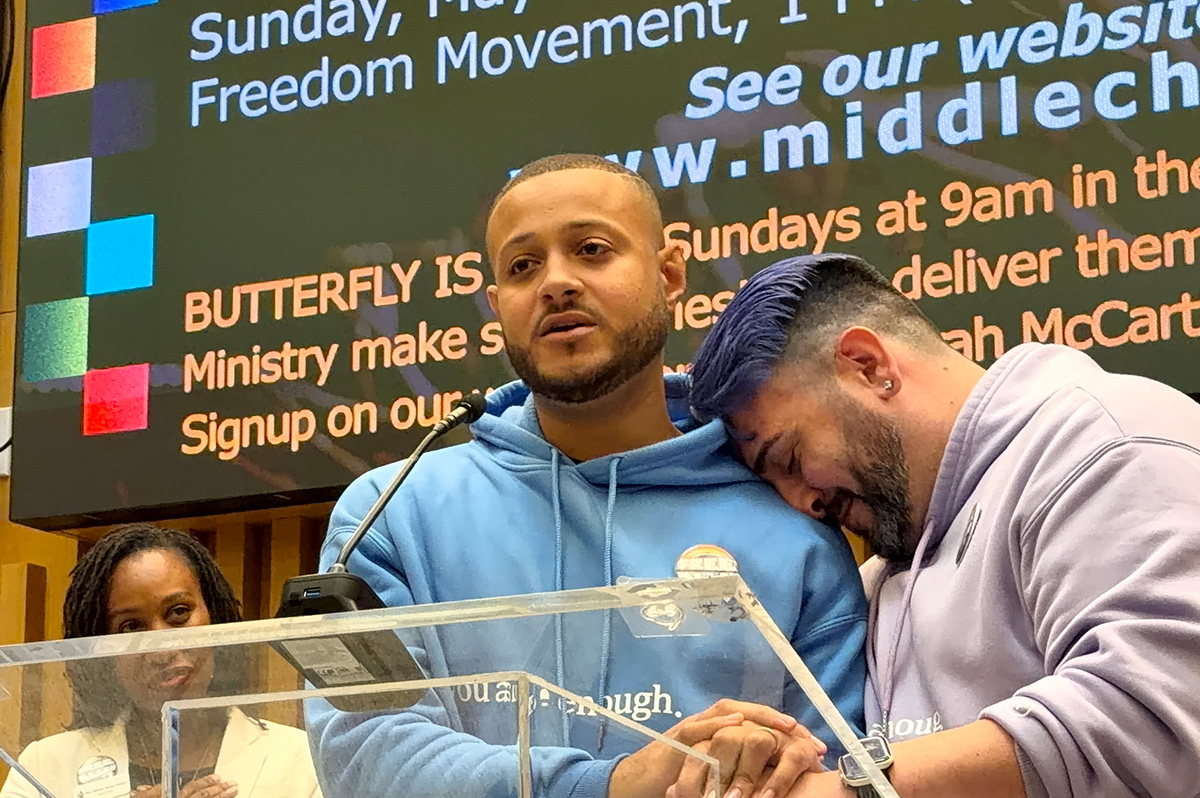
Following nearly half a year in U.S. Immigration and Customs Enforcement detention, Allan Marrero has been released and is back home with his husband in New York.
Marrero spent 150 days in ICE custody, held in multiple detention centers across the U.S. after missing an immigration court hearing while in a rehabilitation program for alcohol addiction — a circumstance widely considered “good cause” for failing to appear.
The Washington Blade first reported on Marrero’s case in March after the Cayman Islands native was detained by ICE officers during what was supposed to be a routine marriage-based green card interview at 26 Federal Plaza in New York City.
Marrero had been married to his husband, Matthew Marrero, for two years at the time of the interview. But almost immediately, the experience turned hostile.
The Rev. Amanda Hambrick Ashcraft, a minister at Middle Church in Manhattan who accompanied the couple to provide spiritual support, later described the process as “dehumanizing” and “barbaric.”
During the interview, it became clear the couple was facing an uphill battle. At one point, when asked how they met, Matthew Marrero instinctively looked over at his husband and was “snapped at” and told not to look at him. As the interview continued, the outlook only grew more grim.
Unaware that he had a prior removal order tied to the missed court date while he was in rehab, Allan Marrero was detained on the spot.
Over the following months, Allan Marrero was transferred through multiple detention facilities, including centers in Arizona and Texas, the Everglades Detention Facility — also known as “Alligator Alcatraz,” which has been described as having “unsanitary inadequate conditions” — and ultimately a detention center in Mississippi.
While in custody, Allan Marrero was denied access to prescription medication and, according to advocates, was psychologically pressured by ICE agents to self-deport rather than remain detained while his legal case proceeded.
Although a judge later reopened his case and granted bond after Allan Marrero provided proof that he had been in rehab — a valid medical reason for missing his court date — ICE used procedural mechanisms to keep him detained. A separate judge later issued a ruling denying relief, leaving Allan Marrero in custody.
On the outside, Matthew Marrero said his life felt as though it had been put on pause so ICE could meet enforcement quotas.
“[It feels like] somebody came in and kidnapped someone close to you and took away all of your control and power,” Matthew Marrero told the Blade on March 7. “You shouldn’t be able to have this much control over somebody’s life, especially if they are trying to do the right thing … You’re not going after criminals, you’re not going after the worst of the worst. You’re trying to fill a quota.”
Alexandra Rizio, Allan Marrero’s attorney with Make the Road New York, a progressive grassroots immigrant-led organization, told the Blade that “there seems to be an underlying element of cruelty baked into not only this administration, but everything.”
“It didn’t have to go down that way,” Rizio continued. “If someone goes in for a green card interview and their marriage interview, and they learn that they have a removal order, what the USCIS officer could have done is say, ‘Look, you have a removal order in your name. You need to go hire an attorney right away to get this taken care of. I can’t adjudicate your green card…’ And if you hire a lawyer, you know, you might be able to get it straightened out. Of course, that’s not what happened. And so ICE, which was in the building, were called and they did arrest Allan.”
The Marreros are scheduled to hold a press conference on Tuesday at Middle Church, where Allan Marrero will speak publicly for the first time about his detention.
For additional information on the press conference please visit middlechurch.org.
Commentary
How do you vote a child out of their future?
Students reportedly expelled from Eswatini schools over alleged same-sex relationships

There is something deeply unsettling about a society that turns a child’s future into a public referendum. In Eswatini, there were reports that students were expelled from school over alleged same-sex relationships, and that parents were invited to vote on whether those children should remain, forcing us to confront a difficult question on when did education stop being a right and become a favor granted by collective approval? Because this is a non-neutral vote.
A vote reflects power, prejudice and personal beliefs, which are often linked to tradition, culture, politics and religion. It is shaped by fear, by stigma, by long-standing narratives about morality and belonging. To ask parents, many of whom may already hold hostile views about LGBTIQ+ people, to decide the fate of children is not consultation. It is deferring the responsibility and repercussion. It is placing the lives of young people in the hands of those most likely to deny them protection.
And where is the law in all of this?
The Kingdom of Eswatini is not operating in a vacuum. It has a constitution that guarantees the promotion and protection of fundamental rights, including equality before the law, equal protection of the laws, and the right to dignity. The constitution further goes on to protect the rights of the child, including that a child shall not be subjected to abuse, torture or other cruel, inhuman and degrading treatment or punishment.
The Children’s Protection and Welfare Act of 2012 extends the constitution and international human rights instruments, standards and protocols on the protection, welfare, care and maintenance of children in Eswatini. The Children’s Protection and Welfare Act of 2012 promotes nondiscrimination of any child in Eswatini and says that every child must have psychosocial and mental well-being and be protected from any form of harm. The acts of this very instance place the six students prone to harm and violence. The expulsion goes against one of the mandates of this act, which stipulates that access to education is fundamental to development, therefore, taking students out of school and denying them education contradicts the law.
Eswatini is a signatory to the United Nations Convention on the Rights of the Child and the African Charter on the Rights and Welfare of the Child. These are not just commitments made to make our governments look good and appeasing. They are obligations. The Convention on the Rights of the Child is clear regarding all actions concerning children. The best interests of the child MUST be a primary consideration and NOT secondary one. According to the CRC, as indicated in the Declaration of the Rights of the Child, “the child, by reason of his physical and mental immaturity, needs special safeguards and care, including appropriate legal protection, before as well as after birth.” It is not something to be weighed against public discomfort and popularity.
The African Charter on the Rights and Welfare of the Child reinforces this, grounding rights in non-discrimination (Article 3), privacy (Article 10) and protection from all forms of torture (Article 16). Access to education (Article 11) within these frameworks is not conditional but is a foundational right. It is not something that can be taken away because a child is perceived as falling outside social norms and threatening the moral fabric of society. It is a foundational right and determines one’s ability to participate in civic actions with dignity.
So again, where is the law when children are being expelled?
It is tempting to say the law is silent but that would be too generous. The law is not silent rather, it is being ignored and bypassed in favor of systems of decision-making that make those in power comfortable. When schools and their leadership defer to parental votes rather than legal standards, they are not acting neutrally. Expelling a child from school because of allegations is not a decision to be taken lightly. It disrupts education and limits future opportunities and for children already navigating identity and social pressure, this kind of exclusion can have profound psychological effects. It isolates them. It marks them for potential harm. Imagine being a child whose future is discussed in a room where people debate your worth. That is exposure. That is harm. There is a tendency to justify these actions in the language of culture, tradition, religion and protecting social cohesion. But culture is not static and the practice of Ubuntu values is not an excuse to violate rights. If anything, the principle of Ubuntu demands the opposite of what is happening here.
Ubuntu is not about conformity. It is about recognition and is the understanding that our humanity is bound up in one another. That we are diminished when others are excluded. That care, dignity, respect and compassion are not optional extras but central to how we exist together. Where, then, is Ubuntu in a school where some children are deemed unworthy of access to education?
Why are those entrusted with protecting children are failing to do so?
There is a very loud contradiction at play. On one hand, there is a claim to shared values and to the importance of community. On the other hand, there is a willingness to isolate and exclude those who do not fit within the narrow definition of what is acceptable. You cannot have both. A community that thrives on exclusion is neither cohesive nor safe.
It is worth asking why these decisions are being made in this way. Why not follow the established legal processes? Why not ensure that any disciplinary action within schools aligns with national and international obligations? Why introduce a vote at all? The answer is uncomfortable and lies in legitimacy and accountability. A vote creates the appearance of a collective agreement. But again, I reiterate, it distributes responsibility across many hands, making it hard to hold anyone accountable. It allows the school leadership to say “lesi sincumo sebantfu”(“This is what the community decided, not me”) rather than confronting their own role in human rights violations. If the law is clear and rights, responsibilities and obligations are established, then the question is not what the community feels. The question is why those entrusted with protecting children are failing to do so.
There is also a deeper issue here about whose rights are seen as negotiable. When we talk about children, we often speak of care, of understanding, of protection and safeguarding them because they are the future. But that language becomes selective when it intersects with sexuality, particularly when it involves LGBTIQ+ identities. Suddenly, care, understanding, protection, and safeguarding give way to punishment.
Easy decisions are not always just ones.
If the kingdom is serious about its commitments under its constitution, the Convention on the Rights of the Child and the African Charter on the Rights and Welfare of the Child, then those commitments must be visible in practice, not just in policy documents. Rather, they must guide decision-making in schools and in communities. That means recognizing that a child’s right to education cannot be overridden by a show of hands. It means ensuring that schools remain spaces of inclusion rather than sites of moral policing. It means holding leaders and institutions accountable when they fail to protect those in their care.
Bradley Fortuin is a consultant at the Southern Africa Litigation Center and a human rights activist.

A reign defined by commitment and human impact

Ukrainian MPs advance new Civil Code without protections for same-sex couples

Gay ICE detainee freed after 150 days in detention

How do you vote a child out of their future?

Under new extremism laws, LGBTQ Russians must fight to survive

Republicans attach five anti-LGBTQ riders to State Department funding bill

Tennessee’s trans data bill a frightening omen

Bill seeks to block global gag rule expansion

New Zealand blood donation rules shift