Theater
Creative ways to keep dancing
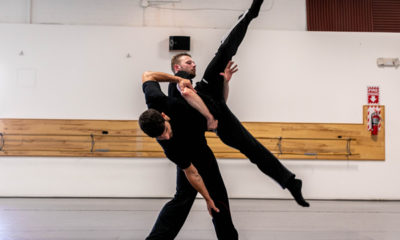
Chamber Dance Project debuts films featuring outdoor performances


In what’s become a hotly anticipated annual event, Washington’s Chamber Dance Project’s (CDP) summer dance concert brings together a far-flung lineup of accomplished artists to perform an exciting program of new works and repertory favorites. Using both dance and live music, the contemporary ballet company connects different worlds and reinvents how we view dance and listen to music.
Of course, the pandemic has made live performance impossible. But rather than scrap it all, CDP’s dynamic artistic director Diane Coburn Bruning requested dancers stay home and work with remote choreographers and local videographers to produce dance filmed outdoors and in public spaces.
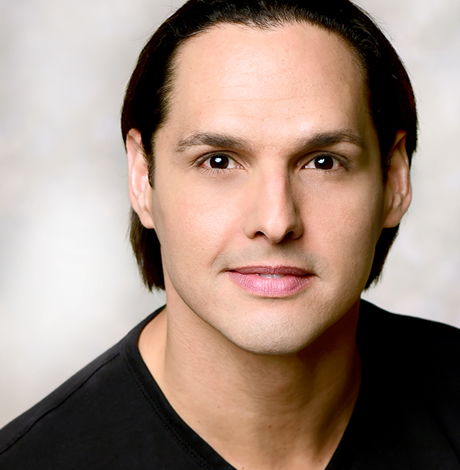
The result is a trio of repertoire films: “Berceuse” (Milwaukee), “In The Silence” (Columbus), and “Sarabande” (Los Angeles), a solo dance performed by Christian Denice, 32.
Calling via phone from Greece where Denice is spending three weeks with his Greek boyfriend, the amiable and determined Los Angeles-based dancer/choreographer takes time from sunning and swimming to talk about his career and introduction to CDP. He’s particularly smitten with the company’s innovative infusion of both dance and live music seen on stage.
The screening will be presented nationally on Friday July 31st at 7 PM EST with free tickets available at chamberdance.org/beyond
WASHINGTON BLADE: You’re in Greece!
CHRISTIAN DENICE: I am. And I feel a little guilty because I’m here and none of my American friends can travel. I have dual citizenship. My mother was born in the Netherlands.
BLADE: If it were normal times, you’d be in Washington dancing “Sarabande.” Can you describe the ballet?
DENICE: It’s about an old man at the end of his life. He’s looking back on the past and coming to grips with her current fragility. There’s a lot of nostalgia to the piece but Diane [Coburn Bruning], the choreographer, wanted me to find my own way around it. It’s a minimal movement solo, very internal.
BLADE: And the filming?
DENICE: It was up to me to find a location. While driving in L.A. I saw the Sepulveda Dam in Van Nuys – it’s a great big industrial structure used a lot for filming. I liked the idea of an increasingly fragile man juxtaposed with this permanent, intimidating structure that’s weathered so much. I absorbed the energy and the vastness, and felt alone and at peace being alone. It was the best way to honor the piece.
It was me and a videographer. I’d never have thought to dance in the dirt and grass without COVID-19. It pulled something out of us. Unfortunately, I missed out on CDP’s use of live music – another time.
BLADE: How did you initially connect with CDP?
DENICE: As a freelancer, I’m always looking for new opportunities, and CDP popped up on my radar. I love how its centered around project-based summer gigs for dancers at the peak of their careers. And I love that it’s a platform where dance and music collide together.
BLADE: What drew you to dance?
DENICE: It’s the classic story – I watched through the window of my younger sister’s class and fell in love with dance. I was 10 years old – very energetic but not skilled at sports – and my parents signed me up. Almost immediately, dance wrapped its arms around me and I was hooked.
BLADE: What kind of dancer are you?
DENICE: I’m athletic. I can blast a lot of energy really fast. I spent most of my professional life at Les Ballets Jazz de Montréal. The aesthetic was balletic and that challenged me a lot. I learned a lot of subtle interpretive movement, and discovered that I can be both a physical and nuanced artist.
Leaving the company after four and a half years was a big decision. Scary but necessary. I love dancing on stage but working on a new piece in the studio is where I’m happiest. I knew I needed choreography in my future.
BLADE: And will there be more CDP in your future?
DENICE: Yes, I’m slated to choreograph some new work for them. If all goes well it will be performed in 2021. Knock on wood.


Theater
‘Some Like It Hot’ a wild ride at renovated Bernard Family Theatre
Exhilarating show brimming with fun, feeling, and focus on gender exploration
“Some Like It Hot”
Through Nov. 8
Olney Theatre Center
2001 Olney-Sandy Spring Rd.
Olney, Md.
Olneytheatre.org
There’s reason to celebrate at Olney Theatre Center. Currently, they’re debuting their renovated Bernard Family Theatre while inaugurating the soaring new space with a regional premiere of “Some Like It Hot,” the musical adaptation of Billy Wilder’s classic 1959 comedy.
Toying with this cinematic gem took some cojones, but it works.
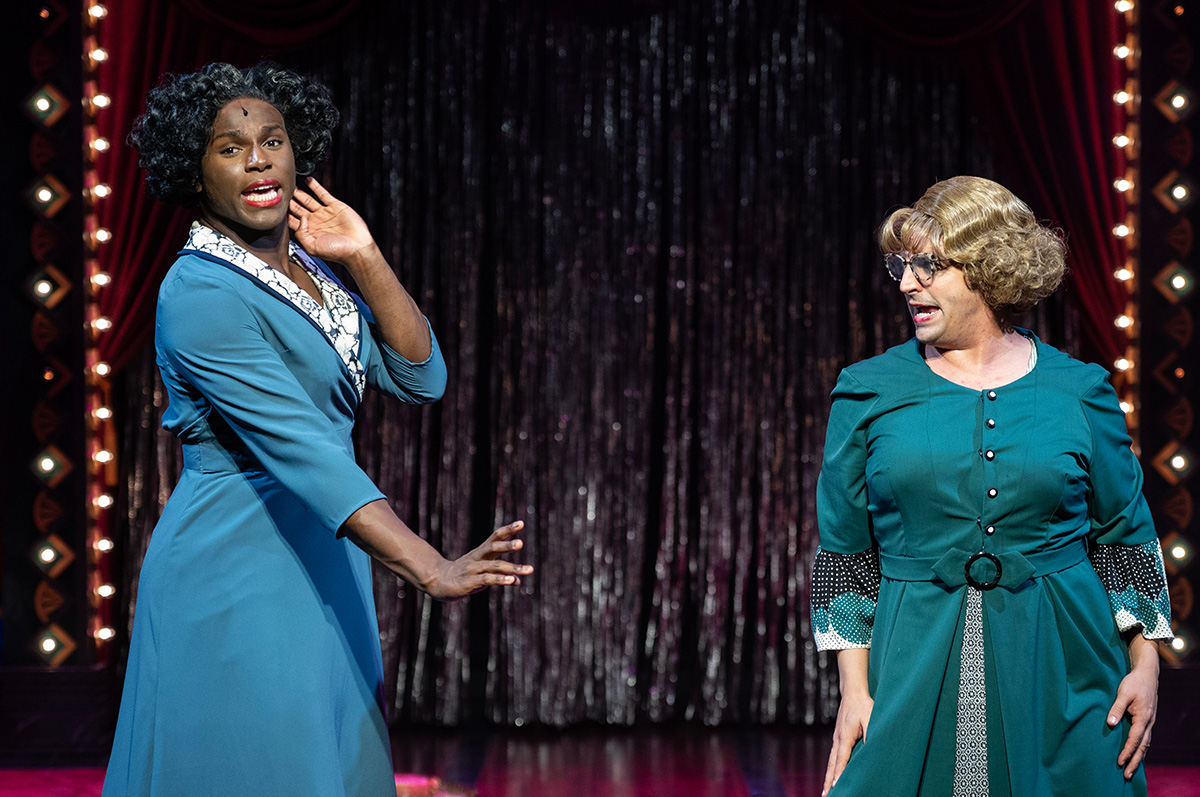
The film and the Tony Award-winning musical share similar plot lines: After witnessing a mob hit, Chicago musicians Joe and Jerry need to leave town. So, they don dresses, join Sweet Sue and Her Society Syncopators all-female band, and board a train headed for warmer climes (Southern California). As Josephine and Daphne, they experience new slants on romance, gift giving, and the male gaze. It’s funny and illuminating.
Helmed by out artistic director Jason Loewith, OTC’s exhilarating production is brimming with fun, feeling, and the musical’s focus on Black identity and gender exploration (recreated for Broadway by writers Matthew López /Amber Ruffin, and songwriting team Marc Schaiman/Scott Whittman).
OTC’s Loewith embraces it all while masterfully bringing together big dance numbers, romantic interludes, slapstick, and what’s more, he makes it look easy.
It’s 1933, deep in the Great Depression, and no-nonsense bandleader Sweet Sue (the excellent Ashleigh King) sets the speakeasy scene with “What Are You Thirsty For?” (not an unusual inquiry during the Prohibition era).
Away from Chicago at San Diego’s glamorous Coronado Hotel, matters become further complicated for Joe (Jacob Tischler) as he pursues the band’s irresistibly unreliable Sugar Kane, sensitively played by the talented Montria Walker. (A couple of her songs, including “A Darker Shade of Blue,” describe a rural Georgia, Jim Crow backstory.)
Meanwhile, Daphne (nonbinary actor Tavis Kordell) is learning a new love language with impish root beer fortune heir Osgood Fielding III (terrific out actor Edward Juvier).
Drinking in a Mexican cantina not far from the hotel, Osgood tenderly serenades Daphne with “Fly, Mariposa, Fly,” a romantic number about metaphorically spreading wings, and transformation. The beloved’s powerful reply number “You Coulda Knocked Me Over with a Feather” is filled with emotional revelation.
In its examination of gender fluidity and self-discovery, the musical isn’t an indoctrination. Instead, audiences accept what’s happening on stage, and soon they’re seduced and painlessly invested in the characters’ wellbeing.
Frank Labovitz’s intelligent costume design is brimming with storytelling. Joe and Jerry’s quick change from guys to girls isn’t flashy — at first. It’s all drab colors, modest hem lengths…street clothes pulled from the Great Depression. Later it’s showbiz silver sequins.
An adept and marvelous actor, Tishler does double duty as the straight and funny man. Even when dolled up for gigs, his Josephine destroys the look with men’s black socks, the dowdy wig, and cockeyed glasses, hilariously setting up a running gag of how Joe, as Josephine, looks so much older than the other girls in the band.
For “Some Like It Hot,” Karla Puno Garcia’s wide-ranging choreography style ranges from those early 1930s flapper flicks (think the young manic Joan Crawford) to something more elegant, Joe and Sugar dancing à la Fred and Ginger in the show’s dreamy number “Let’s Dance the World Away.” Another highlight is the second act’s penultimate number “Tip Top Trouble,” a wild but meticulously staged, gloriously gender bending, sixteen-person, cops and robbers chase sequence.
Top notch music director Christopher Youstra reliably delivers Marc Shaiman’s swinging, 1920s and 30s-inspired score played by a mostly hidden 10-piece band and mimed onstage by Sue’s lively Syncopators.
And in meeting the specialness of the challenge, scenic designer Ryan Douglass transforms the newly renovated theater into a good club setting featuring a colorful inlaid thrust stage surrounded by cabaret tables where just several short yards ahead of Row C, a contented couple is served a bottle of Champagne while settling in before the show starts.
Today, the Bernard Family Theatre with its raftered ceiling and industrial vibe suggests past and promise for the future.
For now, experience the revamped wild ride in a wonderfully redone space.
Theater
‘Merrily’ is for Sondheim super fans, the uninitiated, and anyone in between
Experience it in an intimate setting with beautiful design, incredible cast
‘Merrily We Roll Along’
Through Nov. 1
Signature Theatre
4200 Campbell Ave., Arlington, Va.
Tickets start at $47
Sigtheatre.org
Unfaithful. Compromised. A sellout. Just a few descriptors that might fit Frank Shepard, the talented composer in the Stephen Sondheim musical “Merrily We Roll Along.”
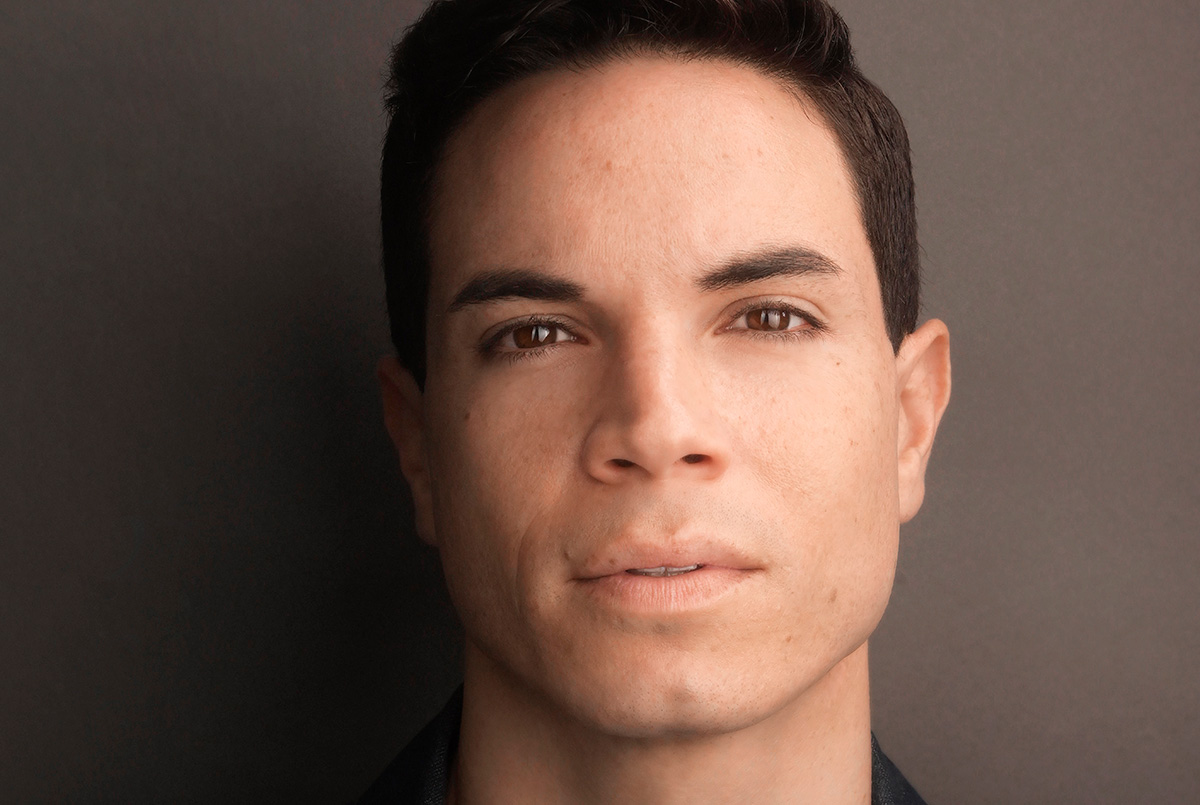
“Personally, I think he gets a bad rap,” says Jason Gotay, the gay actor who’s currently playing womanizing Frank at Signature Theatre in Arlington. “At his core he wants to be loved. He’s concerned with making those around him happy and he’s a people pleaser. That’s my window into Frank.”
Whatever your thoughts, by show’s end, we know Frank started out as a nice guy. “Merrily” famously moves in a reverse chronological order. We meet Frank and friends, lyricist Charley Kringas (Jake Loewenthal) and writer Mary Flynn (Melanie Field), disillusioned in a New York penthouse in 1976. Ensuing scenes filled with disappointments and broken relationships move toward more hopeful times, eventually leaving the trio on a rooftop in 1957, young and full of promise searching the night sky for a happy future.
“Moving backward makes it difficult to build on the prior scene,” explains Gotay. 37. “You live heightened moments followed by 30-second costume changes, and you’re meant to forget everything you just did. To be honest, it’s a bit of a mind fuck.”
A marvelous but humble tenor, he begrudgingly acknowledges his artistic versatility. At New York City Center he sang Che in “Evita” (contemporary almost operatic), and he was solemn Henrik in Lincoln Center’s “A Little Night Music,” (classical Sondheim). On Broadway, he played Homer, the loyal brother in “Floyd Collins” (folksy bluegrass), and he’s sung the sweeping songs of a few Disney princes.
“I’m asked to do a lot of things because vocally I sing in many styles; it’s something I can do and I love doing it.”
Growing up in residential Dyker Heights, Brooklyn, Gotay was immersed in school plays and community theater. For high school, he attended the Professional Performing Arts School in midtown Manhattan with a focus on musical theater.
He continued on the same track for a year at Emerson College in Boston followed by Marymount Manhattan before graduating in 201l. A year later, he made his Broadway debut as Randall in Lin-Manuel Miranda’s hip-hop inspired “Bring It On: The Musical.”
Along the way, Gotay became a huge Sondheim fan. As a musical theater kid, he was introduced to the composer’s enduring classics all written before Gotay was born: “Into the Woods,” “Sweeney Todd,” and the actor’s forever favorite “Sunday in the Park with George.”
To many theatergoers’ surprise, “Merrily” flopped badly when it premiered on Broadway in 1981. But over many years of tweaks, reimaginings and revivals, the show became a major Broadway hit in 2023, with Jonathan Groff winning a Tony Award for playing Frank.
While he was aware of “Merrily,” Gotay didn’t make a deep dive into its wild provenance until he was asked to audition for the Broadway revival. (Briefly it looked like Groff, long attached to the show, might come up against some film conflicts.) It was during this short time that Gotay fell in love with Frank.
The experience left him further determined to sink his teeth into the complex character along with Sondheim’s lush melodic score with songs like “Not a Day Goes By,” “Old Friends,” and “Our Time.” So, when Gotay learned that Signature was slated to do “Merrily” this season, he reached out to Matthew Gardiner, the company’s artistic director as well as the production’s director/choreographer, asking how the role of Frank might be his. Long story short, he sought it, got it, and is ecstatically happy that it has worked out.
Several years ago, when Audible (Audible.com) came calling with an invitation to record a cabaret entirely of his own creation, he was thrilled.
“It’s probably the most personal thing I’ve ever done. My own story is a love letter to the women – my mother, friends, mentors, Broadway icons – who helped to shape my life; it’s about self-acceptance and what it is to grow up queer.”
He titled the solo show “Where You’ll Find Me,” a nod to his first love Dorothy Gale from “The Wizard of Oz.”
Often described as “a television heartthrob” (something the once chubby 12-year-old sometimes finds hard to process), Gotay is not unfamiliar with screens large and small. He’s remembered for various screen roles including his turn as Rafa Caparros, a prep school classics teacher who becomes entangled with a male student in HBO Max’s reboot of “Gossip Girl.”
Gotay recommends Signature’s “Merrily” for Sondheim superfans, the uninitiated, and anyone in between. He says, “It’s a great opportunity to learn about this once niche now increasingly mainstream musical. And if you have seen it before, this is a chance to experience it in an intimate setting with beautiful design and an incredible cast that truly brings the show to life.”
Theater
What’s frightening is also funny in ‘Venus’
Don’t miss spectacular Woolly Mammoth production from out director
‘Venus’
Through Oct. 4
Woolly Mammoth Theatre Company
641 D St., NW
$20– $105
Woollymommoth.net
Meet Beth. She’s an art-house film projectionist. Cocky yet awkward, and a bit of a player, she’s exceedingly fond of international cinema and women. Her current interest is Nicole, a pretty librarian with an obsession for order and safety. Romance seems unlikely.
Written by Los Angeles-based playwright Steve Yockey, “Venus” pits odd against odder, and similar to some of his past works, what’s frightening is also funny.
When Beth (Kimberly Gilbert) crashes a “not fun” book club (currently reading Faulkner’s “As I Lay Dying”), she succeeds in bagging a date with the group’s poised, and –according to Beth – “imminently fuckable” member Nicole (Regina Aquino).
The pair climbs into Beth’s beloved vintage gold Mercedes (or “sort of rust colored,” says Nicole) and head into the night. They reach an isolated hilltop to star gaze and share a Thermos of spiced rum. Charmed by the surprise outing, Nicole warms up to her new friend, but that soon changes when Beth corrects Nicole on some planetary specifics, and lets it slip that she’s taken other women on this same exact date.
Away from age (40 or so), the pair couldn’t be more ill matched. Whether it’s personal style, temperament, approach to dating, they’re chalk and cheese. Beth’s romantic M.O. is spontaneous, whereas Nicole’s dating app profile is “always clean, organized, and up to date with recent pictures and current information.” And she never makes the first move.
“Venus” is perceptively staged by out director Reggie D. White who specifically selected Yockey’s newest play for his directorial debut as Woolly’s new artistic director, and it’s a spectacular launch. The out playwright and director, and the terrific two-person cast, successfully lean into the work’s dark comedy without denying past heartbreaks.
The actors play off each other compellingly, capturing precisely what’s both disturbing and funny about Yockey’s creations. Nicole (Aquino) isn’t particularly concerned about the horrors she visits upon her date, and while Gilbert’s Beth might fall into the most dreadful situations, she handles them with detached wit. It’s hilarious.
The dialogue is spoken to each other, to us, to themselves. Words might switch from conversational to rapidly delivered monologues about varied things like well-meant instructions that Nicole once received from her father on how to box and bury things that upset her.
Costume designer Danielle Preston captures the women’s carefully chosen attire. Nicole is dressed boho prep with a conservative silhouette, flat shoes, and interesting artisanal jewelry. Beth is a bit hit or miss: wide-legged pants, black thick-soled, black boots, and on trend frames– all the sort of things that might look cool.
After the date, Beth drops Nicole at her immaculate, meticulously mid-century curated house. Beth tells us that she’s not averse to a clean home, but other than Susanna, a goldfish in the kitchen, this house with its collection of precisely placed handstitched pillows, looks entirely unlived in; other than the alarming contents of a mysterious drawer, it might be a show home.
And while Beth has made a few moves that her date didn’t entirely dodge, the evening has come to an end. Nicole has a Scholastic book fair in the morning, so she gives Beth the old heave-ho. Nicole likes a clean exit.
What ensues is a one-sided obsession with grand floral gestures, incessant texts, and some stalking. Just when you think one couldn’t grow any madder and that the other is the voice of reason, the script flips. They take turns at being the most neurotic or easily triggered.
Also, each in turn encounters an unseen woman wearing a red raincoat, a sort of physical manifestation of fear. How said interactions work differently for each of the daters, explains a lot.
But to say more would be a spoiler. With its myriad twists and turns, there are so many possible spoilers, scores of them, that might ruin the experience of an absolutely glorious 90-minute uninterrupted traipse through the madly unexpected.
So ably written and acted, you’ll leave believing that you’ve seen the vintage car, been inside a pristine house, and visited a hilltop. But you didn’t.
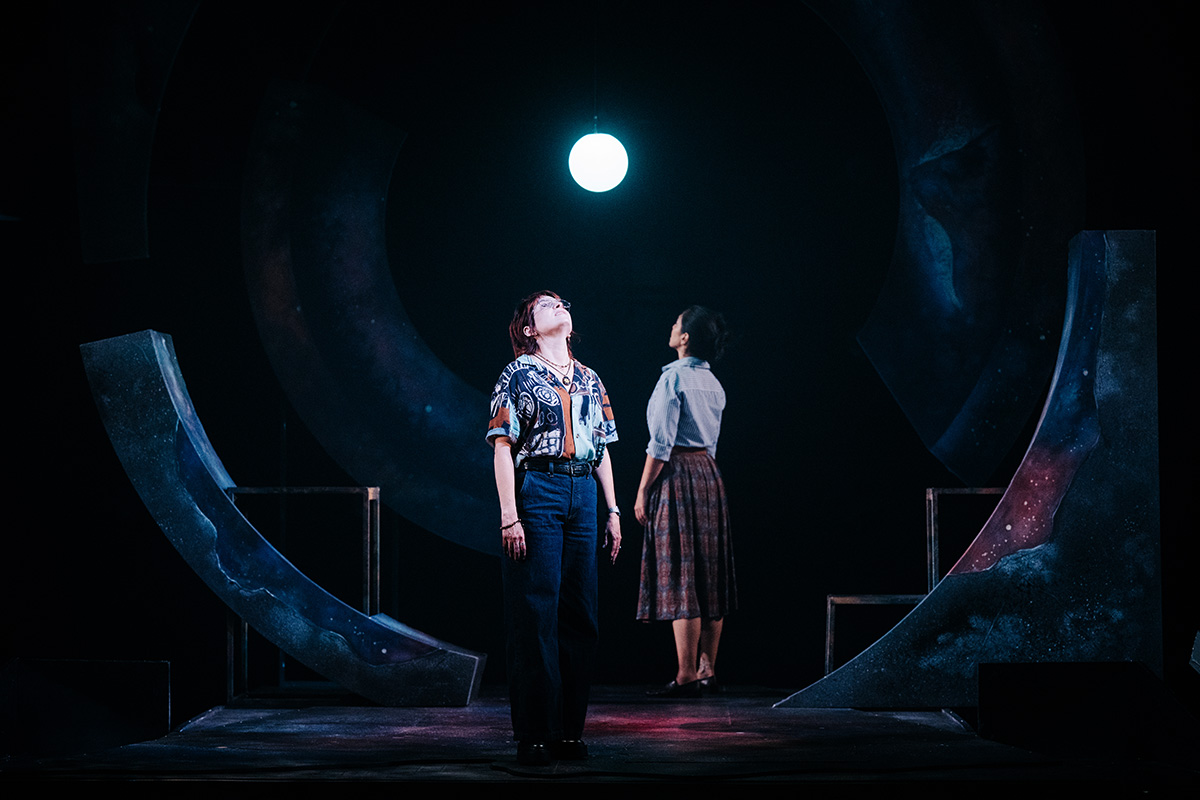
Giselda Estrada’s scenic design includes a raised black platform backed by a dark circle broken into segments, above hang lanterns, globes, pendant lights, and lamps raised and lowered to great effect by lighting designer Nic Vincent. One of the more significant orbs is singled out as a green-hued celestial body. The ground is a blanket of clunky gray gravel.
Even with its two, or maybe three, particularly (and personally) dreaded scenarios, it’s unstoppably pleasing. There’s nothing not to like about “Venus.”

Trump uses anti-trans slur against Democratic Senate candidate

D.C.’s LGBTQ homeless facilities face possible hit from Trump funding cuts

10 years later, we still can’t shake Barry Jenkins’s ‘Moonlight’

‘Some Like It Hot’ a wild ride at renovated Bernard Family Theatre

Bessent says Trump chose him for his qualifications, not his sexuality

Eliot Glazer’s new book an engaging collection of essays

Equality Chamber hosts Pride in Business Expo and Profits & Pours

Learn more about Virginia’s queer history

Lula, Flávio Bolsonaro to face off in second round of Brazilian presidential election

‘Merrily’ is for Sondheim super fans, the uninitiated, and anyone in between
-

 Books3 days ago
Eliot Glazer’s new book an engaging collection of essays
-
Out & About3 days ago
Equality Chamber hosts Pride in Business Expo and Profits & Pours
-
Out & About3 days ago
Learn more about Virginia’s queer history
-
Brazil3 days ago
Lula, Flávio Bolsonaro to face off in second round of Brazilian presidential election