a&e features
Queer literary lion Edmund White not slowing down at age 83
New novel ‘Humble Lover’ features sex, unrequited passion, and ballet
“It’s remarkable,” Edmund White, the acclaimed queer novelist memoirist, playwright, biographer and essayist, told the Blade this summer in a telephone interview, “I’m 83 years old! A lot of people my age would give up.”
“Not me,” he added, “I still feel sharp.”
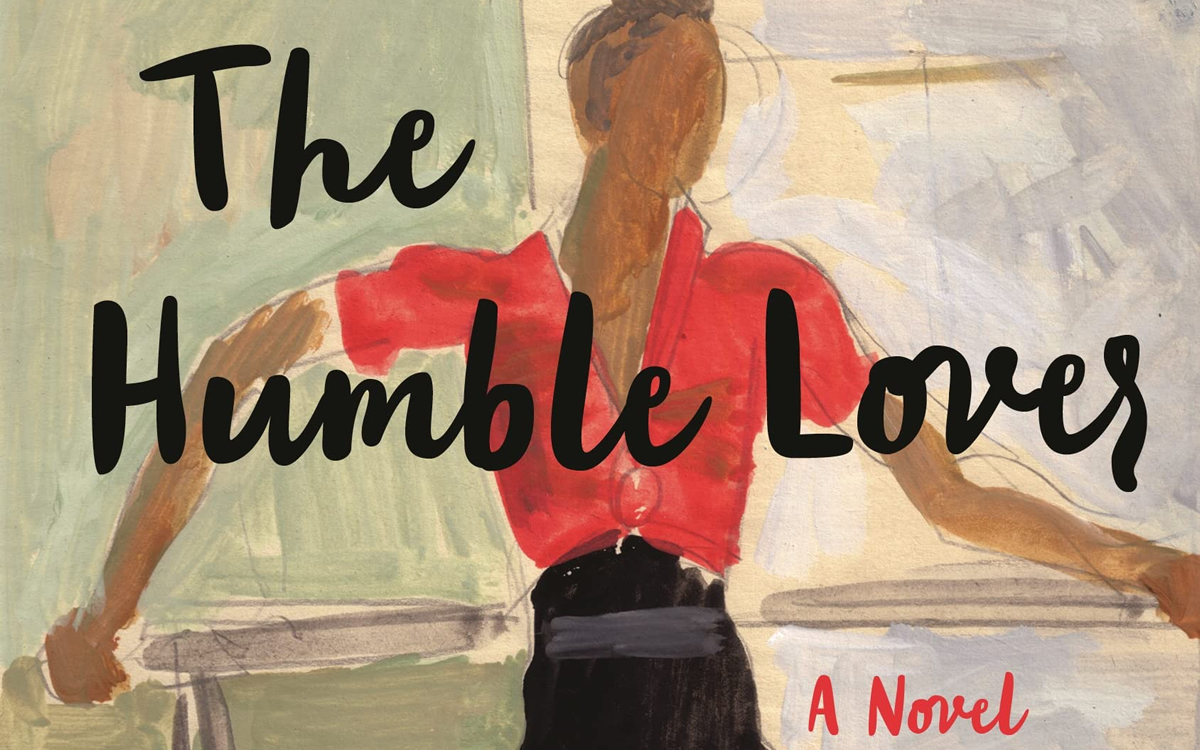
White, born in 1940, is more than as good as his word. At a time of life when many rest on their laurels, he has not only published his latest novel, “The Humble Lover,” (Bloomsbury), but is working on new literary projects.

Don’t be fooled by White’s age. “The Humble Lover” is no sleepy, “octogenarian” novel. Yes, its protagonist, Aldwych West, who’s desperately in love with 20-year-old August Dupond, a principal dancer in the New York City Ballet, sleeps. But that’s all “The Humble Lover” has in common with staid novels for “the elderly.” The novel features lots of sex, unrequited passion, ballet, Champagne, and Ernestine, a dominatrix, who makes Joan Crawford or Bette Davis at their bitchiest seem tame. August doesn’t return Aldwych’s affections. In an effort to spike August’s interest, Aldwych, who’s incredibly wealthy, creates a ballet company so August can have his own ballet troupe to star in. Poor Aldwych! August still doesn’t lust for him. Instead, he hooks up with Padro, a sex worker, and Ernestine, who’s married to his investment banker nephew Bryce. It’s deliciously wicked.
“Why don’t they have more gay villains,” White said, “I liked writing Ernestine. She’s a real bitch!”
“The Humble Lover” is one of the more than 30 novels that White has written. To say that White, who grew up in Evanston, Ill., has had a creative and productive life is an understatement. White, who lives in New York, was a co-founder of the Gay Men’s Health Crisis and of the 1980s queer writers group The Violet Quill. In addition to his many novels, he has written memoirs, essay collections, book reviews as well as biographies of Rimbaud, Genet, and Proust. White wrote a novel (unpublished) when he was a teen at Cranbrook School, a boarding school in Broomfield Hills, Mich.
White has received more honors than you could imagine. His many awards include the PEN/Saul Bellow Award for Career Achievement in American Fiction and Lambda Literary’s Visionary Award.
The National Book Foundation presented White with the 2019 Medal for Distinguished Contribution to American Letters. “A master of narrative and craft across fiction, journalism, memoir and more,” David Steinberger, chair of the board of directors of the Foundation said of White. “Whether it’s evocative depiction of gay life during the tumultuous 1980s, painstakingly researched biography or elegant memoir, White’s work stands out across decades as its resonance … for a multitude of devoted readers.”
Along with being a legendary queer literary lion, White is professor emeritus of creative writing at Princeton. (He taught at Princeton for 19 years.) White has been called the “godfather of gay American literature,” Princeton Alumni Weekly has reported.
In 2013, White and the writer Michael Carroll, who is 25 years younger than White, were married. White has lived much of his life in New York and Paris.
From early on, White was imaginative. As a child, White, like many writers thought up stories and had imaginary friends. “One of my imaginary friends was named Cottage Cheese,” White said.
Today, White is one of the most out, unabashedly, joyfully queer people you’d ever want to meet. “I’m working now on a sex memoir about the loves of my life,” White, who in 1977 co-wrote with Charles Silverstein, “The Joy of Gay Sex,” said.
“It’s so much more sex positive now,” he added.
But when White grew up in the Midwest in the 1940s and 1950s, there was nothing sex positive about being queer. Being gay was sinful and illegal. At best, it was believed to be a sickness. In that era, “the three most heinous things in America were heroin, communism and homosexuality,” White wrote in an essay.
White knew he was queer early on (even though he secretly perused the dictionary to find words for his feelings).
In his 2018 memoir “Unpunished Vice: A Life of Reading,“ White recounts that, when he was 12, his mother gave him a biography of Nijinsky, the queer Russian ballet dancer. “Was it just that he was an iconic artist…and she wanted to stoke my artistic fires,” he writes, “Or was it innocent compliance with a sissy streak I’d already manifested?”
When he was a teen and underage, men would come by, cruising, in their cars. He’d have sex with them. But, “I was jailbait,” White said, “they’d never meet me a second time.”
White always wanted to be a writer. “But, I knew writers can’t support themselves,” White said, “so I thought, maybe I’ll be a professor.”
At boarding school, White’s favorite teacher had studied Chinese. White decided to follow in his footsteps. In 1962, he graduated from the University of Michigan, where he studied Chinese. White was accepted into Harvard University’s doctoral program in Chinese. But he decided against entering the program. He opted to follow a lover and move to New York.
For several years, he pursued journalism. Working for Time-Life Books, freelancing for Newsweek, editing the Saturday Review and Horizon as well as freelancing for publications such as The New Republic.
White is best known for his trio of autobiographical novels: “A Boy’s Own Story,” “The Beautiful Room Is Empty” and “The Farewell Symphony.”
But not all of his fiction, especially, his most recent novels (such as “A Previous Life” and “A Saint from Texas”) are about his life.
“I got tired of writing autobiographical fiction,” White said, “I enjoy making people up.”
White talked enthusiastically about creating “The Humble Lover.” “When I was in my 20s, I had an affair with a well-known ballet dancer,” White said, “and I’ve always been fascinated by the ballet.”
His fascination with ballet and his acquaintanceship with wealthy, WASPy people helped him to imagine the characters in “The Humble Lover.”
“I had an office mate who was the ultimate WASP from a good family in New York City,” White said. “They had their own brownstone. He’d gone to Harvard. He had a way of pronouncing words that was different from anybody else.”
White, like an anthropologist, studied him. “He became the basis for Aldwych,” White said.
Part of writing for White is finding characters equivalent to people in your life. “When I worked for Vogue magazine, I met a lot of society people,” he said. “They interest me in an anthropological way.”
“I had a boyfriend who was on the best-dressed list,” White added, “these jet set people talk all the time about their schedules.”
At the same time, White thinks people spend too much time thinking about celebrities. “They’re not that interesting,” he said.
In addition to working on a memoir about sex, White is writing a new novel. The novel, White said, is based on his nephew who killed himself at age 50. “It was 10 years ago. He was hetero and lived with me for a little bit,” White said. “He was a little bit crazy. He wouldn’t stay on lithium. I was very close to him.”
“I’ve always wondered if I could find a way to do it,” White added.
Before Stonewall, queer writers would try to explain LGBTQ people to readers. “Or they would try to get compassion for gays and present us as sick in sad stories,” White said. “Or, as in Gore Vidal’s case, they’d show us as campy.”
It’s very different, today. “It’s sex positive.” White said.
The Blade may receive commissions from qualifying purchases made via this post.



a&e features
Introducing the Torchbearers Awards honoring queer, trans women and nonbinary people
Meet the Legends and Illuminators lighting new paths
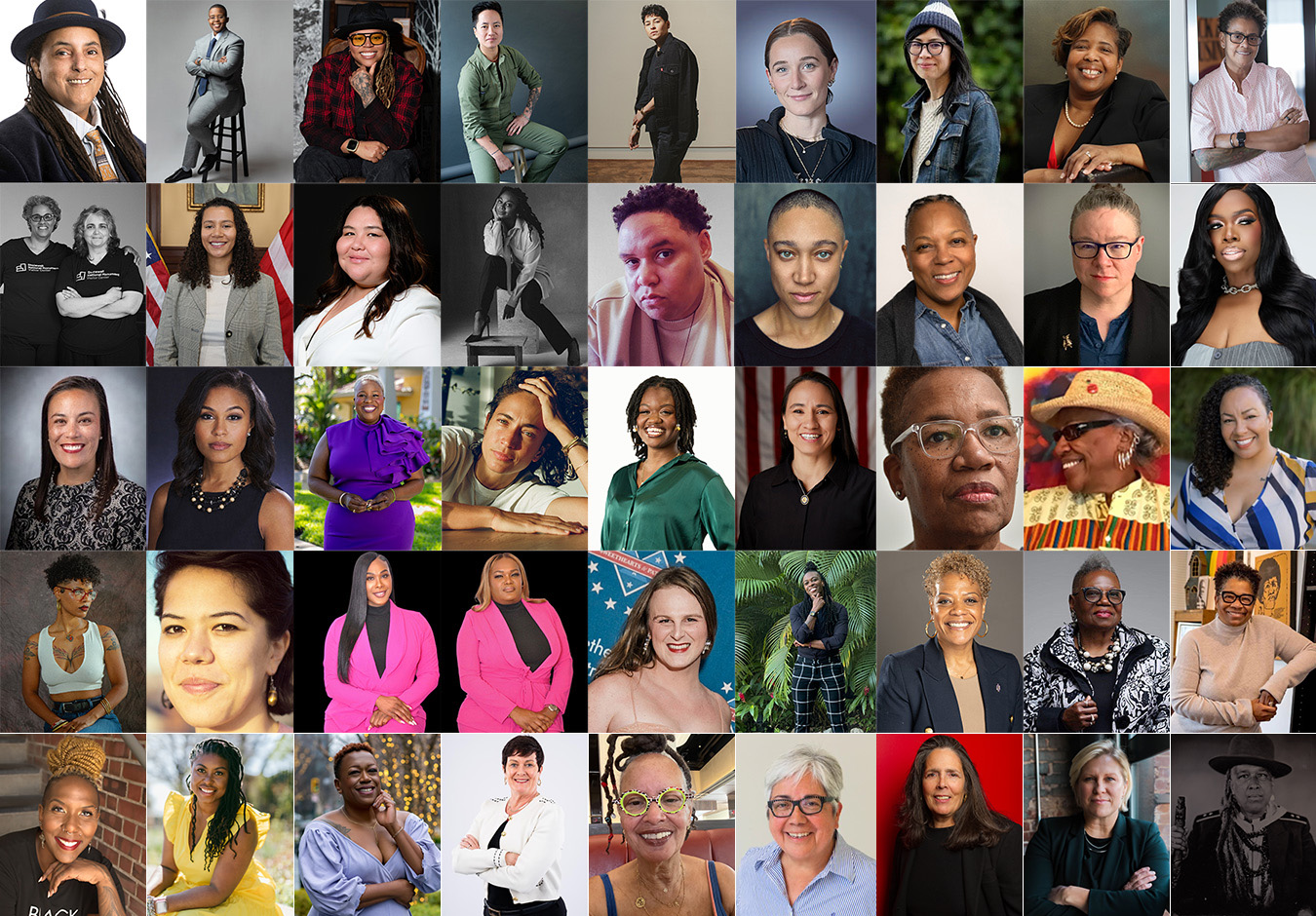
The Torchbearers Awards are more than recognition—they are a continuation of legacy. They honor the quiet architects of progress in our community: those who organize, advocate, build, and protect, often without fanfare but always with purpose. Rooted in a belief in intentional recognition, this honor names those who carry our movements forward—those who make room for others, who remind us that change is both generational and generative. In a time marked by uncertainty and challenge, these leaders push forward with courage, clarity, and an unwavering commitment to expanding opportunity and equity.
This year’s honorees reflect the full breadth of our community, spanning generations, backgrounds, identities, and industries. From Legends, with decades of leadership and having created pathways for others, to Illuminators, who are lighting new paths with creativity and innovation, each Torchbearer represents the power of intergenerational leadership and the strength found in our diversity. They are organizers, advocates, artists, policy leaders, healers, and changemakers whose lived experiences shape a shared vision for equity and liberation.
This award is our love letter to queer and trans women and nonbinary people who carry the flame when it would be easier to let it dim. To those who consistently show up, who use their voice and visibility and stand firm, often without recognition, so that others may live more freely and fully. The Torchbearers Awards celebrates not just what has been done, but the enduring spirit, responsibility, and collective care that ensure the work continues, and that the flame is always passed forward.
Co-Creators of the Torchbearers Awards: Shannon Alston, June Crenshaw, Heidi Ellis
Torchbearers Awards Advisory Board: Aditi Hardikar, Lesley Bryant, Jasmine Wilson-Bryant, Stephen Rutgers
ILLUMINATOR AWARDEES
- Representative Sharice Davids (she/her), (D, KS-03)
— U.S. House of Representatives - Greisa Martinez Rosas (she/her/ella)
— Executive Director, United We Dream - Paola Ramos (she/her)
— Journalist & Correspondent - Meagan A. Fitzgerald (she/her)
— Journalist & Correspondent - Jessica L. Lewis (she/her)
— Founder / Producer, Play Play DC - Savannah Wade (she/her)
— Founder, OAR Agency - Suhad Babaa (she/her)
— Filmmaker/ Former Executive Director of Just Vision - Ashlee Davis (she/her)
— Global Head of Inclusive Outcomes, Ancestry - Jazmine Hughes (she/her)
— Journalist and Former Editor at New York Times Magazine - Queen Adesuyi (she/they)
— Policy Advisor & Organizer, ReFrame Health & Justice - Michele Rayner, Esq. (she/her)
— Civil Rights Attorney, State Representative (Florida House of Representatives) - Gaby Vincent (she/her)
— Sports/Cultural Commentator and Community Leader - Jenny Nguyen (she/her)
— Founder & Owner, The Sports Bra - Denice Frohman (she/her)
— Independent Artist, Poet / Performer - Vida Rangel (she/her)
— Founder, Our Trans Capital - Roxanne Anderson (they/them)
— Executive Director, Our Space - Ann Marie Gothard (she/her)
— Co-Founder & President, Pride Live (Stonewall National Monument Visitor Center) - Diana Rodriquez (she/her)
— Co-Founder & CEO, Pride Live (Stonewall National Monument Visitor Center) - Wendi Cooper (she/her)
— Founder / Executive Director, Transcending Women - Toya Matthews (she/her)
— City of San Antonio, Texas - Mayor Gina Ortiz Jones (she/her)
— Sports/Cultural Commentator and Community Leader - Charity Blackwell (she/her)
— Poet, LGBTQ Advocate & Community Leader - Wilhelmina Indermaur (she/her)
— Director of Communications, Tyler Clementi Foundation - Em Chadwick (she/her)
— CMO, For Them & Autostraddle - Kylo Freeman (they/he)
— CEO, For Them & Autostraddle
LEGEND AWARDEES
- Sheila Alexander-Reid (she/her)
— Executive Director, PHL Diversity, Philadelphia Convention & Visitors Bureau - Cassandra Cantave Burton (she/her)
— Interim Director of Thought Leadership & Senior Research Advisor, AARP - leigh h. mosley (she/her)
— Photographer / Educator, PhotoFlo Photography - Jenn M. Jackson, PhD (they/them)
— Assistant Professor of Political Science; Author & Columnist, Syracuse University - Jordyn White (she/her)
— COO, Washington Prodigy / VP of Leadership Development & Research, HRC Foundation - AJ Hikes (they/them)
— Deputy Executive Director, ACLU - RaeShanda Lias (she/her)
— Digital Creator, RL Lockhart - Donna Payne-Hardy (she/her)
— Educator, EEO Specialist, Founder of NBJC, Former Leader at the Human Rights Campaign - Courtney R. Snowden (she/her)
— Principal, Blueprint Strategy Group - Gaye Adegbalola (she/her)
— Musician & Activist, Musician / Inductee of the Blues Hall of Fame - Cheryl A. Head (she/her)
— Independent Author, Novelist (Crime Fiction) - Letitia Gomez (she/her)
— The American LGBTQ+ Museum, Board Chair - Lynne Brown (she/her)
— Publisher, Washington Blade - Shay Franco-Clausen (She/Her/Ella/Queen)
— Political Strategist and Organizer - Melissa L. Bradley (she/her)
— Founder & Managing Partner, New Majority Ventures - Meghann Burke (she/her)
— Executive Director, NWSL Players Association - Victoria Kirby York, MPA (she/they)
— Director of Public Policy & Programs, National Black Justice Collective - Joli Angel Robinson (she/her)
— CEO, Center on Halsted - Jeannine Frisby LaRue (she/her)
— CEO, Moxie Strategies - Alice Wu (she/her)
— Film Director (Saving Face, The Half of It) / Screenwriter - Storme Webber (she/her)
— Interdisciplinary Artist / Educator, University of Washington - Kim Stone
— CEO of the Washington Spirit, Washington Spirit - Mickalene Thomas
— American Visual Artist, Mickalene Thomas Studio - Erika Lorshbough (any/they/she)
— Executive Director, interACT - J. Gia Loving (she/ella)
— Co-Executive Director, GSA Network
a&e features
D.C. springs back to life with new, returning events
Cherry blossoms, Rehoboth season kickoff, and more on tap
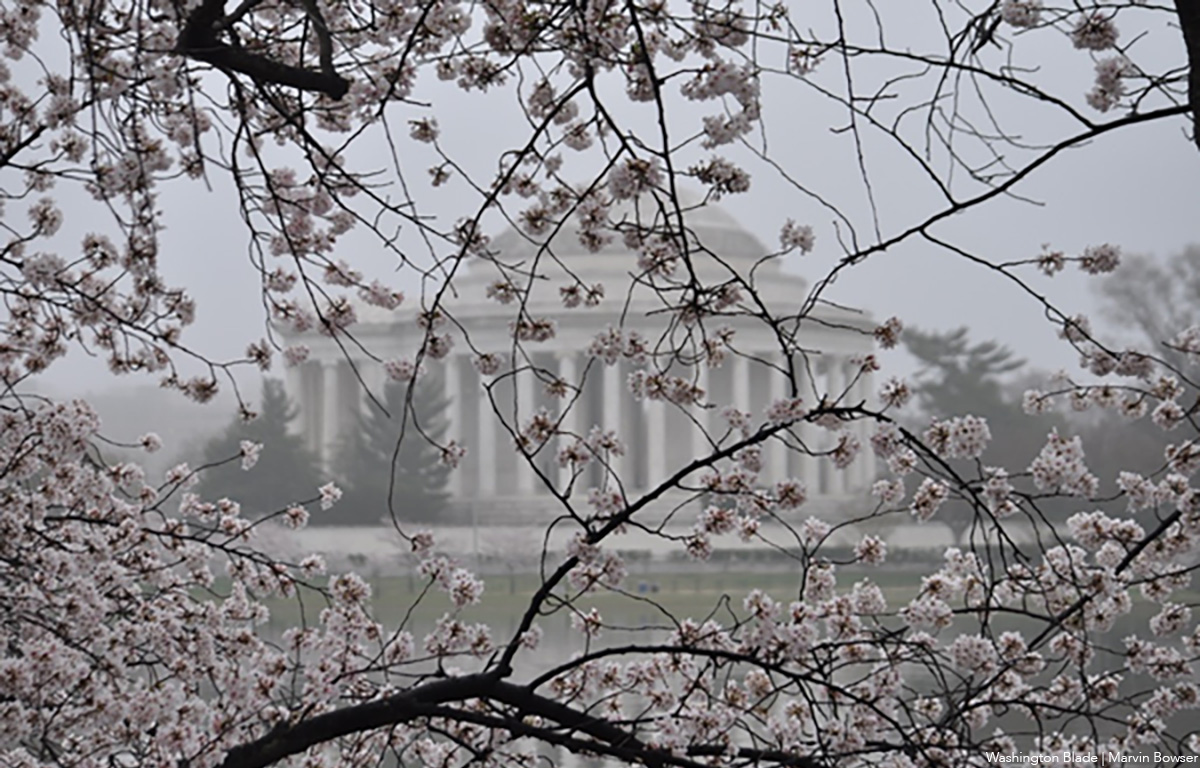
Longer and warmer days are back meaning: It’s time to get out of the house and enjoy Washington D.C.’s many events. Below are a few to check out this spring.
The National Museum of Women in the Arts will host “Making their Mark: Works from the Shah Garg Collection” until Sunday, July 26. This exhibition illustrates women artists’ vital role in abstraction, considers historical contributions, formal and material breakthroughs and intergenerational relationships among women artists over the last eight decades. For more details, visit. NMWA’s website.
Art in the Attic will host a pop-up on Saturday, March 14 at 6 p.m. at 1012 Madison St., Alexandria, Va. There will be a variety of vendors selling products across different modes of art. For more details, visit Eventbrite.
Play Play will host “Indoor Recess – The art of play” on Sunday, March 15 at 2 p.m. This event will embody classic recess energy, including opportunities to build and experience community and connections through games, movement, art stations, and creative freedom. Tickets are $12.51 and can be purchased on Eventbrite.
Spark Social will host “Gay Bar Crawl on U Street” on Friday, March 20 at 7:30 p.m. This will be a fun night out in gay D.C. with other gay people, whether you’re visiting D.C., new to the area, or just looking to expand your social circle. Many crawlers have formed lasting friendships and even romantic relationships after just one night out. Tickets are $35.88 and are available on Eventbrite.
Creative Suitland Arts Center will host “EFFERVESCENT: House of Swann” on Saturday, May 30 at 7 p.m. This will be a gay, good time where we will celebrate love, joy, wellness, and visibility for the LGBTQIA+ community. Tickets start at $17.85 and can be purchased on Eventbrite.
SWAG Works DC will host “Unapologetically Her” on Saturday, March 14 at 2 p.m. at 701 E St., S.E. This event is a powerful celebration of womanhood, resilience, creativity, and self-expression in honor of Women’s History Month. This all-women exhibition highlights the diverse voices, stories, and artistic perspectives of women who create boldly, live authentically, and stand confidently in their truth. This event is free and more details are available on Eventbrite.
9:30 Club will host “Gimme Gimme Disco: A Dance Party Inspired by ABBA” on Saturday, March 14 at 6 p.m. There will also be a “Donna Summer Power Hour – The Queen of Disco” segment during this event. It’ll be one hour of music with no skips. Tickets are available on 9:30 Club’s website.
Harder Better Faster Stronger will host “Heated Rivalry Rave” on Friday, March 20 at 9 p.m. at Howard Theatre. This event is open to all ages. Tickets are available on the theater’s website.
CAMP Rehoboth hosts its 25th annual Women’s+ FEST, April 9-12 in Rehoboth Beach, Del. Entertainers include headliner Mina Hartong, a comedian, storyteller, and founder of Lez Out Loud; and singer Yoli Mayor. There are dances, dinners, pickleball, and much more. Details and tickets at camprehoboth.org.
Also in Rehoboth Beach, the Washington Blade’s 19th annual Summer Kickoff Party is set for Friday, May 15 featuring Ashley Biden, who will accept an award on behalf of her brother Beau. State Rep. Claire Snyder-Hall will also speak. More speakers and the venue to be announced soon.
The annual D.C. Cherry Blossom Festival kicks off March 21 at DAR Constitution Hall and culminates with Petalpalooza on April 4, the day-long, outdoor street party with music and art, stretching across Navy Yard, and ending with fireworks over the Anacostia River.
a&e features
‘Queer Eye’ star Dorriene Diggs on life before and after appearing on hit show
Emotional January episode highlighted 40-year love affair with partner

Dorriene Diggs, 70, whose 40-year relationship with her domestic partner, Diane until Diane’s passing in 2020, the couple’s tense relationship with their respective parents, and Dorriene’s current living arrangement with her straight sister Jo, were the focus of a final season episode of the popular TV series “Queer Eye.”
In a recent interview with the Washington Blade, Diggs told of how her appearance on the show has impacted her life. She elaborated on the many aspects of her life experiences that she told to the five “Queer Eye” co-hosts who interviewed her and her sister in their D.C. home.
Although her parents and her partner’s parents, who have since passed away, were not accepting of their relationship, Diggs has said most of her family members at this time reacted positively to her appearance on the show.
“They loved it,” she told the Blade. “Yes, everybody that saw the show called me and said they loved the show, they really enjoyed themselves watching it.”
Through an arrangement with D.C.’s Rainbow History Project, the “Queer Eye” show featuring Diggs and her sister was presented in a special screening on a large video screen at the D.C. History Center in January.
“Dorriene, a 70-year-old Black lesbian living in Washington, D.C., had spent decades building a life with her partner while navigating silence within her own family,” a “Queer Eye” statement announcing the episode on Diggs states.
“The Fab Five did not arrive to introduce Dorriene to herself, but to help ensure her story was finally heard in full,” the statement says.
Blade: Can you tell us how your appearance on the “Queer Eye” program came about? How did they find out about you?
Diggs: You know, I still don’t have all the details. I think it was my niece, Missy. And she knows somebody there from “Queer Eye.”
Blade: So, did you first learn about it when someone from “Queer Eye” contacted you?
Diggs: No, the “Queer Eye” guy knocked on my bedroom door and started talking. I was in my bedroom watching television and the next thing I know my door opened up and there was Karamo [Karamo Brown, one of the “Queer Eye” co-hosts] with his big black cowboy hat on, opening the door grinning. … They contacted Jo first. And when they came here, they realized there was a gay woman in the house, too. Because my name was not mentioned at first. After they came here, they learned about me, because when Missy reached out to them, she reached out to them about Jo. But that doesn’t bother me. This was all about Jo in the beginning, and not me. … They started talking to me and Jo. And he said, Dorriene, ‘you’ve done so much for so many people, it’s time for someone to do something for you.’ That’s what they said. He said, ‘this is the day we’re doing it for you.’
And so, they put me and my sister up in a hotel for a week. They gave us a personal driver to take us anywhere we wanted to go. And then they took us to a bunch of places. We didn’t know why they were doing all of this. We had no idea that they were renovating the house and renovating our bedrooms. We had no idea.
Blade: What was your reaction when you saw the home renovation?
Diggs: It was amazing. And they bought us all new complete wardrobes – clothes, shoes. But most of the stuff they got me I gave away to a women’s shelter. But it was so nice. Actually, to meet the guys. I’ve been watching the show for 10 years. I have watched it from the beginning. And actually, it brought me and my sister closer – really. We’re closer now than we’ve ever been. She’s my baby sister – not the baby, but next to the baby. She’s the younger one.
Blade: What has been the reaction to your appearance on the show? Do more people now recognize you?
Diggs: Yes, yes. I’m getting phone calls and it’s almost like I’m a celebrity. And I don’t want people to make a fuss over me. All the things I did I did from the heart. I really did. And I don’t want people to think I’m more than I am. I’m just a good Christian woman that believes in giving back.
And I do. God gives me help giving. That’s what I do. And I don’t want anything in return from anyone. You know, because I know what it means to not to have. I know what it means to go to bed hungry, with no food. Going to school with holes in your shoes. I know that. I know that feeling. I’ve been there. And I promised myself as a kid I would never live like this again. And when I got bold enough to leave home, I left home at 14, and I moved in with a drag queen. Damen was his name.
Blade: Did your appearance on the show change your life and your relationship with your sister?
Diggs: Yeah, yeah, it actually did. We are actually closer now than we’ve ever been. Because, like I said, I moved away from home early and I never went back. My parents had a problem with my lifestyle. They really did. My mom looked at me with such hatred. When I was old enough to say goodbye, I never looked back. And to come back around now in the last few years after Diane died, that’s when I came back here.
And at one point I stayed with my nephew Todd and his wife – but he got killed in a car accident. I couldn’t stay at his house anymore. So, then I called Jo and told her I need to get out of here. And without hesitating she came and picked me up and brought me to her home. And I’ve been here ever since.
Blade: Can you tell a little about when it came about and how you met your partner?
Diggs: We lived on 18th Avenue in condos. I just bought one. Hers was above mine. I bought the bottom one. When my brother came over, she was getting out of her car. She was driving a Vega. And I turned to my brother and I said – this is the God’s honest truth – I said Keith, that’s the woman I’m going to spend the rest of my life with. Just like that. And he started laughing. He said, girl you’re crazy. I said I know I’m crazy, Keith, but I’m telling you that woman right there is who I’m going to spend the rest of my life with.
Blade: And when was that?
Diggs: It was 1980 actually. And then I started going to the laundry room to do my laundry. So I started talking to her. She said, ‘I’m not speaking to you.’ Isaid ‘why not?’ She said ‘because you’re nothing but a female gigolo.’ And I said I’m not dating anymore. I’m waiting for you. ‘No, you’re too fast for me.’ I said, ‘well, I’m not giving up.’
And I didn’t give up. So, I was playing an album one day and she knocked on the door and asked what I was playing, I think. I said you liked that. She said yeah. I said OK, I’ll bring it upstairs and we can listen to it together. So, when I went up there to her apartment that day and whenever I went up there, I never left.
Blade: So, your partner’s name was Diane?
Diggs: Yes, Ruth Diane Robinson. But she hated the name Ruth. So, the only people who called her Ruth were at work, the people she worked with. Everybody else called her Diane.
Blade: And how many years were you together?
Diggs: Forty. Forty years together
Blade: And where were you living with her most of the time?
Diggs: We lived in Hagerstown the longest, Hagerstown, Md. And so, if Diane hadn’t died I probably still would have been in our house in Hagerstown.
Blade: Can you tell me a little about what you were doing career wise during those years?
Diggs: I do computers. I used to do computers. And before that I cooked. I love to cook like my mom. And then I wanted to do something else. So, I taught myself computers. I taught myself how to build computers and stuff. So, then I got my own computer business called Ida One Computer Consulting. And so, we helped build computers for people.
Blade: Around when was this, in the 1980a or 1990s?
Diggs: Yes, in the 1980s. I think I stopped I would say around ’96, when I stopped. Because we both said we were going to retire at 55. And we did. We both retired at 55. And then she started diabetes. Every day I had to give her an injection because she was afraid of needles. She couldn’t give it to herself. So, I had to give her an injection every day One time, I don’t remember when, she had a mild stroke. And I had to take care of her. I’ve always taken care of her. And I don’t regret it. I never regretted it. It’s taking care of the one you love.
Blade: When was it that she passed away?
Diggs: In 2020. I found her on the kitchen floor.
Blade: How did your family and your extended family react to your relationship with Diane?
Diggs: Well, her family, oh my God, they hated me – her mother the worst. Because I put a stop to them treating her really bad. I told her mother – I said never in my life – my mother raised me well. Never disrespect someone’s mother. I said but this time I’m going to disrespect you because you are going to start treating Diane like you ought to. This is a wonderful woman and you and your son and you it’s always about your son. You never, ever say anything good about your daughter.
I said it isn’t going to happen again. You’re never going to disrespect her again. I said you take a damn good look at her because you’ll never see her again. I meant that. I grabbed Diane. I said it’s time to go. They don’t care about you.
Blade: Can you tell a little about your family?
Diggs: Yeah, I’m a triplet sister. So, it’s Dorriene, Chorine, and Chrissy — we are the triplets. So, my mom had a set of twins and a set of triplets within nine months. One of the twins died at birth. So, the other twin is Margaret.
Blade: So then how did your family react to you and Jo being on “Queer Eye”?
Diggs: Most of my family really had no problem with it.
Blade: Were you out to them?
Diggs: Oh yeah. I was never in the closet. I didn’t give a damn what people felt about me, sweetheart. I really didn’t. I didn’t care. Because I was going to be me. And for people who didn’t like it, I wasn’t living for them, I was living for me. I’ve always been out. I had a brother who was also gay, Marvin. God rest his soul, too. But he stayed in the closet. He was in the closet until he was about 55 years old.
But everything I said on the show was the truth – my account. The things that I went through with family … You can’t tell me how I felt. If they try to make mom and dad out as perfect, they weren’t perfect. They were the worst parents. That’s my account of it.
So yes, everything I said on that interview was the truth. That’s one thing people who know me know – I do not lie.
Blade: What are some of the things you like to do these days?
Diggs: I’m a sports lover. I love sports. So, my baseball season is getting ready to get started. Baseball is my favorite sport. Yes, I love baseball. I like the statistics of it. And watching the guys. I wish they had a women’s professional baseball team, honestly. … I’m a D.C. sports fan. The Wizards, the Nationals, the Mystics, the Caps. … And see, I’m a diehard Redskins fan and I refuse to call them the Commanders. They’re the Redskins. They will always be the Redskins to me. I love my sports teams.
Blade: Can you tell a little about the history of the house where you and Jo now live and where they did the filming of the “Queer Eye” show?
Diggs: Jo had a house on 17th Street, I think it was Northeast because it was over there by H Street, N.E. And I think somebody wanted to buy her house. I don’t know why she moved. So, she found this house. Because she wanted to buy something where she could buy a house straight out. She didn’t want a mortgage on another house.
Blade: What are your thoughts on being on the last season of “Queer Eye?”
Diggs: Yeah, we were the last ones. We took it out with a bang, me and Jo. That was it.
Blade: Can you say how you and Jo appearing on the show impacted your life?
Diggs: I don’t know. I’m the same person. I’ve been getting calls from people saying I saw you on the show. And friends who I haven’t seen in years have been calling. … So yeah, the show, people I haven’t seen and talked to in years have been calling. I think that’s a good thing.

Trump tells Fox News he won the ‘gay vote’ — but polls tell a different story

Anti-trans visa ruling echoes Nazi regime destroying trans documents

Japanese Supreme Court to consider marriage equality

The outrage economy is not the LGBTQ community

Calendar: March 27-April 2

PHOTOS: Capital Stonewall Democrats 50th anniversary

Polish court rules country must recognize same-sex marriages from EU states

Capital Stonewall Democrats 50th anniversary gala draws sold out crowd

Trans Day of Visibility events planned

Virginia General Assembly’s 2026 legislative session ends
-

 Photos5 days ago
PHOTOS: Capital Stonewall Democrats 50th anniversary
-
Poland5 days ago
Polish court rules country must recognize same-sex marriages from EU states
-
District of Columbia5 days ago
Capital Stonewall Democrats 50th anniversary gala draws sold out crowd
-
District of Columbia4 days ago
Trans Day of Visibility events planned