District of Columbia
Man charged in 2019 D.C. gay murder sentenced to 16 years
Distraught family members urged judge to hand down longer prison term
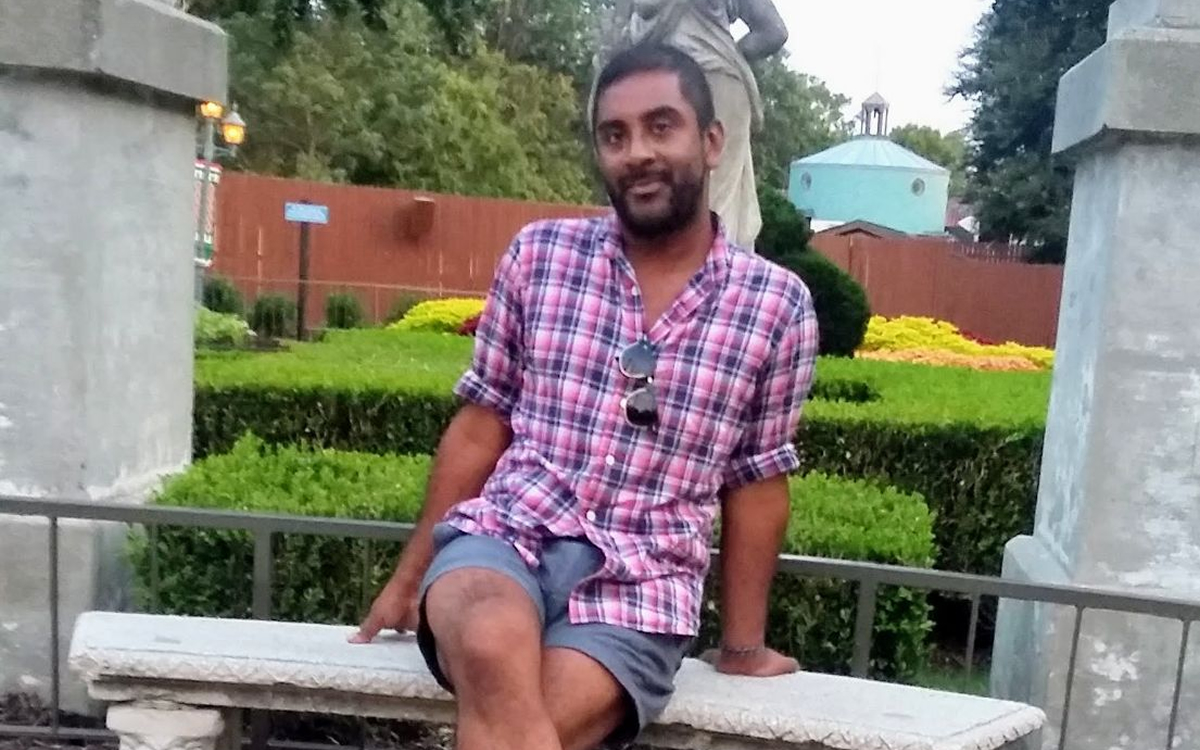
Former U.S. Navy Hospital Corpsman Collin J. Potter, 31, who earlier this year pleaded guilty to second-degree murder while armed for the Jan. 6, 2019, stabbing death of gay D.C. resident Vongell Lugo, was sentenced Sept. 15 by a D.C. Superior Court judge to 16 years in prison and five years of supervised probation upon his release.
The sentencing took place at a hearing in which Assistant United States Attorney Peter V. Roman, the lead prosecutor in the case, described in gruesome detail how Potter stabbed Lugo 42 times inside Lugo’s Northwest D.C. apartment shortly after the two met at a D.C. bar and Potter accepted Lugo’s invitation to come to the apartment.
Superior Court Judge Marisa Demeo handed down her sentence after listening to testimony by Lugo’s mother, brother, and sister, and seven of Lugo’s friends, who presented highly emotional victim impact statements describing Lugo as a beloved figure whose brutal murder had a devastating impact on their lives.
Nearly all of the 10 who spoke – eight in the courtroom and two through a live video hookup – urged the judge to hand down a far greater prison term than the 14 to 16-year sentence that prosecutors with the Office of the U.S. Attorney for D.C. offered and Potter accepted in exchange for pleading guilty as part of a plea bargain deal. The plea arrangement made it clear that the judge would make the final decision on what the sentence should be.
Under D.C. criminal law, judges have the discretion to hand down a sentence of up to life in prison for a second-degree murder conviction.
Many of the family members and friends wept as they described Lugo, 36, as a loving, caring person who enriched their lives and who was taken from them by Potter in an unimaginable act of violence.
The sentencing took place a little over seven months after Potter, who was 26 at the time of the murder, pleaded guilty to the charge of second-degree murder while armed and prosecutors dropped their original charge of first-degree murder while armed and other related charges as part of the plea bargain deal.
Court records show that at the request of prosecutors, a D.C. Superior Court grand jury on Aug. 20, 2019, indicted Potter on five counts related to the murder, including two counts of first-degree felony murder while armed, felony murder while armed with aggravating circumstance, and kidnapping.
The U.S. Attorney’s Office has declined to disclose why prosecutors offered the plea deal that included dropping those charges and allowing Potter to plead guilty to second-degree murder rather than bringing Potter to trial on the first-degree murder and other charges.
Attorneys familiar with this type of case have said prosecutors usually offer a plea deal when they are uncertain whether they can convince a jury to find someone guilty beyond a reasonable doubt at a trial.
At the Sept. 15 sentencing hearing, Potter’s defense attorney, Matthew Davies of the D.C. Public Defender Service, told the judge one reason why the plea offer made sense was it avoided a trial in which Potter would likely have used the defense of insanity or severe mental health problems, that Davies said his client is currently grappling with.
Davies pointed to information submitted by the defense that Potter has a history of trauma brought about by being sexually abused as a child. He said Potter also has an alcohol abuse problem and related mental health issues, and those factors led to the stabbing incident that took the life of Lugo.
He asked the judge to hand down a sentence of 14 years of incarceration, saying that would adequately serve the cause of justice for this case.
The subject of Potter’s mental health also surfaced in a 10-page sentencing memorandum that Roman filed in court two days before the sentencing, and which Roman summarized at the hearing, including the recommendation of a sentence of 16 years of incarceration.
The sentencing memo begins by describing Lugo as an “openly gay man who was born and raised in Trinidad & Tobago before emigrating to the United States with his family several years ago.” One of Lugo’s friends told the Washington Blade that Lugo had been working as an associate manager for a company that provides language translation services.
The sentencing memo says police arrived at Lugo’s apartment about 4 a.m. on Jan 6, 2019, when two neighbors called 911 after hearing Lugo screaming for help through the walls of their adjoining apartments.
It says police arrived shortly after Potter, who was fully nude and covered in Lugo’s blood, had dragged Lugo’s nude body outside the apartment door into the apartment building hallway.
“After the police arrived, the defendant made several statements,” the sentencing memo says. “He repeatedly referred to Mr. Lugo as his girlfriend and as a female and stated that Mr. Lugo’s injuries were self-inflicted,” the memo continues. “The defendant then banged his own head against the wall and started screaming obscenities and that he did not want to live,” it says.
Several of the close to 20 friends and family members of Lugo who were sitting in the courtroom as prosecutor Roman presented these details were crying.
Defense attorney Davies told the judge that he informed Potter that he had a strong defense based on mental health issues if the case went to trial. But Davies said Potter expressed strong opposition to going to trial and subjecting Lugo’s family to additional trauma.
Court documents show Potter was arrested at the scene and has been held in jail since that time as the case dragged on for more than four years since the January 2019 murder.
Court records also show that Lugo and Potter met at the Black Whiskey, a bar on 14th Street, N.W. where Lugo was a regular customer. Although some of Lugo’s family members and friends who spoke at the sentencing hearing said they considered the murder a hate crime, court records show police and prosecutors did not list the case as a hate crime.
“He was a beautiful gay man, and everyone loved him,” Hannah Donnelly, one of Lugo’s friends and co-workers said in presenting her victim’s impact presentation in the courtroom.
Another friend said in her impact statement that Lugo invited her to join him to watch D.C.’s Capital Pride parade. She and nearly all the others who presented their impact statements at the hearing were not gay or lesbian themselves but said Lugo was beloved because he always did all he could to help them and support them in their everyday lives.
“He was like a brother to me,” said Gregory Porter, one of Lugo’s friends who, along with his wife, presented their victim impact statements in the courtroom. “There was never a thought that he would no longer be a part of our life,” Porter told the judge. “We ask for equal justice. We ask the court to invoke the maximum possible sentence,” he said.
Victoria Lugo, Lugo’s mother, was the first of the family members and friends to deliver her victim’s impact statement. Looking directly at Potter, she told him there was nothing her son could have done to him to justify what Potter did.
“You have taken my child from me, Mr. Potter,” she said while crying. “My heart hurts,” she continued. “No mother should have to go through this.”
Potter, who was dressed in an orange prison jumpsuit, accepted Judge Demeo’s invitation to speak before she handed down her sentence.
“I’d like to say I am truly very sorry,” Potter told the judge. “I accept the consequences of my action,” he said. “I feel I will spend the rest of my life having a positive impact on other people’s lives to make up for what I have done,” he said.
After listening to Potter, the presentations by Lugo’s family members and friends and hearing remarks from prosecutor Roman and defense attorney Davies, Judge Demeo said she would accept the plea agreement. She said the circumstances surrounding the case, including what she called the “brutal nature of the crime,” warranted that she issue a sentence representing the upper end of the plea agreement of 16 years’ incarceration and five years of supervised release.
She said she would order that the facility where Potter is incarcerated will provide him with mental health treatment.
“There is no doubt that this was a horrific crime,” she said. “Vongell Lugo was shown by witnesses to be a wonderful soul,” she added.


District of Columbia
McDuffie on LGBTQ support and standing up to Trump
‘I’m committed to governing with the queer community at the table’
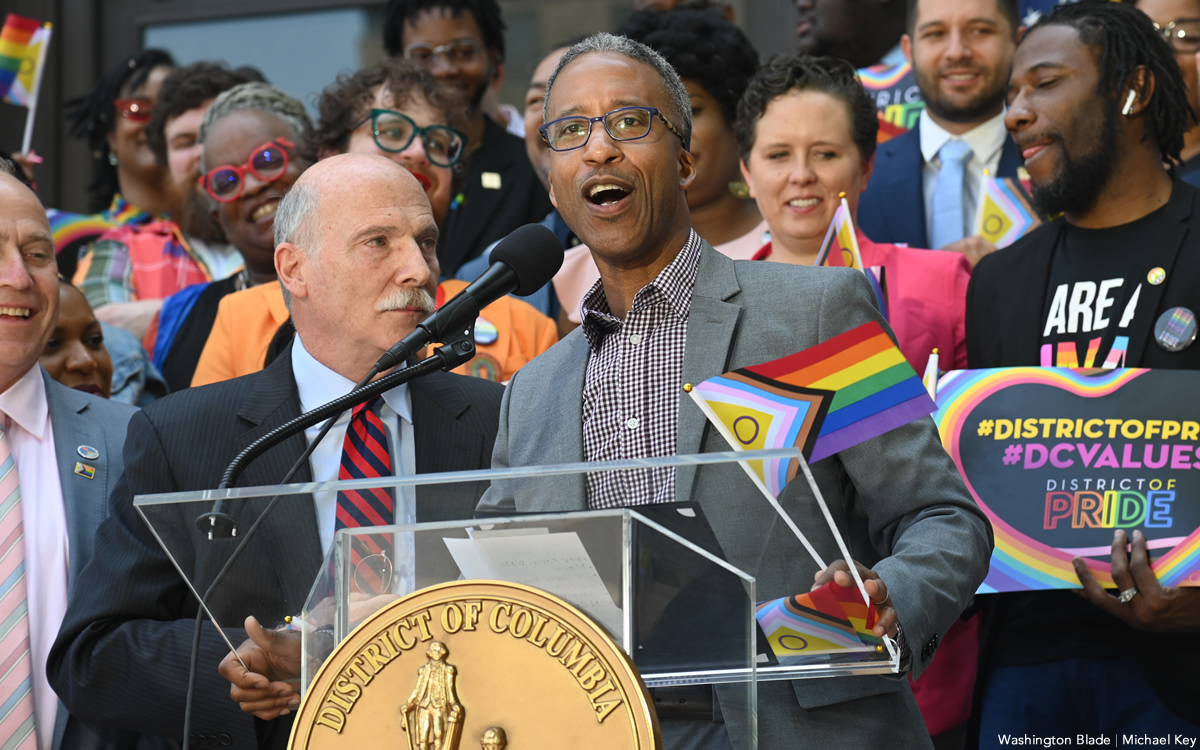
Former D.C. Council member Kenyan McDuffie is running for mayor as Muriel Bowser’s third term expires in January. He’s running in a crowded Democratic primary field; recent polls show him in second place behind Council member Janeese Lewis George. D.C.’s primary is Tuesday, June 16.
The Blade sat down with McDuffie on June 8 for a wide-ranging conversation about his pro-LGBTQ record and challenges now facing the community.
The Blade reached out to fellow mayoral candidates Lewis George and Rini Sampath, who identifies as queer, for interviews. Neither responded to repeated requests over several weeks.
Blade: Members of the D.C. LGBTQ community are receiving information that most if not all the seven Democratic candidates for mayor, including you and Council member Janeese Lewis George, are strong supporters of the LGBTQ community. What message would you have for LGBTQ voters on why they should support you rather than one of the other candidates?
McDuffie: Thank you for the question, Lou. And thank you for your work over the years with the Washington Blade. I’m really looking forward to having this conversation. You know, Washington, D.C. is the capital of the United States, and our city is one of the most beautifully diverse and inclusive cities in America because generations of LGBTQ+ residents, advocates, and organizations have fought to make it that way.
And throughout my time on the Council, I’ve been proud to support that work by advancing equity and opportunity and standing up for the rights and dignity of every resident across the District regardless of where they live, who they know, how much money they have. And as mayor, I’m going to build on that progress by ensuring D.C. remains a place where LGBTQ+ residents can live safely, where they can access quality healthcare and housing, they can build families and businesses and thrive in the neighborhoods of our city.
And now more than ever, making sure we protect residents from a hostile federal administration, including President Donald Trump, who seeks to roll back civil rights and civil liberties.
Blade: Some people, including members of the LGBTQ community, have criticized Mayor Bowser for what they say has been her position of not standing up forcefully enough against the Trump administration on various issues, including the deployment of National Guard soldiers in the city. What are your thoughts on that? How would you deal with the Trump administration if you were mayor?
McDuffie: Well, I’m going to deal with the Trump administration by prioritizing D.C. residents first. I’m going to stand up and fight back against federal infringement from Donald Trump and from Republicans in Congress or any other individual or organization that seeks to threaten Washington, D.C. residents.
And that means on day one rescind the executive order that permits cooperation between the Metropolitan Police Department and ICE and DHS [U.S. Department of Homeland Security]. And I know because of my work 13-and-a-half years on the Council doing research, authoring transformational legislation that protects people’s civil rights, that makes the Metropolitan Police Department more transparent, doing things like authoring the landmark NEAR Act [a 2016 D.C. law aimed at reducing violent crime].
I know from that work, and I know from my former work as a civil rights attorney in President Obama’s Department of Justice that you have to fight to ensure that we have a fair and more just society. I did that as a civil rights attorney traveling the country fighting to protect people’s civil rights. I did that as a prosecutor who fought crime and delivered justice for victims.
And I’m going to do that as mayor to ensure that we use every legal and political tool available as mayor to resist any federal effort to roll back LGBTQ+ protections in Washington, D.C. And I’m committed to governing with the queer community at the table and lifting up their contributions to this city at the center of every decision that I make as mayor. You know that I’ve been a champion making Washington, D.|C. more equitable, more just, and economically inclusive. And I plan to continue to build on that work that I have done and the work that so many important people have done in the LGBTQ+ community in Washington, D.C. to make sure that our residents can live safely and thrive in Washington, D.C.
And so, we’re going to fight back against Trump and any hostile federal administration to make sure we’re protecting the residents first. And we will work with the federal government where there is an opportunity to do transformational economic development projects like RFK, transformational infrastructure projects like expanding Union Station. Both of those will create thousands of jobs and thousands of opportunities for D.C.-based small businesses.
But I will draw a very bright line when it comes to protecting the civil rights of individuals across the District of Columbia, including the LGBTQ+ community and our vulnerable neighbors like our immigrant neighbors and families who in many cases today are living in the shadows, afraid to leave their homes, afraid to go to work, afraid to walk their kids to school because they’re being snatched off the streets in safe places around schools and places of worship. And it is utterly despicable what Donald Trump has done and how he’s weaponized our federal law enforcement.
Blade: As a follow-up to that, reports surfaced last year that the mayor had to cut the budget for the Office of LGBTQ Affairs for this year by $600,000 because of a large cut in the city’s budget by Republicans in the U.S. House of Representatives. Would you do something to try to restore the funds that were cut from that office?
McDuffie: Absolutely. I will as mayor fully fund the Mayor’s Office of LGBTQ+ Affairs and direct it to proactively identify gaps in city services while also ensuring that the Office of Human Rights has additional resources to vigorously enforce efforts against discrimination across government agencies and within the private sector where it arises. I am a civil rights attorney by training. And I will bring the full force of the District of Columbia government to bear when it comes to protecting the rights of our residents, including especially our vulnerable communities like LGBTQ+ community.
And we’re going to fully fund the Office of LGBTQ+ Affairs and make sure it is doing the work proactively to identify any gaps in services any gaps in resources that are needed to shore up the supports and services to the community. And that’s been my record on the Council, too. As you know, I’ve supported on the Council marriage equality. That I’ve supported helping to repeal D.C.’s anti-surrogacy laws, expanding opportunities for LGBTQ couples.
You know that I’ve supported polices that recognize diverse family structures and co-introduced and passed the birth certificate equality amendment act. I supported efforts to reduce bureaucratic barriers faced by transgender residents. So, that’s the kind of work that I’ve done as a Council member. And as mayor I’m going to really fight and deliver for our LGBTQ+ neighbors to ensure that they’re supported, seen, heard, continue to be woven into the fabric of our city.
Blade: Do you or your campaign have any plans for participating in any LGBTQ Pride events during Pride month?
McDuffie: Oh, we are going to be not only front and center in marching in the Pride parade but being there as a resources to work directly with the organizers to make sure that they have every single thing that they need to build on the strong legacy of Washington, D.C.’s Pride community and all the festivities that are associated with it. I was so proud to stand on the steps of the Wilson Building last year for WorldPride and announce what Washington, D.C. does and how we do it and why we’re so special as a city. And when it comes to supporting Pride this year, I’m going to be right there marching with everybody else and ensuring that the longstanding relationships with the LGBTQ community across the District of Columbia are shown and displayed as our nation’s capital sets the example of what it looks like to really protect the beautiful diversity that we have in our city.
Blade: People have been talking about the poll just released by the Washington Post showing you to be 11 points behind Janeese Lewis George in the race for mayor. Do you have any reaction to that?
McDuffie: Well, what the poll shows is that I have the broadest coalition of support across the District of Columbia. Because I continue to show up and meet residents where they are. That demonstrates whether you are a longtime resident or whether you are Black or white or a member of the LGBTQ+ community. My support in the District of Columbia is deep, and it is broad.
Because I will govern as mayor in the way I have led as a Council member, which is by building the broadest coalition possible, walking across differences and really coming out with solutions to address intractable issues. So, I know that Washington, D.C. has been a national leader when it comes to protecting civil rights and ensuring fairness and justice. And I’ve been one of the people who led on those issues, making our city more racially equitable, more socially just, and more economically inclusive.
Blade: As you know, some of your critics have been trying to link you to the Pepco electric rate increase and for being responsible for higher utility costs. Do you have a response to that?
McDuffie: They try to link me to a number of things that are a part of what is a widespread disinformation campaign much like what we’ve seen on a national level from Trump and other Republicans. I don’t accept it. I think the fact that I’ve been elected four times in the District of Columbia, I demonstrate my ability to work with residents across the District of Columbia to get things done.
When it comes to utilities, I’m going to fight to lower utilities costs for residents, ensuring that we expand renewables and alternative energy sources, recognizing that Janeese Lewis George was the only Council member who voted against expanding solar a couple of years ago. But I’m also going to make sure that we have automatic enrollment for individuals in the District of Columbia who are having trouble paying for the utilities. I will make sure we protect seniors who are feeling a squeeze when it comes to being able to pay for utilities …
And we’re going to make sure that everybody understands why their energy bill is going up and push back against disinformation, so that they understand that a lot of what we’re seeing in increased utility bills, which I also face with my wife, is driven by demand on the regional grid at PJM. It is the data centers that are driving up our costs and lowering supplies. I’m going to hold those data centers accountable to pay their fair share for how they are contributing to the increase in utility costs that residents across the District of Columbia and across the region are seeing on their Pepco bills.
Blade: Thank you for your time. Do you have anything else you may wish to say to conclude your remarks?
McDuffie: Just to be clear that the disinformation campaign that Janeese Lewis George and her supporters are waging is one of the lowest political tactics that we’ve seen in D.C. politics. But she is banking on voters who are not doing their research. And what I know is that D.C. voters are smart. They know me from my work on the Council. And they know I am better qualified on day one to stand up and fight back against Trump to protect home rule and to deliver a city that is safer, that is more affordable and deliver a government that is more accountable and works for residents across the District of Columbia.
District of Columbia
David Archuleta, Monroe Alise named D.C. Pride parade marshals
Honorees ‘live authentically’ and ‘power of sharing your story’

The Capital Pride Alliance has announced that David Archuleta and Monroe Alise will be the grand marshals for the Pride parade on June 20.
Ryan Bos, the Capital Pride Alliance’s president, said the two were chosen for the way that they exemplify the theme “Exist. Resist. Have the Audacity!”
Archuleta is the “American Idol” season 7 runner-up and a strong supporter of the LGBTQ community.
He grew up religious and has been clear about his struggle to reconcile his faith, identity, and self-expression. In 2021, he publicly came out and has since been a major voice for LGBTQ visibility and acceptance. This year, Archuleta published the memoir “Devout,” which details his lived experience as a closeted Mormon teenager.
Alise is a transgender advocate and a D.C. native.
She has appeared in the shows “P-Valley” and “The Chi.” She also grew a major online following through her social media series “I’m CLOCKABLE,” where she discusses topics such as dating, culture, and self-discovery from the perspective of a queer person.
“Together, they represent to live authentically and the power of sharing your story to create change,” Bos said in a statement.
As grand marshals, the two will kick off celebrations leading up to the parade and participate in it. Alise will join the Crack of Noon Parade Brunch from 12-3 p.m. at Viceroy Washington, alongside honorees such as D.C. Mayor Muriel Bowser.
The parade will kick off at 3 p.m. at the intersection of 14th and T Streets, N.W., before moving straight down 14th Street and ending at Pennsylvania Avenue at 7 p.m. The parade is free for anyone to watch at designated viewing areas.
More information about celebrations throughout Pride and the parade can be found at www.capitalpride.org.
District of Columbia
Hundreds of thousands expected to attend D.C. Pride events
Parade to take place on June 20
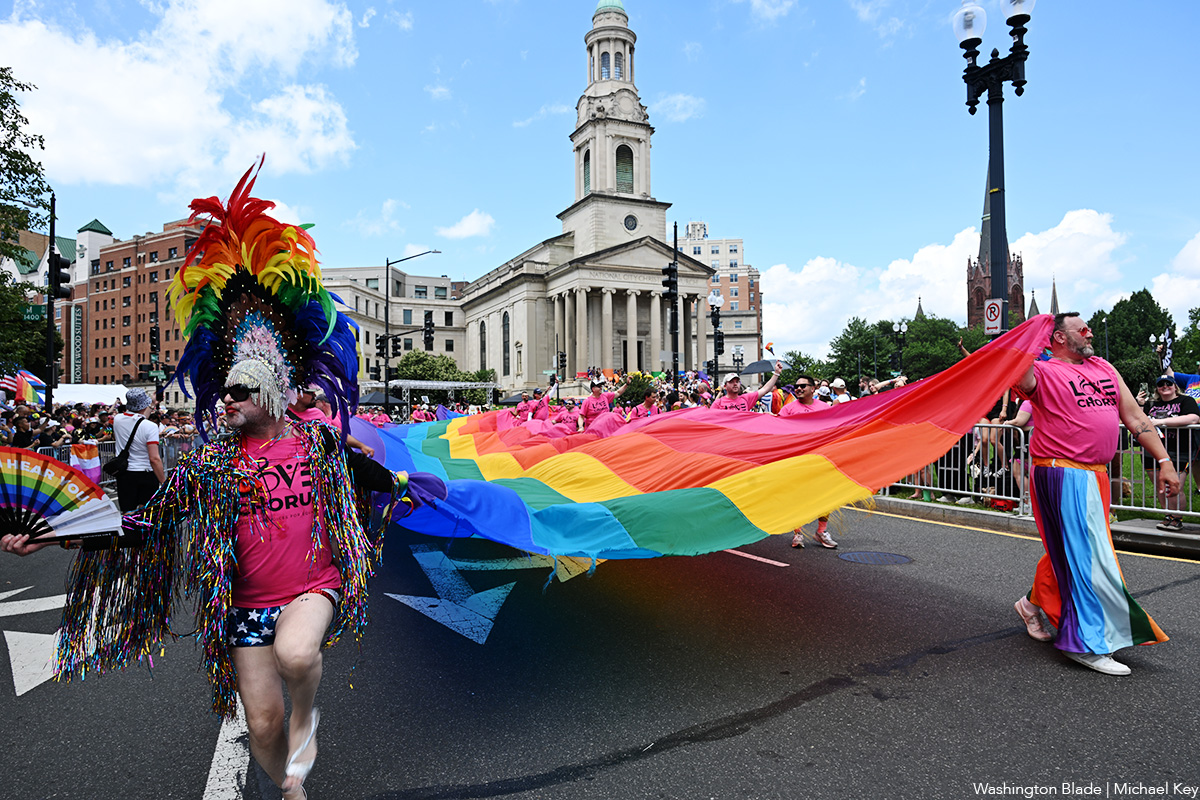
Hundreds of thousands of people are expected to attend Pride events in D.C. this month.
The Capital Pride Alliance is marking its 51st year with a full slate of events, including a parade, festival, concert, parties, and community events across the city. This year’s theme is “EXIST. RESIST. Have the Audacity!”
“Our audacity is our collective strength. Against the forces that try to diminish us, we must remain bold, courageous, visible and heard, in a world that questions our humanity and challenges our rights. Together, let’s have the audacity to live, thrive, be joyful, and proud!” Capital Pride Alliance said in a statement.
Capital Pride’s signature weekend events will center on the June 20 parade and June 21 festival and concert.
The parade and concert will not take place on the second weekend of June, as they have in the past, to avoid conflicts with America’s 250th anniversary celebration.
The parade route is expected to begin at 14th and T Streets, N.W., and end at Pennsylvania Avenue and 9th Street, N.W. Free viewing areas will be available, though reservations are required for seating at designated locations across the route.
Leading up to the parade, a family event will be hosted from 11 a.m. to 3 p.m. at Stead Park in Dupont Circle. Activities will include crafts, glitter tattoos, hair tinsel, photo ops, and an inflatable obstacle course. The event is free, but a prior reservation is required.
Crack of Noon Parade Brunch, a 21+ event featuring an all-you-can-eat buffet, will also take place earlier on June 20 at the Viceroy Washington at 1430 Rhode Island Ave., N.W.
The 17th Street Block Party, presented by Absolut, will also take place from noon to 10 p.m. on 17th Street in Dupont Circle. It will feature local food, an adult beverage garden, and other events.
On June 21, the Capital Pride Festival will run from noon to 10 p.m. on Pennsylvania Avenue The festival includes the Capital Pride Concert at Capitol Stage. The lineup of artists for the festival concert includes Maren Morris, queer rapper Leikeli47, Lisa Lisa, “Heated Rivalry” DJ Harrison, Tracy Young, and Myki Meeks.
“In a moment when LGBTQ+ people are being challenged across the country, the Capital Pride Concert is a space where our community is fully seen and heard,” said Capital Pride Alliance President Ryan Bos in a news release regarding the concert lineup.
Tickets to the concert are free, with exclusive pit and VIP experiences available for purchase.
The night will end with a “Capitol” Sunset Dance Party from 8-10 p.m., directly following the concert. It is available to all ages.
Other stages for concerts include the Monument and Dupont Dance Stage, with the artist lineup yet to be announced.
Three main parties will be available leading up to and during the parade: Riot!: The Official Pride Opening Party on June 19, featuring Bob the Drag Queen with a DJ set and headliner Myki Meeks. ELIX-Her on June 20 is a women-centered event at Decades and is 21+. On the same night, KINETIC: Toyland will feature headliner Alaska, “RuPaul’s Drag Race All Stars 2” winner.
Before the parade and festival weekend, community events, and celebrations will take place throughout the city.
The Washington Blade will host Pride on the Pier on June 13 from 4-9 p.m. at The Wharf. The free event will feature Pride365 Radio, a drag show with Venetian, DJ Chord, and dancing.
Capital Pride will have Night of Expression on June 10 at 7 p.m. at Busboys and Poets (14th and V streets). The event will feature an open mic and other performances.
Capital Pride Honors
Beyond its public celebrations, the Capital Pride Alliance will also recognize community leaders through its annual Capital Pride Honors program. This year’s honorees were selected based on how their work reflected the 2026 theme of Pride.
The winners were awarded at the Audacity Brunch: In Full Fuchsia, which is part of a fundraiser with Pride365, on Sunday.
Honorees included D.C. Del. Eleanor Holmes Norton, who received the Paving the Way Award; D.C. Mayor Muriel Bowser, who received the Key to Capital Pride Award; and the Heroes Award recipients Benjamin Coy, Charity Blackwell, Darryl Hamilton, Thea Kano, Kendall Martinez-Wright, and Lee Levingston Perine.
Dylan Drobish and Tyler Hack received the SaVanna Wanzer Visibility Award, while Patrick Magee and Judy Schloss were honored with the Bill Miles Award for Outstanding Volunteer Service.
Darrell Wood and Tyler Cargill received the Breaking Barriers: Community Impact Award, and Dai Nguyen received the Bernie Delia Award.

Blade editor inducted into D.C. Society of Professional Journalists Hall of Fame

Pride in a new world order

McDuffie on LGBTQ support and standing up to Trump

PHOTOS: Fairfax City Pride