European Union
Activists demand EU sanction Uganda over Anti-Homosexuality Act
Yoweri Museveni signed law on May 29, 2023
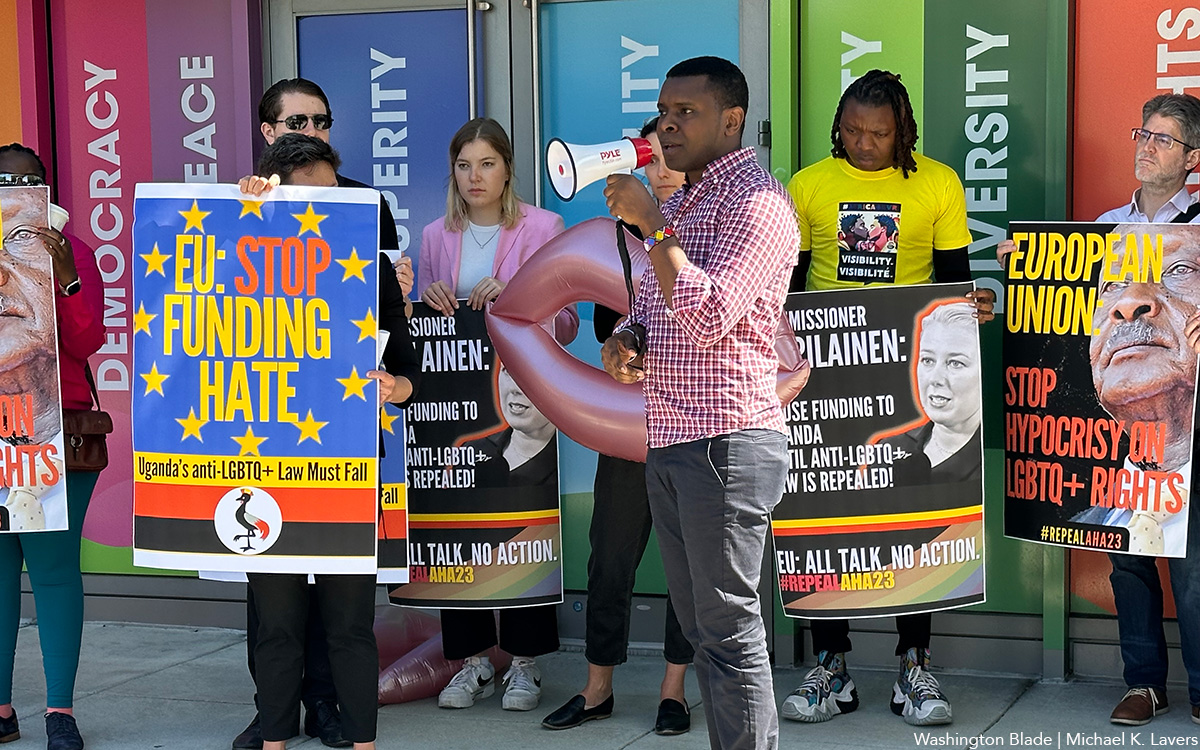
More than a dozen activists who protested in front of the European Union Delegation to the United States in D.C. on Thursday demanded the EU to sanction Uganda over the country’s Anti-Homosexuality Act.
Hillary Innocent Taylor Seguya, a Ugandan LGBTQ activist, and Global Black Gay Men Connect Executive Director Micheal Ighodaro are among those who spoke at the protest. Health GAP Executive Director Asia Russell also participated in the event that her organization organized along with GBGMC and Convening for Equality Uganda, a Ugandan LGBTQ rights group.
Ugandan President Yoweri Museveni last May signed the Anti-Homosexuality Act that, among other things, contains a death penalty provision for “aggravated homosexuality.”
The country’s Constitutional Court on April 3 refused to “nullify the Anti-Homosexuality Act in its totality.” A group of Ugandan LGBTQ activists have appealed the ruling.
A press release that Health GAP issued ahead of Thursday’s protest notes EU Commissioner for International Partnerships Jutta Urpilainen on March 6 announced more than €200 million ($212.87 million) for Uganda in support of “small business owners, young female entrepreneurs, agribusinesses as well as vital digital infrastructure projects in full Team Europe format with the European Investment Bank (EIB) and several member states.”
“These concrete initiatives will make a difference to aspiring entrepreneurs, Ugandan businesses and create jobs in multiple sectors,” said Urpilainen in a press release that announced the funds. “This is a perfect example of how Global Gateway can make a tangible difference for citizens and businesses and unlock the full potential of a partner country by working together.”
Convening for Equality Uganda on Tuesday in a letter they sent to Urpilainen asked the EU to review all funding to Uganda and “pause or reprogram any funds that go via government entities.” The protesters on Thursday also demanded European Commission President Ursula von der Leyen “to hold Ugandan President Museveni’s government accountable for this attack on human rights.”
Josep Borrell, the EU’s top diplomat, in a statement he released after Museveni signed the Anti-Homosexuality Act said the law “is contrary to international human rights law and to Uganda’s obligations under the African Charter on Human and People’s Rights, including commitments on dignity and nondiscrimination, and the prohibition of cruel, inhuman or degrading punishment.”
“The Ugandan government has an obligation to protect all of its citizens and uphold their basic rights,” said Borrell. “Failure to do so will undermine relationships with international partners.”
“The European Union will continue to engage with the Ugandan authorities and civil society to ensure that all individuals, regardless of their sexual orientation and gender identity, are treated equally, with dignity and respect,” he added.
Urpilainen last September in a letter to the European Parliament said the EU would not suspend aid to Uganda over the law.






European Union
Poland’s top court rejects recognition of same-sex marriages from other EU countries
Ruling sets up potential clash with bloc

Poland’s top court this week rejected the recognition of same-sex marriages legally performed in other EU countries.
The EU Court of Justice in Luxembourg last November ruled in favor of a same-sex couple who challenged Poland’s refusal to recognize their German marriage. Poland’s Supreme Administrative Court in March reaffirmed the decision.
The couple, who lives in Poland, brought their case to Polish courts in 2019. The Supreme Administrative Court referred it to the EU Court of Justice.
The Polish government in May announced it will recognize same-sex marriages legally performed in other EU countries. Polish President Karol Nawrocki on July 17 vetoed bills that would have extended rights to same-sex couples.
The Constitutional Tribunal ruling, which it issued on July 28, was unanimous and final. It also sets up a potential clash between it and the EU Court of Justice.
European Union
European Commission says all EU countries should ban conversion therapy
Recommendation ‘an important step forward for LGBTI rights across Europe’
The European Commission on Wednesday said all European Union countries should ban so-called conversion therapy.
The recommendation comes weeks after the European Parliament voted in favor of prohibiting the widely discredited practice across the EU. More than 1.2 million people signed a campaign in support of the ban that ACT (Against Conversion Therapy) LGBT launched in 2024 through the EU’s European Citizens Initiative framework.
“We warmly welcome today’s commitment from the European Commission to a recommendation on ending conversion practices, an important step forward for LGBTI rights across Europe,” said ILGA Europe in a statement.
Seven EU countries — Belgium, Cyprus, France, Malta, Norway, Portugal, and Spain — have banned conversion therapy outright.
Greece in 2022 banned the practice for minors. German lawmakers in 2020 passed a law that prohibits conversion therapy for minors and for adults who have not consented to undergoing the widely discredited practice.
ILGA Europe said the European Commission’s recommendation “highlights how much work remains to be done.”
“Ending conversion practices cannot stop at symbolic commitments or fragmented national approaches,” stressed the advocacy group. “We need coordinated EU action, proper training for professionals, and survivor-centered support systems that recognize the serious harm these practices cause.”
“More than one million people supported the European Citizens’ Initiative calling for change,” added ILGA Europe. “The message is clear: conversion practices are not therapy or belief, they are a form of violence that Europe can and should end.”
European Union
European Parliament backs EU-wide conversion therapy ban
More than 1.2 million people backed campaign
The European Parliament on Wednesday voted in favor of banning so-called conversion therapy across the European Union.
ACT (Against Conversion Therapy) LGBT in 2024 launched a campaign in support of the ban through the EU’s European Citizens Initiative framework. More than 1.2 million people ultimately signed it.
The proposed ban had the support of 405 MEPs. The European Commission is expected to formally respond to it by May 18.
Seven EU countries — Belgium, Cyprus, France, Malta, Norway, Portugal, and Spain — have banned conversion therapy outright.
Greece in 2022 banned the practice for minors. German lawmakers in 2020 passed a law that prohibits conversion therapy for minors and for adults who have not consented to undergoing the widely discredited practice.

ICE arrests Milo Yiannopoulos in New Orleans

San Francisco, long a queer safe haven, remains competitive for homebuyers

For LGBTQ youth starting with nothing, Pride House in Florida offers help

Archuleta to host book signing in Rehoboth Beach

Actor Tim Curry dies at 80

Proposed Indian foreign funding law overhaul could further pressure LGBTQ groups

Two awesome, affordable rides

Advocates honored at Engendered Spirit Awards

Gay-owned pizzeria in Dupont Circle burglarized