European Union
Gay Ukrainian man struggles to rebuild life in Berlin
Dmytro Shapoval arrived in Germany in March 2022
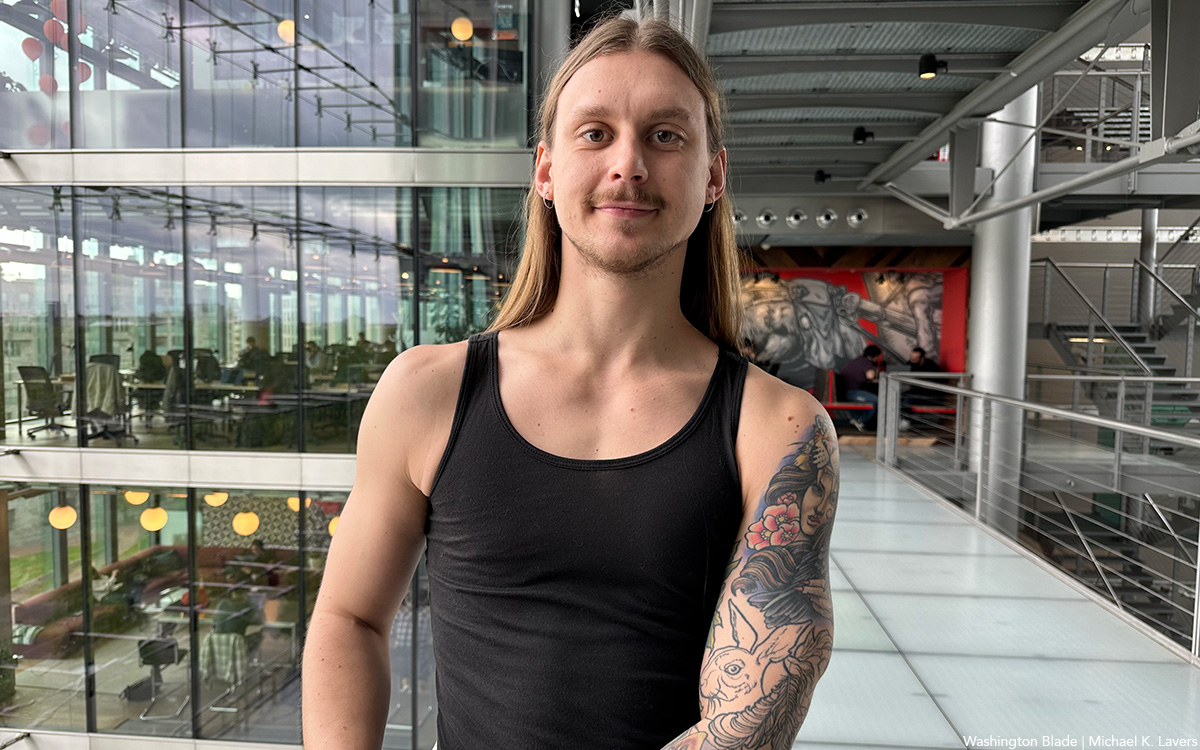
Editor’s note: International News Editor Michael K. Lavers was on assignment in Berlin from April 12-15.
BERLIN — A gay Ukrainian man with HIV who fled his war-torn country more than two years ago remains in Berlin.
Dmytro Shapoval first spoke with the Washington Blade in July 2022.
He was working at an IT company’s call center and studying web and UX design in Kyiv, the Ukrainian capital, when Russia launched its war against his country on Feb. 24, 2022. Shapoval less than a month later swam across a river with his cat Peach and entered Poland.
He arrived in the German capital on March 19, 2022.
“I feel very secure here,” said Shapoval when he first spoke with the Blade on July 22, 2022, during a reception that took place at the end of a two-day meeting with European activists the Organization for Refuge, Asylum and Migration organized.
Shapoval again spoke with the Blade on April 15 while he was at ORAM’s offices near Berlin’s Potsdamer Platz.
He said he was sleeping on a mattress on the kitchen floor of a Ukrainian friend’s apartment in Berlin’s Wedding neighborhood, while looking for a more permanent place to live.
Shapoval had just finished an IT course at a private university, but told the Blade he “was not in that headspace to study” because of the depression from which he said he suffers. Shapoval also told the Blade the German government has postponed his residency permit for a year.
“It’s challenging,” he said.
Germany has granted temporary protection to nearly 1 million Ukrainians
The German government has granted temporary protection to more than 900,000 Ukrainians since the war began. (The U.N. Refugee Agency says there are 2.2 million refugees in Germany.)
Ukrainians are able to enter Germany without a visa.
The German government offers those who have registered for residency a “basic income” that helps them pay for housing, food and other basic needs. Ukrainian refugees can also access health care, language classes, job training programs and childcare.
Shapoval and other single Ukrainian refugees receive €563 ($609.30) a month through the program.
Shapoval told the Blade it is difficult for him to find a job because his legal status remains uncertain. He also complained about German bureaucracy, which he described as “such a hell here.”
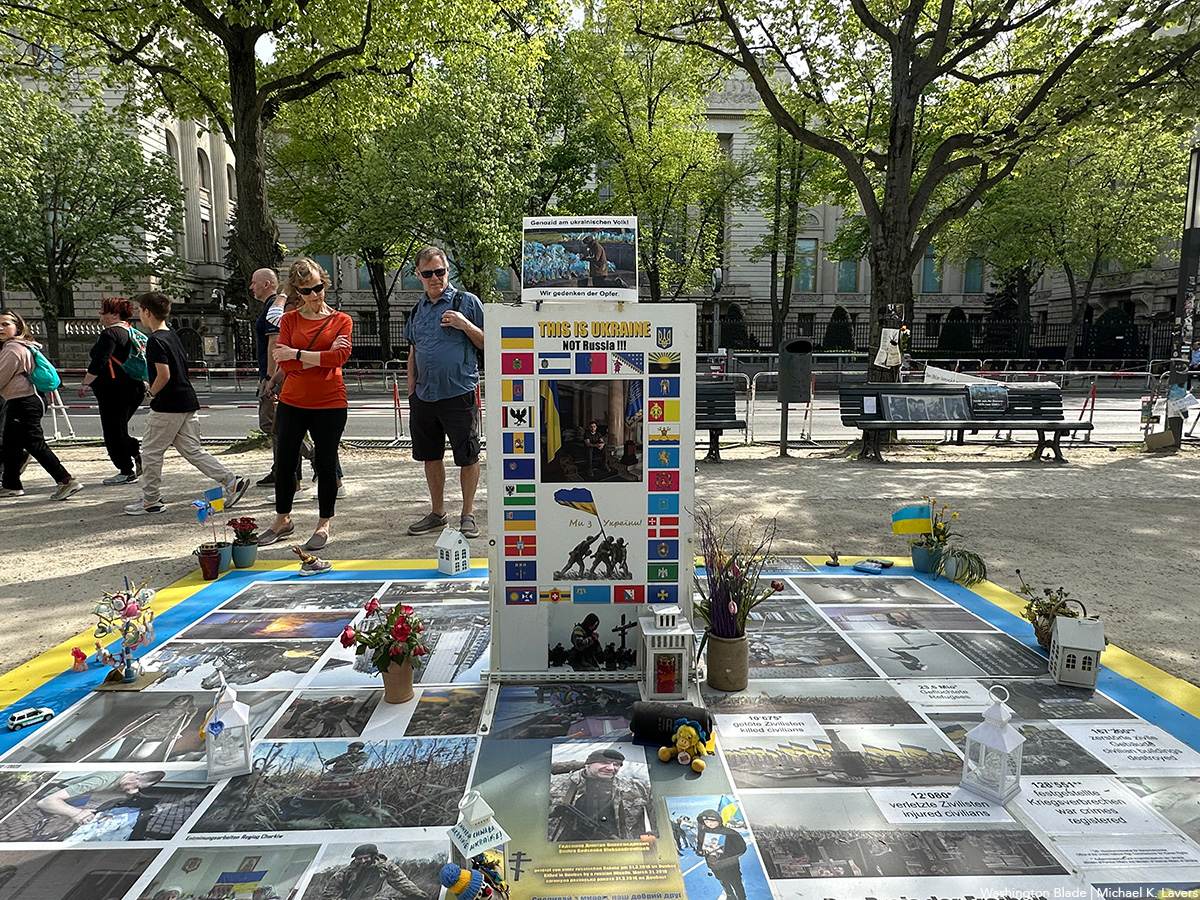
Shapoval’s mother remains in Dnipro, a city on the Dnipro River that is roughly 300 miles southeast of Kyiv.
He said the first year of the war was “pretty quiet” in Dnipro because it is not as big as Kyiv, Kharkiv, Odesa and other Ukrainian cities. Shapoval said the situation in Dnipro changed last fall.
Shapoval told the Blade a Russian missile hit a nine-story civilian building in the city.
“I had the worst day of my life because I knew that my mom was going to Dnipro,” he said.
Shapoval said the building the missile hit struck was close to his grandmother’s home.
“I was so horrified,” he told the Blade. “I was trying to call her to get in touch. She was not answering at all.”
Shapoval said his grandmother called him several hours after the attack. She told him the missile strike damaged the city’s communications infrastructure.
“It’s pretty horrible,” said Shapoval.
Shapoval spoke with the Blade hours before Ukrainian President Volodymyr Zelensky signed a controversial conscription law that seeks to replenish the country’s military. Zelensky last month also enacted a statute that lowers the minimum draft age from 27 to 25.
Shapoval said he does not want to go into the military, and has thoughts that he would die in the war. Shapoval also told the Blade he does not watch news reports about Ukraine because they exacerbate his depression.
“Just seeing these buildings destroyed and sometimes (at night when) people are sleeping there, or also (seeing) news about kids being stolen into Russia and then brainwashed there in these camps … is really bad,” he said.
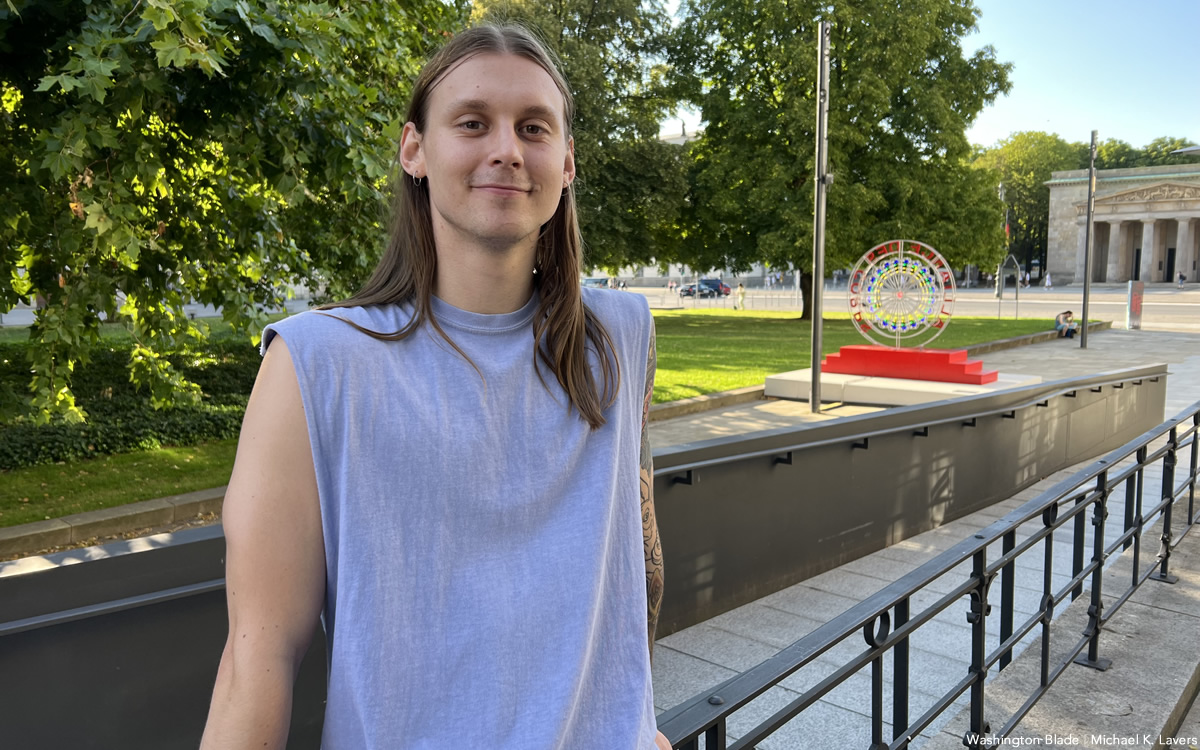
‘You’re a white refugee, so everything’s fine’
Shapoval noted support for Ukrainian refugees in Germany has begun to wane.
He recalled a conversation he had at a queer bookstore in Berlin’s Kreuzberg neighborhood during which someone who he described as German asked him what its like to be a refugee.
“Without even letting me answer without any space, he’s like, ‘Oh, but you’re a white refugee, so everything’s fine,'” recalled Shapoval.
Hamas on Oct. 7, 2023, launched a surprise attack against Israel.
Shapoval said the Israel-Hamas war in the Gaza Strip has pushed the conflict between Ukraine and Russia and the plight of Ukrainian refugees out of the headlines. He also recalled an exchange he had with a Syrian woman with whom he had become friends in Berlin after Oct. 7.
Shapoval said she wrote in an Instagram post that “one or two years of war in Ukraine, this amount of kids died and two months of war in Palestine, this amount of kids died.”
“I’m like, what the fuck is that?” he recalled. “It’s not a competition of dead babies.”
“The fact you put two in comparison already makes one side less valuable and one side more valuable, but it’s also different pain,” added Shapoval. “I know that it is also horrible there … it seems like people are not understanding that.”
Shapoval said he reached out to her and tried to explain his perspective.
“It’s a bit hard right now,” he told the Blade.





European Union
Poland’s top court rejects recognition of same-sex marriages from other EU countries
Ruling sets up potential clash with bloc

Poland’s top court this week rejected the recognition of same-sex marriages legally performed in other EU countries.
The EU Court of Justice in Luxembourg last November ruled in favor of a same-sex couple who challenged Poland’s refusal to recognize their German marriage. Poland’s Supreme Administrative Court in March reaffirmed the decision.
The couple, who lives in Poland, brought their case to Polish courts in 2019. The Supreme Administrative Court referred it to the EU Court of Justice.
The Polish government in May announced it will recognize same-sex marriages legally performed in other EU countries. Polish President Karol Nawrocki on July 17 vetoed bills that would have extended rights to same-sex couples.
The Constitutional Tribunal ruling, which it issued on July 28, was unanimous and final. It also sets up a potential clash between it and the EU Court of Justice.
European Union
European Commission says all EU countries should ban conversion therapy
Recommendation ‘an important step forward for LGBTI rights across Europe’
The European Commission on Wednesday said all European Union countries should ban so-called conversion therapy.
The recommendation comes weeks after the European Parliament voted in favor of prohibiting the widely discredited practice across the EU. More than 1.2 million people signed a campaign in support of the ban that ACT (Against Conversion Therapy) LGBT launched in 2024 through the EU’s European Citizens Initiative framework.
“We warmly welcome today’s commitment from the European Commission to a recommendation on ending conversion practices, an important step forward for LGBTI rights across Europe,” said ILGA Europe in a statement.
Seven EU countries — Belgium, Cyprus, France, Malta, Norway, Portugal, and Spain — have banned conversion therapy outright.
Greece in 2022 banned the practice for minors. German lawmakers in 2020 passed a law that prohibits conversion therapy for minors and for adults who have not consented to undergoing the widely discredited practice.
ILGA Europe said the European Commission’s recommendation “highlights how much work remains to be done.”
“Ending conversion practices cannot stop at symbolic commitments or fragmented national approaches,” stressed the advocacy group. “We need coordinated EU action, proper training for professionals, and survivor-centered support systems that recognize the serious harm these practices cause.”
“More than one million people supported the European Citizens’ Initiative calling for change,” added ILGA Europe. “The message is clear: conversion practices are not therapy or belief, they are a form of violence that Europe can and should end.”
European Union
European Parliament backs EU-wide conversion therapy ban
More than 1.2 million people backed campaign
The European Parliament on Wednesday voted in favor of banning so-called conversion therapy across the European Union.
ACT (Against Conversion Therapy) LGBT in 2024 launched a campaign in support of the ban through the EU’s European Citizens Initiative framework. More than 1.2 million people ultimately signed it.
The proposed ban had the support of 405 MEPs. The European Commission is expected to formally respond to it by May 18.
Seven EU countries — Belgium, Cyprus, France, Malta, Norway, Portugal, and Spain — have banned conversion therapy outright.
Greece in 2022 banned the practice for minors. German lawmakers in 2020 passed a law that prohibits conversion therapy for minors and for adults who have not consented to undergoing the widely discredited practice.

In ‘The Lost Brontë,’ a complicated lie can lead to danger

CAMP Rehoboth Block Party returns Oct. 18

Essential queer horror classics for Halloween

Solidarity beyond the parade: the actual cost of Pride

Physician: addiction doesn’t always look the way you think it does

10 years later, we still can’t shake Barry Jenkins’s ‘Moonlight’

Bessent says Trump chose him for his qualifications, not his sexuality

‘Some Like It Hot’ a wild ride at renovated Bernard Family Theatre

D.C.’s LGBTQ homeless facilities face possible hit from Trump funding cuts

Trump uses anti-trans slur against Democratic Senate candidate
-

 Movies4 days ago
10 years later, we still can’t shake Barry Jenkins’s ‘Moonlight’
-
Federal Government5 days ago
Bessent says Trump chose him for his qualifications, not his sexuality
-
Theater4 days ago
‘Some Like It Hot’ a wild ride at renovated Bernard Family Theatre
-
District of Columbia4 days ago
D.C.’s LGBTQ homeless facilities face possible hit from Trump funding cuts