Congress
Senate looks ready to pass NDAA despite its anti-trans healthcare restriction
Sen. Tammy Baldwin, others object to the policy rider
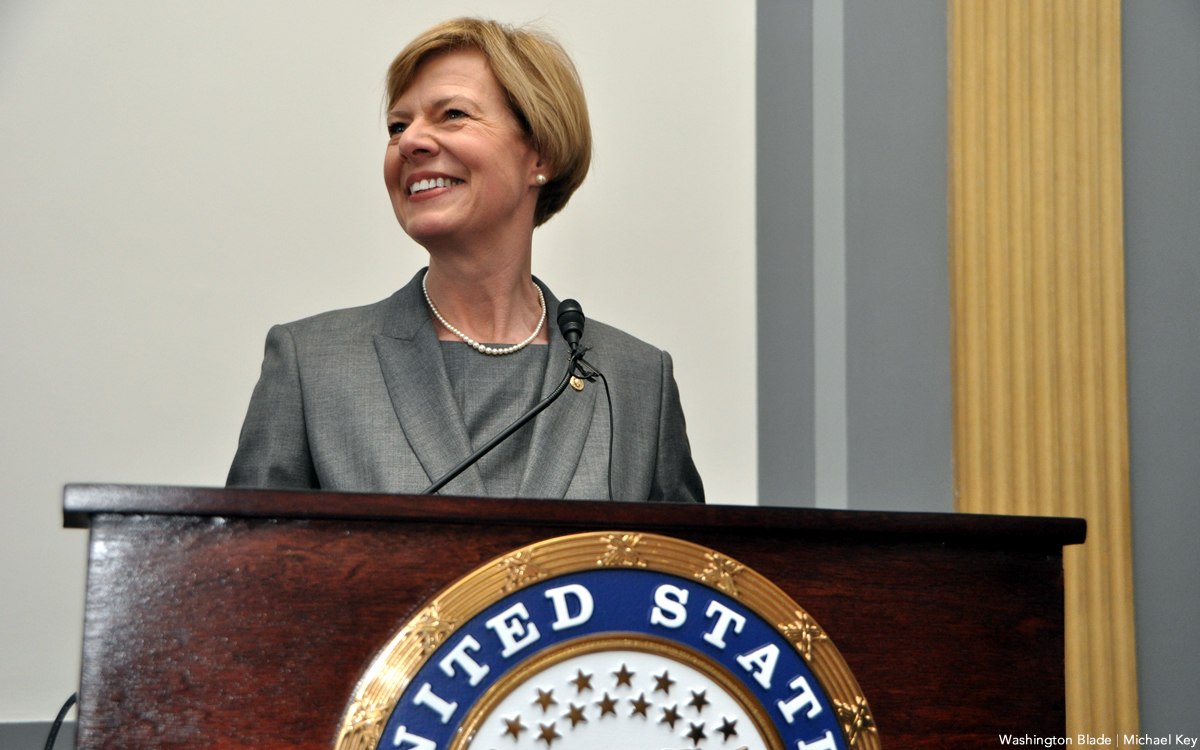
Update: On Wednesday afternoon, the U.S. Senate voted 85-14 to pass the National Defense Authorization Act. Several Democrats voted against the military spending package, in many cases over their objection to a restriction on health coverage for gender affirming care. The Human Rights Campaign issued a statement urging President Joe Biden to veto the bill.
The U.S. Senate appears poised to pass the National Defense Authorization Act later this week, voting 63-7 on Monday to invoke cloture on the annual defense budget bill, which contains controversial provisions, including a prohibition on covering transgender medical care for the children of U.S. service members.
While all signs now point toward a smooth journey for passage of the NDAA, 21 Senate Democrats led by U.S. Sen. Tammy Baldwin (Wis.) signed on to an amendment introduced Monday evening that would remove the anti-trans policy rider.
U.S. Sen. Ed Markey (Mass.), a cosponsor of Baldwin’s resolution, held a press conference on Tuesday with LGBTQ advocates to raise awareness about the issue, telling reporters “It is unacceptable for politicians to use the NDAA to force themselves between families and their health care providers, all in pursuit of their discriminatory aims.”
“We cannot stand by as these attacks on health care freedom continue, and we cannot pass the NDAA with this language included,” the senator said. “Trans rights are human rights.”
Also on Tuesday, U.S. Senate Majority Whip Dick Durbin (Ill.), another co-sponsor, delivered a speech on the Senate floor in which he shared, “there’s one provision in this conference agreement that troubles me—a provision that would ban certain medical treatments for transgender children of service members,” which “eliminates the ability of military families to work with medical professionals and make their own decisions about the health care needs of their own children.”
Baldwin’s office said the rule could restrict healthcare access for 6,000 to 7,000 children of U.S. service members who rely on the military’s Tricare provider for coverage of guideline-directed, medically necessary gender affirming treatments.
The rider was first added by House Republican Speaker Mike Johnson (La.) who passed the NDAA last week by a comfortable margin, 281-140 — with 81 Democrats including Minority Leader Hakeem Jeffries (N.Y.) voting for the bill as others objected to the anti-trans provision.
U.S. Rep. Adam Smith (D-Wash.), ranking member of the House Armed Services Committee, who said “Blanketly denying health care to people who clearly need it, just because of a biased notion against transgender people, is wrong.”
U.S. Rep. Mark Pocan, the gay chair of the Congressional Equality Caucus, said in a statement that “Speaker Johnson is playing political games with the health of our service members’ children by inserting himself into private medical decisions and overriding families’ choices—and our service members and their children will pay the price.”
Also voting against the bill last week was every out LGBTQ member of the House, with the exception of U.S. Rep. Chris Pappas (D-N.H.), who told The Advocate that, “I strongly oppose the riders that Speaker Johnson included in the NDAA that would limit insurance coverage for military family members” and “will continue to fight for full equality for all members of the LGBTQ+ community, including transgender Americans, and my record in Congress demonstrates that.”
The Senate’s likely passage of the NDAA comes also despite last week’s letter by 45 Democratic members urging leadership to reject the “partisan, discriminatory, and harmful” policy riders added by House Republicans to must-pass spending bills, noting that most have tended to target reproductive and LGBTQ rights.
While the GOP caucus ultimately rejected more extreme anti-trans proposals, like a ban on funding gender transition surgeries for adults, the NDAA includes, along with the Tricare rule, a ban on contracting with advertising companies that “blacklist conservative news sources” and a freeze on hiring and recruiting for DEI-related roles pending the completion of an investigation into those programs.




Congress
HRC president campaigns for Chris Pappas in NH
Gay congressman running to succeed retiring U.S. Sen. Jeanne Shaheen

Human Rights Campaign President Kelley Robinson on Sunday campaigned for U.S. Rep. Chris Pappas (D-N.H.) in New Hampshire.
Robinson traveled to Manchester, the state’s largest city, nine days before the Sept. 8 primary that will determine who will vie for retiring U.S. Sen. Jeanne Shaheen (D-N.H.)’s seat.
We’re hitting the pavement across New Hampshire to fight for a freer, fairer future for everyone.
Glad to have Human Rights Campaign President @KelleyJRobinson join us for a canvass launch in Manchester today. pic.twitter.com/XWCEaQxy4o
— Chris Pappas (@ChrisPappasNH) August 30, 2026
Former U.S. Sen. John E. Sununu, who represented New Hampshire in the U.S. Senate from 2003-2009, will face off against former U.S. Sen. Scott Brown, who represented Massachusetts in the U.S. Senate from 2010-2013, in the Republican primary.
Karishma Manzur is among the Democrats challenging Pappas.
A poll the University of New Hampshire Survey Center released on Aug. 26 shows Sununu is ahead of Brown. The same survey shows Pappas ahead of Manzur and his other Democratic challengers.
The UNH Survey Center poll shows Sununu ahead of Pappas by a 45-43 percent margin if they were to face off in the general election. The margin of error is +/-2.1 percent.
Pappas would become the first openly gay man elected to the U.S. Senate if he were to win in November.
Congress
Chris Van Hollen says the Democratic Party needs change. Is he the one to lead it?
Senator is backing anti-establishment Democrats across the country
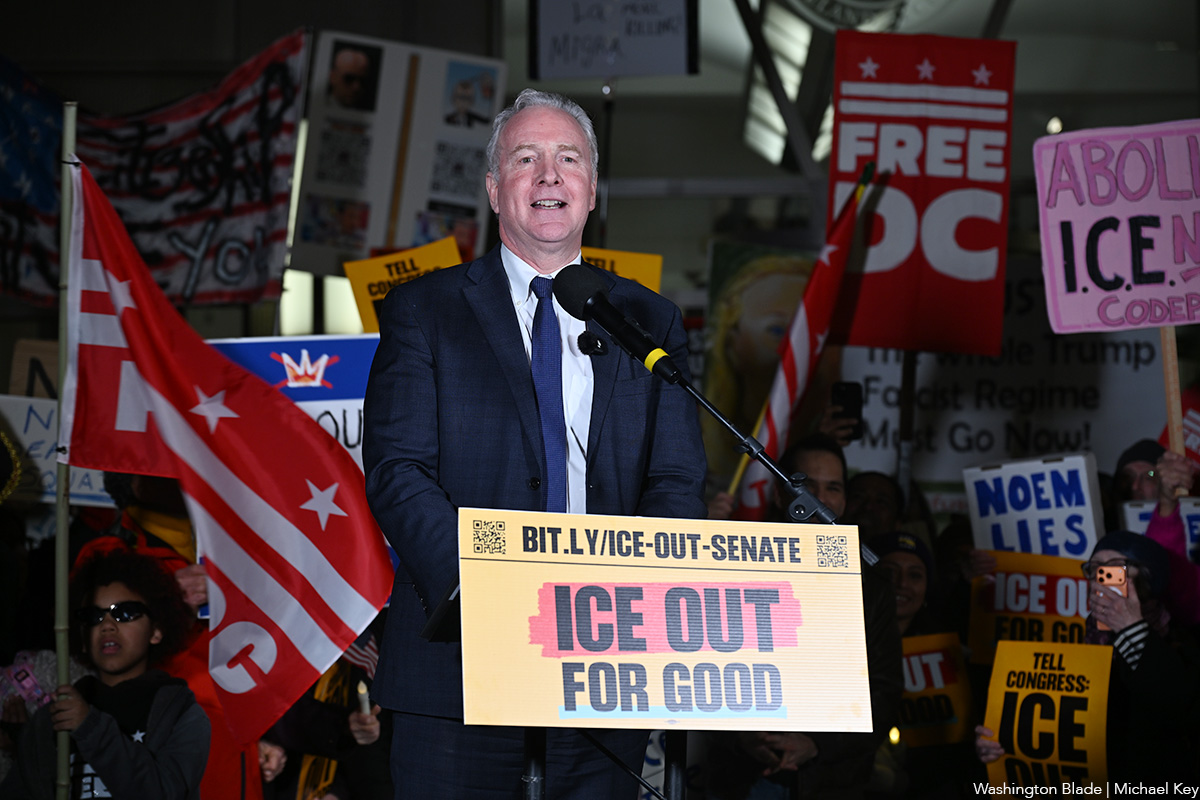
By LEE O. SANDERLIN | The Democratic Party is having something of an identity crisis — losing to President Donald Trump twice in three elections will do that.
Should the party embrace anti-establishment figures who espouse progressive policy ideas like Medicare for all and rhetoric about unrigging the economy for the 1 percent? Or should Democrats try to appeal to moderates who want to return to semi-normalcy in a time of political upheaval?
Although he’s been in Congress since 2002, with key leadership roles throughout his tenure, Maryland Sen. Chris Van Hollen, 67, counts himself firmly in the anti-establishment camp.
The rest of this article can be found on the Baltimore Banner’s website.
Congress
House blocks effort to codify transgender servicemember ban into law
Lawmakers approved two anti-trans NDAA amendments

The U.S. House of Representatives on Tuesday rejected an amendment to the National Defense Authorization Act that would have codified a ban transgender servicemembers in the military.
The bipartisan vote was 212-217.
The NDAA is for the 2027 fiscal year and sets policies for the Defense Department programs and activities and the national security programs of the Department of Energy.
U.S. Rep. Lauren Boebert (R-Colo.) proposed the amendment on July 21. It stated that all personnel are required to serve in accordance with their biological sex, citing military readiness and discipline.
Human Rights Campaign Senior Director of Government Affairs Jennifer Pike Bailey stated that she is grateful for the bipartisan vote that rejected President Donald Trump and Defense Secretary Pete Hegseth’s “dangerous and discriminatory policy that has kicked brave transgender servicemembers out of the military and weakened our national security.”
“Everyone who meets the same rigorous standards should be able to serve their country. We should honor that patriotism, particularly in this moment where we are witnessing brave servicemembers making the ultimate sacrifice for our country, instead of ending their careers and politicizing their existence. We’re grateful that a permanent extension of this ban failed, and we will keep fighting to reverse this senseless policy,” Bailey said.
Mark Takano, chair of the Congressional Equality Caucus, stated that he and his members put in countless hours of work to kill the amendment.
“When Americans know they or their families are going to be targeted by or not supported by the military, that leads them to avoid signing up to serve or staying in the service — making it harder to keep the ranks of the armed services full and our nation safe. My colleagues in the Equality Caucus and I will continue working to prevent these attacks on our servicemembers and their families from becoming law,” Takano said.
According to the Congressional Equality Caucus, two other bills could potentially be passed that would also target the transgender community, both of which were proposed by U.S. Rep. Nancy Mace (R-S.C.).
The first was a bill that would have prohibited gender-related medical care under TRICARE and to prevent TRICARE from covering certain gender-related medical procedures and treatments, which was approved in a vote of 219-208.
The second was a bill that would have prohibited male participation in female sports at DoDEA schools. DoDEA schools are Department of Defense Dependents Schools, which is a network of primary and secondary schools.
The amendment was approved in a vote of 221-203.

Pentagon expands testosterone screening as trans troops face hormone therapy restrictions

Calendar: September 4-10

Swiss government backs nationwide conversion therapy ban

Gloria Steinem dies at 92

The mastery of love

Poland begins to legally recognize same-sex marriages from other countries

HRC president campaigns for Chris Pappas in NH

We’re getting married but our parents object

Prominent French activist attacked outside Paris bar