The White House
Trump immigration policies ‘will cost lives’
Groups that work with LGBTQ migrants, asylum seekers condemn White House EOs

Groups that work with LGBTQ migrants and asylum seekers have condemned the Trump-Vance administration over its immigration policies.
President Donald Trump shortly after his Jan. 20 inauguration signed several immigration-specific executive orders. They include:
• Declaring a national emergency on the Southern border
• Suspending the U.S. Refugee Admissions Program
• Ending birthright citizenship under the 14th amendment. (U.S. District Judge John Coughenour, who Ronald Reagan appointed, in a Jan. 23 ruling described the directive as “blatantly unconstitutional.”)
Trump has reinstated the Migrant Protection Protocols program, also known as the “Remain in Mexico” policy that forced asylum seekers to pursue their cases in Mexico. The White House on Jan. 20 also shut down the CBP (U.S. Customs and Border Protection) One app that asylum seekers used to schedule appointments that would allow them to enter the U.S. at ports of entry.
A press release the Department of Homeland Security issued on Jan. 21 issued notes the Trump-Vance administration has ended “the broad abuse of humanitarian parole” for undocumented migrants. Immigration and Customs Enforcement and CBP agents can also make arrests in schools, churches, and other so-called “sensitive” areas.
An ICE press release notes the agency, the U.S. Marshals Service and other federal agencies on Sunday “began conducting enhanced targeted operations” in Chicago “to enforce U.S. immigration law and preserve public safety and national security by keeping potentially dangerous criminal aliens out of our communities.”
ICE on X said its agents arrested 956 people on Sunday across the country. NBC Washington reported ICE Enforcement and Removal Operations personnel on Sunday morning were at a Fairfax County apartment building, but it is not clear whether they took anyone into custody.
A second press release that ICE issued on Jan. 23 notes the arrest of an undocumented Mexican man in Houston who was wanted for the “rape of a child” in Veracruz, Mexico. Mexican authorities took him into custody after ICE officials returned him to his country of origin.
“We now have a government that cannot manage even a simple crisis at home while, at the same time, stumbling into a continuing catalogue of catastrophic events abroad,” said Trump in his inaugural address.
“It fails to protect our magnificent, law-abiding American citizens, but provides sanctuary and protection for dangerous criminals, many from prisons and mental institutions, that have illegally entered our country from all over the world,” he added.
Immigration Equality Executive Director Aaron C. Morris on Jan. 22 said Trump’s “agenda to detain, deport, and dehumanize people is an affront to fundamental American values.”
“The executive orders will cost lives, separate families, and trap queer people in extreme danger,” he said. “They are an overt, illegal power grab with mortal consequences for LGBTQ people seeking safety in the United States.”
Then-Vice President Kamala Harris and others in the previous administration acknowledged violence based on sexual orientation and gender identity is among the “root causes” of migration from the Central American countries of Guatemala, El Salvador, and Honduras. (Morris is among the activists who sharply criticized the Biden-Harris administration over policies they said restricted LGBTQ people and people with HIV from seeking asylum in the U.S.)
“The Trump administration’s recent executive orders targeting asylum seekers, refugees, and immigrants while escalating attacks on the LGBTIQ community are unethical, un-American, and jeopardize countless lives,” Organization for Refuge, Asylum and Migration Executive Director Steve Roth told the Washington Blade in a statement. “By barring asylum and suspending refugee programs, these policies strip away fundamental human rights and protections, directly threatening LGBTIQ refugees who already endure persecution, xenophobia, homophobia, transphobia, and systematic inequality.”
Familia: TQLM, an organization that advocates on behalf of transgender and gender non-conforming immigrants, was even more pointed in a statement it posted to its Facebook page shortly after Trump’s inauguration.
“On Jan. 20, we resist,” said Familia: TQLM. “This is not a day to give into fear, but a day to reclaim our power.”
“Trans and queer immigrant people have endured through regimes that sought to erase, silence, and destroy us,” it added. “Yet, we remain.”
Casa Frida, which works with LGBTQ migrants and asylum seekers in Mexico City, in a Jan. 20 post to its X account said it will continue to work with the aforementioned groups with the support of local officials.
“We are preparing ourselves to continue working with love and solidarity in favor of LGBTIQ communities, migrants and displaced people,” said Casa Frida. “Our programs are reorganized and coordinated with local governments with pride, dignity and without fear or shame of who we are.”
Ante los esperados cambios políticos; Estamos preparándonos para seguir adelante trabajando con amor y solidaridad en favor de las comunidades y personas LGBTIQ migrantes y desplazadas. Nuestros programas se reorganizan y coordinan con gobiernos locales. Con orgullo, dignidad y…
— Refugio LGBTIQ 🏳️🌈🏳️⚧️🇲🇽 (@CasaFridaLGBT) January 20, 2025


The White House
Thousands attend ‘No Kings’ protests in D.C.
Protesters demand accountability, defend democracy, and oppose Trump administration
Across all 50 states — and D.C. — more than 8 million people came out nationwide from towns big and small, red and blue, to make their voices heard. That united voice echoed what nearly 20,000 protesters declared in the nation’s capital back in October 2025: the citizens of the U.S. would not sit idly by as President Donald Trump and his administration erode democracy, attempt to restrict human rights, loosens First Amendment protections, and begin wars without congressional approval.
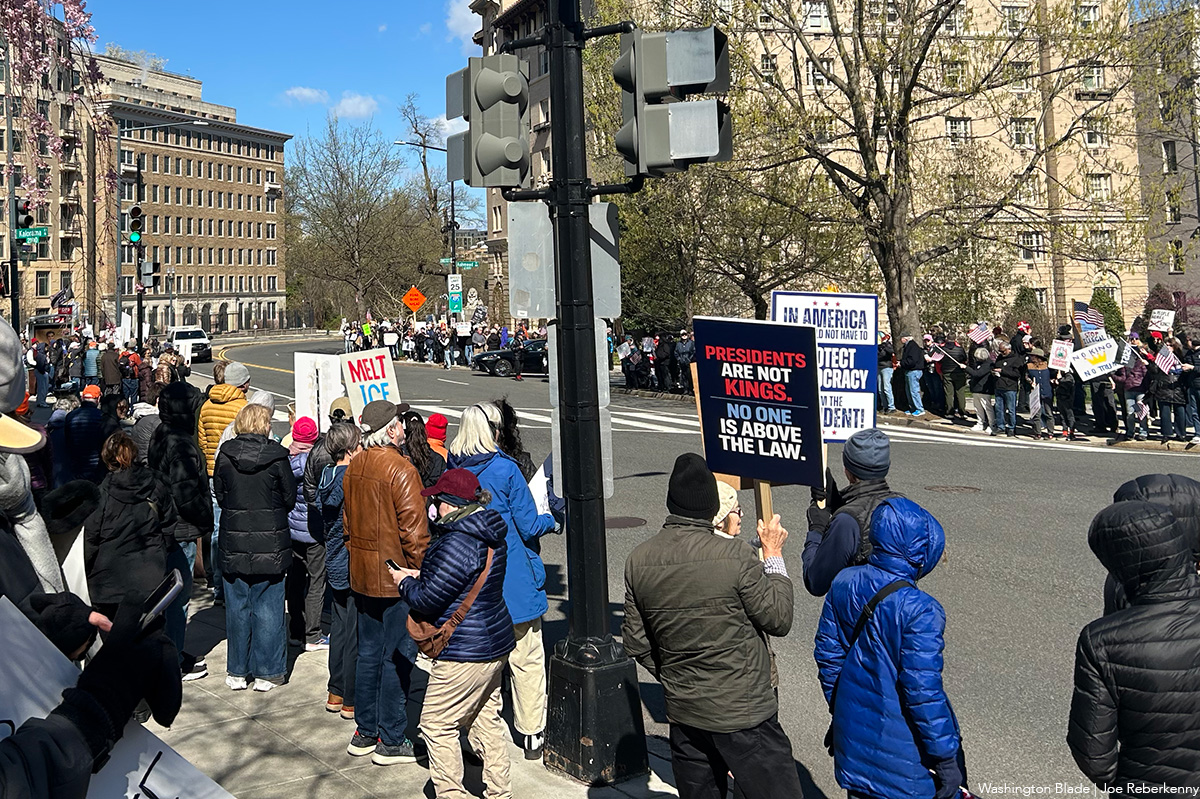
While there were countless differences among the thousands who joined the “No Kings” protests this weekend in the DMV — from creeds and socioeconomic statuses to races, sexualities, and gender identities — there was one thing that united them all during the chilly March 28 weather: a commitment to making their voices heard.
By 10 a.m., the Washington Blade estimated around 200 people had braved bitter winds and temperatures hovering around 40 degrees, with bright sun, to stand along the cherry blossom-adorned streets of Kalorama and Connecticut Avenue. Protesters carried signs large and small from criticizing Trump’s disregard for the “everyman” to handmade signs emphasizing love, calling for the melting of ICE, and addressing issue-specific concerns like ending the wars in Gaza and Iran — both policies propagated by Trump.
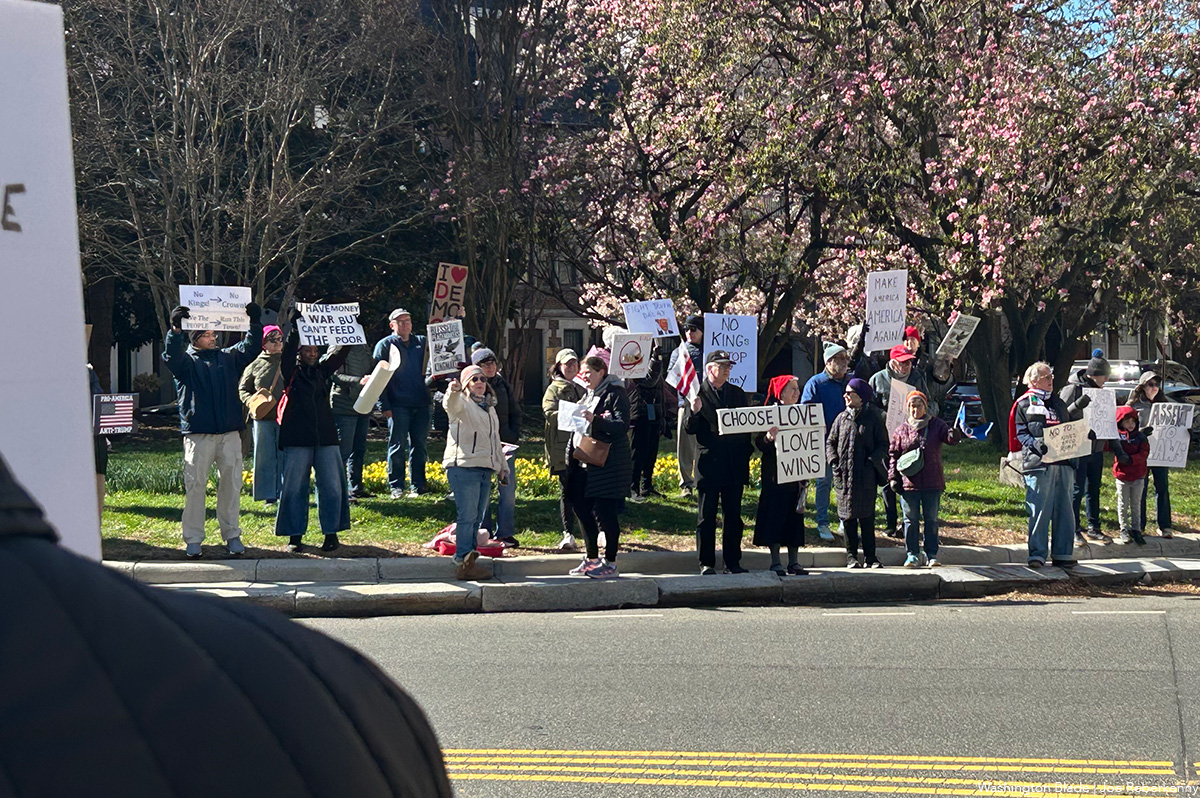
While a solid group of D.C. residents came out with babies in strollers and dogs on leashes, the Kalorama protest skewed older with a majority-white crowd.
On the other side of town, the more heavily attended protest in Anacostia started at 1:30 p.m., crossing the Frederick Douglass Bridge.
MS Now estimates that over 20,000 people marched across the bridge, sending a clear message to the president, his administration, and the Republican-controlled federal government: federal overreach is not what the majority of Americans want to see, hear, or witness as protesters in the thousands came out for, as organizers say “the single largest non-violent day of action” in American history.
The two marches on Saturday differed in both theme and location — the Kalorama protest felt like a small-town demonstration in a big city, covering a wide variety of topics, whereas the Anacostia protest was more focused, directly calling out and pushing back against the actions of Stephen Miller (the White House chief of staff)and other Trump allies.
Many participants shared their reasons for marching with glee — shouting as cars honked in support passing by and discussing the broader issues within the current political climate with those standing next to them: some neighbors, some friends, others complete strangers. Regardless, an important discussion was happening across the city.
A surprise to many participants — and the Blade reporter covering the event — was seeing U.S. Rep. Sara Jacobs (D-Calif.) stand outside in near-freezing temperatures with her staff and some signs.
Jacobs used the exclusive — and more intimate — ability to speak on her experience watching everything unfold from inside the halls of Congress.
“We had votes until midnight last night, so I couldn’t make it back to San Diego for the march, but it’s important to show up and cheer on people standing up and making their voices heard,” Jacobs said. “This is just the start. We need to make our voices heard every day through the end of the year.”
Jacobs also used the opportunity to criticize congressional inaction from those on the other side of the aisle, reminding the Blade that a legislator’s job is to protect and secure the people they represent — not the interests of a wannabe king or corporations that back many congressional campaigns through PACs.
“It makes me angry at my Republican colleagues who won’t stand up to Trump. Actions like this inject courage into my colleagues — they need to see that the American people have their back,” she added, eventually emphasizing the public responsibility lawmakers have to protect the Constitution and everyone in the country (which the Supreme Court had pointed out as far back as 1886 with Yick Wo v. Hopkins). “Congress is not going to save people. This is about everyone showing up and making our voices heard and building the democracy we want.”

Ashley Gould, a tourist visiting from Missouri, told the Blade that despite Washington being seen as one of the most politically active towns in the country, over the past few years, she and many other politically active Missourians have been preparing for this moment and were zealous to have their voices heard together as one.
“I’m actually visiting my sister from Missouri, and we’ve been doing this since the first No Kings protest [there]. I wanted to see how you guys did it here,” she said. “As someone in a red state, we’re not represented in Congress right now, so I don’t personally have a say in any of this. If I can do one small thing, I want kids in our town to see me trying to make a difference, get petitions signed. This is all we have.”
Gould continued, “I don’t know if it’s going to cause an impact for elected officials, but I hope that little kid who sees us with the posters sees that we do have a voice—and maybe one day they can, if they can’t right now.”
Gary Bowman, another early protest-goer, held a sign that pointed out the obscurity — and unconstitutional nature — of the current administration’s actions.
“I hate the direction the country is going in, and Donald Trump is not fit to be in office,” Bowman said, adding that his choice of sign exemplified that. “It’s obvious based on his policies — his attacks on the trans and LGBTQ communities — that he’s trying to suppress people. And the Republican Congress isn’t helping.”
When asked how the phrase “No Kings” resonates with him, especially since this is the third one held in two years, Bowman said it may be catchy for headlines or help inspire creative signs (like Trump on a golden throne or toilet), but the march and protest are about something much more important.
“‘No Kings’ is a catchphrase for me; I’m more concerned about losing our democracy. We, the people, have a voice we should use,” he said, elaborating on how this administration’s course of action disregards rules designed to prevent an authoritarian — or wannabe-authoritarian — from taking power. “I don’t think Trump is overstepping … I think he’s shattering democratic norms. He wants to do what’s right for Donald Trump, not for anyone else.”
He concluded bluntly that unless everyone — including Republicans in power — stand up to the president for these ludicrous choices, change won’t happen, regardless of how loud he or any other Trump critics scream at protests.
“Until we have a Congress that would actually look at protests and take action, it won’t matter. He’ll just get pissed off and act against them,” Bowman said.
When asked what he could say to those in charge, he finished strongly: “If I could say one thing to him? Fuck off, Donald Trump.”
Jameson Woosley and Elena Lacayo were standing on the corner of Kalorama Road, holding their baby tight as pink cherry blossom trees swayed behind them, as if to cheer on the protesters.
“It’s the degradation of democracy. Every day there’s an overreach by the executive branch, and Congress just sits on their hands,” Woosley said, standing side by side with Lacayo.
“It’s terrifying for my baby. This administration has turned people who’ve done nothing wrong into criminals — it’s Orwellian. Up is down, war is peace,” Lacayo noted. “I was raised in another country with authoritarians… I’m a citizen here, and I’m going to use every right I have to advocate for those who can’t.”
Lacayo then spoke about how, for many, direct protests against government action (and inaction) are the only choice — especially under a supermajority federal government with the White House, Supreme Court, and both chambers of Congress.
“We have no choice but to believe change can come. This is what we can do. We must continue fighting; that’s what the human spirit is about,” she said.
Woosley emphasized the growing impact of the protests, saying, “Every protest gets bigger, and opinion polls keep swinging in the right direction … We need to speak up and get all the right people out to bring positive change.”
“These people are nothing without us,” Lacayo added.
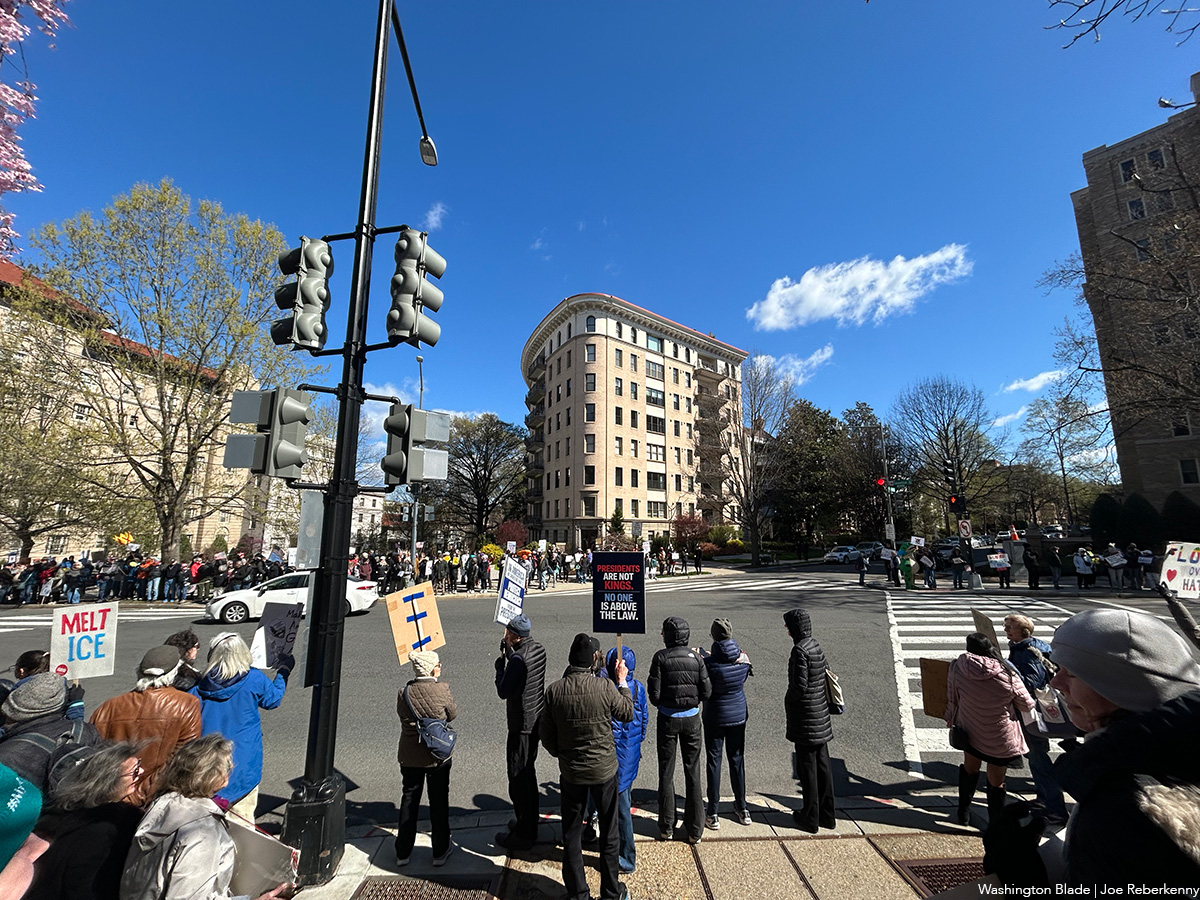
Beth Davis, a former resident of Kalorama, shared with the Blade that this place holds special meaning for her — and her children — which is in part why she chose this one over the larger protest in Anacostia.
“I used to live in the neighborhood, so this is special for me. It’s easy to bring the kids and let them be part of the movement,” Davis said, as her elementary-aged children ran around the manicured grass while bundled up, enjoying the lively atmosphere.
“What’s happening to immigrant communities is horrific, and I want to show solidarity. Also, the Iran war — it’s terrifying what’s happening,” she added before explaining what the “No Kings” name actually means to her. “’No Kings’ makes me think of the extreme grab for power — it’s unprecedented.”
Davis then noted the importance of protesting when it seems like the main goal is often to iisolate : “Coming to protests makes people feel like they’re not alone, and that momentum carries into elections,” she explained, noting why she not only brought her two children to this protest—and many others in the past as well– but uses these as real world teaching moments. “We bring kids to teach them their civic responsibilities. My oldest has been to about ten protests.”
Another remarkable aspect of D.C. protests is the diversity of participants. Teachers, retail workers, students, and even some congresspeople turned out. In Kalorama on Saturday, the No Kings protest brought out Anne Plant, a biochemist and fellow at the National Institute of Standards and Technology, where she was previously chief of the Biosystems and Biomaterials Division.
Plant focused on many issues when speaking to the Blade, but started with what many consider the most important: Trump-era policies making civic engagement more difficult, particularly regarding civil rights.
“A lot of things are going wrong, and the only way to change them is for people to act. D.C. has no statehood, no vote — it’s a civil rights issue,” Plant said. “To deny the vote to any group of U.S. citizens doesn’t make sense. These people work for us; we should be able to hold them accountable.”
She held a small, hand-painted sign with two cohesive messages: “Reject Fascism. Defend democracy.”
“Some of what’s going on now is not healthy for society. No one will benefit; it’s just ruination,” Plant concluded. “Seeing more people out here shows that others feel the same, and momentum is what it takes to move things.”
Religious activists also joined the marches. Sister Diane and Sister Claire, two Catholic nuns, were out protesting Trump and his agenda.
“We’re sisters, Catholics in support of LGBTQ rights. I work with immigrants, and we wanted to stand in solidarity,” Sister Diane said.
Sister Claire reflected on the era the U.S. is in now: “It’s so disturbing. I’m almost glad my folks aren’t alive anymore for all they cared about. It’s heartbreaking, but we need something for the future.”
John Jones, another attendee teeming with energy and anger against the regime, captured the urgency of the moment succinctly.
“We’ve got to do something. I needed to be part of the community and let them know we’re tired of all the madness,” Jones told the Blade before detailing specific atrocities by the Trump-Vance administration.
“Rounding up legal people who follow the rules — throwing them away just because he’s racist, or his friends tell him to be racist. Helping pay for a war, bombing Gaza, killing people for no reason, manipulating the stock market for personal gain. It’s crazy,” he said, still holding out hope that small acts — like the protest gathering — show everyday Americans they have power, advocating for even more people to come out for the next No Kings protest.
“I hope protests can spark change. I won’t hold my breath, but the more people out here, the more they [in power] seem to be listening.”
Patty Bowring, who had moved with her family from the United Kingdom to join her husband in D.C. for his career, is set to return soon due to immigration restrictions. She, her children, and her mother came out to protest because she believes it is just as important for non-citizens to have the right to both protest and exist in a country founded and enriched by immigrant and enslaved labor.
“Even though we’re British, we’re leaving America in two months because of the administration. But this affects everybody — it’s hugely dangerous and worrying,” Bowring said.
Despite the somber mood, she kept a smile and joked: “I hope it’s the death of dinosaurs and that nothing more radical comes next. I want them to be happy,” also pointing out that the mixed messages at the protest could dilute impact. “Protests need a clearer message. ‘Anti-fascist’ should be the focus; too many other messages muddy things.”
Finally, John Norrin highlighted the continuity of civic engagement, informing the Blade that this protest — albeit a smaller version — happens every week on the corner.
“I’m here with friends, looking for more,” Norrin said. “There’s a regular protest every Thursday morning, and I’m going to start joining … The kings today are mostly figureheads, but we also have dictators not called kings who act like one. We have an elected representative trying to be a king.”
He, much like others around him — even with Jacobs standing mere feet away — criticized Congress’ inaction.
“Congress is understepping. They should assert their rights under Article One — declare war, impose tariffs — but they’re too afraid to follow their oath,” Norrin said, eventually shifting to a note of hope. “If at least 3.5 percent of the populace regularly protests, there’s a good possibility for change. I hope that happens here. Some friends will go to Connecticut to join larger groups. I had to figure out which protest in D.C. to join—it took a while.”
The White House
Trump tells Fox News he won the ‘gay vote’ — but polls tell a different story
Trump falsely claims LGBTQ support on Fox despite polling showing overwhelming opposition.
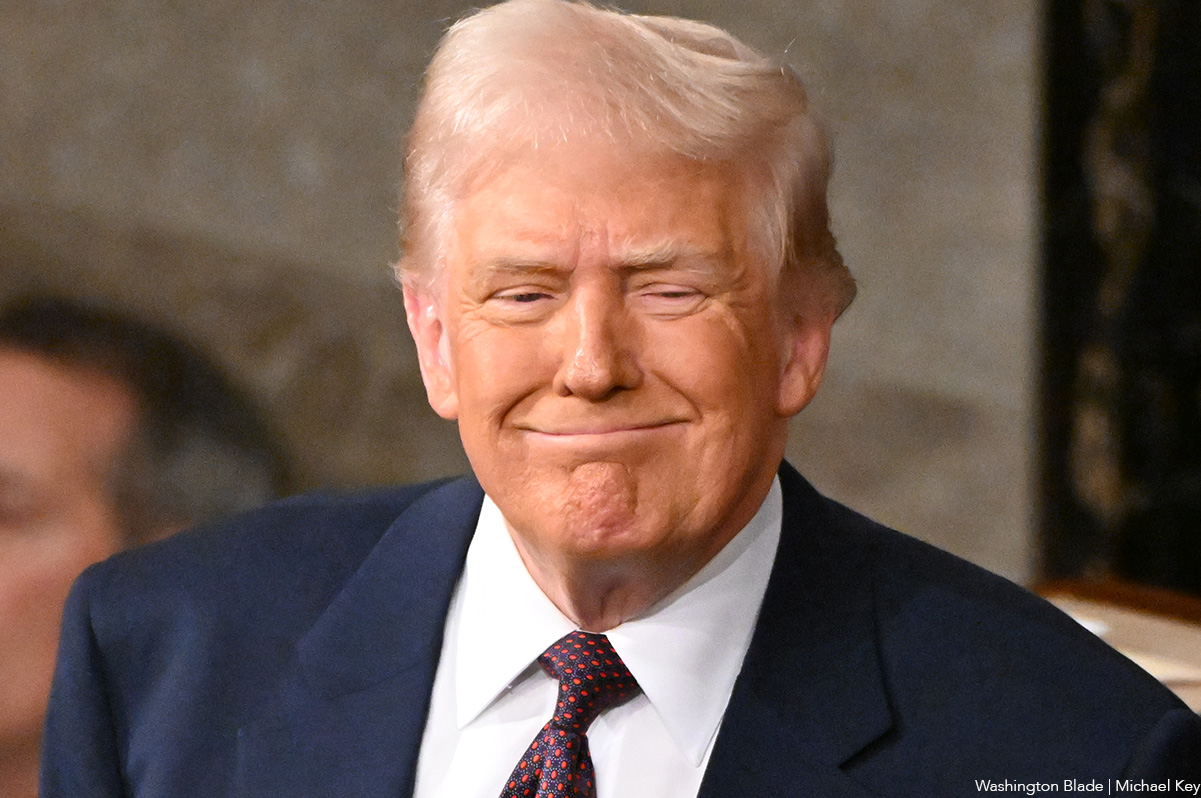
President Donald Trump claimed he won the “gay vote” in 2024, despite evidence showing otherwise.
While appearing by phone on Fox News’s panel show “The Five” on Thursday, Trump falsely claimed he performed particularly well among gay voters while discussing the ongoing war in Iran — a conflict he initiated without formal congressional approval.
“Now I think I did very well with the gay vote, OK? I even played the gay national anthem as my walk-off, OK?” Trump said on air.
“And I think it probably helped me. But I did great. No Republican’s ever gotten the gay vote like I did and I’m very proud of it, I think it’s great. Perhaps it’s because I’m from New York City, I don’t know…”
His claim contradicts 2024 polling from NBC News, which found that the GOP presidential ticket captured fewer than 1 in 5 LGBTQ male voters — a figure that may also include bisexual and transgender men. Trump’s support among LGBTQ female voters was even lower, at just 8%.
White LGBTQ voters favored Vice President Kamala Harris over Trump by a margin of 82% to 16%, while LGBTQ voters of color backed Harris by an even wider 91% to 5%.
Trump also used the appearance to criticize “Gays for Palestine,” saying: “Look at ‘Gays for Palestine’… they kill gays, they kill them instantly, they throw them off buildings, and I’m saying, ‘Who are the gays for Palestine?’”
He further pointed to his campaign’s use of the song “Y.M.C.A.” by the Village People — which he has repeatedly described as a “gay national anthem” — noting that it was frequently used as a walk-off song at rallies, as an indication that he and his campaign were supported by the gay community. The track, long associated with camp and hyper-masculine gay imagery, became a staple of Trump campaign events.
The Village People were later booked to perform at Turning Point USA’s inaugural ball celebrating Trump’s second inauguration. Lead singer Victor Willis previously criticized Trump’s use of the song dating back to 2020 and considered legal action to block it, but ultimately said there was “not much he can do about it.” He later acknowledged the renewed exposure was “beneficial” and “good for business,” boosting the song’s popularity and chart performance.
Despite Trump’s claims of strong support from gay voters, polling has consistently shown otherwise — even as several prominent gay men have held roles in or around his orbit, sometimes dubbed the “A-gays.” These include Richard Grenell, former executive director of the Kennedy Center and Special Presidential Envoy for Special Missions; Treasury Secretary Scott Bessent; Under Secretary of State Jacob Helberg; Department of Energy official Charles T. Moran; and longtime supporter Peter Thiel, co-founder and CEO of Palantir.
His efforts to portray himself as aligned with the gay community stand in conflict with policies advanced under his leadership. These include removing LGBTQ-related data from State Department reports, attempting to narrowly redefine gender identity in federal policy, restricting access to gender-affirming health care, and rolling back anti-discrimination protections. His administration also rescinded initiatives focused on LGBTQ health equity, data collection, and nondiscrimination in health care and education — moves advocates say contribute to stigma and worsen mental health outcomes.
Additionally, some HIV programs and community health centers have lost funding from the federal government after supporting initiatives inclusive of transgender people as a direct result of Trump-Vance policies.
The White House
Kennedy Center leadership changes as Trump ally Grenell departs
Numerous productions cancelled shows during gay Trump loyalist’s tenure

Longtime Trump ally and openly gay “Special Presidential Envoy for Special Missions of the United States” Richard Grenell is stepping down from his leadership role at the John F. Kennedy Center for the Performing Arts.
The story was first reported by Axios on March 13 before President Donald Trump made any official statements about the leadership change at the Kennedy Center, which has undergone a sweeping overhaul of rule changes and pro-Trump appointees to its board since Trump took office in 2025.
In addition to packing the Kennedy Center boardroom with loyalists and appointing himself chair of the board in February 2025, the Trump-Vance administration has placed the president’s name on the facade in an attempt to rename the center — despite the move being illegal without an act of Congress to officially change its name. The administration has also painted the building’s columns white and removed diverse programming.
Since these changes, multiple shows have pulled out of performing at the historic venue — including productions associated with the Washington National Opera.
Matt Floca, the former vice president of facilities operations at the national cultural center under Grenell, has been named the new head of the Kennedy Center, according to Trump.
The change is expected to be announced at a Kennedy Center board of directors meeting at the White House on Monday, which Trump is expected to attend.
“I am pleased to announce that Matt Floca, subject to the approval of the Board of Directors, will be named the Chief Operating Officer and Executive Director of THE TRUMP KENNEDY CENTER where, as Vice President of Operations, Matt has helped us achieve tremendous progress in bringing the Center to the highest level of Excellence!” Trump wrote in a post on Truth Social. “A Complete Reconstruction of THE TRUMP KENNEDY CENTER will begin after the July 4th Celebration, with a scheduled Grand Re-Opening in approximately two years.”
“Ric Grenell has done an excellent job in helping to coordinate various elements of the Center during the transition period, and I want to thank him for the outstanding work he has done,” the post added. “THE TRUMP KENNEDY CENTER will be, at its completion, the finest facility of its kind anywhere in the World! — President DONALD J. TRUMP.”
Grenell previously served as U.S. ambassador to Germany and later as acting director of national intelligence during Trump’s first term. He led the Kennedy Center during a period in which its programming was reshaped and new board members aligned with Trump were appointed. Trump also named himself chair of the board.
Congress approved $257 million in reconstruction funding for the Kennedy Center in last year’s spending package, a project estimated to take roughly two years to complete. Kennedy Center officials have also said they implemented increased cost-cutting measures — including large-scale layoffs — and that staff salaries are no longer being paid using debt reserves.
Actor Harvey Fierstein, a longtime critic of Trump’s takeover of the cultural institution and an award-winning openly gay performer, posted on Instagram celebrating Grenell’s departure.
“Good old anti-LGBTQ+ self-loathing dick licker, #RichardGrenell, is moving on to ruin something new under the auspices of our demented war-mongering MAGA fool Prez,” Fierstein wrote. “Maybe #RicGrennell can open a little boutique selling red baseball hats. But first, after destroying the Kennedy Center for the Arts, he’s earned a vacation. Maybe he and Kristi Noem can go puppy hunting together. They can tell each other tales of when they were once called ‘the best people’ and other fairy tales.”

Thousands attend ‘No Kings’ protests in D.C.

Blade contributor, husband exchange vows in D.C.

Ghanaian president welcomed to Philadelphia amid backlash over anti-LGBTQ bill

PHOTOS: ‘No Kings’ rally and march

‘Out for McDuffie’ event held at D.C. gay bar

Pa. House passes bill to codify marriage equality in state law

Introducing the Torchbearers Awards honoring queer, trans women and nonbinary people

New IOC policy bans trans women from Olympics

‘No Kings’ protests set for D.C.

Border to border: modern slavery and human trafficking in refugee movements across East Africa
-

 Pennsylvania5 days ago
Pa. House passes bill to codify marriage equality in state law
-
a&e features5 days ago
Introducing the Torchbearers Awards honoring queer, trans women and nonbinary people
-
Sports5 days ago
New IOC policy bans trans women from Olympics
-
District of Columbia5 days ago
‘No Kings’ protests set for D.C.