District of Columbia
Rainbow History Project WorldPride exhibition hit by vandalism
Organizers scramble to repair damaged exhibits in D.C.’s Freedom Plaza
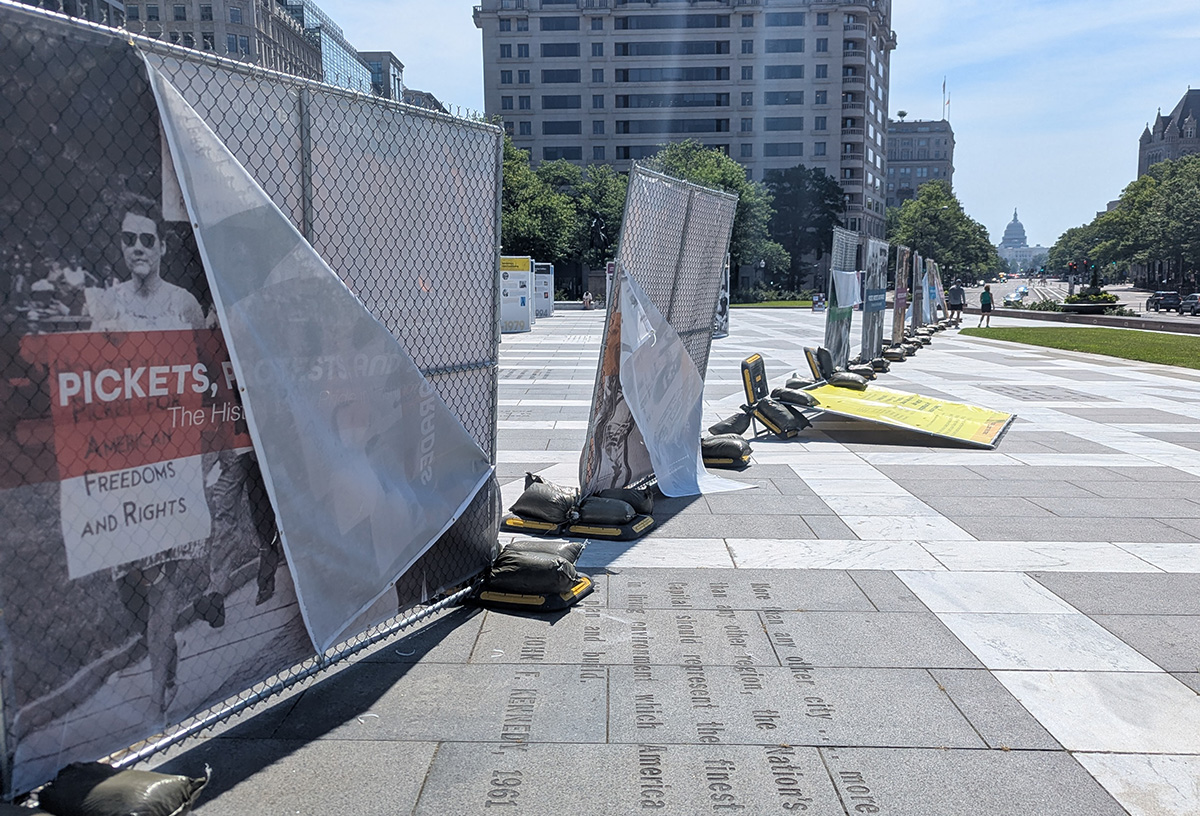
At least five of the multiple exhibits displayed in D.C.’s Freedom Plaza as part of the local Rainbow History Project’s WorldPride exhibition have been damaged by one or more vandals since the exhibition opened on May 18, according to Vincent Slatt, one of the exhibition’s lead organizers.
The most recent incident took place during the early morning hours of Sunday, June 22, when someone pulled down two of the exhibits displayed on decorated chain link fences, Slatt told the Washington Blade.
The Rainbow History Project exhibition, called “Pickets, Protests, and Parades: The History of Gay Pride in Washington,” has been available for public viewing 24 hours each day since it opened in Freedom Plaza, which is located near the White House on Pennsylvania Avenue, N.W. between 13th and 14th streets.
Slatt says it will remain open until its scheduled closing on July 6, regardless of efforts by vandals to strike at its individual LGBTQ exhibits.
“Covering 1965 to the present, the exhibition explores the history of Pride in D.C. in 10 distinct thematic eras,” a statement released by Rainbow History Project says. “Each of the 10 areas are detailed in thematic cubes rich with history and visuals,” it says.
Slatt said at least two instances of vandalism, including the June 22 incident, occurred between 11 p.m. and 6 a.m. during the time when a security guard working for a security company retained by Rainbow History Project was scheduled to be on duty at the Freedom Plaza site. But Slatt said the guard appears to have left before his shift was supposed to end, leaving the exhibition unsupervised.
“And so sometime during that security guard’s shift last night it happened,” said Slatt, referring to the two exhibits that were pulled down Sunday morning, June 22.
He said a decision was made later that day to fire the security company and retain another company to provide security for the 11 p.m. to 6 a.m. shift. Slatt said volunteers recruited by Rainbow History Project have been acting as “monitors” to secure the site during daytime and the evening up to 11 p.m. He said the group was unable to recruit volunteers to staff the shift from 11 p.m. to 6 a.m.
Rainbow History Project, according to Slatt, received a $1,000 payment invoice from the company that has been providing the metal fencing for the exhibits under a rental agreement after one of the vandals damaged two ten-foot-by-ten-foot fencing strips beyond repair last week.
Slatt said a possible suspect for acts of vandalism appeared in Freedom Plaza the day before the exhibition opened on May 17, as volunteers were setting up the exhibits.
“The first night we were out there we had a homophobe yelling at us when he saw the word gay,” said Slatt, who described the person as a white male with red hair and a red beard appearing in his 30s or 40s in age. “He’s been out here a couple of times preaching the Bible and yelling slurs,” Slatt said.
At least one witness, a homeless man who sometimes sleeps in Freedom Plaza at night, has reported seeing a man fitting that same description vandalizing an exhibit, Slatt told the Blade.
He said Rainbow History Project has reported the vandalism incidents to the U.S. Park Police, which has jurisdiction over Freedom Plaza. A Park Police officer who came to the site on June 22 to prepare a report on the latest incident advised exhibition volunteers to call police immediately if they see the male suspect return to the site.
As if all this were not enough, Slatt said a few of the exhibits that had been damaged by a vandal and were structurally weakened were blown down by high winds during the storm that hit the D.C. area on June 19. He said volunteer workers put everything back together over the next few days only to have the yet unidentified vandal or vandals pull down two other exhibits on June 22.




District of Columbia
Celebrations of life planned for Sean Bartel
Two memorial events scheduled in D.C.

Two celebrations of life are planned for Sean Christopher Bartel, 48, who was found deceased on a hiking trail in Argentina on or around March 15. Bartel began his career as a television news reporter and news anchor at stations in Louisville, Ky., and Evansville, Ind., before serving as Senior Video Producer for the D.C.-based International Brotherhood of Electrical Workers union from 2013 to 2024.
A memorial gathering is planned for Friday, April 10, 11:30 a.m.-1:30 p.m. at the IBEW International Office (900 7th St., N.W.), according to a statement by the DC Gay Flag Football League, where Bartel was a longtime member. A celebration of life is planned that same evening, 6-8 p.m. at Trade (1410 14th St., N.W.).
District of Columbia
D.C. Council member honored by LGBTQ homeless youth group
Doni Crawford receives inaugural Wanda Alston Legacy Award

About 100 people turned out Tuesday evening, April 7, for a presentation by D.C.’s Wanda Alston Foundation of its inaugural Wanda Alston Legacy Award to D.C. Council member Doni Crawford (I-At-Large) for her support for the foundation’s mission to support homeless LGBTQ youth.
Among those who attended the event was Japer Bowles, director of D.C. Mayor Muriel Bowser’s Office of LGBTQ Affairs, who delivered an official proclamation issued by Bowser declaring April 7, 2026 “A Day of Remembrance for Wanda Alston.”
Alston, a beloved women’s and LGBTQ rights activist, served as the city’s first director of the then newly created Office of LGBTQ Affairs under then-Mayor Anthony Williams from 2004 until her death by murder on March 16, 2005.
To the shock and dismay of fellow LGBTQ rights advocates, police and court records reported Alston, 45, was stabbed to death inside her Northeast D.C. house by a man high on crack cocaine who lived nearby and who stole her credit cards and car. The perpetrator, William Martin Parrott, 38, was arrested by D.C. police the next day and later pleaded guilty to second-degree murder. He was sentenced in July 2005 to 24 years in prison.
Crawford was among those attending the award event who reflected on Alston’s legacy and outspoken advocacy for LGBTQ and feminist causes.
“I am deeply humbled and honored to receive this inaugural award,” Crawford told the Washington Blade at the conclusion of the event. “I think the world of Wanda Alston. She has set such a great foundation for me and other Council members to build on,” she said.
“Her focus on inclusivity and intersectionality is really important as we approach this work,” Crawford added. “And it’s going to guide my work at the Council every day.”
Crawford was appointed to the D.C. Council in January of this year to replace then Council member Kenyan McDuffie (I-At-Large), who resigned to run for D.C. mayor as a Democrat. She is being challenged by four other independent candidates in a June 16 special election for the Council seat.
Under the city’s Home Rule Charter written and approved by Congress, the seat is one of two D.C. Council at-large seats that cannot be held by a “majority party” candidate, meaning a Democrat.
A statement released by the Alston Foundation last month announcing Crawford’s selection for the Wanda Alston Legacy Award praised Crawford’s record of support for its work on behalf of LGBTQ youth.
“From behind the scenes to now serving as an At-Large Council member, she has fought fearlessly for affordable housing, LGBTQ+ funding priorities, and racial justice,” the statement says. “Council member Crawford’s leadership reflects the same courage and conviction that defined Wanda’s legacy.”
Organizers of the event noted that it was held on what would have been Wanda Alston’s 67th birthday.
“Today’s legacy reception was a smashing success,” said Cesar Toledo, the Alston Foundation’s executive director. “Not only did we come together to celebrate Wanda Alston on her birthday, but we also were able to raise over $10,000 for our homeless LGBTQ youth here in D.C.,” Toledo told the Blade.
“In addition to that, we celebrated and we acknowledged a rising star in our community,” he said. “And that is At-Large Council member Doni Crawford, who we named the inaugural Wanda Alston Legacy Award recipient.”
At the request of D.C. Council Chair Phil Mendelson (D-At-Large) the Council voted unanimously on Jan. 20, 2026, to appoint Crawford to the Council seat being vacated by McDuffie.
Council records show she joined McDuffie’s Council staff in 2022 as a policy adviser and later became his legislative director before McDuffie appointed her as staff director for the Council’s Committee on Business and Economic Development for which McDuffie served as chair.
District of Columbia
Police mental health struggles gain growing attention
‘My body begins to manifest physically, through depression, stress’
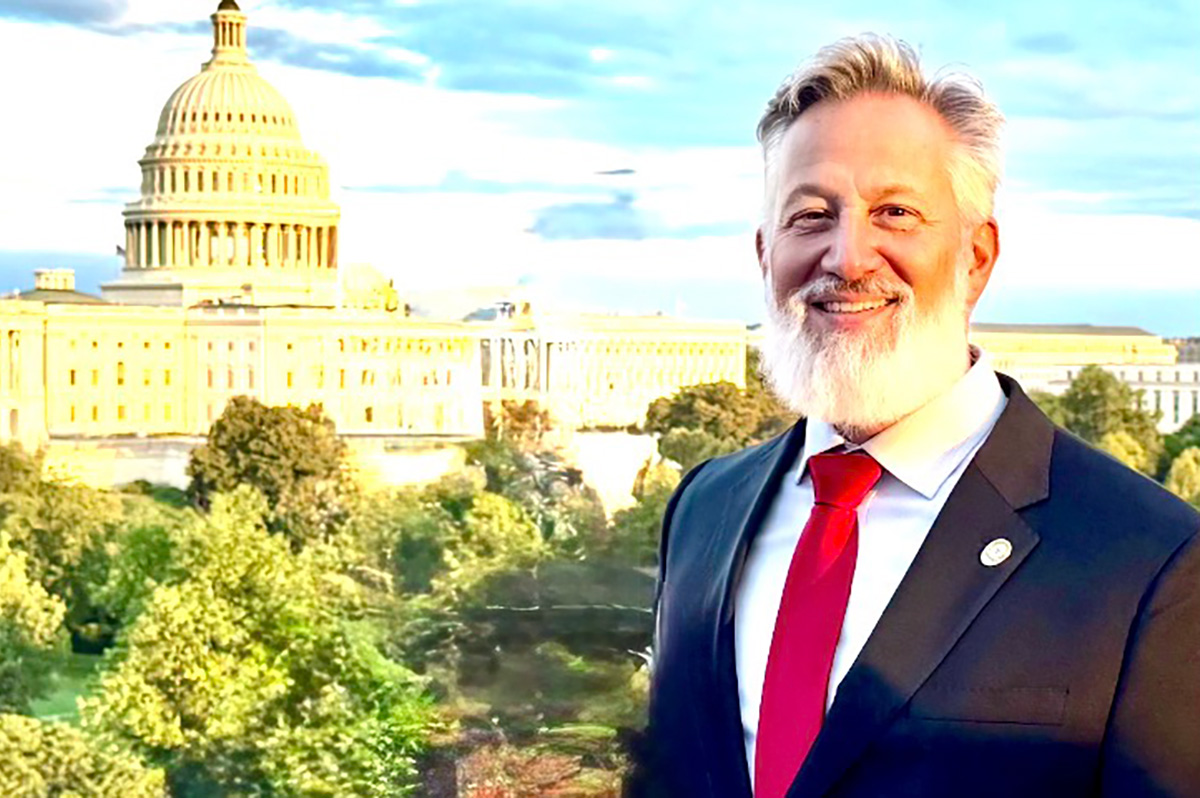
When Scott Silverii began his career as a police officer, he faced daily exposure to traumatic incidents with little guidance or support, particularly in distressed neighborhoods where officers were expected to respond decisively under pressure.
“When I started, the only thing they offered was to suck it up and get over it,” Silverii said. “Any indication that you were hurt meant that you were weak, and if you were weak, it meant you could not be trusted.”
Years later, when Silverii became a police chief, he chose a different approach. Rather than reinforcing silence around trauma, he made mental health support a visible part of his leadership.
“In every critical incident that we had, I would bring the critical incident stress debriefing team in — and I would participate in it,” Silverii said. “I wanted to promote it from the top. That’s what it’s going to continue to take to change the culture.”
Silverii’s experience reflects a broader reality in law enforcement. Across the country, police officers face ongoing mental health challenges linked to repeated exposure to violent crime scenes, fatal accidents, and human suffering — experiences that most civilians never encounter. Long shifts and the responsibility of protecting the public have long been documented to further intensify emotional strain, particularly when officers fear making mistakes with serious consequences.
Silverii, former Thibodaux, La., chief of police and current National Law Enforcement Initiative Manager at Mothers Against Drunk Driving (MADD), said coping mechanisms in the past were often unhealthy.
“A lot of officers, they would drink — sometimes prescription drug use, just different ways,” of coping, he said. Today, he said, the trauma can linger long after an incident: “…you become affected by the trauma. It doesn’t have to happen to you. But when officers respond to a crash, you’re involved… You carry this trauma.”
In some cases, he says, the impact resurfaces every year. “My body begins to manifest physically, through depression, through stress… once I realize it’s the anniversary, I can start dealing with it,” he said.
For decades, police culture discouraged officers from seeking mental health support, often treating emotional distress as a weakness rather than an occupational hazard. In recent years, however, departments have begun expanding access to counseling, peer-support programs, and crisis-intervention training.
In Baltimore, a shift in police culture is tackling the long-standing “shrug it off” mentality toward officer mental health. The Baltimore Police Department’s Officer Safety and Wellness Section, started in 2018, changed how the agency handles trauma, depression, and substance abuse by treating these issues as medical needs rather than disciplinary failures.
A core component of the program is its confidential alcohol addiction treatment, which has seen more than 250 officers voluntarily sign themselves in without fear of termination. This proactive approach has led to a dramatic drop in internal interventions — falling from 250 in 2018 to 48 in 2024 — alongside a decrease in citizen complaints and use-of-force incidents.
The need for such programs is underscored by national data from the Police1 2024 State of the Industry report, which found that 76% of officers cite a lack of time due to heavy workloads as the primary barrier to maintaining their health. More than 50% of respondents report that a significant stigma still surrounds seeking mental health services. Perhaps most telling — 12% of officers nationwide report having no access to mental health resources at all, and 33% have considered calling themselves out of service due to emotional distress or exhaustion.
Chris Asplen, executive director of the National Criminal Justice Association, is a former Washington prosecutor who handled child abuse and other high-stakes cases. He said the emotional weight of the work eventually led him to step away after becoming a parent.
“It became too mentally and emotionally difficult after I had my own child,” Asplen said.
Asplen said his understanding of trauma was also shaped in part by his upbringing. Raised by a parent who struggled with mental illness, he described growing up feeling overlooked. “My father’s mental health issues made me essentially invisible to him,” he said — an experience that later informed how he approached victims in the justice system.
Asplen also pointed to disparities in how mental health crises are handled. His family’s middle-class background, he said, afforded protections and support not available to many others. “Mental health issues for people who are not white and middle class are often treated as criminal matters,” he said.
Experts warn that when mental health challenges go unaddressed, they can affect officers’ judgment, job performance, and interactions with the public. In response, lawmakers and communities have begun exploring preventive approaches. In 2023, Congress passed the De-escalation Act, providing funding for training focused on crisis response, de-escalation, and officer wellness.
In addition to legislative efforts, some communities are turning to violence intervention programs aimed at reducing harm before police are required to respond. One such organization, Roca, was founded in Massachusetts in 1988 and has operated in Baltimore since 2018. According to the organization’s impact data, 87% of its participants have had no new incarcerations after entering the program for at least 24 months.
Police officers in Baltimore and several other cities have been trained by Roca’s nonprofit coaching arm, the Roca Impact Institute, to use cognitive behavioral therapy (CBT) to regulate their emotions and understand the impact of trauma on officers and community members. The training reduced stress, loss of temper and use of force incidents, according to the institute.
A 2024 report by the D.C. Office of the Attorney General showed the city’s violence intervention program’s efforts contributed to an 18% decrease in shootings and a 26% decrease in gun homicides across its target neighborhoods in 2023. Based on the national Cure Violence Global model, the programs treat violence as a public health epidemic through the use of what it calls “credible messengers” to de-escalate conflicts.
But a Washington Post investigation published Feb. 3 found excessive spending that City Administrator Kevin Donahue called a “completely inappropriate use of public money.” A week later, the publication reported that two DC violence interrupters were charged with murder in the death of a Baltimore man in a DC nightclub in 2023.
When done correctly, these programs can offer a secondary benefit by reducing the volume of high-stress calls handled by law enforcement. Advocates say such approaches can lessen the emotional toll on officers by preventing traumatic encounters altogether.
“If we can reduce the amount of trauma that occurs at the scene,” Asplen said, “then we’re a lot further along.”
(Carl Barbett is a senior at Bard High School Early College DC, one of Youthcast Media Group’s journalism class partners. This story was produced under the mentorship of Edith Mwangi, a Kenyan multimedia journalist based in D.C. with a background in international reporting and politics.)

How to navigate shifting tenant expectations

Viktor Orbán ousted in Hungarian elections

Minimal version of ‘Streetcar Named Desire’ heading to Dupont Underground

Comings & Goings

An effort to increase the number of psychiatrists of color

Tenn. lawmakers pass transgender “watch list” bill

LGBTQ groups condemn Trump’s threat to destroy Iranian civilization

Report: Grenell wants Russian ambassadorship

D.C. Council member honored by LGBTQ homeless youth group

Glisten’s 30th annual Day of Silence to take place April 10
-

 Tennessee5 days ago
Tenn. lawmakers pass transgender “watch list” bill
-

 Iran5 days ago
LGBTQ groups condemn Trump’s threat to destroy Iranian civilization
-
The White House4 days ago
Report: Grenell wants Russian ambassadorship
-
District of Columbia5 days ago
D.C. Council member honored by LGBTQ homeless youth group