New York
Two teens shot steps from Stonewall Inn after NYC Pride parade
One of the victims remains in critical condition
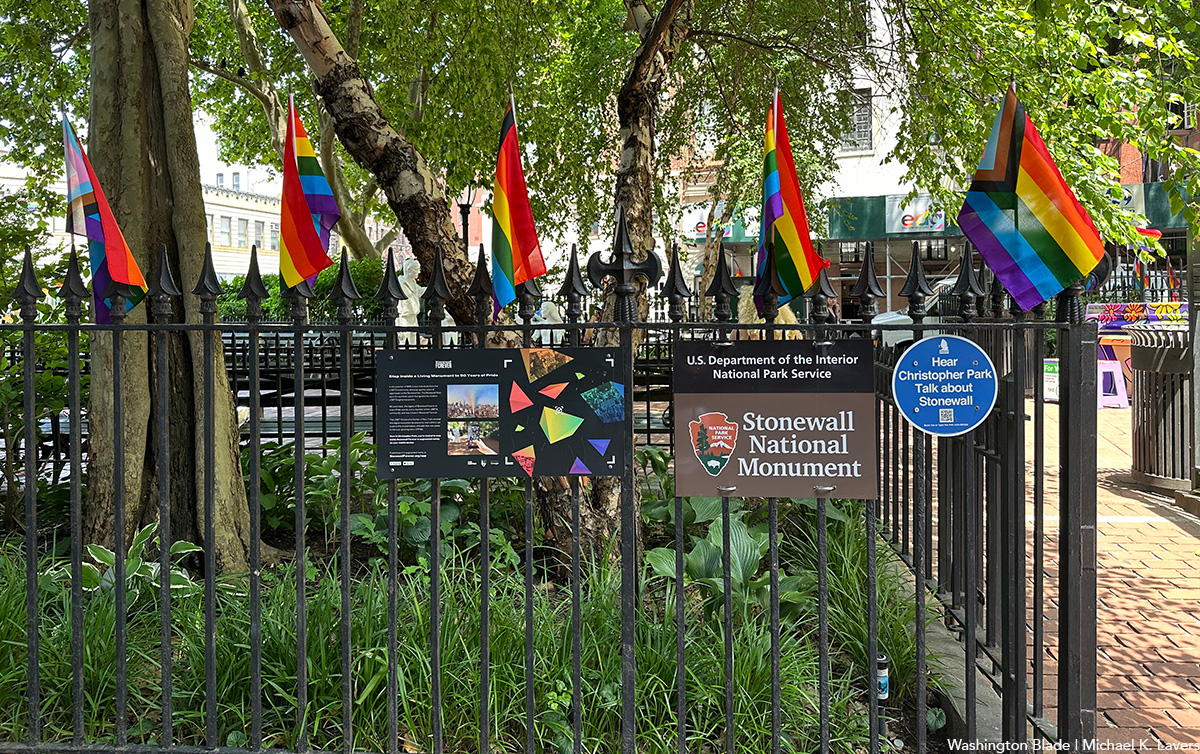
On Sunday night, following the annual NYC Pride March, two girls were shot in Sheridan Square, feet away from the historic Stonewall Inn.
According to an NYPD report, the two girls, aged 16 and 17, were shot around 10:15 p.m. as Pride festivities began to wind down. The 16-year-old was struck in the head and, according to police sources, is said to be in critical condition, while the 17-year-old was said to be in stable condition.
The Washington Blade confirmed with the NYPD the details from the police reports and learned no arrests had been made as of noon Monday.
The shooting took place in the Greenwich Village neighborhood of Manhattan, mere feet away from the most famous gay bar in the city — if not the world — the Stonewall Inn. Earlier that day, hundreds of thousands of people marched down Christopher Street to celebrate 55 years of LGBTQ people standing up for their rights.
In June 1969, after police raided the Stonewall Inn, members of the LGBTQ community pushed back, sparking what became known as the Stonewall riots. Over the course of two days, LGBTQ New Yorkers protested the discriminatory policing of queer spaces across the city and mobilized to speak out — and throw bottles if need be — at officers attempting to suppress their existence.
The following year, LGBTQ people returned to the Stonewall Inn and marched through the same streets where queer New Yorkers had been arrested, marking the first “Gay Pride March” in history and declaring that LGBTQ people were not going anywhere.
New York State Assemblywoman Deborah Glick, whose district includes Greenwich Village, took to social media to comment on the shooting.
“After decades of peaceful Pride celebrations — this year gun fire and two people shot near the Stonewall Inn is a reminder that gun violence is everywhere,” the lesbian lawmaker said on X. “Guns are a problem despite the NRA BS.”




New York
Court orders Pride flag to return to Stonewall
Lambda Legal, Washington Litigation Group filed federal lawsuit
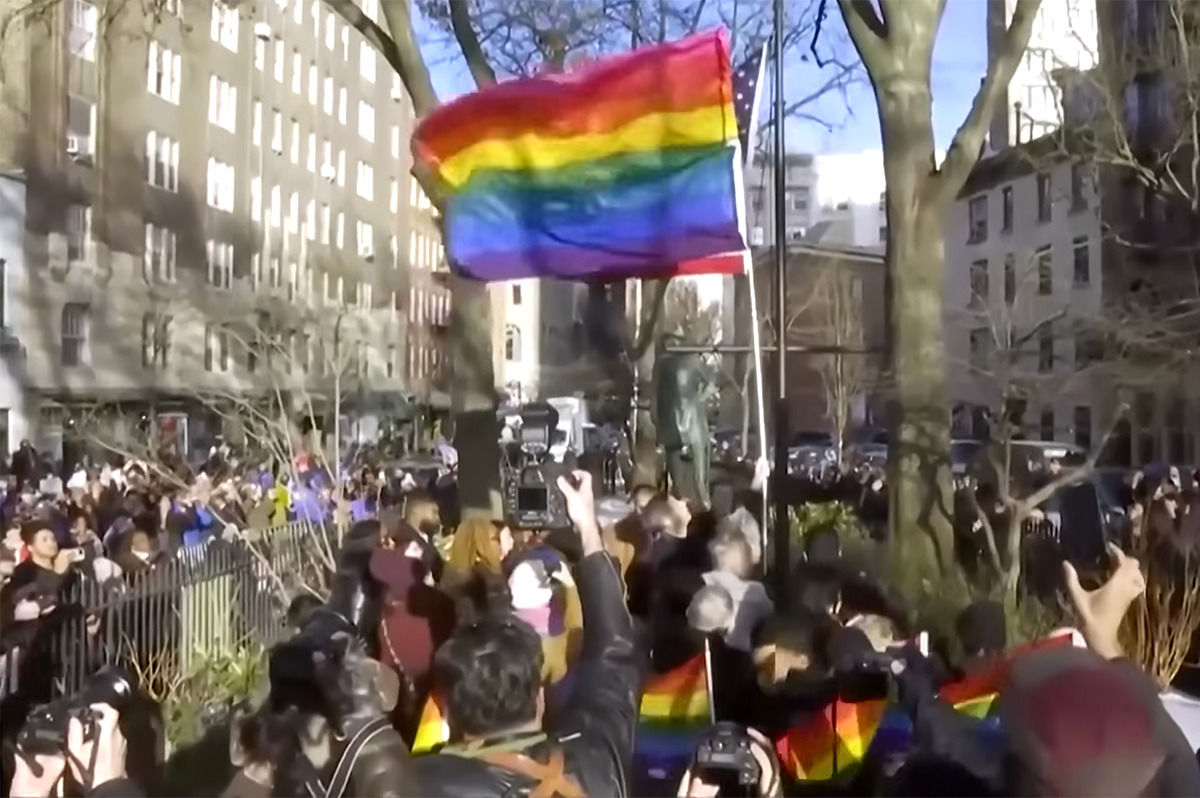
The Pride flag will once again fly over the Stonewall National Monument in New York following a court order requiring the National Park Service to raise it over the site.
The decision follows a lawsuit filed by Lambda Legal and the Washington Litigation Group in the U.S. District Court for the Southern District of New York, which challenged the removal as unconstitutional under the Administrative Procedure Act and argued that the government unlawfully targeted the LGBTQ community.
In February, the NPS removed the Pride flag from the Stonewall National Monument, the first national monument dedicated to LGBTQ rights and history in the U.S. The move followed a Jan. 21 memorandum issued by President Donald Trump-appointed NPS Director Jessica Bowron restricting which flags may be flown at national parks. The directive limited displays to official government flags, with narrow exceptions for those deemed to serve an “official purpose.”
Plaintiffs successfully argued that the Pride flag meets that standard, given Stonewall’s status as the birthplace of the modern LGBTQ rights movement. They also contended that the policy violated the APA by bypassing required public input and improperly applying agency rules.
The lawsuit named Interior Secretary Doug Burgum, Bowron, and Amy Sebring, superintendent of Manhattan sites for the NPS, as defendants. Plaintiffs included the Gilbert Baker Foundation, Village Preservation, Equality New York, and several individuals.
The court found that the memorandum — while allowing limited exceptions for historical context purposes — was applied unlawfully in this case. As part of the settlement, the NPS is required to rehang the Pride flag on the monument’s official flagpole within seven days, where it will remain permanently.
“The sudden, arbitrary, and capricious removal of the Pride flag from the Stonewall National Monument was yet another act by this administration to erase the LGBTQ+ community,” said Karen Loewy, co-counsel for plaintiffs and Lambda Legal’s Senior Counsel and Director of Constitutional Law Practice. “Today, the government has pledged to restore this important symbol back to where it belongs.”
“This is a complete victory for our clients and for the LGBTQ+ community,” said Alexander Kristofcak, lead counsel for plaintiffs and a lawyer with Washington Litigation Group. “The government has acknowledged what we argued from day one: the Pride flag belongs at Stonewall. The flag will be restored and it will fly officially and permanently. And we will remain vigilant to ensure that the government sticks to the deal.”
“Gilbert Baker created the Rainbow Pride flag as a symbol of hope and liberation,” said Charles Beal, president of the Gilbert Baker Foundation. “Today, that symbol is restored to the place where it belongs, standing watch over the birthplace of the modern LGBTQ+ rights movement.”
“The government tried to erase an important symbol of the LGBTQ+ community, and the community said no,” said Amanda Babine, executive director of Equality New York. “Today’s accomplishment proves that when we stand together and fight back, we win.”
“The removal of the Pride flag from Stonewall was an attempt to erase LGBTQ+ history and undermine the rule of law,” said Andrew Berman, executive director of Village Preservation. “This settlement restores both.”
With Loewy on the complaint are Douglas F. Curtis, Camilla B. Taylor, Omar Gonzalez-Pagan, Kenneth D. Upton Jr., Jennifer C. Pizer, and Nephetari Smith from Lambda Legal. With Kristofcak on the complaint are Mary L. Dohrmann, Sydney Foster, Kyle Freeny, James I. Pearce, and Nathaniel Zelinsky from Washington Litigation Group.
New York
Lawsuit to restore Stonewall Pride flag filed
Lambda Legal, Washington Litigation Group brought case in federal court
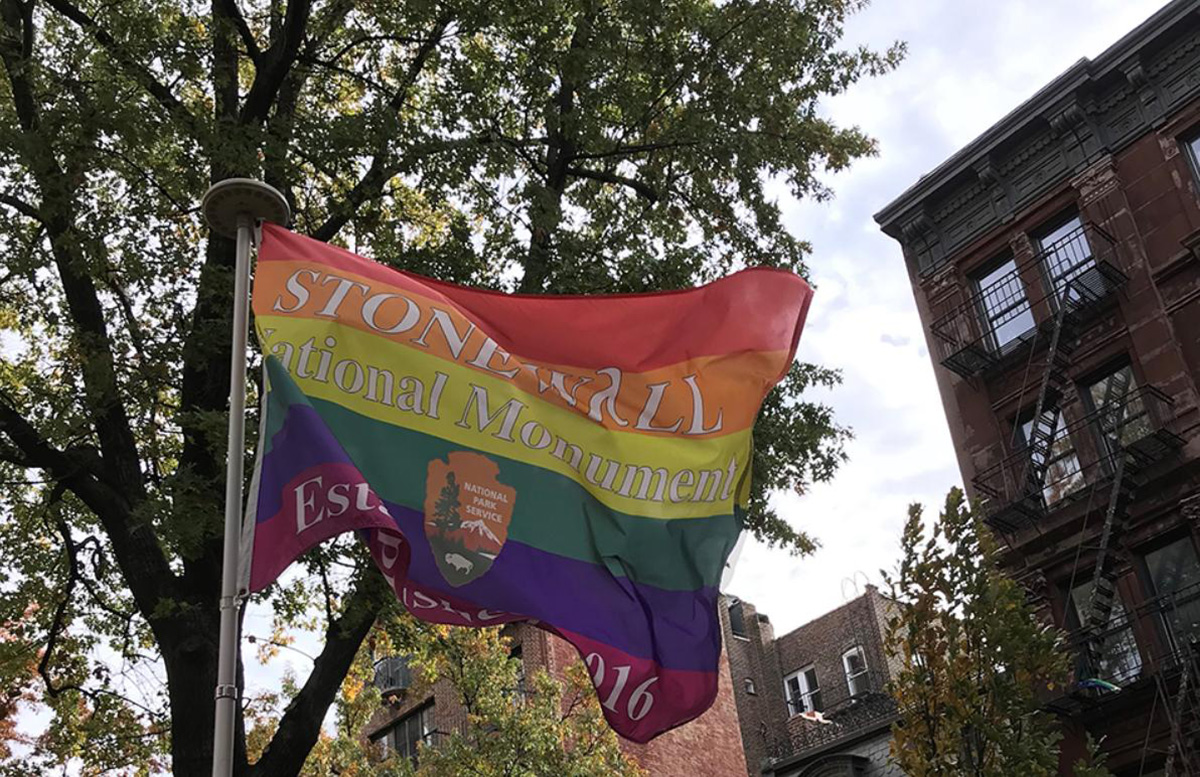
Lambda Legal and Washington Litigation Group filed a lawsuit on Tuesday, challenging the Trump-Vance administration’s removal of the Pride flag from the Stonewall National Monument in New York earlier this month.
The suit, filed in the U.S. District Court for the Southern District of New York, asks the court to rule the removal of the Pride flag at the Stonewall National Monument is unconstitutional under the Administrative Procedures Act — and demands it be restored.
The National Park Service issued a memorandum on Jan. 21 restricting the flags that are allowed to fly at National Parks. The directive was signed by Trump-appointed National Park Service Acting Director Jessica Bowron.
“Current Department of the Interior policy provides that the National Park Service may only fly the U.S. flag, Department of the Interior flags, and the Prisoner of War/Missing in Action flag on flagpoles and public display points,” the letter from the National Park Service reads. “The policy allows limited exceptions, permitting non-agency flags when they serve an official purpose.”
That “official purpose” is the grounds on which Lambda Legal and the Washington Litigation Group are hoping a judge will agree with them — that the Pride flag at the Stonewall National Monument, the birthplace of LGBTQ rights movement in the U.S., is justified to fly there.
The plaintiffs include the Gilbert Baker Foundation, Charles Beal, Village Preservation, and Equality New York.
The defendants include Interior Secretary Doug Burgum; Bowron; and Amy Sebring, the Superintendent of Manhattan Sites for the National Park Service.
“The government’s decision is deeply disturbing and is just the latest example of the Trump administration targeting the LGBTQ+ community. The Park Service’s policies permit flying flags that provide historical context at monuments,” said Alexander Kristofcak, a lawyer with the Washington Litigation Group, which is lead counsel for plaintiffs. “That is precisely what the Pride flag does. It provides important context for a monument that honors a watershed moment in LGBTQ+ history. At best, the government misread its regulations. At worst, the government singled out the LGBTQ+ community. Either way, its actions are unlawful.”
“Stonewall is the birthplace of the modern LGBTQ+ rights movement,” said Beal, the president of the Gilbert Baker Foundation. The foundation’s mission is to protect and extend the legacy of Gilbert Baker, the creator of the Pride flag.
“The Pride flag is recognized globally as a symbol of hope and liberation for the LGBTQ+ community, whose efforts and resistance define this monument. Removing it would, in fact, erase its history and the voices Stonewall honors,” Beal added.
The APA was first enacted in 1946 following President Franklin D. Roosevelt’s creation of multiple new government agencies under the New Deal. As these agencies began to find their footing, Congress grew increasingly worried that the expanding powers these autonomous federal agencies possessed might grow too large without regulation.
The 79th Congress passed legislation to minimize the scope of these new agencies — and to give them guardrails for their work. In the APA, there are four outlined goals: 1) to require agencies to keep the public informed of their organization, procedures, and rules; 2) to provide for public participation in the rule-making process, for instance through public commenting; 3) to establish uniform standards for the conduct of formal rule-making and adjudication; and 4) to define the scope of judicial review.
In layman’s terms, the APA was designed “to avoid dictatorship and central planning,” as George Shepherd wrote in the Northwestern Law Review in 1996, explaining its function.
Lambda Legal and the Washington Litigation Group are arguing that not only is the flag justified to fly at the Stonewall National Monument, making the directive obsolete, but also that the National Park Service violated the APA by bypassing the second element outlined in the law.
“The Pride flag at the Stonewall National Monument honors the history of the fight for LGBTQ+ liberation. It is an integral part of the story this site was created to tell,” said Lambda Legal Chief Legal Advocacy Officer Douglas F. Curtis in a statement. “Its removal continues the Trump administration’s disregard for what the law actually requires in their endless campaign to target our community for erasure and we will not let it stand.”
The Washington Blade reached out to the NPS for comment, and received no response.
New York
Pride flag raised at Stonewall after National Park Service took it down
‘Our flag represents dignity and human rights’
A Pride flag was raised at the site of the Stonewall National Monument days after a National Park Service directive banned flying the flag at the birthplace of the LGBTQ rights movement in the U.S.
The flag-raising was led by Manhattan Borough President Brad Hoylman-Sigal and supported by other elected officials.
“The community should rejoice. We have prevailed,” Hoylman-Sigal said shortly after the flag was hoisted. “Our flag represents dignity and human rights.”
The flag now sits in Christopher Street Park, feet away from the Stonewall Inn, where in 1969 a police raid of the gay bar sparked outrage and led to a rising of LGBTQ people pushing back on NYPD brutality and unjust treatment.
Elected officials brought a new flagpole with them, using plastic zip ties to attach it to the existing pole.
In 2016, President Barack Obama declared the site a national monument.
One day before the planned re-raising of the Pride flag, the National Park Service installed only an American flag on the flagpole, which days prior had flown a rainbow flag bearing the NPS logo.
The directive removing the flag was put forward by Trump-appointed National Park Service Acting Director Jessica Bowron.
This comes one day after more than 20 LGBTQ organizations from across the country co-signed a letter to Interior Secretary Doug Burgum and General Services Administrator Ed Forst, demanding the flag be restored to the monument.
“It is our understanding that the policy provides limited exceptions for non-agency flags that provide historical context or play a role in historic reenactments. Simply put, we urge you to grant this flag an exception and raise it once again, immediately,” the letter read. “It also serves as an important reminder to the 30+ million LGBTQ+ Americans, who continue to face disproportionate threats to our lives and our liberty, that the sites and symbols that tell our stories are worth honoring … However, given recent removals of the site’s references to transgender and bisexual people — people who irrefutably played a pivotal role in this history — it is clear that this is not about the preservation of the historical record.”
The letter finished with a message of resilience the LGBTQ community is known for: “The history and the legacy of Stonewall must live on. Our community cannot simply be erased with the removal of a flag. We will continue to stand up and fight to ensure that LGBTQ+ history should not only be protected — it should be celebrated as a milestone in American resilience and progress.”
When asked about the directive, the NPS responded with this statement:
“Current Department of the Interior policy provides that the National Park Service may only fly the U.S. flag, Department of the Interior flags, and the Prisoner of War/Missing in Action flag on flagpoles and public display points. The policy allows limited exceptions, permitting non-agency flags when they serve an official purpose. These include historical context or reenactments, current military branch flags, flags of federally recognized tribal nations affiliated with a park, flags at sites co-managed with other federal, state, or municipal partners, flags required for international park designations, and flags displayed under agreements with U.S. Citizenship and Immigration Services for Naturalization ceremonies.”
An Interior Department spokesperson on Thursday called the move to return the flag to the monument a “political stunt.”
“Today’s political pageantry shows how utterly incompetent and misaligned the New York City officials are with the problems their city is facing,” a department spokesperson said when reached for comment.
The clash comes amid broader efforts by the Trump-Vance administration to minimize LGBTQ history and political power. The White House has spent much of President Donald Trump’s second presidency restricting transgender rights — stopping gender-affirming care for transgender youth, issuing an executive order stating the federal government will recognize only two sexes, male and female, and blocking Medicaid and Medicare from being used for gender-affirming care.

Court orders Pride flag to return to Stonewall

Sri Lankan government withdraws support for LGBTQ tourism initiative

In an act of artistic defiance, Baltimore Center Stage stays focused on DEI

Trump budget targets ‘gender extremism’

Susan Lucci on love, loss, and ‘All My Children’

Trump’s war threats trigger rare 25th Amendment discussion

New book celebrates 1970s dance music icons

ROSENSTEIN: Vote McDuffie for mayor of D.C.

A Sondheim masterpiece ‘Merrily’ rolls onto Netflix