District of Columbia
Capital Pride files anti-stalking complaint against local LGBTQ activist
Darren Pasha denies charge, claims action is linked to Ashley Smith’s resignation
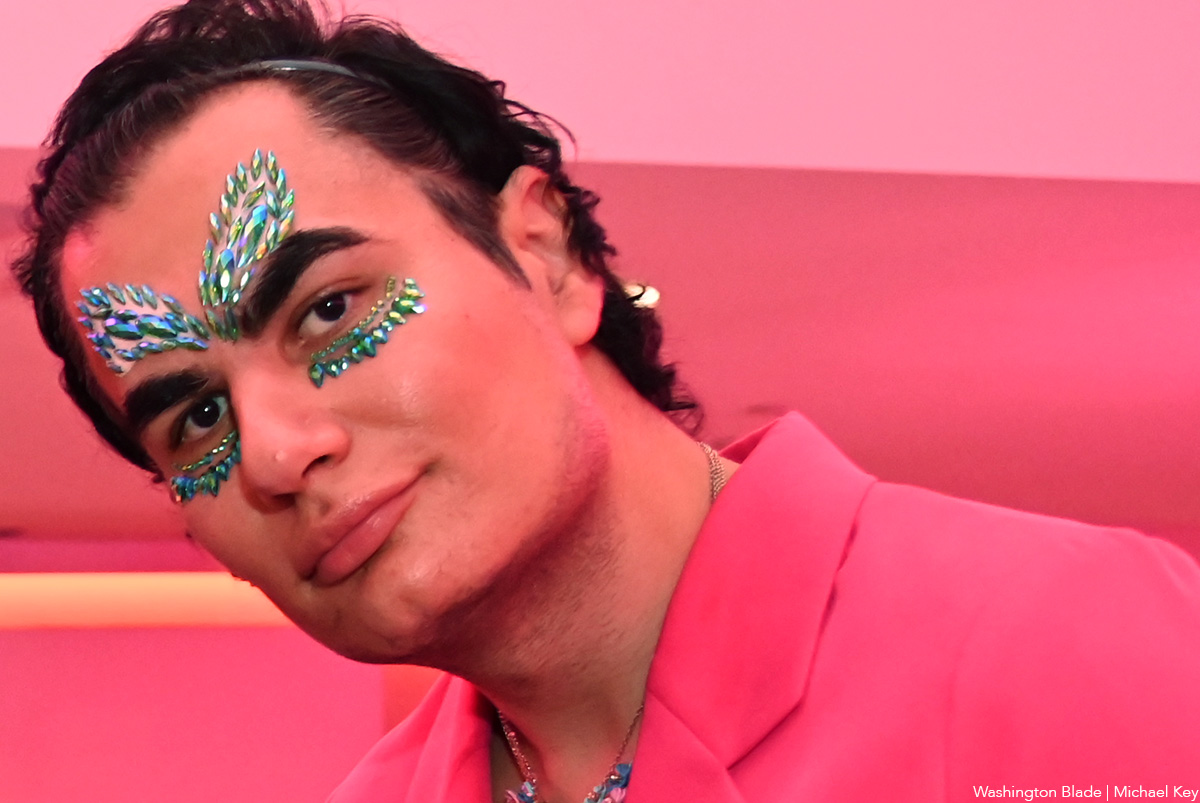
Capital Pride Alliance, the D.C.-based LGBTQ group that organizes the city’s annual Pride events, filed a Civil Complaint on Oct. 27 against local LGBTQ activist and former volunteer Darren Pasha, accusing him of engaging in a year-long effort to harass, intimidate, and stalk Capital Pride’s staff, board members, and volunteers.
The complaint, which was filed in D.C. Superior Court, was accompanied by a separate motion seeking a court restraining order, preliminary injunction and anti-stalking order prohibiting Pasha from “any further contact, harassment, intimidation, or interference with the Plaintiff, its staff, board members, volunteers, and affiliates.”
According to online court records, on Oct. 28, a judge issued an “initial order” setting the date for a scheduling conference for the case on Feb. 6, 2026. As of the end of the business day on Friday, Nov. 7, the judge did not issue a ruling on Capital Pride’s request for an injunction and restraining order
The court records show that on Nov. 5 Pasha filed an answer to the complaint in which he denies all allegations that he targeted Capital Pride officials or volunteers for stalking or that he engaged in any other improper behavior.
“It is evident that the document is replete with false, misleading, and unsubstantiated assertions,” Pasha says in his response, adding that “no credible or admissible evidence has been provided” to meet the statutory requirements for an anti-stalking order.
The Capital Pride complaint includes an 18-page legal brief outlining its allegations against Pasha and an additional 167-page addendum of “supporting exhibits” that includes multiple statements by witnesses whose names are blacked out in the court filing documents.
“Over the past year, Defendant Darren Dolshad Pasha (“DSP”} has engaged in a sustained and escalating course of conduct directed at CPA, including repeated and unwanted contact, harassment, intimidation, threats, manipulation, and coercive behavior targeting CPA staff, board members, volunteers, and affiliates,” the Capital Pride complaint states.
It continues, “This conduct included physical intimidation, unwanted physical contact, deception to gain unauthorized access to events, retaliatory threats, abusive digital communication, proxy-based harassment, and knowing defiance of organizational bans and protective orders.”
The sweeping anti-stalking order requested in Capital Pride’s court motion would prohibit Pasha from interacting in person or online or electronically with “all current and future staff, board members, and volunteers of Capital Pride Alliance, Inc.”
The proposed order adds, the “defendant shall stay at least 200 yards away from the principal offices of Capital Pride Alliance” and “shall stay at least 200 yards away from all Capital Pride Alliance events, event venues, associated activities, and affiliated gatherings.”
The reason for these restrictions, according to the complaint, is that Pasha’s actions toward Capital Pride staff, board members, and volunteers allegedly reached the level of causing them to fear for their safety, become “alarmed, disturbed, or frightened,” or suffer emotional distress as defined in D.C.’s anti-stalking law.
Among the Capital Pride officials who are identified by name and who have included statements in the complaint in support of its allegations against Pasha are Ashley Smith, the former Capital Pride Alliance board president, and June Crenshaw, the Capital Pride Alliance deputy director.
“I am making this declaration based on my personal knowledge to support CPA’s petition for a Civil Anti-Stalking Order (ASO) against Daren Pasha,” Smith says in his court statement. “My concerns about the respondent are based on my personal interactions with him as well as reports I have received from other members of the CPA community,” Smith states.
The Capital Pride complaint against Pasha and its supporting documents were filed by D.C. attorney Nick Harrison of the local law firm Harrison-Stein PC.
In his 16-page response to the complaint that he says he wrote himself without the aid of an attorney, Pasha says the Capital Pride complaint against him appears to be a form of retaliation against him for a dispute he has had with the organization and its then president, Ashley Smith, over the past year.
His response states that the announcement last month by Capital Pride that Smith resigned from his position as board president on Oct. 18 after it became aware of a “claim” regarding Smith and it had opened an investigation into the claim supports his assertion that Smith’s resignation is linked to his year-long claim that Smith tarnished his reputation.
Among his allegations against Smith in his response to the Capital Pride complaint, Pasha accuses Smith of using his position as a member of the board of the Human Rights Campaign, the D.C.-based national LGBTQ advocacy organization, to persuade HRC to terminate his position as an HRC volunteer and to ban him from attending any future HRC events. He attributes HRC’s action against him to “defamatory” claims about him by Smith related to his ongoing dispute with Smith.
The Capital Pride complaint cites HRC officials as saying Pasha was ousted from his role as a volunteer after he allegedly engaged in abusive and inappropriate behavior toward HRC staff members and other volunteers.
Capital Pride has so far declined to disclose the reason for Smith’s resignation pending an internal investigation.
In its statement announcing Smith’s resignation, a copy of which it sent to the Washington Blade, Capital Pride Alliance says, “Recently, CPA was made aware of a claim made regarding him. The organization has retained an independent firm to initiate an investigation and has taken the necessary steps to make available partner service providers for the parties involved.”
The statement adds, “To protect the integrity of the process and the privacy of all involved, CPA will not be sharing further information at this time.”
Smith did not respond to a request by the Blade for comment, and Capital Pride has declined to disclose whether Smith’s resignation is linked in any way to Pasha’s allegations.
The Capital Pride complaint seeks to “characterize me as posing a threat sufficient to justify the issuance of a Civil Anti-Stalking Order (CAO), yet no credible or admissible evidence has been provided to satisfy the statutory elements required under D.C. Code 22-3133,” Pasha states in his response.
“CPA’s assertions fail to establish any such conduct on my part and instead appear calculated to discredit and retaliate against me for raising legitimate concerns regarding the conduct of its former Board President,” he states in his response.
In its complaint against Pasha and its legal memorandum supporting its request for an anti-stalking order, Capital Pride provides a list of D.C. Superior Court records that show Pasha has been hit with several anti-stalking orders in cases unrelated to Capital Pride in the past and has violated those orders, resulting in his arrest in at least two of those cases.
“A fundamental justification for granting the [Anti-Stalking Order] lies in the Respondent’s extensive and recent criminal history demonstrating a proven propensity for defying judicial protective measures,” the complaint states. “This history suggests that organizational bans alone are insufficient to deter his behavior, elevating the current situation to one requiring mandatory judicial enforcement,” it says.
“It is alleged that in or about June 2025, Defendant was convicted on multiple counts of violating existing Anti-Stalking Orders in matters unrelated to Capital Pride Alliance (“CPA”),with consecutive sentences imposed, purportedly establishing a pattern of contempt for judicial restraint,” Pasha states in his court response to the Capital Pride complaint.
“These allegations are irrelevant to the matter currently before the Court,” his response continues. “The events cited are entirely unrelated to CPA and the allegations underlying the petition for a Civil Anti-Stalking Order. Moreover, each of these prior matters has been fully adjudicated, resolved, and dismissed, and therefore cannot serve as a basis to justify the issuance of a permanent Civil Anti-Stalking Order in this unrelated proceeding.”
He adds in his response, “Any reliance on such prior matters is misleading, prejudicial, and legally insufficient.”



District of Columbia
How new barriers to health care coverage are hitting D.C.
Federally qualified health centers bracing for influx of newly uninsured patients

Washington, D.C. has the second-lowest rate of people who lack health insurance in the country, but many residents are facing new barriers to health care due to provisions of the sweeping federal law passed in July, which threatens access for thousands.
Changes to insurance eligibility and the rising cost of premiums, which kicked in for some in October and others more recently, are expected to leave many more patients uninsured or unable to afford medical care. Federally qualified health centers, including D.C.’s Whitman-Walker Health, where 10 to 12 percent of patients are uninsured, are bracing for an influx of newly uninsured patients while facing their own financial challenges.
Even in D.C., where uninsured rates have been among the lowest in the country, changes brought on by the passage of the Republican mega bill (known as the “Big Beautiful Bill”) will have major effects.
The changes from the bill affect Medicaid, which is free to low-income patients, and subsidies for insurance that people buy on the health insurance exchanges that were started under the Affordable Care Act, which were allowed to expire on Dec. 31.
Erin Loubier, vice president for access and strategic initiatives at Whitman-Walker Health, says some Whitman-Walker Health patients have received notices about premium increases, including several who say the increases are up to 1,000 percent more than they were paying.
“That is like paying rent,” she says. “We live in an expensive city, so any increases are going to be really, really hard on people.”
Whitman-Walker Health and other healthcare providers are expecting the changes to have multiple effects — some patients may not be able to afford coverage or may avoid going to the doctor and allow health conditions to worsen because they can’t afford care, and many more will be seeking care who don’t have insurance.
“I’m worried that we’re going to not just have people who can’t get care, but that they delay care until they’re really sick, and then the care is not as effective because they might have waited too long, and then we may have a less healthy population,” Loubier says.
Loubier says delaying care, and serving more people without insurance has major implications for Whitman-Walker Health and other health centers serving the community.
“There’s going to be a lot of pressure on us to try to find and raise more money, and that’s going to be harder, because I think all organizations who provide health care are going to be facing this,” she says.
The U.S. health care system is the most expensive in the world, and has much higher out-of-pocket costs for individuals. But in other countries like the United Kingdom, Australia, Canada, and many others, health care is much less expensive — or even free.
Even though the U.S. has a high-priced healthcare system, critics say there are still ways to bring down costs by forcing insurance and pharmaceutical companies to absorb more of the costs, rather than transferring the costs to patients.
“In the U.S., they end up trying to cut costs at the person’s level, not at the level of the different corporations or structures that are making a lot of money in healthcare,” said Loubier. “Our system is so complicated and there is probably waste in it, but I don’t think that that cost and waste is at the ‘people’ level. I think it’s higher up at the system level, but that is much, much harder to get people to try to make cuts at that end.”
Ultimately at Whitman-Walker Health, healthcare providers and insurance navigators are planning to help with everyday necessities when it comes to healthcare coverage and striving to provide healthcare in partnership with patients, said Loubier.
“The key here is we’re going to have a lot of people who may lose insurance, and they’re going to rely on places like Whitman-Walker Health and other community health centers, so we have to figure out how we keep providing that care,” she said.
(This article was written by a student in the journalism program at Bard High School Early College DC. This work is part of a partnership between the Washington Blade Foundation and Youthcast Media Group, funded through the FY26 Community Development Grant from the Office of D.C. Mayor Muriel Bowser.)
District of Columbia
Mayor Bowser signs bill requiring insurers to cover PrEP
‘This is a win in the fight against HIV/AIDS’

D.C. Mayor Muriel Bowser on March 20 signed a bill approved by the D.C. Council that requires health insurance companies to cover the costs of HIV prevention or PrEP drugs for D.C. residents at risk for HIV infection.
Like all legislation approved by the Council and signed by the mayor, the bill, called the PrEP D.C. Amendment Act, was sent to Capitol Hill for a required 30-day congressional review period before it takes effect as D.C. law.
Gay D.C. Council member Zachary Parker (D-Ward 5) last year introduced the bill.
Insurance coverage for PrEP drugs has been provided through coverage standards included in the Affordable Care Act, known as Obamacare. But AIDS advocacy organizations have called on states and D.C. to pass their own legislation requiring insurance coverage of PrEP as a safeguard in case federal policies are weakened or removed by the Trump administration, which has already reduced federal funding for HIV/AIDS-related programs.
Like legislation passed by other states, the PrEP D.C. Amendment Act requires insurers to cover all PrEP drugs approved by the U.S. Food and Drug Administration.
Studies have shown that PrEP drugs, which can be taken as pills or by injection just twice a year, are highly effective in preventing HIV infection.
“I think this is a win for our community,” Parker said after the D.C. Council voted unanimously to approve the bill on its first vote on the measure in February. “And this is a win in the fight against HIV/AIDS.”
District of Columbia
Blade editor to be inducted into D.C. Society of Professional Journalists Hall of Fame
Kevin Naff marks 24 years with publication this year

Longtime Washington Blade Editor Kevin Naff will be inducted into D.C.’s Society of Professional Journalists Hall of Fame in June, the group announced this week.
Hall of Fame honorees are chosen by the Society of Professional Journalists’ Washington, D.C., Pro Chapter. Naff and two other inductees — Seth Borenstein, a Washington-based national science writer for the AP and Cheryl W. Thompson, an award-winning correspondent for National Public Radio — will be celebrated at the chapter’s Dateline Awards dinner on Tuesday, June 9, at the National Press Club. The dinner’s emcee will be Kojo Nnamdi, host of WAMU radio’s weekly “Politics Hour.”
“I am tremendously honored by this recognition,” Naff said. “I have spent a lifetime in the D.C. area learning from so many talented journalists and am humbled to be considered in their company. Thank you to SPJ and to all the LGBTQ pioneers who came before me who made this possible.”
Naff joined the Blade in 2002 after years in print and digital journalism. He worked as a financial reporter for Reuters in New York before moving to Baltimore in 1996 to launch the Baltimore Sun’s website. He spent four years at the Sun before leaving for an internet startup and later joining the mobile data group at Verizon Wireless working on the first generation of mobile apps.
He then moved to the Blade and has served as the publication’s longest-tenured editor. In 2023, Naff published his first book, “How We Won the War for LGBTQ Equality — And How Our Enemies Could Take It All Away.”
Previous Hall of Fame inductees include luminaries in journalism like Wolf Blitzer, Benjamin Bradlee, Bob Woodward, Andrea Mitchell, and Edgar Allen Poe. The Blade’s senior news reporter Lou Chibbaro Jr. was inducted in 2015.

Women’s FEST returns to Rehoboth Beach next week

Belarusian lawmakers approve bill to crackdown on LGBTQ rights

Calendar: April 3-9

How new barriers to health care coverage are hitting D.C.

Kenyan advocacy groups launch LGBTQ voter mobilization campaign

‘Out for McDuffie’ event held at D.C. gay bar

‘Jonah’ an undeniably compelling but unusual memory play

The Oscar-losing performance that’s too good to miss

Thousands attend ‘No Kings’ protests in D.C.