The White House
Trans workers take White House to court over bathroom policy
Federal lawsuit filed Thursday

Democracy Forward and the American Civil Liberties Union, two organizations focused on protecting Americans’ constitutional rights, filed a class-action lawsuit Thursday in federal court challenging the Trump-Vance administration’s bathroom ban policies.
The lawsuit, filed on behalf of LeAnne Withrow, a civilian employee of the Illinois National Guard, challenges the administration’s policy prohibiting transgender and intersex federal employees from using restrooms aligned with their gender. The policy claims that allowing trans people in bathrooms would “deprive [women assigned female at birth] of their dignity, safety, and well-being.”
The lawsuit responds to the executive order titled “Defending Women from Gender Ideology Extremism and Restoring Biological Truth to the Federal Government,” signed by President Donald Trump on his first day in office. It alleges that the order and its implementation violate Title VII of the Civil Rights Act of 1964, which prohibits sex discrimination in employment. In 2020, the U.S. Supreme Court ruled 6-3 that Title VII protects trans workers from discrimination based on sex.
Since its issuance, the executive order has faced widespread backlash from constitutional rights and LGBTQ advocacy groups for discriminating against trans and intersex people.
The lawsuit asserts that Withrow, along with numerous other trans and intersex federal employees, is forced to choose between performing her duties and being allowed to use the restroom safely.
“There is no credible evidence that allowing transgender people access to restrooms aligning with their gender identity jeopardizes the safety or privacy of non-transgender users,” the lawsuit states, directly challenging claims of safety risks.
Withrow detailed the daily impact of the policy in her statement included in the lawsuit.
“I want to help soldiers, families, veterans — and then I want to go home at the end of the day. At some point in between, I will probably need to use the bathroom,” she said.
The filing notes that Withrow takes extreme measures to avoid using the restroom, which the Cleveland Clinic reports most people need to use anywhere from 1–15 times per day depending on hydration.
“Ms. Withrow almost never eats breakfast, rarely eats lunch, and drinks less than the equivalent of one 17 oz. bottle of water at work on most days.”
In addition to withholding food and water, the policy subjects her to ongoing stress and fear:
“Ms. Withrow would feel unsafe, humiliated, and degraded using a men’s restroom … Individuals seeing her enter the men’s restroom might try to prevent her from doing so or physically harm her,” the lawsuit states. “The actions of defendants have caused Ms. Withrow to suffer physical and emotional distress and have limited her ability to effectively perform her job.”
“No one should have to choose between their career in service and their own dignity,” Withrow added. “I bring respect and honor to the work I do to support military families, and I hope the court will restore dignity to transgender people like me who serve this country every day.”
Withrow is a lead Military and Family Readiness Specialist and civilian employee of the Illinois National Guard. Previously, she served as a staff sergeant and has received multiple commendations, including the Illinois National Guard Abraham Lincoln Medal of Freedom.
The lawsuit cites the American Medical Association, the largest national association of physicians, which has stated that policies excluding trans individuals from facilities consistent with their gender identity have harmful effects on health, safety, and well-being.
“Policies excluding transgender individuals from facilities consistent with their gender identity have detrimental effects on the health, safety and well-being of those individuals,” the lawsuit states on page 32.
Advocates have condemned the policy since its signing in January and continue to push back against the administration. Leaders from ACLU-D.C., ACLU of Illinois, and Democracy Forward all provided comments on the lawsuit and the ongoing fight for trans rights.
“We cannot let the Trump administration target transgender people in the federal government or in public life,” said ACLU-D.C. Senior Staff Attorney Michael Perloff. “An executive order micromanaging which bathroom civil servants use is discrimination, plain and simple, and must be stopped.”
“It is absurd that in her home state of Illinois, LeAnne can use any other restroom consistent with her gender — other than the ones controlled by the federal government,” said Michelle Garcia, deputy legal director at the ACLU of Illinois. “The Trump administration’s reckless policies are discriminatory and must be reversed.”
“This policy is hateful bigotry aimed at denying hardworking federal employees their basic dignity simply because they are transgender,” said Kaitlyn Golden, senior counsel at Democracy Forward. “It is only because of brave individuals like LeAnne that we can push back against this injustice. Democracy Forward is honored to work with our partners in this case and is eager to defeat this insidious effort to discriminate against transgender federal workers.”



The White House
Kennedy Center leadership changes as Trump ally Grenell departs
Numerous productions cancelled shows during gay Trump loyalist’s tenure

Longtime Trump ally and openly gay “Special Presidential Envoy for Special Missions of the United States” Richard Grenell is stepping down from his leadership role at the John F. Kennedy Center for the Performing Arts.
The story was first reported by Axios on March 13 before President Donald Trump made any official statements about the leadership change at the Kennedy Center, which has undergone a sweeping overhaul of rule changes and pro-Trump appointees to its board since Trump took office in 2025.
In addition to packing the Kennedy Center boardroom with loyalists and appointing himself chair of the board in February 2025, the Trump-Vance administration has placed the president’s name on the facade in an attempt to rename the center — despite the move being illegal without an act of Congress to officially change its name. The administration has also painted the building’s columns white and removed diverse programming.
Since these changes, multiple shows have pulled out of performing at the historic venue — including productions associated with the Washington National Opera.
Matt Floca, the former vice president of facilities operations at the national cultural center under Grenell, has been named the new head of the Kennedy Center, according to Trump.
The change is expected to be announced at a Kennedy Center board of directors meeting at the White House on Monday, which Trump is expected to attend.
“I am pleased to announce that Matt Floca, subject to the approval of the Board of Directors, will be named the Chief Operating Officer and Executive Director of THE TRUMP KENNEDY CENTER where, as Vice President of Operations, Matt has helped us achieve tremendous progress in bringing the Center to the highest level of Excellence!” Trump wrote in a post on Truth Social. “A Complete Reconstruction of THE TRUMP KENNEDY CENTER will begin after the July 4th Celebration, with a scheduled Grand Re-Opening in approximately two years.”
“Ric Grenell has done an excellent job in helping to coordinate various elements of the Center during the transition period, and I want to thank him for the outstanding work he has done,” the post added. “THE TRUMP KENNEDY CENTER will be, at its completion, the finest facility of its kind anywhere in the World! — President DONALD J. TRUMP.”
Grenell previously served as U.S. ambassador to Germany and later as acting director of national intelligence during Trump’s first term. He led the Kennedy Center during a period in which its programming was reshaped and new board members aligned with Trump were appointed. Trump also named himself chair of the board.
Congress approved $257 million in reconstruction funding for the Kennedy Center in last year’s spending package, a project estimated to take roughly two years to complete. Kennedy Center officials have also said they implemented increased cost-cutting measures — including large-scale layoffs — and that staff salaries are no longer being paid using debt reserves.
Actor Harvey Fierstein, a longtime critic of Trump’s takeover of the cultural institution and an award-winning openly gay performer, posted on Instagram celebrating Grenell’s departure.
“Good old anti-LGBTQ+ self-loathing dick licker, #RichardGrenell, is moving on to ruin something new under the auspices of our demented war-mongering MAGA fool Prez,” Fierstein wrote. “Maybe #RicGrennell can open a little boutique selling red baseball hats. But first, after destroying the Kennedy Center for the Arts, he’s earned a vacation. Maybe he and Kristi Noem can go puppy hunting together. They can tell each other tales of when they were once called ‘the best people’ and other fairy tales.”
The White House
Trump proclamation targets trans rights as State Dept. shifts visa policy
Recent policy actions from the White House limit transgender rights in sports, immigration visas, and overarching federal policy.

In a proclamation issued by the Trump White House Thursday night, the president said he would, among other things, “restore public safety” and continue “upholding the rule of law,” while promoting policies that restrict the rights of transgender people.
“We are keeping men out of women’s sports, enforcing Title IX as it was originally written, and ensuring colleges preserve — and, where possible, expand — scholarships and roster opportunities for female athletes,” the proclamation reads. “At the same time, we are restoring public safety and upholding the rule of law in every city so women, children, and families can feel safe and secure.”
The statement comes amid a broader series of actions by the Trump administration targeting transgender people across multiple federal policy areas, including education, health care, and immigration. A nearly complete list of policies the current administration has put forward can be found on KFF.org.
One day before the proclamation was issued, the U.S. State Department announced changes to visa regulations that could impact transgender and gender-nonconforming people seeking entry into the United States.
The policy, published March 11 and scheduled to take effect April 10, introduces changes to the Diversity Immigrant Visa Program, commonly known as the “DV Program.” The rule is framed by the department as an effort to strengthen oversight and prevent fraud within the visa lottery system, which allocates a limited number of immigrant visas annually to applicants from countries with historically low rates of immigration to the United States.
However, the updated language also standardizes the use of the term “sex” in federal regulations in place of “gender,” a change that LGBTQ advocates say could create additional barriers for transgender and gender-diverse applicants.
The policy states: “The Department of State (‘Department’) is amending regulations governing the Diversity Immigrant Visa Program (‘DV Program’) to improve the integrity of, and combat fraud in, the program. These amendments require a petitioner to the DV Program to provide valid, unexpired passport information and to upload a scan of the biographic and signature page in the electronic entry form or otherwise indicate that he or she is exempt from this requirement. Additionally, the Department is standardizing and amending its regulations to add the word ‘shall’ to simplify guidance for consular officers; ensure the use of the term ‘sex’ in lieu of ‘gender’; and replace the term ‘age’ in the DV Program regulations with the phrase ‘date of birth’ to accurately reflect the information collected and maintained by the Department during the immigrant visa process.”
Advocates say the shift toward using “sex” rather than “gender” in federal immigration rules reflects a broader push by the administration to roll back recognition of transgender identities in federal policy.
According to the National Center for Transgender Equality, an estimated 15,000 to 50,000 undocumented transgender immigrants currently live in the United States, with many entering the country to seek refuge from persecution and hostile governments in their home countries.
The White House
Trump will refuse to sign voting bill without anti-trans provisions
Measure described as ‘Jim Crow 2.0’
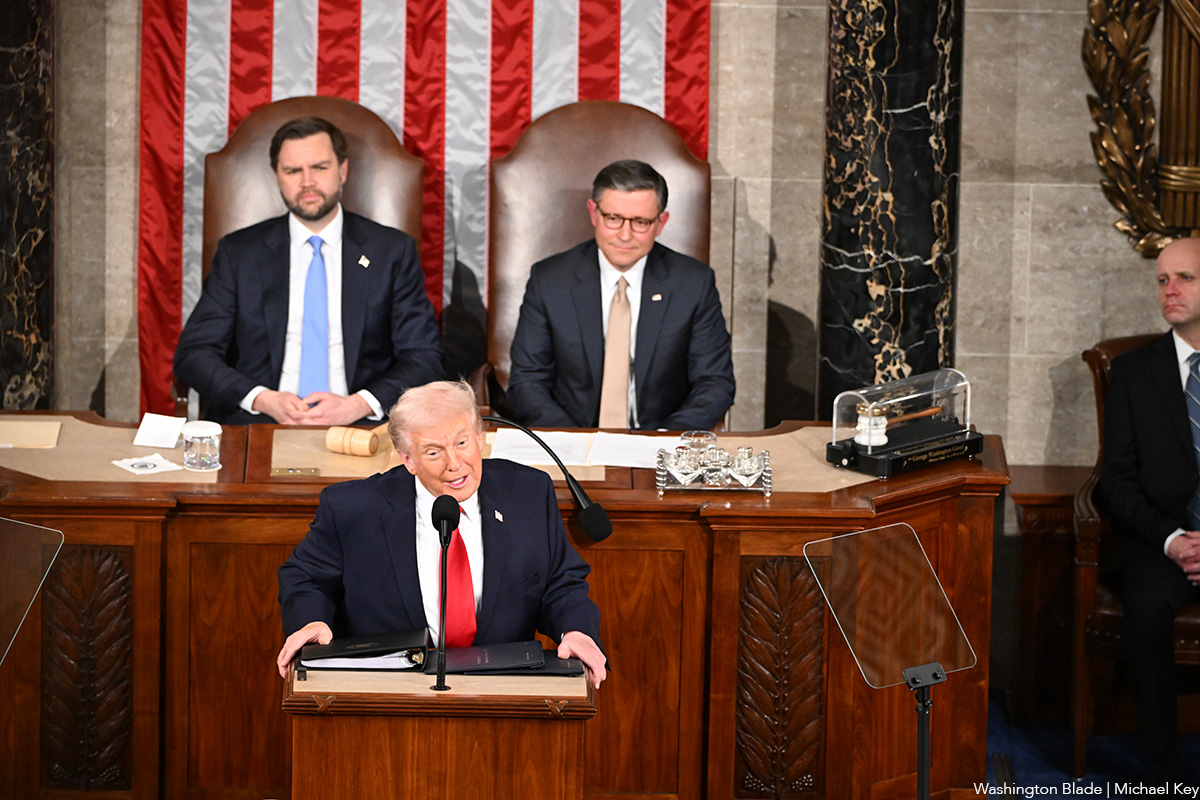
President Donald Trump said he will refuse to sign any legislation into law unless Congress passes the “SAVE Act,” pressuring lawmakers to move forward with the controversial voting bill.
In posts on Truth Social and other social media platforms, the 47th president emphasized the importance of Republican lawmakers pushing the legislation through while also using the opportunity to denounce gender-affirming care.
“I, as President, will not sign other Bills until this is passed, AND NOT THE WATERED DOWN VERSION — GO FOR THE GOLD,” Trump posted. “MUST SHOW VOTER I.D. & PROOF OF CITIZENSHIP: NO MAIL-IN BALLOTS EXCEPT FOR MILITARY — ILLNESS, DISABILITY, TRAVEL: NO MEN IN WOMEN’S SPORTS: NO TRANSGENDER MUTILIZATION FOR CHILDREN! DO NOT FAIL!!!”
The proposed Safeguard American Voter Eligibility (SAVE) Act would amend the National Voter Registration Act of 1993 to require in-person proof of citizenship for anyone seeking to vote in U.S. elections. Trump has also called for the legislation to include a ban on gender-affirming medical care for transgender minors, even with parental consent.
“This is a huge priority for the president. He added on some priorities to the SAVE America Act in recent days, namely, no transgender transition surgeries for minors. We are not gonna tolerate the mutilation of young children in this country. No men in women’s sports,” White House Press Secretary Karoline Leavitt said. “The president putting all of these priorities together speaks to how common sense they are.”
The comments mark the first time the White House has publicly confirmed that Trump is pushing to attach anti-trans policies to the SAVE Act.
The bill would also require the removal of undocumented immigrants from existing voter rolls and allow election officials who fail to enforce the proof-of-citizenship requirement to be sued.
It is already illegal for noncitizens to vote in federal elections. Current safeguards include requirements such as providing a Social Security number when registering to vote, cross-checking voter rolls with federal data and, in some states, requiring identification at the polls.
Trump began pushing for the legislation during his State of the Union address last month, where he singled out Senate Majority Leader John Thune (R-S.D.) by name while criticizing the lack of movement on the bill.
Senate Minority Leader Chuck Schumer (D-N.Y.) has denounced the legislation as “Jim Crow 2.0” and said it has little chance of advancing through the Senate, calling it “dead on arrival.”
In remarks on the Senate floor, Schumer said “the SAVE Act includes such extreme voter registration requirements that, if enacted, could disenfranchise 21 million American citizens.”
Trump has repeatedly used political messaging around trans youth and gender-affirming care as part of broader cultural and policy debates during his presidency — most recently during his State of the Union address, where he cited the case of Sage Blair, a Virginia teenager whose school allegedly encouraged her to transition without her parents’ consent.
LGBTQ advocates — including those familiar with Blair’s story — say the situation was far more complex than described and argue that using a single anecdote to justify sweeping federal restrictions could place trans people, particularly youth, at greater risk.

Polish court rules country must recognize same-sex marriages from EU states

Capital Stonewall Democrats 50th anniversary gala draws ‘sold out’ crowd

PHOTOS: Capital Stonewall Democrats 50th anniversary

Small is beautiful: subcompact SUVs

‘Inherit the Wind’ isn’t about science vs. religion, but the right to think

Idaho advances bill to restrict bathroom access for transgender residents

Gay candidate running for D.C. congressional delegate seat

SAVE Act could silence millions of trans voters

Thomas A. Decker of Arlington dies at 73

The frightening rise of antisemitism, Islamophobia
-

 Idaho5 days ago
Idaho advances bill to restrict bathroom access for transgender residents
-
District of Columbia5 days ago
Gay candidate running for D.C. congressional delegate seat
-
Opinions4 days ago
SAVE Act could silence millions of trans voters
-
Obituary5 days ago
Thomas A. Decker of Arlington dies at 73