The White House
SPJ calls for take down of Trump’s ‘media offenders’ website
White House launched online database on Monday

The Society for Professional Journalists has called out the White House for creating a website that targets individual journalists and news outlets that publish unfavorable coverage of the Trump-Vance administration.
In a letter to White House Press Secretary Karoline Leavitt on Monday, the SPJ — the nation’s most broad-based journalism organization, which works to protect the free practice of journalism with high ethical standards — asked the White House to take down its website singling out journalists for negative coverage of the administration.
“Journalists have a constitutionally protected and societally encouraged duty to hold power to account. They are not political opponents to be tracked, cataloged or punished,” the letter signed by SPJ National President Chris Vaccaro and SPJ Ethics Committee Chair Dan Axelrod.
“By publishing reporters’ names, outlets and specific stories, the White House is naming and shaming members of the press in a highly charged political and social environment. SPJ regards this as a form of online harassment that exposes journalists to potential threats and even violence.”
The website currently lists 23 outlets as “Media Offenders of the Week,” singling out national organizations like CBS News, the Boston Globe, and the Independent. The website says these particular organizations “misrepresents and exaggerates President Trump.”
The letter goes on to explain that there are more civil ways to disagree with published stories without singling out people for doing the only constitutionally protected job in the country.
“There are well-established ways of resolving disagreements over the fairness or accuracy of stories. The White House web page attacking so-called ‘media offenders’ ignores these principles and instead denigrates and attacks reporters.”
It also highlights how Trump often attacks women journalists in particular, noting that two weeks ago he told White House correspondent Catherine Lucey from Bloomberg News to be “quiet piggy” after she asked questions related to Trump’s relationship with sex offender Jeffery Epstein on Air Force One.
“Journalists, particularly women, already face an enormous amount of online harassment, and this can convert into physical violence. As you know, women journalists have also been publicly insulted by the president in recent weeks.”
The letter also explains that attacks like this on the legitimate press can cause tensions between journalists who attempt to hold those in power responsible and the public who consumes the rhetoric.
“This page, which categorizes reporting as ‘lies,’ ‘left-wing lunacy,’ and ‘malpractice,’ has a chilling effect on coverage. It undermines the healthy democratic relationship in which journalists hold power to account.”
The letter also draws a connection to how the Russian authoritarian dictatorship references media it dislikes, saying, “The president’s new ‘media offenders’ list mirrors a 2017 initiative by the Kremlin that labeled independent journalism as ‘fake news.’ The United States should not follow that example.”
“SPJ believes civility must be restored between the media and the Administration. Removing this page would be a vital first step toward lowering the temperature and reinforcing America’s commitment to free expression.”
The SPJ’s code of ethics, widely regarded as the ethical standard for good journalism, has four main pillars: Seek Truth and Report It, Minimize Harm, Act Independently, and Be Accountable and Transparent. The code was adopted in 1926 from the American Society of Newspaper Editors and has been revised multiple times since then, including in 1984, 1987, 1996, and most recently in 2014.
NLGJA, the The Association of LGBTQ+ Journalists is the journalist-led association that works within the news media to advance fair and accurate coverage of LGBTQ+ communities and issues, provided a statement to the Blade on the website and supports the SPJ’s public call for removing the website to restore faith in journalistic freedom in the U.S.
“We stand with SPJ in urging the Trump administration to remove its website targeting so-called “media offenders.” While NLGJA believes that media organizations should be held to the highest standards of accuracy and ethical reporting, this website does nothing to support a healthy press environment,” National Board President Ken Miguel told the Blade via email. “Instead, it undermines public trust in the free press, enables the harassment and targeting of journalists, and hinders their ability to cover the news fairly and accurately. Journalists must be able to do their work without fear of government retaliation.”
The White House has not responded to the Washington Blade’s request for comment on the letter.

The White House
Kennedy Center leadership changes as Trump ally Grenell departs
Numerous productions cancelled shows during gay Trump loyalist’s tenure

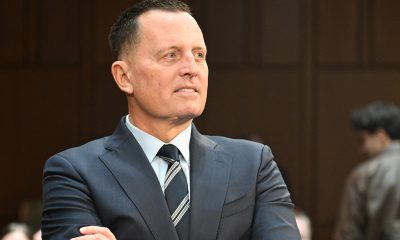
Longtime Trump ally and openly gay “Special Presidential Envoy for Special Missions of the United States” Richard Grenell is stepping down from his leadership role at the John F. Kennedy Center for the Performing Arts.
The story was first reported by Axios on March 13 before President Donald Trump made any official statements about the leadership change at the Kennedy Center, which has undergone a sweeping overhaul of rule changes and pro-Trump appointees to its board since Trump took office in 2025.
In addition to packing the Kennedy Center boardroom with loyalists and appointing himself chair of the board in February 2025, the Trump-Vance administration has placed the president’s name on the facade in an attempt to rename the center — despite the move being illegal without an act of Congress to officially change its name. The administration has also painted the building’s columns white and removed diverse programming.
Since these changes, multiple shows have pulled out of performing at the historic venue — including productions associated with the Washington National Opera.
Matt Floca, the former vice president of facilities operations at the national cultural center under Grenell, has been named the new head of the Kennedy Center, according to Trump.
The change is expected to be announced at a Kennedy Center board of directors meeting at the White House on Monday, which Trump is expected to attend.
“I am pleased to announce that Matt Floca, subject to the approval of the Board of Directors, will be named the Chief Operating Officer and Executive Director of THE TRUMP KENNEDY CENTER where, as Vice President of Operations, Matt has helped us achieve tremendous progress in bringing the Center to the highest level of Excellence!” Trump wrote in a post on Truth Social. “A Complete Reconstruction of THE TRUMP KENNEDY CENTER will begin after the July 4th Celebration, with a scheduled Grand Re-Opening in approximately two years.”
“Ric Grenell has done an excellent job in helping to coordinate various elements of the Center during the transition period, and I want to thank him for the outstanding work he has done,” the post added. “THE TRUMP KENNEDY CENTER will be, at its completion, the finest facility of its kind anywhere in the World! — President DONALD J. TRUMP.”
Grenell previously served as U.S. ambassador to Germany and later as acting director of national intelligence during Trump’s first term. He led the Kennedy Center during a period in which its programming was reshaped and new board members aligned with Trump were appointed. Trump also named himself chair of the board.
Congress approved $257 million in reconstruction funding for the Kennedy Center in last year’s spending package, a project estimated to take roughly two years to complete. Kennedy Center officials have also said they implemented increased cost-cutting measures — including large-scale layoffs — and that staff salaries are no longer being paid using debt reserves.
Actor Harvey Fierstein, a longtime critic of Trump’s takeover of the cultural institution and an award-winning openly gay performer, posted on Instagram celebrating Grenell’s departure.
“Good old anti-LGBTQ+ self-loathing dick licker, #RichardGrenell, is moving on to ruin something new under the auspices of our demented war-mongering MAGA fool Prez,” Fierstein wrote. “Maybe #RicGrennell can open a little boutique selling red baseball hats. But first, after destroying the Kennedy Center for the Arts, he’s earned a vacation. Maybe he and Kristi Noem can go puppy hunting together. They can tell each other tales of when they were once called ‘the best people’ and other fairy tales.”
The White House
Trump proclamation targets trans rights as State Dept. shifts visa policy
Recent policy actions from the White House limit transgender rights in sports, immigration visas, and overarching federal policy.

In a proclamation issued by the Trump White House Thursday night, the president said he would, among other things, “restore public safety” and continue “upholding the rule of law,” while promoting policies that restrict the rights of transgender people.
“We are keeping men out of women’s sports, enforcing Title IX as it was originally written, and ensuring colleges preserve — and, where possible, expand — scholarships and roster opportunities for female athletes,” the proclamation reads. “At the same time, we are restoring public safety and upholding the rule of law in every city so women, children, and families can feel safe and secure.”
The statement comes amid a broader series of actions by the Trump administration targeting transgender people across multiple federal policy areas, including education, health care, and immigration. A nearly complete list of policies the current administration has put forward can be found on KFF.org.
One day before the proclamation was issued, the U.S. State Department announced changes to visa regulations that could impact transgender and gender-nonconforming people seeking entry into the United States.
The policy, published March 11 and scheduled to take effect April 10, introduces changes to the Diversity Immigrant Visa Program, commonly known as the “DV Program.” The rule is framed by the department as an effort to strengthen oversight and prevent fraud within the visa lottery system, which allocates a limited number of immigrant visas annually to applicants from countries with historically low rates of immigration to the United States.
However, the updated language also standardizes the use of the term “sex” in federal regulations in place of “gender,” a change that LGBTQ advocates say could create additional barriers for transgender and gender-diverse applicants.
The policy states: “The Department of State (‘Department’) is amending regulations governing the Diversity Immigrant Visa Program (‘DV Program’) to improve the integrity of, and combat fraud in, the program. These amendments require a petitioner to the DV Program to provide valid, unexpired passport information and to upload a scan of the biographic and signature page in the electronic entry form or otherwise indicate that he or she is exempt from this requirement. Additionally, the Department is standardizing and amending its regulations to add the word ‘shall’ to simplify guidance for consular officers; ensure the use of the term ‘sex’ in lieu of ‘gender’; and replace the term ‘age’ in the DV Program regulations with the phrase ‘date of birth’ to accurately reflect the information collected and maintained by the Department during the immigrant visa process.”
Advocates say the shift toward using “sex” rather than “gender” in federal immigration rules reflects a broader push by the administration to roll back recognition of transgender identities in federal policy.
According to the National Center for Transgender Equality, an estimated 15,000 to 50,000 undocumented transgender immigrants currently live in the United States, with many entering the country to seek refuge from persecution and hostile governments in their home countries.
The White House
Trump will refuse to sign voting bill without anti-trans provisions
Measure described as ‘Jim Crow 2.0’
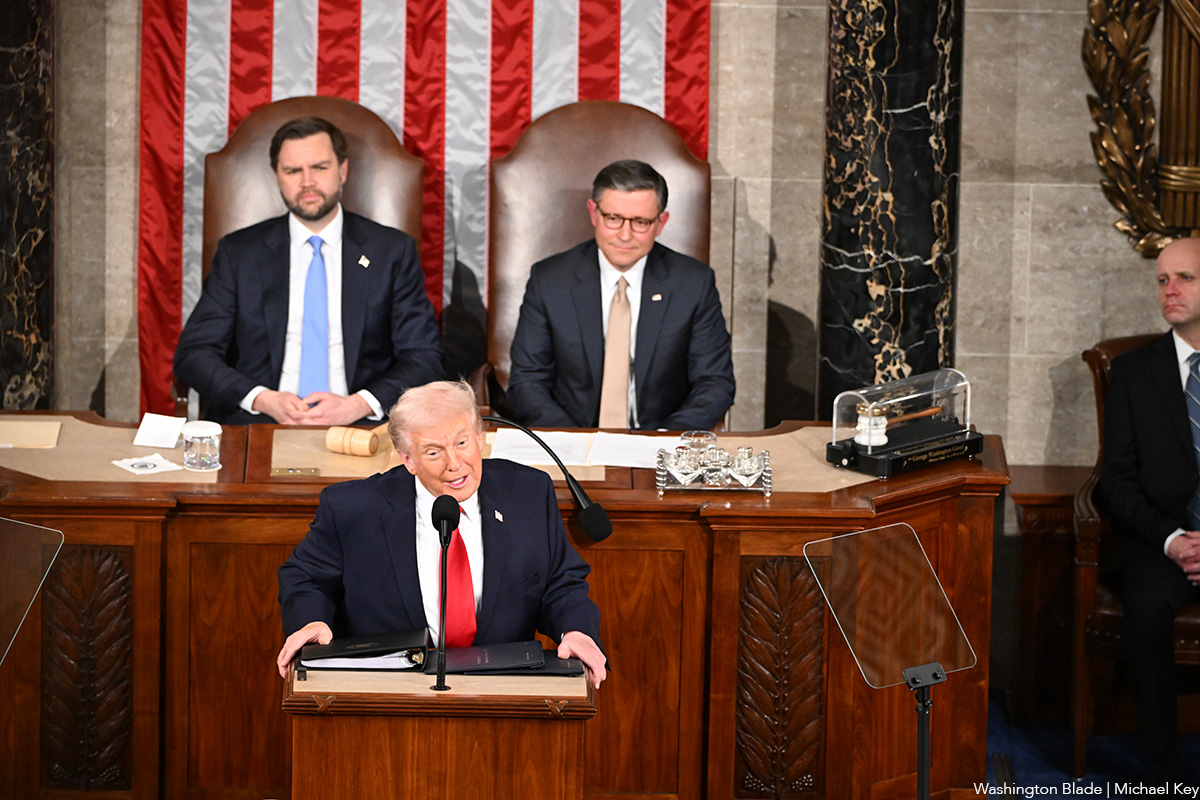
President Donald Trump said he will refuse to sign any legislation into law unless Congress passes the “SAVE Act,” pressuring lawmakers to move forward with the controversial voting bill.
In posts on Truth Social and other social media platforms, the 47th president emphasized the importance of Republican lawmakers pushing the legislation through while also using the opportunity to denounce gender-affirming care.
“I, as President, will not sign other Bills until this is passed, AND NOT THE WATERED DOWN VERSION — GO FOR THE GOLD,” Trump posted. “MUST SHOW VOTER I.D. & PROOF OF CITIZENSHIP: NO MAIL-IN BALLOTS EXCEPT FOR MILITARY — ILLNESS, DISABILITY, TRAVEL: NO MEN IN WOMEN’S SPORTS: NO TRANSGENDER MUTILIZATION FOR CHILDREN! DO NOT FAIL!!!”
The proposed Safeguard American Voter Eligibility (SAVE) Act would amend the National Voter Registration Act of 1993 to require in-person proof of citizenship for anyone seeking to vote in U.S. elections. Trump has also called for the legislation to include a ban on gender-affirming medical care for transgender minors, even with parental consent.
“This is a huge priority for the president. He added on some priorities to the SAVE America Act in recent days, namely, no transgender transition surgeries for minors. We are not gonna tolerate the mutilation of young children in this country. No men in women’s sports,” White House Press Secretary Karoline Leavitt said. “The president putting all of these priorities together speaks to how common sense they are.”
The comments mark the first time the White House has publicly confirmed that Trump is pushing to attach anti-trans policies to the SAVE Act.
The bill would also require the removal of undocumented immigrants from existing voter rolls and allow election officials who fail to enforce the proof-of-citizenship requirement to be sued.
It is already illegal for noncitizens to vote in federal elections. Current safeguards include requirements such as providing a Social Security number when registering to vote, cross-checking voter rolls with federal data and, in some states, requiring identification at the polls.
Trump began pushing for the legislation during his State of the Union address last month, where he singled out Senate Majority Leader John Thune (R-S.D.) by name while criticizing the lack of movement on the bill.
Senate Minority Leader Chuck Schumer (D-N.Y.) has denounced the legislation as “Jim Crow 2.0” and said it has little chance of advancing through the Senate, calling it “dead on arrival.”
In remarks on the Senate floor, Schumer said “the SAVE Act includes such extreme voter registration requirements that, if enacted, could disenfranchise 21 million American citizens.”
Trump has repeatedly used political messaging around trans youth and gender-affirming care as part of broader cultural and policy debates during his presidency — most recently during his State of the Union address, where he cited the case of Sage Blair, a Virginia teenager whose school allegedly encouraged her to transition without her parents’ consent.
LGBTQ advocates — including those familiar with Blair’s story — say the situation was far more complex than described and argue that using a single anecdote to justify sweeping federal restrictions could place trans people, particularly youth, at greater risk.

‘They took him!’ Gay married couple torn apart by ICE

Man charged with carjacking, kidnapping after having sex in D.C. park pleads guilty

The rule of law, not the rule of religion

Meet the Scandals, D.C.’s LGBT rugby team

D.C. journalist, video producer Sean Bartel dies at 48

Trump proclamation targets trans rights as State Dept. shifts visa policy

Gay Cameroonian immigrant will be freed from ICE detention — for now

‘Are you on PrEP?’

Gaga, Cardi B, and more to grace D.C. stages this spring

Remembering Jesse Jackson
-

 The White House4 days ago
Trump proclamation targets trans rights as State Dept. shifts visa policy
-
Cameroon4 days ago
Gay Cameroonian immigrant will be freed from ICE detention — for now
-
Opinions5 days ago
‘Are you on PrEP?’
-
Music & Concerts4 days ago
Gaga, Cardi B, and more to grace D.C. stages this spring