Federal Government
Top Democrats reintroduce bill to investigate discrimination against LGBTQ military members
Takano, Jacobs, and Blumenthal sponsored measure
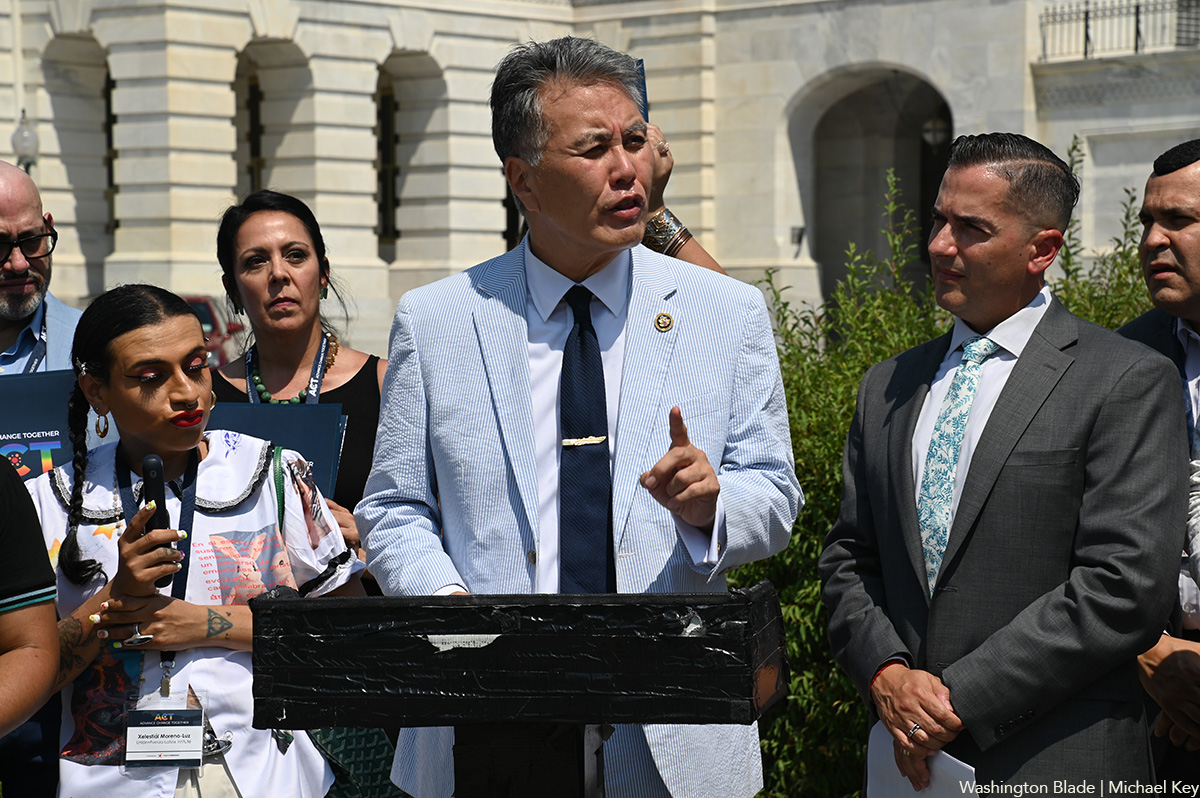
Multiple high-ranking members of Congress reintroduced the Commission on Equity and Reconciliation in the Uniformed Services Act into the U.S. House of Representatives and the U.S. Senate, aiming to establish a commission to investigate discriminatory policies targeting LGBTQ military members.
Three leading Democratic members of Congress — U.S. Rep. Mark Takano (D-Calif.), who is the House Veterans’ Affairs Committee’s ranking member and chairs the Congressional Equality Caucus; U.S. Sen. Richard Blumenthal (D-Conn.), who is the Senate Veterans’ Affairs Committee’s ranking member; and U.S. Rep. Sara Jacobs (D-Calif.) — introduced the bill on Tuesday.
The bill, they say, would establish a commission to investigate the historic and ongoing impacts of discriminatory military policies on LGBTQ servicemembers and veterans.
This comes on the one-year anniversary of the Trump-Vance administration’s 2025 Executive Order 14183, titled “Prioritizing Military Excellence and Readiness,” which essentially banned transgender servicemembers from openly serving in the Armed Forces, leading to the forced separation of thousands of capable and dedicated servicemembers.
In a joint statement, Takano, Blumenthal, and Jacobs shared statistics on how many service members have had their ability to serve revoked due to their sexual orientation:
“Approximately 114,000 servicemembers were discharged on the basis of their sexual orientation between WWII and 2011, while an estimated 870,000 LGBTQ servicemembers have been impacted by hostility, harassment, assault, and law enforcement targeting due to the military policies in place,” the press release reads. “These separations are devastating and have long-reaching impacts. Veterans who were discharged on discriminatory grounds are unable to access their benefits, and under the Trump administration, LGBTQ+ veterans and servicemembers have been openly persecuted.”
The proposed commission is modeled after the Congressional commission that investigated and secured redress for Japanese Americans interned during World War II. Takano’s family was among the more than 82,000 Japanese Americans who received an official apology and redress payment under that commission.
The press release notes this is a major inspiration for the act.
“Qualified servicemembers were hunted down and forced to leave the military at the direction of our government,” said Takano. “These practices have continued, now with our government targeting transgender servicemembers. The forced separation and dishonorable discharges LGBTQ+ people received must be rectified, benefits fully granted, and dignity restored to those who have protected our freedoms.”
“LGBTQ+ servicemembers have long been the target of dangerous and discriminatory policies—resulting in harassment, involuntary discharge, and barriers to their earned benefits,” said Blumenthal. “Establishing this commission is an important step to understand the full scope of harm and address the damage caused by policies like ‘Don’t Ask, Don’t Tell.’ As LGBTQ+ servicemembers and veterans face repugnant and blatant bigotry under the Trump administration, we will keep fighting to secure a more equitable future for all who serve our country in uniform.”
“Instead of righting wrongs and making amends to our LGBTQ+ service members and veterans who’ve suffered injustices for decades, I’m ashamed that the Trump administration has doubled down: kicking trans folks out of the military and banning their enlistment,” said Jacobs. “We know that LGBTQ+ service members and veterans have faced so much ugliness — discrimination, harassment, professional setbacks, and even violence — that has led to unjust discharges and disparities in benefits, but we still don’t have a full picture of all the harm caused. That needs to change. That’s why I’m proud to co-lead this bill to investigate these harms, address the impacts of discriminatory official policies like ‘Don’t Ask, Don’t Tell’ and the transgender military ban, and ensure equity and justice for our LGBTQ+ service members and veterans.”
Takano and Jacobs are leading the bill in the House, while Blumenthal is introducing companion legislation in the Senate.
Takano’s office has profiled and interviewed LGBTQ servicemembers who were harmed by discriminatory policies in the uniformed services.
The Commission on Equity and Reconciliation in the Uniformed Services Act is supported by Minority Veterans of America, Human Rights Campaign, Equality California, SPARTA, and the Transgender American Veterans Association.
In recent weeks, thousands of trans military members were forcibly put into retirement as a result of Trump’s executive order, including five honored by the Human Rights Campaign with a combined 100 years of service, all due to their gender identity: Col. Bree B. Fram (U.S. Space Force), Commander Blake Dremann (U.S. Navy), Lt. Col. (Ret.) Erin Krizek (U.S. Air Force), Chief Petty Officer (Ret.) Jaida McGuire (U.S. Coast Guard), and Sgt. First Class (Ret.) Catherine Schmid (U.S. Army).
Multiple career service members spoke at the ceremony, including Takano. Among the speakers was Frank Kendall III, the 26th U.S. Air Force secretary, who said:
“We are in a moment of crisis that will be worse before it is better. Members of my father’s and mother’s generation would ask each other a question: what did you do during the war? Someday we will all be asked what we did during this time. Please think about the answer that you will give.”

Federal Government
Markwayne Mullin confirmed as next DHS secretary
Okla. senator to succeed Kristi Noem
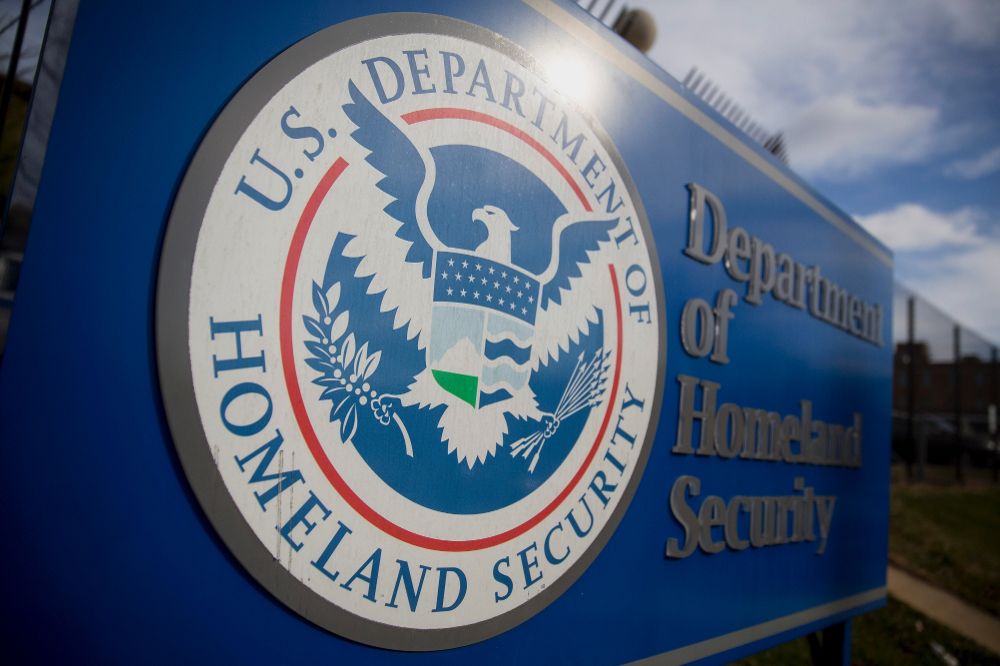
The U.S. Senate confirmed Markwayne Mullin as the next secretary of Homeland Security on Monday, as the agency continues to grapple with what lawmakers have described as a “never-ending” funding standoff, with Democrats attempting to withhold funding from one of the nation’s largest and most costly agencies.
Mullin — a Republican senator from Oklahoma, former mixed martial arts fighter, and plumbing business owner — was confirmed in a 54–45 vote. Two Democrats — U.S. Sens. John Fetterman (D-Pa.) and Martin Heinrich (D-N.M.) — sided with Republicans in supporting his confirmation.
The new agency head is expected to follow the policy direction set by President Donald Trump, emphasizing stricter immigration enforcement. This includes proposals to support immigration agents at polling sites and to cut funding to so-called “sanctuary cities.”
Mullin replaces Kristi Noem, who was fired earlier this month following a widely scrutinized 2-day congressional hearing on Capitol Hill.
During the hearing, Noem faced intense questioning over her response to several crises, including the fatal shooting of two American citizens in Minneapolis by U.S. Immigration and Customs Enforcement agents, a $220 million border security advertising campaign that featured her on horseback near Mount Rushmore amid one of the largest federal workforce reductions in U.S. history, and the federal response to major natural disasters such as the July 2025 Texas floods and Hurricane Helene in 2024.
Noem had previously drawn criticism for a series of policy decisions in South Dakota that broadly focused on restricting the rights of LGBTQ individuals. In 2023, she signed House Bill 1080, banning gender-affirming medical care for transgender minors. She also signed legislation and executive orders restricting trans athletes’ participation in women’s sports, as well as the state’s “Religious Freedom Restoration Act,” which critics argued enabled discrimination against LGBTQ individuals. Additionally, the state canceled contracts related to LGBTQ support services — including suicide prevention and health care navigation programs‚ and later agreed to a $300,000 settlement with trans advocacy group, The Transformation Project.
Despite her removal from DHS, Noem will remain in the Trump-Vance administration as a special envoy for the “Shield of the Americas,” an initiative aimed at promoting U.S. influence in the Western Hemisphere, including efforts to counter cartel networks, reduce Chinese influence, and manage migration.
The new head of DHS has served in Congress since 2013, in both houses of the federal legislature. While in the Senate and a member of the Health, Education, Labor, and Pensions (HELP) Committee, Mullin has been a vocal critic of policies aimed at expanding LGBTQ inclusion. He led a group of lawmakers in urging the Administration for Community Living to reverse a rule requiring states to prioritize Older Americans Act services based on sexual orientation and gender identity, arguing the policy could have unintended consequences.
Mullin also makes history as the first Native American — and a citizen of the Cherokee Nation — to lead the Department of Homeland Security. He was also among the 147 Republicans who voted to overturn the 2020 presidential election results despite no evidence of widespread fraud, and was present in the U.S. House of Representatives chamber on Jan. 6.
Federal Government
Protesters say SAVE Act targets voters, transgender youth
Bill described as ‘Jim Crow 2.0’
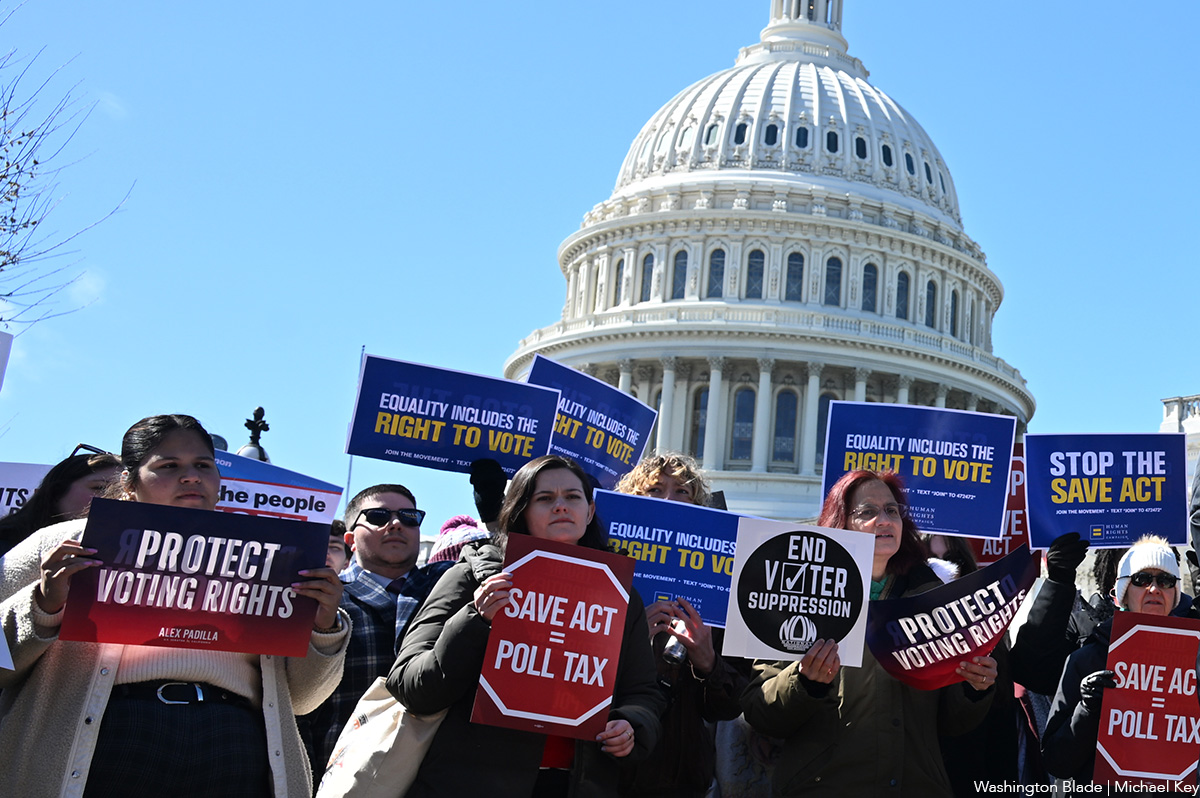
Members of Congress, advocates, and people from across the country gathered outside the U.S. Capitol on Tuesday to protest proposed federal legislation that voting rights activists have deemed “Jim Crow 2.0.”
The Safeguard American Voter Eligibility (SAVE) Act would amend the National Voter Registration Act of 1993 to require in-person proof of citizenship for anyone seeking to vote in U.S. elections.
President Donald Trump has also pushed for the proposed legislation to include a section that would ban gender-affirming medical care for transgender minors, even with parental consent, and prohibit trans people from participating in school or professional sports consistent with their gender identity rather than their sex assigned at birth.
In addition to changing voter registration requirements, the bill would limit acceptable forms of identification to documents such as a birth certificate or passport — records that the Brennan Center for Justice estimates more than 21 million Americans do not have — effectively restricting access to the ballot. It would also ban online voter registration, DMV voter registration efforts, and mail-in voter registration.
A 2021 investigation by the Associated Press found that fewer than 475 people voted illegally or improperly, a tiny fraction of the estimated 160 million Americans who voted in the 2020 election.
Senate Minority Leader Chuck Schumer (D-N.Y.) spoke at the event.
“It will kick millions of American citizens off the rolls. And they don’t even require you to be told,” the highest-ranking Democrat in the Senate told protesters and reporters outside the Capitol. “If this law passes — and it won’t — you’re gonna show up in November … and they’ll say… sorry, you’re no longer on the voting rolls.”
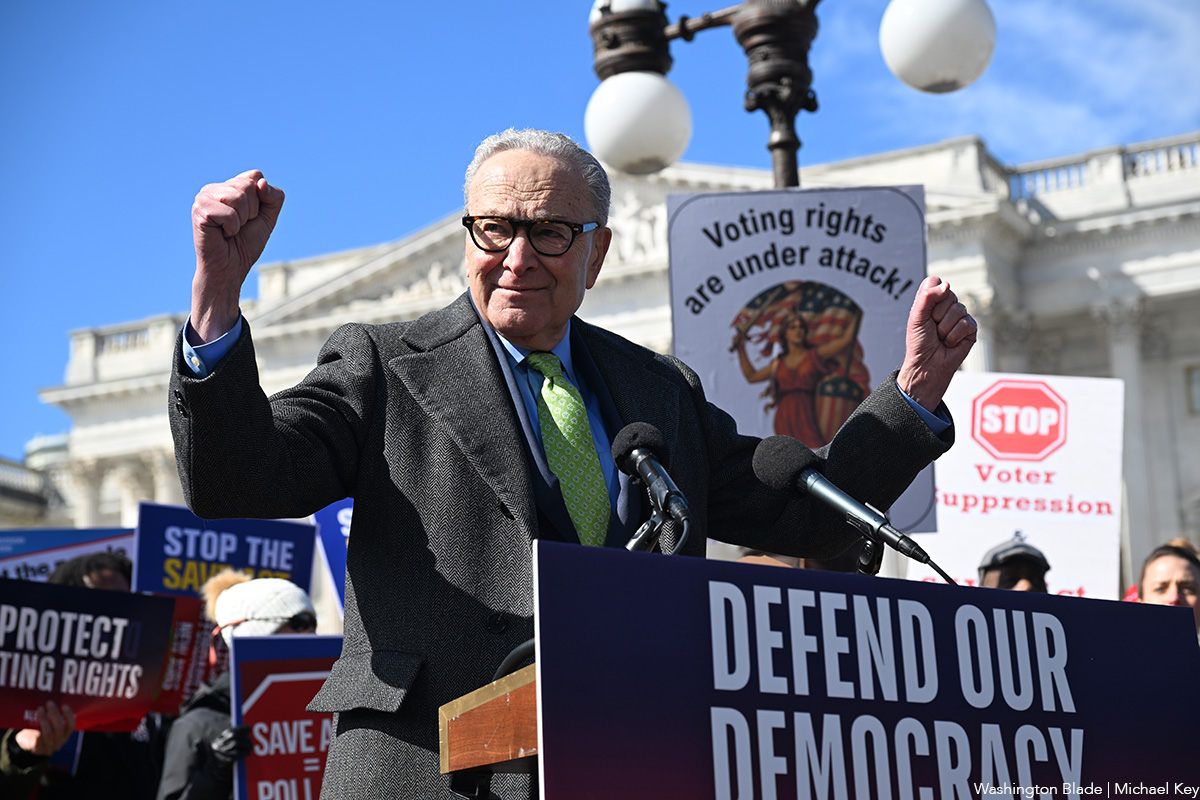
He, like many other speakers, emphasized the bill in the context of American history, pointing to what he described as its racist roots and its impact on Black and brown Americans.
“I have called this act, over and over again, Jim Crow 2.0 … because they know it’s the truth.”
U.S. Sen. Alex Padilla (D-Calif.) was one of the lawmakers leading opposition to the legislation and spoke at the rally.
“It’s not just voting rights that are on the line — our democracy is on the line,” the California lawmaker said. “It’s not a voter I.D. bill. It’s a bait and switch bill.”
He added historical context, noting the significance of voting rights legislation passed more than 60 years ago. In 1965, Alabama civil rights activists marched to protest barriers to voter registration. Alabama state troopers violently attacked peaceful demonstrators at the Edmund Pettus Bridge in Selma, using tear gas, clubs, and whips against more than 500 — mostly Black — protesters.
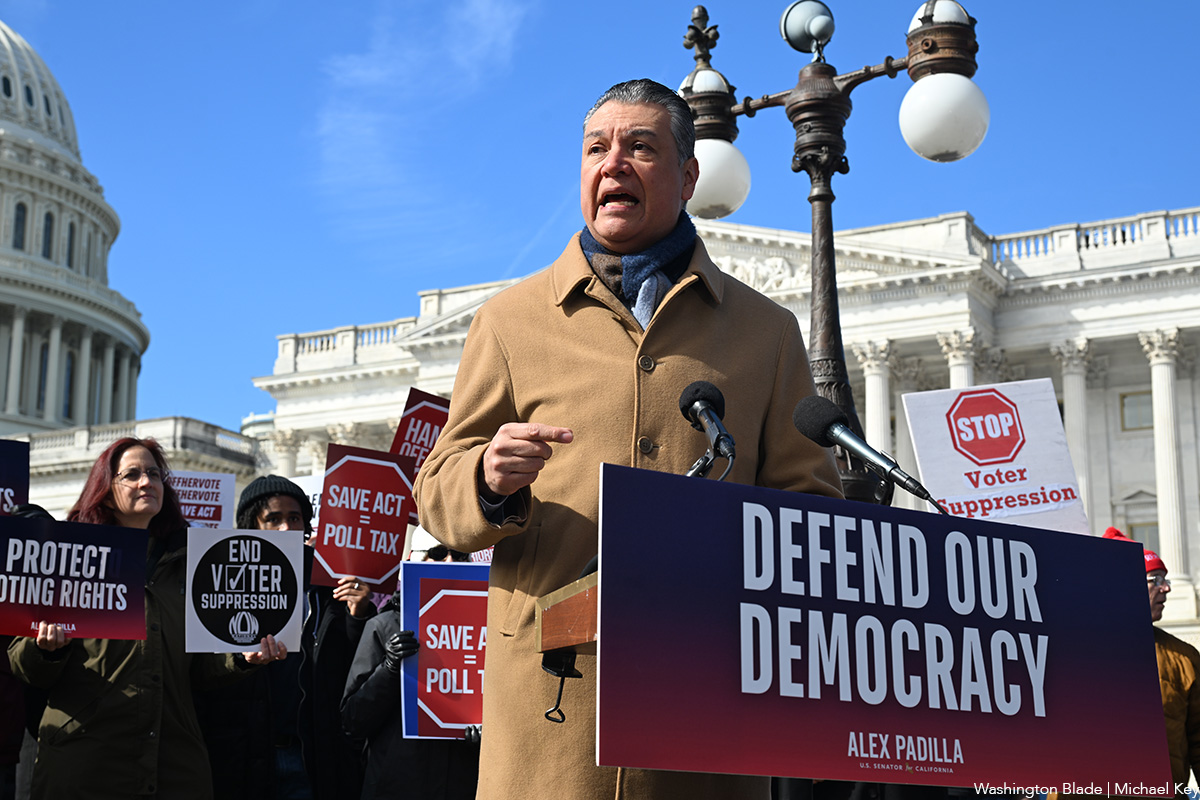
“61 years ago — not to the day — but this week, President Lyndon Johnson came to the Capitol and addressed a joint session of Congress in the wake of Bloody Sunday and pushed Congress to pass the Voting Rights Act,” Padilla said. “61 years later, Donald Trump and this Republican majority wants to take us backwards. We’re not gonna let that happen.”
U.S. Sen. Ben Ray Luján (D-N.M.) also spoke, emphasizing that he views the effort as a Republican-led and Trump-backed attempt to restrict voting access, particularly among Black, brown, and predominantly Democratic communities.
“President Trump told Republicans when they were meeting behind closed doors that ‘The SAVE Act will guarantee Republicans win the midterms and ensure they do not lose an election for 50 years,’” Luján said. “The first time I think Donald Trump’s been honest … This voter suppression bill is only that. Taking away vote by mail? I hope my Republican colleagues from states that voted for Donald Trump or where vote by mail is popular have the courage and the backbone to stand up and say no to this nonsense, because their constituents are going to push back.”
U.S. Sen. Lisa Blunt Rochester (D-Del.) also spoke.
“Our Republican colleagues have already cut Medicaid, Medicare, people don’t know how they’re gonna be able to afford energy,” she said, providing context for the broader political moment. “We’re in the middle of a war that they can’t even get straight while we’re in it and don’t have a way to get out of it. And we are now faced with defending our democracy?”
She then showed the crowd something that she said has been with her throughout her political journey in Washington.
“I brought with me something that I carried on the day that I was sworn into the House of Representatives when I was elected in 2016, and I carried it with me on the day that I was sworn in as United States senator. And I also carried it with me when I was trapped up in the gallery on Jan. 6 and all I could think to do was pray … This document allowed my great great great grandfather, who had been enslaved in Georgia, to have the right to vote. We took this and turned it into a scarf. It is the returns of qualified voters and reconstruction code from 1867. This is my proof of what we’ve been through. This is also our inspiration.”
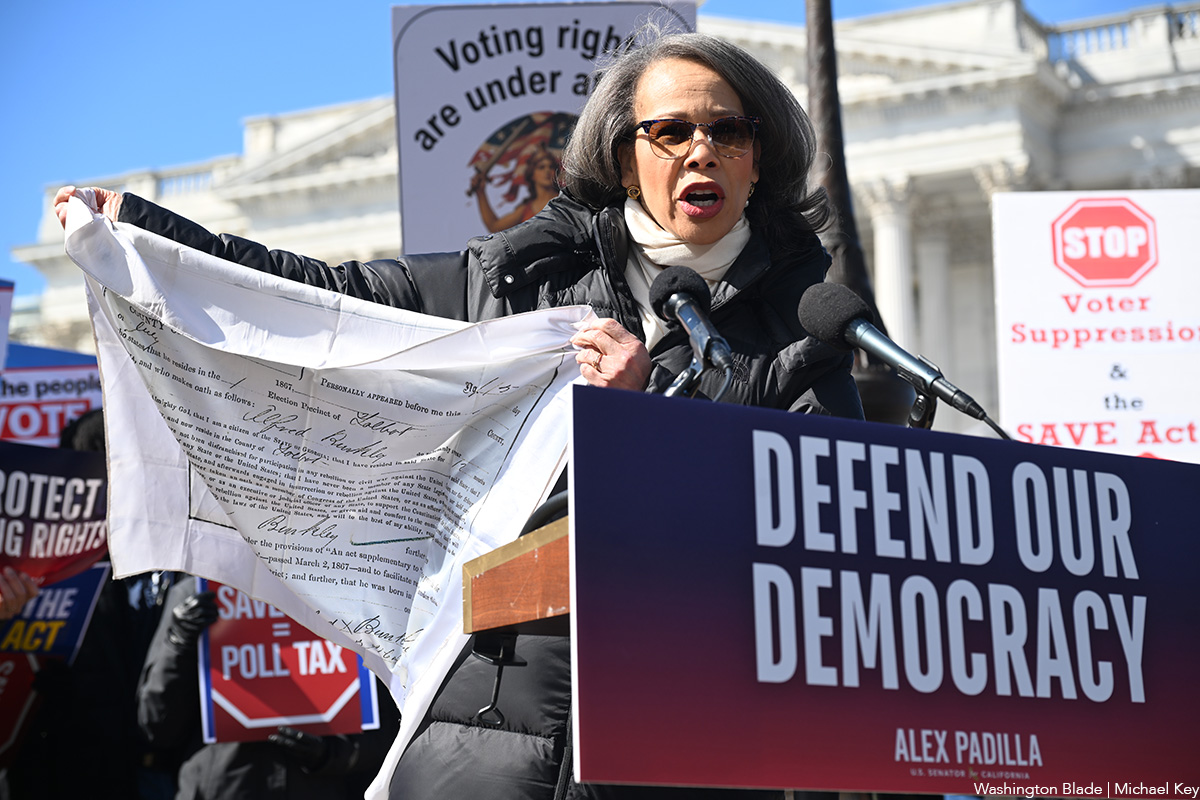
“I got to travel between the Edmund Pettus Bridge two times. And even as I thought about this moment, I recognized that while we wish we weren’t in it, while we don’t know why we’re in it, I do know we were made for it … So I came today to tell you that, um, just like the leader said, that he calls it Jim Crow 2.0. I call it Jim Crow 2.NO.”
Kelley Robinson, president of the Human Rights Campaign, the largest LGBTQ advocacy organization in the U.S., also spoke, highlighting the impact of the bill’s proposed provisions affecting trans people.
“This bill is not about saving America. This bill is about stealing an election. This bill is about suppressing voters,” Robinson said. “This bill not only tries to disenfranchise voters that deserve their right to vote, it also tries to criminalize trans kids and their families … It tries to criminalize doctors providing medically necessary care for our trans youth.”
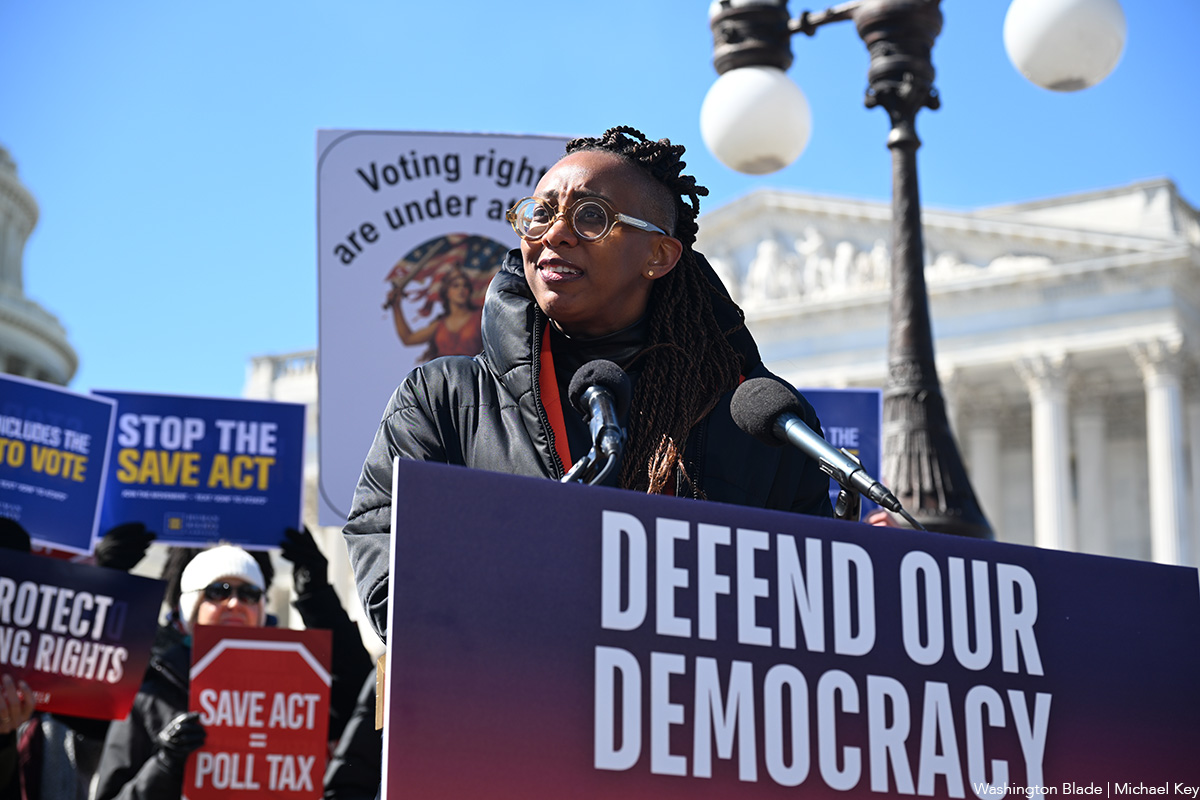
The SAVE Act passed the U.S. House of Representatives on Feb. 11 but has not yet been considered in the U.S. Senate.
Federal Government
Gay Venezuelan man ‘forcibly disappeared’ to El Salvador files claim against White House
Andry Hernández Romero had asked for asylum in US

A gay Venezuelan asylum seeker who the U.S. “forcibly disappeared” to El Salvador has filed a claim against the federal government.
Immigrant Defenders Law Center, who represents Andry Hernández Romero, on Friday announced their client and five other Venezuelans who the Trump-Vance administration “forcibly removed” to El Salvador under the Alien Enemies Act of 1798, filed “administrative claims” under the Federal Tort Claims Act.
The White House on Feb. 20, 2025, designated Tren de Aragua, a Venezuelan gang, as an “international terrorist organization.”
President Donald Trump less than a month later invoked the Alien Enemies Act of 1798, which the Associated Press notes allows the U.S. to deport “noncitizens without any legal recourse.” The White House then “forcibly removed” Hernández, who had been pursuing his asylum case in the U.S., and more than 250 other Venezuelans to El Salvador.
Immigrant Defenders Law Center disputed claims that Hernández is a Tren de Aragua member.
Hernández was held at El Salvador’s Terrorism Confinement Center, a maximum-security prison known by the Spanish acronym CECOT, until his release on July 18, 2025. Hernández, who is back in Venezuela, claims he suffered physical and sexual abuse while at CECOT.
“As a Venezuelan citizen with no criminal record anywhere in the world, I would like to tell not only the government of the United States but governments everywhere that no human being is illegal,” said Hernández in the Immigrant Defenders Law Center press release. “The practice of judging whole communities for the wrongdoing of a single individual must end. Governments should use their power to help every person in the nation become more aware and informed, to strengthen our cultures and build a stronger generation with principles and values — one that multiplies the positive instead of destroying unfulfilled dreams and opportunities.”
Immigrant Defenders Law Center filed claims on behalf of Hernández and the five other Venezuelans less than three months after American forces seized then-Venezuelan President Nicolás Maduro and his wife, Cilia Flores, at their home in Caracas, the Venezuelan capital.
Maduro and Flores have pleaded not guilty to federal drug charges. Delcy Rodríguez, who was Maduro’s vice president, is Venezuela’s acting president.
‘Due process and accountability cannot be optional’
Immigrant Defenders Law Center on Friday also made the following demands:
- The Trump administration must officially release the names of all people the United States sent to CECOT to ensure that everyone has been or will be released.
- The federal government must clear the names of the 252 men wrongfully labeled as criminal gang members of Tren de Aragua.
- DHS (Department of Homeland Security) must end the practice of outsourcing torture through third‑country removals, restore humanitarian parole, and rebuild a functioning, humane asylum system.
- DHS must reinstate Temporary Protected Status for all individuals who cannot safely return to their home countries, halt mass deportations and unlawful raids and arrests, and guarantee due process for everyone navigating the immigration system.
- Congress must pass the Neighbors Not Enemies Act, which would repeal the Alien Enemies Act.
“In all my years as an immigration attorney, I have never seen a client simply vanish in the middle of their case with no explanation,” said Immigration Defenders Legal Fund Legal Services Director Melissa Shepard. “In court, the government couldn’t even explain where he was — he had been disappeared.”
“When the government detains and transfers people in secrecy, without transparency or access to the courts, it tears at the basic protections a democracy is supposed to guarantee,” added Shepard. “What this experience makes painfully clear is that due process and accountability cannot be optional. They are the only safeguards standing between people and the kind of lawlessness our clients suffered. We must end third country transfers, restore the asylum system, and humanitarian parole, and reinstate temporary protective status so this nightmare never happens again.”

Kristi Noem ‘devastated’ as husband’s alleged fetish spending surfaces

Colo. activists condemn SCOTUS conversion therapy ruling

Is Ghana’s selective justice a human rights contradiction?

Supreme Court ruling against conversion therapy bans could affect Md. law

Glisten report details hostile climate for LGBTQ students

‘Out for McDuffie’ event held at D.C. gay bar

The Oscar-losing performance that’s too good to miss

‘Jonah’ an undeniably compelling but unusual memory play

PHOTOS: ‘No Kings’ rally and march