Congress
Political drama in Angie Craig’s Minn. Senate race heats up
Lesbian lawmaker running to succeed retiring U.S. Sen. Tina Smith

After an historic and expensive July 4th fireworks display capped Donald Trump’s self-indulgent commemoration of America’s 250th birthday, voters are now watching state races explode into political pyrotechnics as Democrats fight to win majorities in Congress and Republicans plan to keep buying power.
With the midterm elections just over three months away and several primary races still undecided, most pundits predict the decline in Trump’s approval ratings will result in Democrats winning the House, if infighting doesn’t turn off voters.
Democrats’ dream of taking the U.S. Senate, however, turned into a nightmare with the scandalous Graham Platner debacle in must-win Maine. Energized party leaders hope to put on a master class in democracy as they pick a new candidate before July 27.
The hike to Senate victory is still steep. Republicans have a 53-47 advantage — meaning Democrats must win eight of 11 competitive races, including defending seats currently held in Minnesota, Michigan, New Hampshire, and Georgia, for a net gain of four seats.
LGBTQ people intent on reversing Project 2025’s prolific erasure might focus on lesbian U.S. Rep. Angie Craig’s race in Minnesota.
With the retirement of Democratic U.S. Sen. Tina Smith, The Cook Political Report’s out guru Amy Walter labeled the open seat “likely” Democrat but with only a +3-point advantage.
New York Times Polling data reporter Alex Lemonides notes that “Trump lost Minnesota by four percentage points in 2024, and Minnesotans have not sent a Republican to the Senate since the 2002 midterms, so a Republican win in the general election would buck the trend.”
But this whole election cycle is about bucking trends. With so many Democratic Socialists defeating establishment candidates, “socialist” is no longer a slur, forcing Trump to switch to the old Cold War charge of Communist!
In Minnesota, U.S. Sen. Bernie Sanders (I-Vt.)-backed candidate Lt. Gov. Peggy Flanagan is out-polling Craig, a more centrist Democrat who flipped a battleground House seat in 2018. Their primary is on Aug. 11.
Republicans are salivating over challenging Flanagan for her administrative role in the scandal that forced Gov. Tim Walz to forgo a third term and deal with widespread fraud in social programs.
Former NBC’s Sunday Night Football sideline reporter and current political podcaster Michele Tafoya has a built-in “bro” audience. The announcement of her Republican candidacy was featured on ESPN.com.
“As Minnesota’s senator, I will clean up the system, fighting corruption, ending the fraud, and protecting your tax dollars,” Tafoya said. “I will protect what’s fair and safe, standing with our law enforcement officers, deporting dangerous criminals, and keeping female sports for female athletes.”
Craig responded quickly. “Trump’s hand-picked candidate just jumped in the race for U.S. Senate,” she said on social media. “Minnesota needs a Senator who will stand up and fight for our state – and we know it won’t be MAGA Michele.”
Craig tells LGBTQ+ Freedom Fighters that she has been happy to represent Minnesota’s Second Congressional District in the U.S. House of Representatives since 2019. Now she wants to represent the entire state as a U.S. senator.
“The state of Minnesota has been so good to me and my family,” says Craig, who chose to move to the state because it would accept her family.
Craig grew up in a mobile home park in Arkansas, one of three children of a single mother. She worked her way through the University of Memphis, earning a degree in journalism, and became a reporter with the Memphis Commercial Appeal.
She has a long history of fighting for LGBTQ rights, including her own. In the late 1990s, while living in Tennessee, Craig and her then-partner, Debra Langston, adopted their first son, Joshua. Under Tennessee law at the time, only one of them could be recognized as an adoptive parent; Craig was listed as Langston’s roommate.
The birth mother wanted the couple to have Joshua, but her parents intervened, seeking to adopt him. The courts had to decide if Langston and Craig were “fit” parents. One appellate court judge objected to the boy being raised by “open, practicing lesbians,” but his two colleagues disagreed, and Langston and Craig won the precedent-setting case in 2000, albeit with lots of caveats.
“The issue in this case is not whether the members of this court approve the homosexual lifestyle or the adoption of children by homosexuals, but rather whether the adoption of this child by this prospective parent is in the child’s best interest. As in any adoption case, the determinative issue was and remains what is in the child’s best interest,” wrote Judge Alan E. Highers in his opinion concurring with the majority in ruling In re: ADOPTION OF M.J.S. in the Tennessee Court of Appeals.
By then, Craig was working in corporate communications for Smith & Nephew, a multinational maker of medical equipment, and the couple had another son, Jacob, born to Craig through alternative insemination. She and her family moved to London, where the company was based, in the early 2000s. They returned to the U.S. in 2005; Craig went to work for another medical equipment company, St. Jude Medical, in the suburbs of Minneapolis. She later said it was the least lucrative job offer she had, but she took it because she knew the area was welcoming to LGBTQ people.
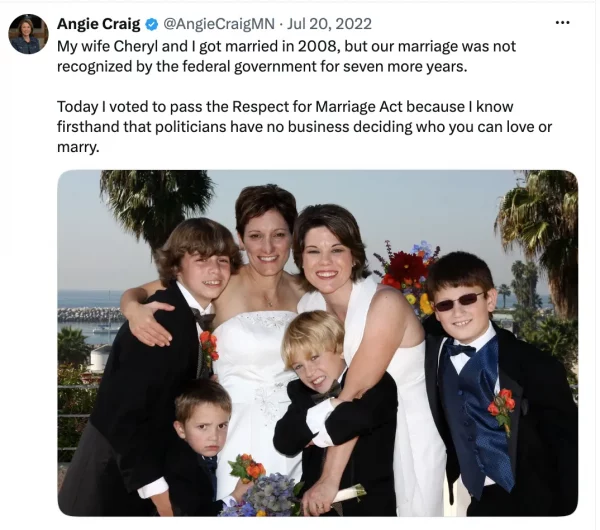
Craig and Langston separated in 2006, and Craig married Cheryl Greene in California in 2008. They have four sons and three grandsons, with a fourth on the way. Greene is a former middle school teacher still involved with youth programming.
Craig worked for LGBTQ equality within her company and for statewide marriage equality in Minnesota. She also fought against an anti-marriage equality constitutional amendment in 2012, which voters rejected. The state legislature passed a marriage equality bill the following year that Gov. Mark Dayton signed into law.
In 2016, when she ran for Congress in Minnesota’s 2nd District, a Republican stronghold for more than a decade, she told the Twin Cities Pioneer Press that the fight for custody of Joshua gave her strength.
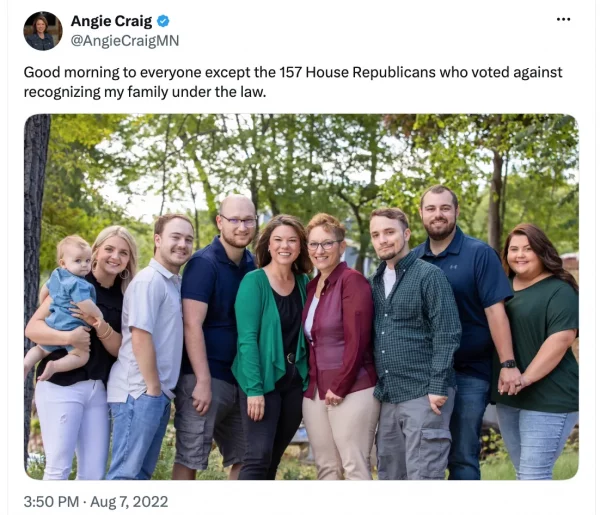
“Whether I win or lose on Election Day, I know that that won’t be the hardest thing or the biggest challenge that I’ve ever faced,” said Craig, then 44. “When you get up every day and wonder, ‘Am I going to (still) have my child the next day?’ you get pretty good at being focused on the big picture.”
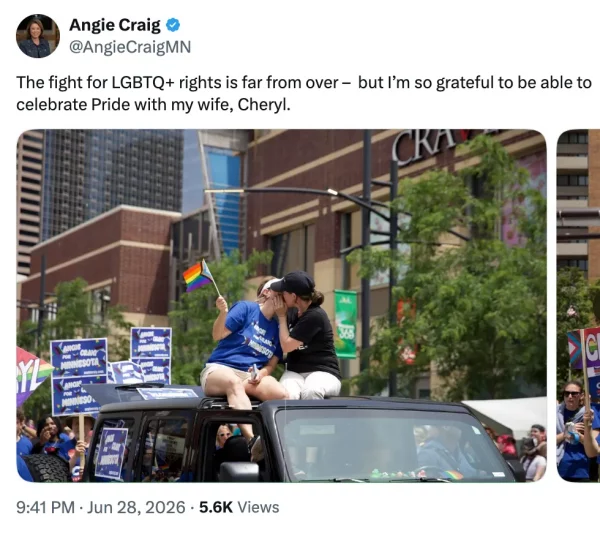
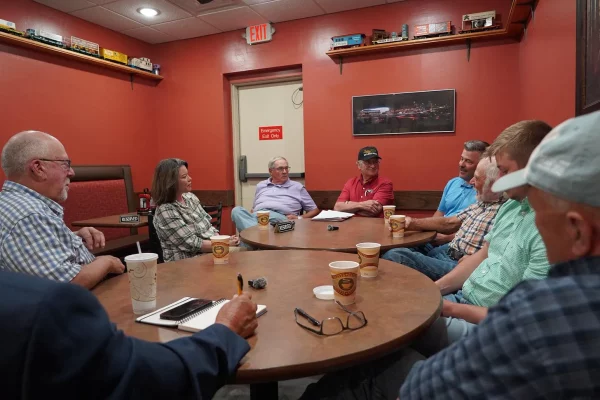
“I’ve always talked about my family openly” on the campaign trail and in office, Craig, co-chair of the Congressional Equality Caucus, tells LGBTQ+ Freedom Fighters. Often at events in her district and around the state, she’ll meet someone who mentions they have an LGBTQ family member, she notes. She finds that if she listens to constituents and addresses what’s important to them, her identity isn’t an issue.
What Craig has addressed for constituents includes health care costs, such as capping the out-of-pocket cost of insulin and limiting overall out-of-pocket drug costs for people on Medicare. These came from a bill introduced by Craig and became provisions of the Inflation Reduction Act, signed into law by President Joe Biden in 2022. She also wants a public option for health insurance, an increased child tax credit, and she introduced a bill to eliminate federal taxes on Social Security benefits.
In a June 19 SurveyUSA poll, Minnesotans say their single most important issue is inflation (39%) and cost of living, followed by health care, immigration, gas prices, and the war in Iran.
But immigration may soon jump to the front as more information leaks out about U.S. Immigration and Customs Enforcement agents shooting and killing Lorenzo Salgado Araujo during a traffic stop in Houston on Tuesday morning, July 9. Homeland Security says the father, with no criminal record, driving to work, ignored verbal instructions and tried to ram their vehicle. ICE shot him in self-defense — the same excuse ICE used on Jan. 7, 2026, when an ICE agent killed nonviolent protester Renee Good. In both instances, video footage proved ICE lied.
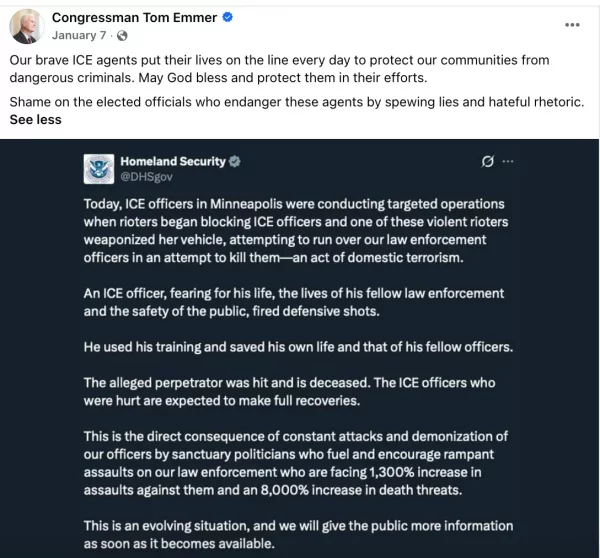
Also caught on tape was Craig’s angry confrontation with Republican Majority Whip Tom Emmer (R-Minn.) on the House floor the day Good was killed after Emmer supported ICE on social media. The story and her response went viral.
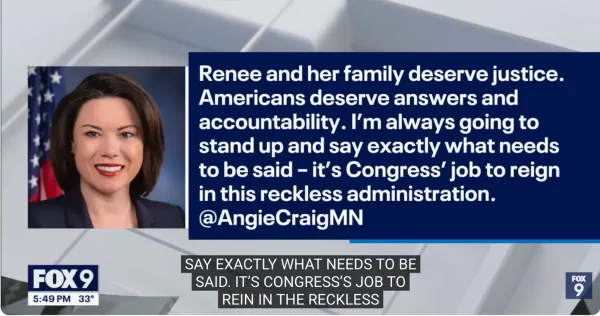
But Craig continues to be criticized for voting for the Laken Riley Act, named for a woman who was killed by an undocumented immigrant. It allows for undocumented immigrants to be detained or deported if they are simply accused of crimes, even nonviolent ones. Critics say she has never apologized — but she has.
In a commentary for The Minnesota Star Tribune in May, Craig wrote, in part:
“The text of the bill did not include the word deportation. I made the difficult decision to vote for it. Democrats like Sens. Mark Kelly and Ruben Gallego, Raphael Warnock and Jon Ossoff — leaders I deeply respect — all came to the same conclusion.
But as I stood side by side with protesters on the streets of Minneapolis and opposite dozens of armed Immigration and Customs Enforcement agents at the Whipple Federal Building after Renee Good’s killing — and again after the killing of Alex Pretti — I couldn’t help but question whether I made the right call last year … It’s also become clear that supporting any bill that gives ICE new authority in this administration was the wrong decision. And I regret my vote.”
“What happened under Operation Metro Surge was horrific,” Craig tells LGBTQ+ Freedom Fighters. The U.S. can secure its borders in a humane fashion while providing a path to citizenship for undocumented people, those brought here as children, and others, she adds.
On LGBTQ rights, Craig says the Equality Act has been a huge priority of hers in the House and would remain so in the Senate.
Since 2019, Craig has introduced the John Lewis Every Child Deserves a Family Act that “would ban discrimination based on sexual orientation, gender identity, religion or marital status in those programs, prohibit the use of federal funds for so-called ‘conversion therapy’ and create a resource center for LGBTQ+ foster and adoptive youth within the Department of Health and Human Services’ Administration for Children and Families,” according to a press release.
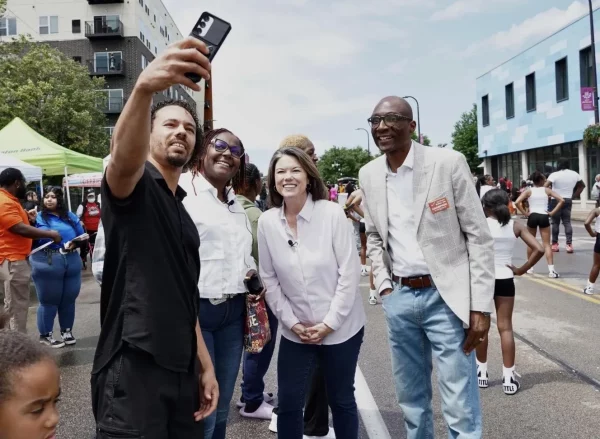
Another priority is passage of the John R. Lewis Voting Rights Advancement Act, named for the late civil rights activist and longtime congressman. “I was lucky enough to serve with John Lewis,” she says.
Additionally, Craig supports campaign finance reform. The recent U.S. Supreme Court ruling that further loosened restrictions was “just another blow to our democracy,” she says. She supports limits on Supreme Court terms.
On foreign policy, she condemns Trump’s war of choice in Iran. “The administration has had zero strategic objectives,” she says, adding that the war has caused “tremendous economic damage,” such as the spike in gas prices.
And though Craig supports a two-state solution to the ongoing Israel-Palestinian conflict, with Palestinians having their own state, her campaign does not accept direct donations from AIPAC’s political action committee — the pro-Israel group held fundraisers for her before her Senate announcement — another point exploited by primary opponent Flanagan.
On gender-affirming care for transgender youth, Craig says politicians should not interfere with decisions made by young people and their parents. Regarding trans girls and women in sports, she says the matter is best handled locally — and that local conversations can foster understanding.
But Craig has had a strong public reaction to federal transphobia. After that, then-U.S. Reps. Tulsi Gabbard (D-Hawaii) and Markwayne Mullin (R-Okla.) introduced the Protect Women’s Sports Act in December 2020. Craig released the following statement:
“As a lesbian woman, I am no stranger to prejudice and intolerance — but this legislation is beyond the pale. Plain and simple, the Protect Women’s Sports Act is transphobic — and this type of discrimination has no place in the halls of Congress. Especially at a time when the transgender community is suffering from a tragic rise in suicide rates and experiencing a surge of transphobic violence, such a bigoted and appalling effort is simply unacceptable. Queer and transgender women must stand together in the face of intolerance — and I am proud to do so today by emphatically denouncing this narrow-minded and hateful legislation, which is harmful not only to transgender women but to the LGBTQ community at-large.”

Craig has been endorsed by prominent LGBTQ groups, including the LGBTQ+ Victory Fund, the Human Rights Campaign PAC, Equality PAC, and LPAC. She has also been endorsed by Minneapolis Mayor Jacob Frey and St. Paul Mayor Kaohly Her, plus many nationally known political figures, such as former Transportation Secretary Pete Buttigieg, U.S. Sen. Tammy Baldwin (D-Wis.), House Speaker Emerita Nancy Pelosi (D-Calif.), and House Democratic Leader Hakeem Jeffries (D-N.Y.).
Flanagan has the endorsement of Smith and her predecessor, Al Franken, Minnesota Attorney General Keith Ellison, and, from outside the state, U.S. Sen. Elizabeth Warren (D-Mass.) and Sanders, among others. U.S. Sen. Amy Klobuchar of Minnesota and the state’s governor, Tim Walz, so far haven’t made endorsements.
“I’m ready on day one” to serve in the Senate, says Craig, noting her four terms in the House, her substantial career before going into politics, and her two votes to impeach Trump. “If we can take the House and Senate, we can put a cap on this administration.”
This is a cross-post from Karen Ocamb’s LGBTQ+ Freedom Fighters Substack.





Congress
Jeremy Moss looks to bring LGBTQ advocacy from Lansing to Capitol Hill
Congressional candidate would represent Detroit suburbs if elected
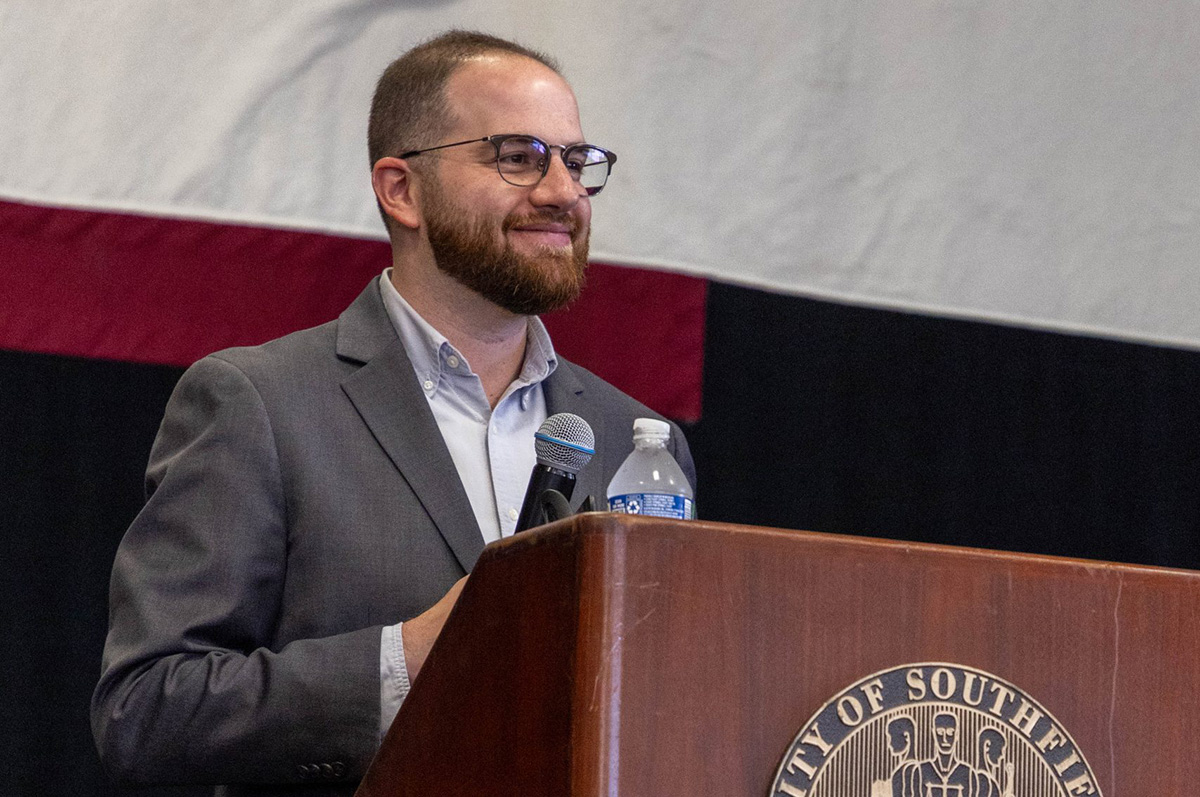
With fall comes swapping out T-shirts for sweaters, raking leaves and, of course, elections. The summer’s primaries have narrowed the playing field in a slew of races, but the big ones — the actual races for seats in federal and local elections — are still to come.
Jeremy Moss is one of those people running for a congressional seat in Michigan. Despite his young age, Moss has quickly learned the ropes of politics in the state, already serving terms in the Great Lakes State’s House of Representatives and Senate.
Moss sat down with the Washington Blade to discuss his history in Michigan politics, his experience as an openly LGBTQ legislator and his vision for a better America as he looks toward Congress.
He currently represents Michigan’s 7th Senate District, but now he is setting his sights beyond Lansing toward Capitol Hill to represent Michigan’s 11th Congressional District, which includes Detroit’s northern suburbs.
Moss earned his bachelor’s degree in journalism from Michigan State University, where just a few years later he made history as the first openly gay person elected to the Michigan Senate and the first to serve as its president pro tempore.
His political experience stretches across multiple offices.
Moss worked in the offices of Southfield Mayor Brenda Lawrence, who also served in the U.S. House of Representatives, and State Rep. Paul Condino.
Moss, at age 25, was elected to the Southfield City Council in 2011, becoming the youngest member elected in the body’s history. He then switched over to the state legislature, representing Michigan’s 35th House of Representatives District in the Michigan House of Representatives from 2014-2018, becoming the second openly gay member elected to the Michigan legislature.
He then moved from Michigan’s House to its Senate in 2018, elected to represent the 11th Michigan Senate District and becoming the Assistant Democratic Leader. Moss started his second term in the Michigan Senate in 2023, this time representing District 7.
He currently has a long list of priorities listed on his campaign website, many of which have become standard for Democrats running across the country, with a particular focus on minimizing — and cleaning up — issues that the Republican-controlled federal government has created under President Donald Trump.
Those goals include lowering healthcare costs, tackling the cost of living crisis, holding U.S. Immigration and Customs Enforcement accountable and fixing the broken immigration system, restoring national voting rights, protecting rights — with a particular focus on abortion access and LGBTQ rights — combating corruption in politics, preventing gun violence and strengthening gun safety, empowering Michigan workers, and preserving the environment.
Why Moss is running for Congress
When asked why he wants to run for Congress, Moss pointed to his lengthy resume in state leadership, with a clear voice arguing that if he can do it in Lansing, he can get it done in Washington.
“I’ve served 12 years in the legislature and have ascended into leadership as president pro tem of the Senate,” Moss explained to the Blade. “We flipped our state legislative chamber to a Democratic majority for the first time in 40 years in 2022, and we passed some big, generational-changing, consequential Democratic wins that had languished for a generation, but had improved people’s lives in our state.
“We’ve passed the first gun safety laws in a generation that are saving lives. We protected the right to vote amidst attacks from Donald Trump and other conspiracies. We pushed forward and finally put LGBTQ rights in our state civil rights law. We provided free school meals and lunches for all public school children in the state of Michigan.
“The problems from Washington, D.C., aren’t getting less severe over time,” he continued. “They’re getting more severe. So this district unexpectedly opened up due to a series of retirements and it was just a great opportunity for me to continue to advocate for big change that we’ve already achieved here in the state legislature.”
“I’m a product of this district. I grew up here. I’ve represented a bulk of the district already in the state legislature, and I knew that I was going to earn grassroots support to be able to wage this campaign. We sought it out, we earned it, including some premier endorsements from Gov. (Gretchen) Whitmer, among many others, and were highly successful in the primary because we were in tune to the needs of this district.”
Moss has been endorsed by a slew of Democratic leaders and organizations, including, as he pointed out, by Whitmer.
Other endorsements include former Gov. Jim Blanchard, Secretary of State Jocelyn Benson, Attorney General Dana Nessel, the Equality PAC, the Human Rights Campaign, the Unity Fund, and the LGBTQ+ Victory Fund.
His political identity and the Democratic Party
Moss described himself as being “on the liberal end of the spectrum,” but argued that the Democratic Party’s internal divisions should not be the central focus.
“I’m certainly on the liberal end of the spectrum, but I don’t even think it necessarily has to be this progressive versus establishment fight that we’ve seen play out,” Moss said when asked about various elements of in-party disagreements. “It has to be between action and, and inaction, fighters versus folders.”
He said that distinction between action and inaction is central to how he would approach Washington.
“At this moment, I think we need to demonstrate that we are ready to take on Donald Trump and MAGA chaos with boldness and effectiveness. I’ve been saying all along our campaign trail, we can no longer be the party that shows up to the knife fight carrying a pie chart, and so I think we have to be showing that we have spine and we have punch, and we’re really ready to be tough fighters for, for Michiganders and the American people.”
“We can’t walk on eggshells anymore. We can’t pull our punches,” he added. “We can’t fear that we’re offending someone, you know, one way or another with how we act. People are expecting a bold party to take on MAGA, and I think that’s exactly what the Democratic Party needs.”
Becoming an LGBTQ legislator
Moss also reminisced with the Blade about his first run for elected office — at a time when Michigan had no openly LGBTQ members serving in the state legislature — and how that experience became deeply connected to his identity and his approach to LGBTQ politics.
In 2014, Michigan was in the pre-marriage equality era, and the state had no openly LGBTQ members serving in the legislature.
“12 years ago in 2014 — this was pre-marriage, the pre-marriage equality era — we had zero people from our community serving in the legislature, and still they were talking about us.
“The big topic then in Michigan was whether or not to expand our civil rights law to include LGBTQ protections, so that people from our community would no longer face discrimination in housing and employment. And they were talking about us regardless of whether or not we were at the table.”
Moss eventually helped lead the effort to expand Michigan’s civil rights protections to include LGBTQ people, a measure that passed with bipartisan support.
He said his experience as an openly gay lawmaker allowed him to make the case for LGBTQ protections in terms that extended beyond LGBTQ issues.
“One thing I definitely aligned with Gov. Whitmer at the time was making the case that discrimination was not only morally wrong, but it was bad for business,” he said. “By not having these protections for our LGBTQ neighbors and family members and friends and community members, we were actually holding back our economy. We were essentially allowing people to be kicked out of Michigan as consumers and workers, because of who they are and how they identified.”
That led to various efforts — including committee hearings and meetings with advocates, businesses and the public — that helped make Michigan what the Movement Advancement Project deems the 16th most LGBTQ-friendly state, solidly above other states due to its robust LGBTQ-related legislation.
“I wanted to meet everybody where they were, including those who may have not been involved with or engaged with the LGBTQ community as legislators, but understood that we couldn’t sustain the economic impact of discriminating against our community,” Moss said. “And as I’ve said all along, discrimination is bad for business. That’s something I think helped broaden the vote and earn some bipartisan support for it.”
Representation and LGBTQ youth
For Moss, the importance of LGBTQ representation also comes from his own experience growing up.
“I think about when I was younger, when I was 18 years old. It was in 2004, and, you know, there are certain things that really shaped me in that time … Michigan had a ballot proposal that passed to have the strictest language banning marriage equality in our state constitution. We didn’t even allow civil unions in that language in our constitution to exist, and there were scandal-plagued LGBTQ politicians.”
“It was the same year that Jim McGreevey was forced to resign as he came out,” he said. “So it really was a signal to me that, you know, you don’t have a future. Not just you don’t have a future in politics; you might not even have a future. Period, and it was pretty defining for me.”
Despite those fears, Moss continued to pursue public office.
“And you can’t be what you can’t see, and so to be able to break the barriers at the state level and at this congressional level, I think is a signal to anybody who is struggling with wondering where their place is?”
“I think that visibility is incredibly important, and it’s something that I needed when I was much younger, and it’s something that I’ve been honored to be able to provide for the, for the next generation of emerging leaders.”
His LGBTQ priorities in Congress
When asked what LGBTQ issues he would prioritize in Congress, Moss emphasized the importance of growing the number of LGBTQ lawmakers while also expanding federal nondiscrimination protections.
“To have a caucus in the legislature has made all the difference because you can, you know, run these issues across the field. You can have somebody take on marriage. You can have somebody take on trans rights. You can have somebody take on LGBTQ youth. You can have somebody take on discrimination protections.”
He sees much of the work he wants to get done on Capitol Hill as a direct follow-up to his work in Lansing — most importantly, the passage of the Equality Act. The legislation has been debated in some form for more than 50 years at the federal level, with the goal of protecting LGBTQ people from discrimination under federal law.
“I think the Equality Act is incredibly important. That’s kind of the, the counterpart to what we’ve done in the state legislature, ensuring discrimination protections for the LGBTQ community,” he said.
“I think housing and, and workplace discrimination is, is everything, you know, to protect our community so that they can have a safe place to call home and earn a living … That’s incredibly important across the board. And I would really want to take a leading role in telling the story of how we were able to do it in Michigan after 50 years since this act was first written — and finally finished the job federally to ensure their federal protections in, in, in, in employment and housing.”
LGBTQ political organizations and Congress
Moss said the LGBTQ political organizations that have supported his political career from its early stages have helped him along the way.
“Obviously, I’ve been affiliated with Victory Fund since I first ran for office, and they were early endorsers, but Equality PAC, which is the political arm of the LGBTQ caucus in Congress, has been an incredible part of my support system. From day one they helped me out.
“I’ve been getting to know a lot of the members of Congress who are LGBTQ, really over the last year of this campaign. So I’m eager to join them. I’m eager to be one of the players on the field here to be able to advocate and advance our issues.”
Voting rights
Voting rights are another major focus for Moss, an issue he said dates back to his experience during the 2004 campaign over marriage equality.
“Something I’m very passionate about is voting rights, and it really does go back to that 2004 campaign where it was very evident that elections can determine your future.
“Elections can determine what rights you do have and don’t have, and so I’ve been very laser focused on increasing access to the ballot box, making sure our democracy remains whole and accessible.”
He explained how Trump’s recent attacks on voting legitimacy and mail-in voting have only made his desire to help that much stronger.
“We went through a real trial of that in 2020 with, with Michigan’s presidential election, with Donald Trump and Rudy Giuliani — as he jetted into Michigan and tried to overturn our valid and accurate election results. We were kind of the spotlight of the nation in that stop this deal movement that led to Jan. 6.”
That, according to Moss, spurred direct action on his end.
“I took the helm as chair of the Senate Elections Committee, and we wrote the law to implement pieces of that ballot proposal, including drafting the law that implemented nine days of early voting here in Michigan, increased access to absentee ballot. We further secured our canvassing and certifications so that nobody could jet in with an alternative slate of electors and send them to Congress on Jan. 6.”
“So I’ve been on the front lines in Michigan on defending our election systems and strengthening protections for both voters to access the ballot box and protections against those who want to overturn our election results.”
Those issues are still present today, he explained.
“He’s pushing for suppressive tactics like the Save Act. The Supreme Court has eroded the federal Voting Rights Act,” Moss said. “I want to really get into Congress as an election expert, we have a Michigan story to tell. I wrote a lot of that story, and, and I think the most urgent thing that we could pass is the John Lewis Voting Rights Act to make sure that there’s no pocket of discrimination anywhere in our country, and that people have the ability to exercise their constitutionally guaranteed right to vote.”
What he would do differently in Washington
Moss also shared that he believes Democrats should communicate differently in Washington, with an emphasis on getting things done.
“Yeah, again, we’ve, we’ve seen politics evolve in this Trump era, and I think that Democrats need to communicate differently.
“He talks so brazenly, and how proud he is that he’s renamed the Gulf of Mexico or Lake Ontario. I put that in the stupid category.
“He’s also done things in the harmful category that he boasts about, like cutting Medicaid and cutting SNAP. And of course, he’s doing things in the dangerous category, but proud of it, like trying to overturn our elections or suppressing the vote.
“What we’re doing is both popular and good for people, whether it’s growing our economy from the middle class outward, whether it’s lowering costs, whether it’s making healthcare more affordable, whether it’s strengthening the core functions of our democracy, we have to be talking about it with the same gusto and confidence that MAGA talks about their agenda.
“I think this is a party that needs more spine and more punch, and really meet this moment because I think that’s what people are looking for, and that’s really what I think a new generation will bring into this next Congress.”
Congress
HRC president campaigns for Chris Pappas in NH
Gay congressman running to succeed retiring U.S. Sen. Jeanne Shaheen

Human Rights Campaign President Kelley Robinson on Sunday campaigned for U.S. Rep. Chris Pappas (D-N.H.) in New Hampshire.
Robinson traveled to Manchester, the state’s largest city, nine days before the Sept. 8 primary that will determine who will vie for retiring U.S. Sen. Jeanne Shaheen (D-N.H.)’s seat.
We’re hitting the pavement across New Hampshire to fight for a freer, fairer future for everyone.
Glad to have Human Rights Campaign President @KelleyJRobinson join us for a canvass launch in Manchester today. pic.twitter.com/XWCEaQxy4o
— Chris Pappas (@ChrisPappasNH) August 30, 2026
Former U.S. Sen. John E. Sununu, who represented New Hampshire in the U.S. Senate from 2003-2009, will face off against former U.S. Sen. Scott Brown, who represented Massachusetts in the U.S. Senate from 2010-2013, in the Republican primary.
Karishma Manzur is among the Democrats challenging Pappas.
A poll the University of New Hampshire Survey Center released on Aug. 26 shows Sununu is ahead of Brown. The same survey shows Pappas ahead of Manzur and his other Democratic challengers.
The UNH Survey Center poll shows Sununu ahead of Pappas by a 45-43 percent margin if they were to face off in the general election. The margin of error is +/-2.1 percent.
Pappas would become the first openly gay man elected to the U.S. Senate if he were to win in November.
Congress
Chris Van Hollen says the Democratic Party needs change. Is he the one to lead it?
Senator is backing anti-establishment Democrats across the country
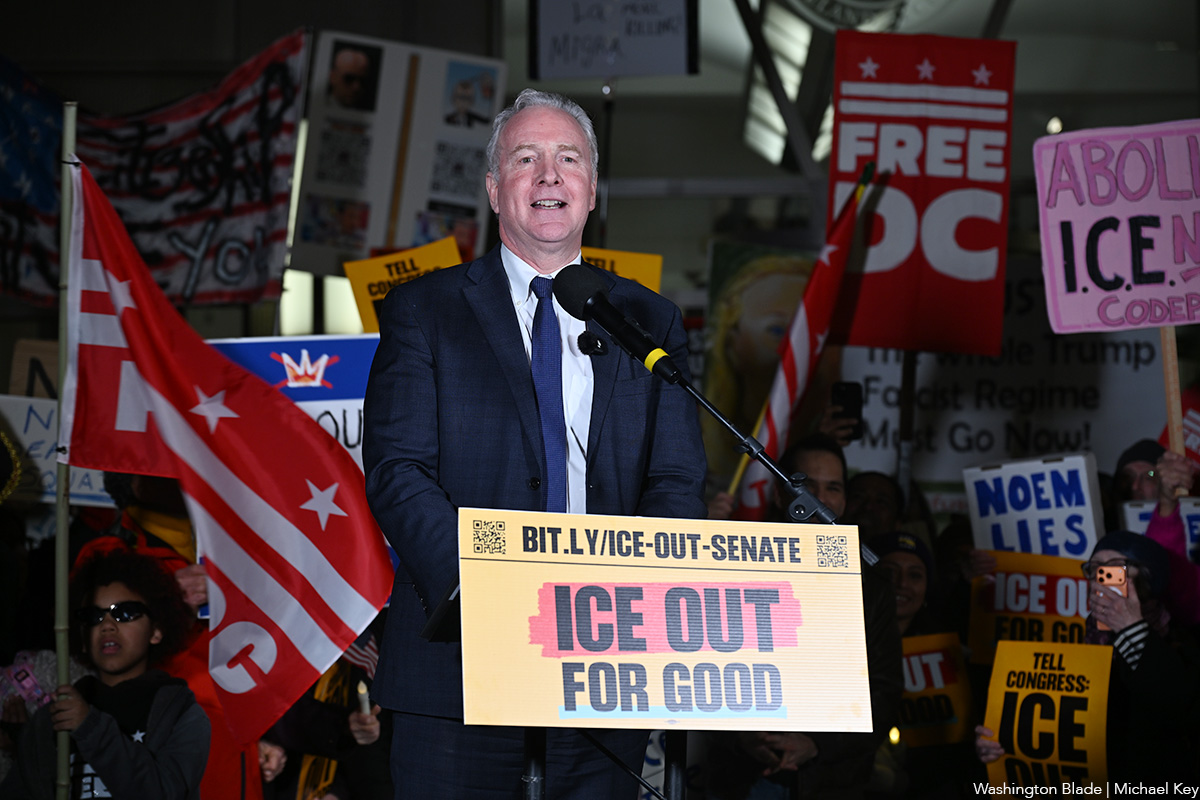
By LEE O. SANDERLIN | The Democratic Party is having something of an identity crisis — losing to President Donald Trump twice in three elections will do that.
Should the party embrace anti-establishment figures who espouse progressive policy ideas like Medicare for all and rhetoric about unrigging the economy for the 1 percent? Or should Democrats try to appeal to moderates who want to return to semi-normalcy in a time of political upheaval?
Although he’s been in Congress since 2002, with key leadership roles throughout his tenure, Maryland Sen. Chris Van Hollen, 67, counts himself firmly in the anti-establishment camp.
The rest of this article can be found on the Baltimore Banner’s website.

In ‘The Lost Brontë,’ a complicated lie can lead to danger

CAMP Rehoboth Block Party returns Oct. 18

Essential queer horror classics for Halloween

Solidarity beyond the parade: the actual cost of Pride

Physician: addiction doesn’t always look the way you think it does

10 years later, we still can’t shake Barry Jenkins’s ‘Moonlight’

‘Some Like It Hot’ a wild ride at renovated Bernard Family Theatre

D.C.’s LGBTQ homeless facilities face possible hit from Trump funding cuts

Trump uses anti-trans slur against Democratic Senate candidate

Calif. GOP gubernatorial candidate ad ‘disgusting attempt to exploit lesbian intimacy’
-

 Movies4 days ago
10 years later, we still can’t shake Barry Jenkins’s ‘Moonlight’
-
Theater4 days ago
‘Some Like It Hot’ a wild ride at renovated Bernard Family Theatre
-
District of Columbia4 days ago
D.C.’s LGBTQ homeless facilities face possible hit from Trump funding cuts
-
2026 Midterm Elections4 days ago
Trump uses anti-trans slur against Democratic Senate candidate