Local
Clinton returns to D.C. lamenting mistakes of 2016 campaign
Dem nominee on role of misogyny, fake news in election loss
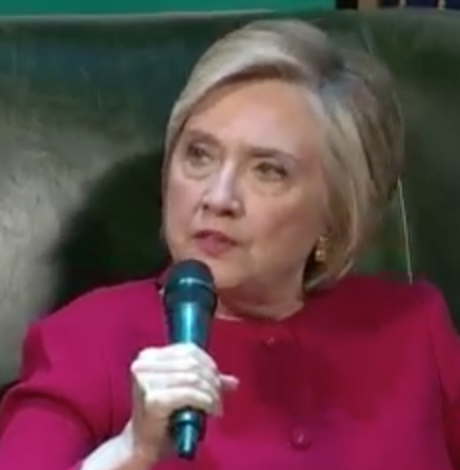
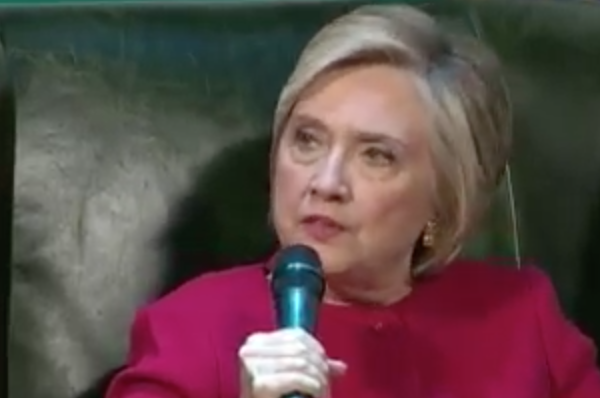
Hillary Clinton lamented having stayed “too focused on a path” in the 2016 election. (Screenshot via CSPAN)
As Hillary Clinton has reemerged in the national spotlight to promote her new book, some critics have groaned and wondered why she won’t just go away. They were not among the crowd at the Warner Theatre on Monday night.
In fact, the veneration for the first female U.S. presidential nominee of a major political party was palpable among attendees, who paid upwards of $82 for a ticket to the event.
The topic of discussion was her new book “What Happened” — a self-examination of the 2016 presidential campaign and actions that led to her loss and the election of President Trump to the White House — and Clinton had many explanations for that outcome and the way forward.
Clinton laid out a balanced approach to explain her loss, attributing the outcome not just to her missteps, but also outside forces that tipped the election in Trump’s favor.
“I just decided I was going to write it, and it was painful,” Clinton said. “I say in the book that I’d write about something, and I’d have to go lie down because it was just so hard to think about the mistakes I made and missed opportunities, but then also to come to grips with these other big forces at work that I think had a determinative impact on the outcome.”
Clinton recalled after the election before she started writing the book in February being “so devastated,” trying to feel better by cleaning out closets and taking walks in the park. The process of the writing the book, Clinton said, was “cathartic,” but also important for her view of democracy.
“It really hit me there were these very important issues that needed to be discussed, debated even, that our democracy and country relied upon that kind of self-examination,” Clinton said.
A key factor Clinton identified in her loss was not realizing the game had changed since her runs with her husband President Bill Clinton in the 1990s and her earlier campaign in 2008 — even during the 1960s and 1970s — when clear policy proposals were crucial for presidential candidates.
“You realize that the press is not putting out the policy that you’re putting out everyday, they’re covering an empty podium,” Clinton said. “And I kept thinking, ‘Well, we’re still going to break through because we really care do about what kind of jobs and infrastructure and health care and other things you want to do for them and their families and their incomes, but there’s a disconnect.”
Although Clinton said she “stayed too focused on a path” and “was not as adept” at changing to the new environment, she cautioned a less detailed approach might not be the path in the future and speculated “people will want details” again in 2020.
Lissa Muscatine, co-owner of Politics & Prose and Clinton’s chief speechwriter in the State Department and the White House, moderated the forum and queried Clinton on factors attributed to her loss, from Russian interference to fake news and misogyny.
Clinton recalled feeling compelled to exercise constraint as a woman and not respond during the second presidential debate when Trump could be seen on camera lurching close behind her as she spoke.
“As you might think back — funny gestures, facial expressions, heavy sighs — these really do affect viewers,” Clinton said. “And I just ended up believing that in addition to the gender-linked aspect of this, there was a history of people in presidential debates who had deviated in a way to show frustration, anger, dismissiveness, whatever their feelings were, and paid a heavy price for it, and I thought whatever price they paid, I would pay double or triple.”
Clinton recalled with indignation the Russians hacking the emails of her campaign chair John Podesta, which she described as being “stolen,” and given to Wikileaks — a website Clinton called “nothing more than a tool of Putin and the Kremlin.” Clinton said Trump’s associates “certainly” knew about it, citing a tweet from Roger Stone that Podesta’s time in a barrel would soon come.
Although Clinton said the emails were “anodyne,” she said they were later weaponized as fake news — in one case to potentially violent consequences as a result of the Pizzagate scandal in which Clinton was accused of running a child trafficking ring out of the basement of D.C. pizzeria. (The restaurant doesn’t even have a basement).
“Even I have to say I don’t believe it was meant to be believed to influence somebody to pick up an AR-15 and drive from North Carolina to Washington to liberate the imaginary children from the imaginary basement of the pizza parlor,” Clinton said. “But in came this young man believing that he was on a mission because he saw it on Facebook, he saw it in other places online, he saw it in quote, news outlets. And so, he was there on a mission of rescue. People could have gotten killed; he [fired] his automatic weapon inside this pizza parlor.”
Citing her loss to Trump by 53 percent among white women, Clinton said a major factor was former FBI Director James Comey reopening the email investigation — only for him to close it again one day before the election .
“All of sudden, people are told being told something’s going on, they’re going to investigate her again, or whatever,” Clinton said. “We could see that a lot of women in particular turned away. They were discouraged. I don’t blame them. They didn’t know what to believe. I mean, it was outrageous.”
When Muscatine mentioned Sen. Bernie Sanders (I-Vt.), whom Clinton heavily criticizes in her book for raising doubts about her connections to Wall Street, the audience at the Warner Theatre audibly booed and hissed.
But there were also moments of levity at the event. Muscatine at one point engaged Clinton in a game of having to choose one of a pair of words. Asked about “tea” or “coffee,” Clinton replied “coffee.” Asked about “beach” or “mountains,” Clinton replied “beach.” Asked about “Trump” or “Putin,” Clinton replied she’d have to “take that under advisement” because she “ran against both of them.”
Attendees at the event — who consisted mostly of middle-class women but also members of D.C.’s LGBT community — came to the Warner Theater adorned in Clinton campaign T-shirts leftover from the 2016 election. One vendor outside sold campaign buttons with slogans reading “Hillary 2016” and “Hil Yes!”
Blake Smith, 20, a gay student at George Washington University, worked for Clinton’s presidential campaign and came to the event wearing a T-shirt comprised of a collage of images of Clinton.
“I just think she gets a bad rap,” Smith said. “And I think that people treat her really unfairly, and I think that she’s really, genuinely a good person and she cares about this country.”




Delaware
New LGBTQ visitor center slated for Wilmington, Del.
The Collective to feature gift shop, queer museum, more

During Pride month this year, the Delaware Sexuality and Gender Collective (DSGC) announced plans for “The Collective,” the first LGBTQ+ visitor center in Wilmington in nearly 40 years.
“We’ve been talking about the concept of a brick-and-mortar space for a long time,” said Noah Duckett, co-founder of the DSGC.
A licensed clinical social worker, Duckett co-founded DSGC with his mother, Julissa Corianno, in 2018. Established under Sussex Pride, the DSGC serves as a hub for leaders and organizations working directly with LGBTQ+ communities throughout Delaware.
“Our vision for The Collective is a place where our community can come to learn, create, work, and be inspired,” said Corianno.
The Collective will feature a visitor center and gift shop highlighting LGBTQ-owned businesses in Delaware.
“I think that this is something that’s going to benefit our community so much,” said Duckett.
Some of the LGBTQ-owned businesses that DSGC has already partnered with include Stressed Induced Art Attack, Moonbeam Art Collaborative, Voce Coffee, Groovy Gemini Co., Scout Cafe, Macaron Social, and Huxley and Hiro.
“Specifically in Wilmington, we haven’t had an LGBTQ-dedicated space in almost 40 years,” said Duckett.
The last LGBTQ community center in Wilmington was The Griffin Community Center, which was open for only a few years in the 1990s.
“The Griffin was a community space in the ’90s, founded by our friends James and Evo, who are so incredible and have been so supportive throughout this process,” said Duckett.
Duckett said the DSGC hopes to carry on The Griffin’s legacy.
“I think now more than ever, there’s more and more spaces closing their doors. More and more spaces are losing funding, seeing reduced funding and reduced access, especially LGBTQ+ organizations and communities,” said Duckett.
The Collective will also feature Delaware’s first LGBTQ history museum, curated by queer historian Carolanne Deal.
“We don’t have any permanent displays in the state about Delaware’s queer history, and we want people to be able to access that history any day of the year, not just during Pride month,” said Deal.
With a master’s degree in art history for museum professionals, Deal has more than seven years of experience in curatorial work and hands-on collections care.
“It’s mainly going to be a graphic display with photographs, articles, and accessible text that draws people in and creates a story for the community,” said Deal.
Although the museum will not initially have an object collection, Deal said she hopes to add physical archival pieces in the future.
“Delaware has been at the forefront of a lot of queer civil rights, and it’ll be really amazing to have that enshrined in a permanent display that’s not only up for Pride month,” said Deal.
Duckett said DSGC is currently raising funds with the goal of breaking ground this summer and opening by the end of the year.
“We would love to have rent paid for, like, multiple years up front,” said Duckett.
Duckett told the Blade that fundraising efforts have reached just under $29,000 and that the organization is awaiting several major donations from community partner organizations.
However, he said DSGC continues to be denied many grants tied to federal or state funding because of restrictions on those funds being used for LGBTQ-serving organizations.
“Private and corporate donations are absolutely vital,” said Duckett.
Anyone interested in supporting the construction of The Collective can donate online or contact [email protected] for more information.
District of Columbia
D.C.’s Mary’s House For Older Adults names new executive director
Charlene Leach to succeed Imani Woody as leader of LGBTQ-supportive seniors home
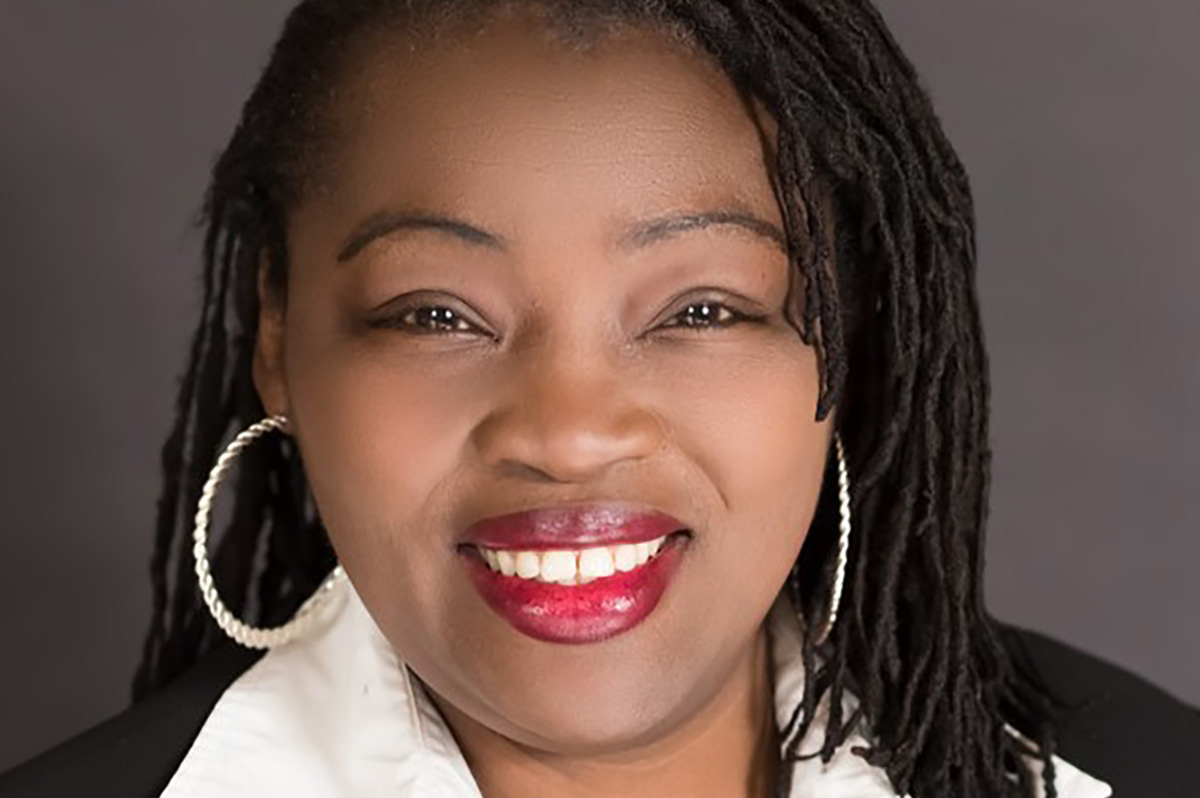
The board of directors of Mary’s House for Older Adults, the D.C.-based home dedicated to providing affordable housing for LGBTQ seniors, has announced it has named longtime nonprofit organization leader A. Charlene Leach as its new executive director.
Leach, who is now serving in the executive director’s position, is succeeding Dr. Imani Woody, the Mary’s House founding president and CEO, who announced her retirement from her official leadership role at Mary’s House on July 7.
Woody, who holds a PhD in Human Services, is credited with playing the lead role over many years in arranging both city and private funding needed to construct and operate the Mary’s House three-story building located at 401 Anacostia Road, S.E., in the city’s Fort DuPont neighborhood.
“With over three decades of nonprofit experience and 15 years serving as an executive director, Charlene brings a wealth of knowledge in organizational leadership, program development, and community engagement,” the Mary’s House board says in a statement.
“Her proven track record of building impactful programs and leading mission-driven organizations makes her uniquely suited to guide Mary’s House into its next phase of growth,” the statement continues. “Charlene is deeply aligned with the mission of Mary’s House and is committed to advancing its work to provide safe, inclusive housing and supportive services for LGBTQ+ older adults,” it says. “Under her leadership, the organization will continue to expand its impact while remaining grounded in the values that define our community.”
Leach’s LinkedIn page shows she has most recently served since 2022 as executive director of the African American AIDS Task Force in Minneapolis. Prior to that, it shows she served as executive director of the Fredericksburg Area Health and Support Services organization in Fredericksburg, Va., and before that as director of development for the D.C.-Baltimore area Women’s Collective.
Her LinkedIn page says she has been involved with Mary’s House as a volunteer and grant writer since 2016.
The newly built and enlarged Mary’s House, which opened in March 2025, with a grand opening ceremony held in May 2025 attended by D.C. Mayor Muriel Bowser, includes 15 single-occupancy residential apartments and more than 5,000 square feet of shared communal living space.
An earlier statement released by the Mary’s House board announcing Woody’s retirement said Woody would continue to be involved with the organization as a member of the board. The earlier statement and board’s more recent statement on July 29 announcing Leach’s appointment as executive director did not say whether the board plans to name someone else as president and CEO, the title that Woody held before her retirement. But the latest statement says Leach will be running Mary’s House’s day-to-day operations as Woody did.
Virginia
Doug Ollivant to face Eugene Vindman in Va. 7th Congressional District
Republican defeated challengers in Tuesday’s primary

Republican Doug Ollivant will face off against incumbent U.S. Rep. Eugene Vindman (D-Va.) in Virginia’s 7th Congressional District.
Ollivant defeated his Republican opponents in Tuesday’s primary. Vindman ran unopposed.
Vindman in 2024 ran to succeed then-Congresswoman Abigail Spanberger in the U.S. House of Representatives after she ran for governor. Spanberger succeeded Republican Gov. Glenn Youngkin in 2025.
U.S. Sen. Mark Warner (D-Va.) on Tuesday easily won his primary. All other Democratic incumbent members of Congress from Northern Virginia also won their respective primaries.

Don’t miss summer productions at Clear Space in Rehoboth Beach

New LGBTQ visitor center slated for Wilmington, Del.

PHOTOS: World Pride March

Tens of thousands take part in World Pride March

PHOTOS: Daddy Issues at Kiki

Continue to engage in community after Pride month

D.C.’s Mary’s House For Older Adults names new executive director

Suzanne Goode is not good for Rehoboth Beach

Greg Araki still wants your sex