Local
Priest who refused communion to lesbian removed from church
Archdiocese says he ‘engaged in intimidating behavior’
A priest who refused to serve communion to a lesbian at her mother’s funeral service last month at a Catholic church in Gaithersburg, Md., has been removed from the church and placed on administrative leave pending an investigation, according to a letter from the Archdiocese of Washington to all of its priests.
The March 9 letter, written by Bishop Barry C. Knestout, chief of staff to Cardinal Donald Wuerl, who heads the Archdiocese, said the action taken against Father Marcel Guarnizo was based on allegations that he engaged in “intimidating behavior” against members of the staff and “others” at St. John Neumann Catholic Church, where he served as a parish priest.
The letter, a copy of which was obtained by the Washington Blade, makes no mention of the allegation by D.C. resident Barbara Johnson that Guarnizo “humiliated” her at her mother’s funeral Mass at the church on March 25 when he reportedly refused to allow her to receive communion as she and others approached the church altar, saying she was living in sin.
“I write to inform you that effective today, Father Marcel Guarnizo’s assignment at St. John Neumann Parish is withdrawn and he has been placed on administrative leave with his priestly faculties removed until such time as an inquiry into his actions at the parish is completed,” Bishop Knestout said in his March 9 letter.
“This action was taken after I received credible allegations that Father Guarnizo has engaged in intimidating behavior toward parish staff and others that is incompatible with proper priestly ministry,” he said in the letter. “Given the grave nature of these allegations, and in light of the confusion in the parish and the concerns expressed by parishioners, Father Guarnizo is prohibited from exercising any priestly ministry in the Archdiocese of Washington until all matters can be appropriately resolved, with the hope that he might return to priestly ministry.”
Last month, Johnson told the Washington Post that Guarnizo “put his hand over the body of Christ and looked at me and said, ‘I can’t give you communion because you live with a woman and in the eyes of the church that is a sin.’”
According to the Post’s account, Johnson’s partner of 20 years had been helping Johnson’s family at the church prior to the service when Guarnizo asked Johnson who she was. “I’m her partner,” the Post quoted Johnson as saying she told Guarnizo.
Bishop Knestout said in his letter that Guarnizo is a priest of the Archdiocese of Moscow, Russia, and has been serving since March 2011 as “parochial vicar” at the St. John Neumann Church parish.
Chieko Noguchi, a spokesperson for the Archdiocese of Washington, said the Archdiocese issued a statement on the same day Bishop Knestout issued his letter that repeats, nearly word for word, the contents of the letter. Noguchi initially indicated the letter was read during Mass at area churches last weekend. But she contacted the Blade to clarify that the letter was only read during the masses offered over the weekend at St. John Newmann Catholic Church in Gaithersburg, where Fr. Guarnizo had been assigned.
Noguchi said the Archdiocese would have no further comment, including a clarification of whether the action taken against Guarnizo is linked to his alleged behavior toward Barbara Johnson, because the action is a “personnel” matter that must remain confidential.
Guarnizo has told news media outlets that he would have no comment on the matter involving Barbara Johnson.
Reports of Guarnizo’s refusal to serve communion to Johnson triggered an uproar among LGBT activists, including LGBT Catholic activists in the D.C. area.
Shortly after the reports surfaced, the Archdiocese of Washington issued a statement saying Guarnizo’s action violated church policy and Archdiocesan officials would look into the matter.
“When questions arise about whether or not an individual should present themselves for communion, it is not the policy of the Archdiocese of Washington to publicly reprimand the person,” the statement said. “Any issues regarding the suitability of an individual to receive communion should be addressed by the priest with that person in a private, pastoral setting.”


District of Columbia
Blade welcomes fall intern
Alexis McLean is student at University of North Florida
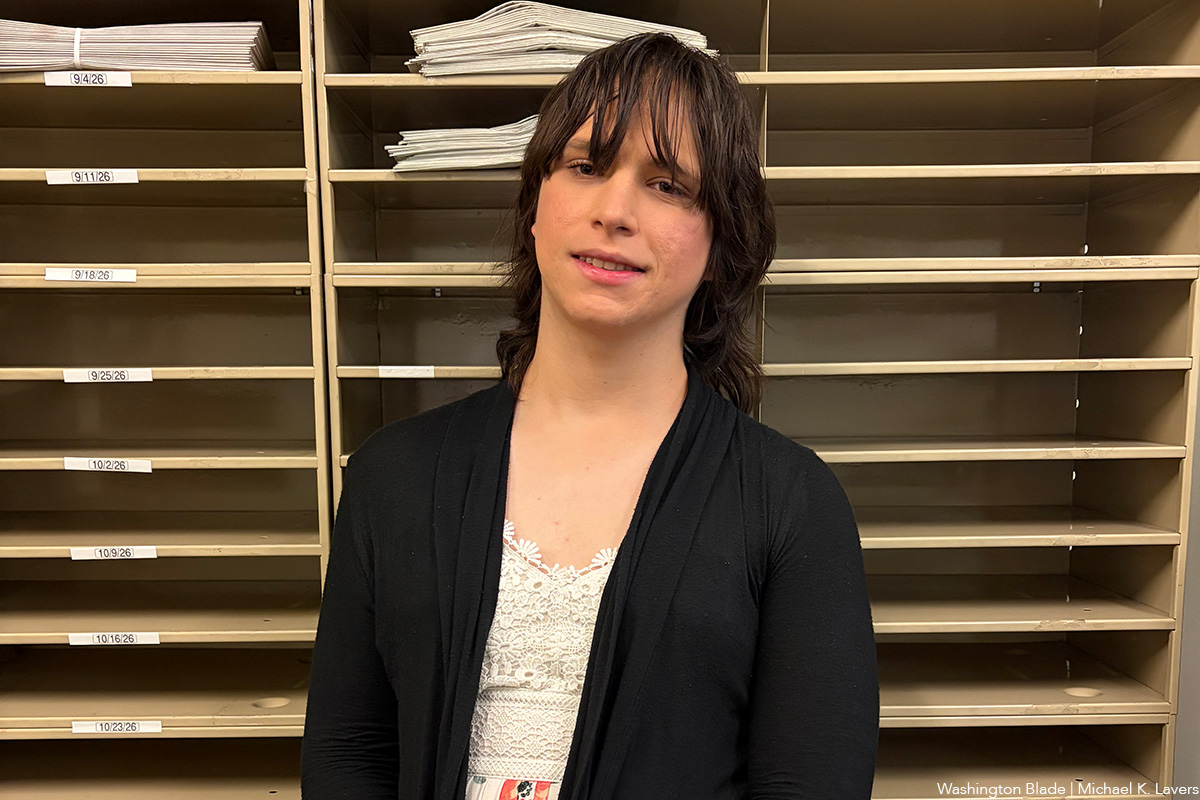
The Washington Blade this week welcomed Alexis McLean as its fall intern.
Alexis is studying political science at the University of North Florida in Jacksonville, Fla. She is interning with the Blade as part of a continued partnership with the Washington Center.
“I am looking forward to spending my time in the fall with the Washington Blade, as this is a new experience for me,” said Alexis. “I have not experienced any journalist jobs in the past so this would be my first time, and I am excited to better my writing and communications skills with this internship.”
Alexis’s internship with the Blade ends in early December.
Rehoboth Beach
SUNFESTIVAL takes center stage as Rehoboth Beach closes out summer
Labor Day Weekend bustling with events, including David Archuleta performance

Labor Day Weekend marks the unofficial end of summer in Rehoboth Beach, but there will be no shortage of LGBTQ events, with CAMP Rehoboth’s annual SUNFESTIVAL taking over town this weekend.
Thursday (9/3)
Get your Labor Day Weekend started early Thursday night with happy hour from 5-7 p.m. at Diego’s Bar & Nightclub, followed by Naughtee Bingo hosted by Magnolia Applebottom at 8:30 p.m.
After bingo, the party continues with Dancing at Diego’s from 9 p.m. to 1:30 a.m.
Aqua Bar & Grill will also kick off its Labor Day Weekend festivities Thursday with a DJ spinning from 9 p.m.-1 a.m.
Friday (9/4)
The weekend ramps up Friday night at Aqua, where DJ Matt Bailer will keep the dance floor moving from 9 p.m.-1 a.m.
Over at Diego’s, DJ Steve Sidewalk will then take over Diego’s for Freedom Friday from 9 p.m.-1:30 a.m.
Saturday (9/5)
The main event of the weekend arrives Saturday with the opening night of CAMP Rehoboth’s SUNFESTIVAL.
Billed as the ultimate party to close out the summer, SUNFESTIVAL has become one of Rehoboth’s signature Labor Day Weekend events. The annual celebration sells out each year, with proceeds benefiting CAMP Rehoboth.
Doors open at 6:30 p.m. with refreshments available at the cash bar while attendees are invited to socialize and find their seats.
Saturday night will feature local singer Ashley Williams as the opening performer, followed by headliner David Archuleta. The event will also feature a live auction.
Back across town Saturday, Aqua will continue its Labor Day Weekend DJ lineup from 9 p.m. to 1 a.m.
Diego’s will also have plenty happening, with ‘Splash Party’ hosted by Magnolia Applebottom at 5 p.m., followed by a Saturday Dance Party with Brett Oosterhaus from 9 p.m.- 1:30 a.m.
The Blue Moon hosts its popular Legends Show at 9 p.m. It’s an all-live singing show by the Blue Moon cast of celebrity impersonators.
Etienne Pilon has taken Rehoboth by storm this summer. Check out the talented singer/pianist at The Pines from 7-10 p.m.
Sunday (9/6)
Sunday’s SUNFESTIVAL event will shift the focus to the dance floor, with globally renowned DJs Robbie Leslie and James Anthony scheduled to perform. Doors open at 7 p.m., with dancing continuing until 1 a.m.
On Sunday, Aqua will throw its annual White Party, with DJs spinning from 9 p.m.-1 a.m. Guests are encouraged to dress in white for the holiday weekend celebration.
Diego’s will host its Sunday High T-Dance with Pamala Stanley at 5 p.m. Later that evening, DJ Tannr will be spinning at 9 p.m.
John Flynn is on the piano from 6-8 p.m. at the Blue Moon.
Monday (9/7)
The final day of Labor Day Weekend brings one last chance to hit the dance floor before summer officially winds down.
Aqua will close out its five-day Labor Day Weekend celebration with DJ Biff from 3-7 p.m.
Maryland
Anne Arundel schools now need parent permission to call trans students by preferred names
Conservative groups challenged system’s policy
By JESSICA CALEFATI | Anne Arundel County Public Schools staff cannot use transgender students’ preferred names if their parents oppose it, according to an internal document reviewed by the Banner, a change that comes after conservative groups challenged the school system’s approach to gender identity.
Teachers union president Kristina Korona told members in an Aug. 20 email that the new guidance undermines district policy on acceptance and inclusivity and “will begin harming affected students immediately.”
Previously, the district didn’t require parental permission to use a high school student’s chosen name and pronouns corresponding to their gender identity, the internal document says. Now it does. The change comes as parents challenge the suburban school system’s gender identity policy and regulation in court and the Trump-Vance administration threatens the district’s funding.
The rest of this article can be found on the Baltimore Banner’s website.

Markey’s primary win deemed success for LGBTQ activists

Top Bulgarian court rules government must legally recognize trans people

Lou Chibbaro Jr. documentary wins award from NLGJA

Beloved D.C. ‘Old Catholic’ Bishop Charles Braun dies at 86

Blade welcomes fall intern

E-INFOSOL leaders encourage youth to pursue tech careers

New book examines Trump cuts to LGBTQ healthcare

Immersive ‘Nation-State’ imagines a society free of authoritarianism

Poland begins to legally recognize same-sex marriages from other countries

HRC president campaigns for Chris Pappas in NH
-

 Technology5 days ago
E-INFOSOL leaders encourage youth to pursue tech careers
-
Books5 days ago
New book examines Trump cuts to LGBTQ healthcare
-
Theater3 days ago
Immersive ‘Nation-State’ imagines a society free of authoritarianism
-
Poland3 days ago
Poland begins to legally recognize same-sex marriages from other countries