Politics
Business experts split on criticism of Buttigieg on supply chain issues
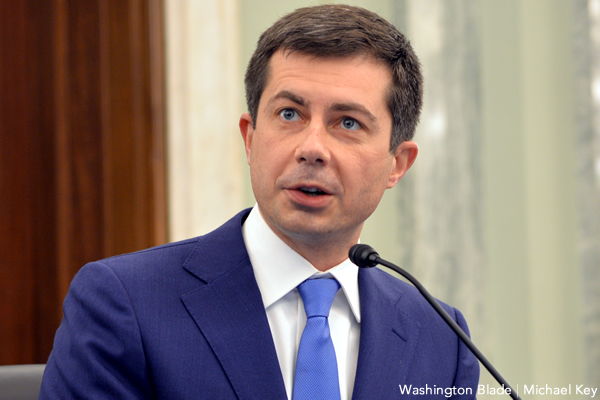
Amid images of goods stranded on ships near America’s ports and notable price increases in basic commodities, including food and gasoline, right-wing critics are lambasting Pete Buttigieg in his role overseeing the supply chain as transportation secretary, although business experts in the field are split over whether that criticism is valid.
Business experts who spoke to the Blade — and whose own views may be colored by their political affiliations — offered a range of explanations for the break down in the supply chain, such as a sharp increase in demand among American consumers, the coronavirus pandemic, and a shortage of truck drivers responsible for transporting goods, which led to different conclusions as to whether Buttigieg, the first openly gay person confirmed by the U.S. Senate for a Cabinet position, was responsible.
Daniel Innis, a professor at the University of New Hampshire Peter T. College College of Business and Economics and who specializes in marketing and logistics and is a board member of Log Cabin Republicans, said criticism of Buttigieg is “certainly warranted” because he isn’t showing leadership in bringing stakeholders to the table.
“Pete can help by sitting down with the trucking industry, the railroads and so on and saying, ‘Look, this is a crisis that we have to solve,'” Innis said. “Eventually, you know, we’re going to get to a place where things that are really important aren’t available to us, and this has to be fixed. So you know, we need some leadership coming from Mayor Pete.”
As a result of supply chain issues, consumers are seeing increased prices for goods, including basic necessities like food and gasoline. With the Thanksgiving holiday fast approaching, experts say prices for turkey could be the most expensive in history for American consumers.
Innis, who said the supply chain depends on flow and “if any part of the chain breaks down, the whole thing collapses,” said the problem he’s hearing is on the receiving end at terminal hubs where truck drivers are supposed to pick up goods.
As an example, Innis offered a personal anecdote about being in Savannah, Ga, and seeing about 20 ships on the coastline waiting to come into the port. Such a port, Innis said, would be a first stop for goods before they’re loaded on trains and headed to terminal hubs, where truck drivers then pick it up.
“That’s where it’s breaking down,” Innis said. “Things are not getting picked up. And maybe a month or so ago, the Union Pacific Railroad basically barred anything coming out of LA for a week, so they could clear out the stuff from the Chicago terminal that wasn’t being picked up. So it seems to me based on my observation that we’ve got a real problem with truck drivers at the final destinations, and they’re not able to pick things up. So it backs up the entire system, and it’s backed up now all the way to the ocean.”
Specific things Buttigieg should be addressing with the trucking industry, Innis said, are why there is an such an acute truck driver shortage and what could be done to address it, including whether or not to change hours of service limiting the number of work hours truckers can drive each day, at least in the short term.
Other ideas Innis brought up, amid a national discussion about making community college free, was whether or not to make truck driver training free or giving 0 percent loans for the cost of school. Additionally, Innis said regulations prohibiting truckers under age 21 from driving across state lines should be scrapped.
“If you can drive from Miami to Jacksonville, which is eight hours, shouldn’t you be able to drive from Jacksonville to Charleston, which is four?” Innis said. “So you see, these are the things that he needs to be talking with the industry about, and maybe taking steps to address. And with just those little things, even if you pick up 10 or 15 percent of capacity, you have really moved things forward, maybe enough to start to gradually bring down the backlog.”
But defenders of the Biden administration say the supply chain breakdowns are complications of the increased demand, not any mismanagement at the top.
Jason Miller, associate professor of supply chain management at the Michigan State University Eli Broad College of Business, echoed the sense the blame for supply chain issues should be placed on increased demand and not Buttigieg.
“The disruptions the import supply chain is experiencing are due to record demand for imports due to record consumer spending on durable goods,” Miller said. “As such, there is nothing Secretary Buttigieg could truly do in such a scenario.”
Indeed, as Miller pointed out, waterborne containerized imports by weight through the first nine months of 2021 are up 17 percent from the first nine months of 2019, according to data from the Census Bureau obtained from USA Trade Online.
“This is why I like to characterize the import supply chain as strained due to record demand, as opposed to broken,” Miller concluded.

Innis, however, said ascribing supply chain issues to the simple increase in demand for goods — while valid in some respects — was over-simplifying matters, pointing out supply chain issues include goods produced and distributed domestically.
“Meat is not being imported from China,” Innis said. “It’s not sitting on a container, nor is bread, nor paper products nor all of these things that aren’t showing up in our stores. My nephew works at Whole Foods. He says they’re getting half shipments from companies. That is not sitting out on the ocean. And so, I’m not buying it across every category.”
Lisa Anderson, a supply chain expert and blogger with the Claremont, Calif.-based LMA Consulting Group, said Buttigieg has fallen short in his role as transportation secretary amid the supply crisis, concluding with respect to objections over his performance: “Unfortunately, the criticism is warranted.”
Among the tasks Buttigieg should take on, Anderson said, are touring the ports, talking to truck drivers and owner operators to understand the constraints from the front lines, coordinating with groups such as the Inland Empire Economic Partnership, the center of the logistics supply chain and conduit from Asia to the rest of the United States and finding ways to bridge government interests with business interests for the common good.
“It is a complex issue and will require strong leadership, involvement, collaboration, innovation and new thinking (breaking the traditional thinking) to resolve,” Anderson concluded.
Right-wing critics have seized on the supply chain issues and turned them into an indictment of the transportation secretary, who with his spouse Chasten Buttigieg, is a new parent, electing to stay on paternity leave for two months as the crisis unfolded.
Fox News’s Tucker Carlson, in a segment last month calling Buttigieg missing in action over the supply chain crisis, speculated Buttigieg may have taken off work “learning how to breast feed,” which defenders of Buttigieg denounced as a homophobic attack (although the snide comment could easily be made of a man in an opposite-sex relationship opting to go on paternity leave). Later, Carlson in a subsequent segment posited affirmative action is only the reason Buttigieg has the role of transportation secretary, implying the position was given to the former South Bend mayor and presidential candidate simply because he’s gay.
Innis, distancing himself from other critics in right-wing media despite his conservative political affiliations, said he was “not going to criticize” Buttigieg’s decision to go on paternity leave, which he called “something that is a part of life.”
The coronavirus pandemic, which disrupted livelihoods and economies from top to bottom across the globe, has also been identified as a factor in complications with the global supply chain, regardless of the administration in power.
Mahour Parast, a professor at Arizona State University’s School of Sustainable Engineering and the Built Environment who specializes in supply chain risk and resilience management, said “external shocks” can be in play with such systems and pointed to coronavirus as an example of such a disruption.
“A supply chain that is designed to be efficient (e.g. cost-effective) cannot be simultaneously resilient to disruptions,” Parast said. “This means that when disruptions such as COVID happen, the supply chain has difficulty to be responsive (because the entire system is designed to be efficient and to minimize cost). To be efficient, redundancy should be eliminated because redundancy adds cost to the system. To be resilient, redundancy is needed because it increases a system’s responsiveness.”
As an example of an eliminated redudancy that could end up being needed in a supply chain crisis, Parast pointed to the decision to move operations overseas to benefit from lower production cost or access to raw materials, which he said leads to cost savings at the expense of responsiveness and agility.
“One can make supply chains more resilient by regionalizing supply chain operations in which case there are several locations to back up each other in case of disruptions,” Parast said.
The Biden administration, for its part, has declared steps it would take to ease supply chain issues, mostly consistent with the dispersement of U.S. government money as a short-term solution. On Tuesday, the White House announced funding for a pop-up container yard project underway at the Port of Savannah, a $420 million grant program for ports and marine highways launched within the next 45 days and identifying coastal and waterway projects by the U.S. Army Corps of Engineers construction.
The White House announcement comes days after President Biden signed into law the bipartisan infrastructure package after months of negotiations among lawmakers, which he was set on Wednesday to promote at an event at the Port of Baltimore.
In his defense, Buttigieg has said in media appearances that supply chain issues aren’t the result of mismanagement, but prosperity and suppliers not being able to keep up under Biden administration policies seeking to lift the country up from economic stagnation.
Buttigieg, appearing on a CNN segment last month with Jake Tapper to respond to criticism about supply chain issues, said the problem exists because “retail sales are through the roof.”
“If you think about those images of ships, for example, waiting at anchor on the West Coast, you know, every one of those ships is full of record amounts of goods that Americans are buying because demand is up, because income is up, because the president has successfully guided this economy out of the teeth of a terrifying recession,” Buttigieg said. “Now the issue is, even though our ports are handling more than they ever have, record amounts of goods coming through, our supply chains can’t keep up.”
In June, the Biden administration set up a supply chain disruptions task force, which is led by the secretaries of commerce, transportation, and agriculture and charged with focusing on areas where a mismatch between supply and demand has been evident: homebuilding and construction, semi-conductors, transportation and agriculture and food.
A Department of Transportation spokesperson, asked by the Washington Blade to comment for this article, said Buttigieg in his role as co-chair of the Task Force “is focused on ensuring that the Department is doing all it can to address these issues and has made progress along the way.”
Among other examples, the spokesperson pointed to the Ports of Los Angeles and Long Beach announcing they would expand hours of operation; new support for paid apprenticeship programs in the truck driving industry; and Union Pacific railroad announcing it would go to 24/7 operations.
Innis, at the end of the day, rejected the idea Buttigieg’s hands were tied, saying despite increased demand causing blockages in the supply chain “there are steps that can be taken to ease it, and those are not being taken.”
“When you drill down into certain product categories, there are severe problems that aren’t being addressed that have nothing to do with the oceans, or even the trains,” Innis said. “Because your bread isn’t riding on a train. It’s on a truck coming from a local area. And these shortages are real. You walk through the grocery store, you see it.”



Politics
Ind. prosecutor declines to press charges over false Buttigieg child welfare complaint
Former Biden-Harris Cabinet member declined to comment on decision

An Indiana prosecutor has declined to file criminal charges against a woman who made a false child welfare complaint against Pete Buttigieg.
Buttigieg, the former transportation secretary in the Biden-Harris administration, was accused in June of posing a threat to his children via an anonymous call to police that resulted in him being temporarily separated from his four-year-old twins.
Marshall County Prosecuting Attorney E. Nelson Chipman Jr. opted not to pursue charges against the Alabama woman who filed the false child welfare claim against the Democratic political figure while she was in Marshall County.
According to ABC 57, the television station in South Bend that published a letter from Michigan State Police to Indiana State Police, the 50-year-old woman, identified only as TJ of Alabama, was responsible for the “brief and intrusive investigation” into Buttigieg and his family.
In the letter to Indiana State Police, Michigan State Police described TJ’s documented alcoholism and other chemical dependencies, as well as hallucinations and delusional thinking. The prosecutor also noted that TJ has self-identified as God and claims to hear voices only she can hear.
The letter from Michigan State Police to Indiana State Police states:
“Your investigation reveals that TJ, 50 years old, has a documented history of alcohol abuse and has experienced numerous treatment facilities and programs for alcoholism and other chemical dependency over the years. Further, TJ has a long history of mental illness, manifested by hallucinations and delusional thinking which includes frequently responding to voices only she hears and grandiose ideation including self-identifying as God. She frequently reports she has enjoyed an evening meal with Barack and Michele Obama.
TJ is from Alabama. During her relatively short stay here, TJ was able to generate three separate police encounters that resulted in reports, one of which resulted in TJ’s arrest for domestic battery. I note her BAC in that case was reported at .323. I also note one of the three early reports was based upon TJ’s claim of herself being a victim of sexual abuse at the age of 3 by her mother some 47 years prior. Her explanation for such a delayed report was incoherent.
As you found out, TJ returned to Alabama and took up residence in a treatment facility only to be soon evicted for a rule violation. She currently resides in a half-way house near Alabama, with very limited mental health treatment options available. I note TJ’s abusive and harassing attitude has resulted in restricting only somewhat her access to a telephone, and that she continues to have access to computers at the facility. Obviously she may still have the ability to file additional complaints. No doubt a regrettable situation.
In light of the totality of circumstances, I am unable to conclude that TJ is capable of forming the requisite intent to support a criminal conviction for this offense. Accordingly, this office will not be filing a criminal case in this matter.
Thank you, as always, for a thorough investigation and cogent report.
Stay safe.
Best regards,
E. Nelson Chipman, Jr.
Marshall County Prosecuting Attorney”
When the situation first arose in June, Buttigieg opened up about the experience via his Substack, where he described the situation as one of the worst things that has ever happened to his family — one that resulted in him being separated from his twins, Joseph August “Gus” and Penelope Rose, for their safety.
“The caller said that he had spoken to a woman who claimed to have met me at a conference several years ago in Alabama, where she said I told her that I had committed unspeakable violent crimes, and the caller believed my children were still at risk,” Buttigieg wrote in a post he titled “A Terrible Thing Happened to My Family.” “I am a reasonable man. I try to keep as calm and low-key as possible. But I cannot describe the mix of rage and sadness that I feel at the idea that someone brought our children into this.”
A Buttigieg spokesman declined to comment on the prosecutor’s decision not to pursue charges, but did tell the Washington Post in a statement: “This has been a painful and infuriating situation for the family. They are in touch with Michigan authorities, seeking answers and accountability for what happened.”
In response to the story Buttigieg shared on his Substack, Kelley Robinson, president of the Human Rights Campaign, released the following statement:
“I know how I would feel if someone tried to come between me and my kids. This is truly bottom-of-the-barrel stuff. It takes an awful, hateful person to question someone’s fitness as a parent just because of who they are, who they love, or in Sec. Buttigieg’s case, perhaps even who he speaks out against politically. We’re thinking of Pete, Chasten, and their whole family in this moment — and we aren’t resting until all LGBTQ+ families have the kind of safety and justice every one of us deserves.”
The Washington Blade reached out to Michigan State Police after the story initially broke to ask if any disciplinary action would be imposed on the woman who made the false report, but was told to file a FOIA request to view the full report. After filing a FOIA request, the Blade was denied access to any additional information.
2026 Midterm Elections
Chris Pappas wins NH Democratic Senate primary
Gay congressman running to succeed retiring U.S. Sen. Jeanne Shaheen

New Hampshire Congressman Chris Pappas on Tuesday won the Democratic primary in the race to succeed retiring U.S. Sen. Jeanne Shaheen (D-N.H.) in the U.S. Senate.
Pappas defeated Karishma Manzur, who was his primary challenger, by a 61.8-36.1 percent margin.
The gay congressman will face off against former U.S. Sen. John E. Sununu, who defeated former U.S. Sen. Scott Brown in the Republican primary.
“Tonight’s victory sends a clear message that voters are looking for leaders who will fight for their rights, their freedoms, and to be treated with dignity and respect,” said Human Rights Campaign President Kelley Robinson in a statement.
She campaigned for Pappas in Manchester, New Hampshire’s largest city, on Aug. 30.
“Chris Pappas has delivered results, stood up for equality, and showed up for the people he serves,” said Robinson in her statement. “HRC was proud to mobilize Equality Voters across New Hampshire to help power this win. We don’t have a second to waste between now and November. We look forward to continuing our work with Rep. Pappas as he drives toward victory in November so he can help return a pro-equality majority to the United States Senate.”
A poll the University of New Hampshire Survey Center released on Aug. 26 showed Sununu ahead of Pappas by a 45-43 percent margin if they were to face off in the general election. The margin of error is +/-2.1 percent.
Pappas would become the first openly gay man elected to the U.S. Senate if he were to win in November.
2026 Midterm Elections
Markey’s primary win deemed success for LGBTQ activists
Mass. lawmaker champions transgender rights
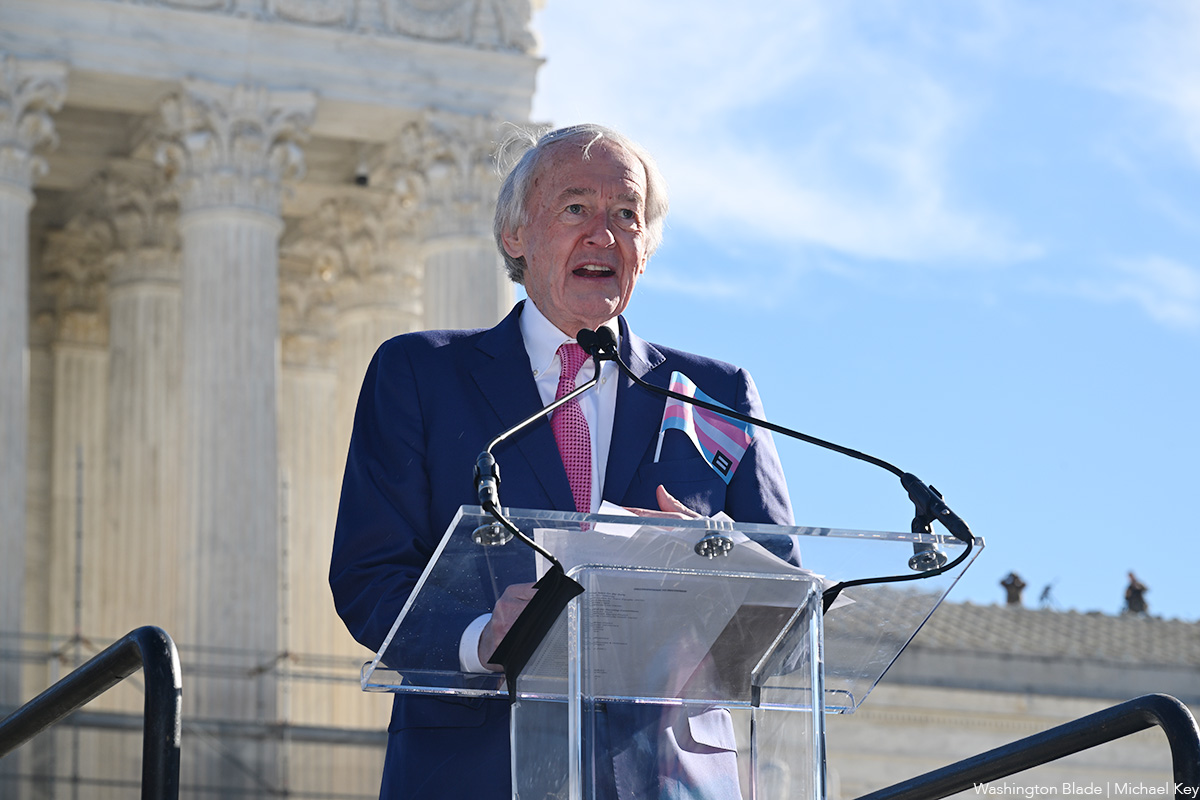
U.S. Sen. Ed Markey (D-Mass.) clinched the Democratic seat for his reelection campaign in Massachusetts’s primary election on Tuesday.
Markey won the deep-blue state with 64.8 percent of the vote, according to NBC News, triumphing over Marine Corps combat veteran and Congressman Seth Moulton, who received 35.2 percent of the vote.
Massachusetts’s primary election, which determined which Democratic candidate will head to the polls to face off against the Republican challenger in November, is being considered a victory for LGBTQ-inclusive policy, as well as for a divisive pro-transgender rights candidate — both things Markey has become an outspoken champion of.
Markey has experience at multiple levels of government, from the state level, where he served three terms in the state House of Representatives, to his federal tenure, including 20 terms in the U.S. House of Representatives and is now serving his second term as a senator. He has become a fixture of a changing Democratic Party in one of the most consistently blue places in the U.S.
This primary — and much of the national discussion surrounding the Senate seat — focused a lot of campaigning power on fighting the growing sentiment, led mostly by Republicans, that the frustration many Americans feel lends itself to an anti-establishment and anti-incumbent attitude.
Markey ran his campaign using his past as a reflection of his commitment to constantly putting his best foot forward for Bay Staters — particularly with apprehension for issues younger and more progressive democrats have been righting for — including Green New Deal and “Medicare for All” while Moulton — who was also elected to federal office prior to this run — campaigned on being younger than Markey, arguing that he was not the same type of established politician.
Moulton also faced backlash for negative comments about trans athletes, sparking criticism for those who did want younger candidate but want for trans rights to be protected.
Markey’s track record of supporting the LGBTQ community is one of the most clear in federal politics, one that has garnered a “100 percent lifetime voting record” on the Human Rights Campaign’s PAC politician review scorecard.
That list of Markey’s actions includes being a cosponsor of the Equality Act, driving landmark legislation to ensure federal protections for LGBTQ Americans, and being one of the most vocal proponents for trans rights in the federal government — specifically in multiple appropriations bills and in the National Defense Authorization Act. He was also the lead sponsor of the Transgender Health Care Access Act and the Transgender Bill of Rights resolution.
Markey first introduced the Transgender Bill of Rights in the Senate in 2023, where it ultimately failed to be brought to law. He reintroduced the legislation this year once again. This was a direct response to the attitude pushed by many conservatives after 2021, when the push to minimize trans rights started to become a key part of their cause and has been constantly propped up by the Trump-Vance administration.
“Massachusetts needs a senator who stands up and fights back, a senator who never forgets who they are fighting for,” Markey said during his victory speech. “That has been the mission of my life, and it always will be.”
Following the calling of the primary, a slew of LGBTQ organizations rallied behind Markey, many pushing his past as an asset that puts his money where his mouth is through advocating for legislation specifically protecting the LGBTQ community.
Tyler Hack, the executive director of the Christopher Street Project, an organization dedicated to pushing for legal protections for trans americans, released a statement following Markey’s win. Hack argued that putting forward such a staunchly pro-trans candidate is a win for the community, especially after endorsing him earlier this year.
“Tonight, anti-trans politics lost. Massachusetts rejected the idea that attacking transgender people is a shortcut to political power. Voters chose a different path: one where equality is not negotiable, cruelty is not courage, and transgender people do not have to disappear for Democrats to succeed.”
The Human Rights Campaign also endorsed him as a candidate earlier this year and issued a statement via its president, Kelley Robinson.
“Ed Markey has spent decades fighting for LGBTQ+ equality, for working people, and for a more livable world,” Robinson said. “He knows why equality matters. He’s stood with us no matter what. We were proud to endorse him this year, and when a pro-equality majority takes back the Senate this fall, we will continue to count on him as a champion for our community.”
Markey is running for reelection against Republican John Deaton in November, where he is expected to win.

Ind. prosecutor declines to press charges over false Buttigieg child welfare complaint

Historiography with heart

Remembering the LGBTQ heroes of 9/11 terrorist attacks

How Dolly became a folk saint for Appalachian queers

Report: 90 percent of LGBTQ groups around the world have lost funding since 2025

‘Here the Whole Time’ delivers queer coming-of-age comedy

Blade Foundation to host fundraiser in Rehoboth on Sept. 12

New book examines fashionista Audrey Smaltz’s fabulous life

Actress takes on bisexual ‘Ma’ Rainey in new Round House production

Iceland implements gender-neutral blood donor rules
-

 Movies4 days ago
‘Here the Whole Time’ delivers queer coming-of-age comedy
-
Out & About3 days ago
Blade Foundation to host fundraiser in Rehoboth on Sept. 12
-
Books3 days ago
New book examines fashionista Audrey Smaltz’s fabulous life
-
Theater3 days ago
Actress takes on bisexual ‘Ma’ Rainey in new Round House production