District of Columbia
Lawsuit charges D.C. Courts illegally fired trans man
Complaint says building technician subjected to abuse by supervisors
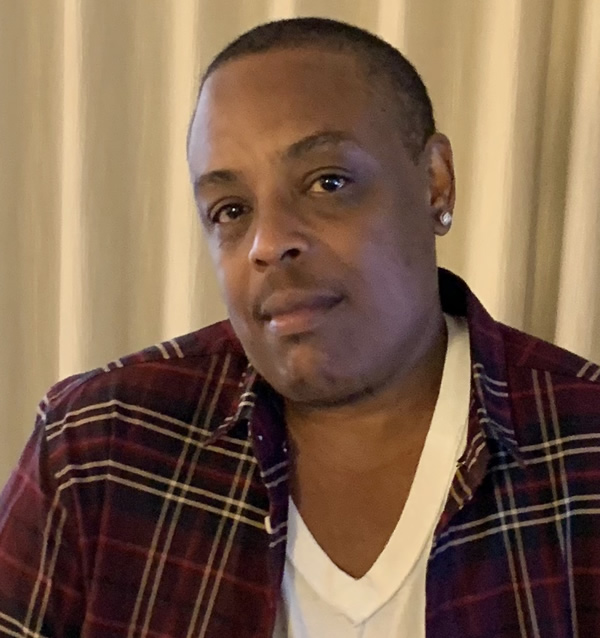
The D.C. Court of Appeals is currently deliberating over whether a 51-year-old transgender man who was fired in June 2019 from his job as a building maintenance technician at three buildings where the D.C. Superior Court and D.C. Court of Appeals are located has legal grounds to contest the firing, which he says was based on his gender identity.
In a little-noticed development, D.C. resident Dion Carter in June 2020 filed a lawsuit in D.C. Superior Court naming the D.C. government as the defendant in the case on procedural grounds, even though D.C. has no legal authority over the courts and was not responsible for more than eight years of discrimination and abusive treatment to which Carter was subjected on the job, according to Carter’s attorney, Stephen Pershing.
At the request of the Office of the D.C. Attorney General, which is representing the DC Court system in the lawsuit, a D.C. Superior Court judge on Jan. 29, 2021, dismissed the lawsuit, also on procedural grounds, without addressing any of Carter’s allegations of discrimination.
Superior Court Judge William M. Jackson stated in a three-page ruling that the D.C. Attorney General’s Office correctly stated in a motion seeking the dismissal of the case that Carter’s lawsuit failed to plead a viable cause of action on two grounds.
One of the grounds, the AG’s office stated, is that the D.C. Courts’ Comprehensive Personnel Policy does not provide employees with a private right of action to seek monetary damages in a lawsuit related to discrimination.
The second ground that the D.C. AG’s office cited, and the judge upheld, is that Carter’s lawsuit was invalid because under court rules pertaining to the D.C. Courts’ personnel system, an internal administrative complaint alleging employment discrimination must be filed and carried out to completion before a lawsuit could be filed in court.
In a brief in support of Carter’s lawsuit, Carter’s attorney, Stephen Pershing, strongly disputes the AG office’s assertions, saying at least one Court of Appeals ruling indicated the D.C. Courts’ personnel policies legally “mirror” the provisions of the D.C. Human Rights Act, which, among other things, prohibits discrimination based on gender identity and sexual orientation.
Pershing also argued in his court briefs that Carter did file an internal administrative complaint to contest his firing. But he stated that a high-level D.C. Courts’ official advised Carter that under the court system’s personnel rules, a ruling in Carter’s favor could not result in monetary compensation for lost wages or other legal remedies that Carter called for in his complaint. The official advised Carter and Pershing to file the discrimination case in a lawsuit in court, the lawsuit says. This prompted Carter to withdraw his administrative complaint, a development that Pershing now says was based on misleading information provided by the D.C. Court’s official.
In February 2021, Pershing appealed the dismissal of the case before the D.C. Court of Appeals, requesting that the dismissal be reversed and the case be sent back to D.C. Superior Court, where the specific merits of the case could be argued and presented before a jury.
Since the filing of the appeal, Pershing and attorneys with the Office of the D.C. Attorney General have filed briefs under consideration by the Court of Appeals supporting and opposing the contention that the D.C. Courts’ personnel rules allow a remedy for Carter’s discrimination claims.
Like the original lawsuit filed in Superior Court, Carter’s appeal briefs filed by Pershing state that the alleged discrimination against Carter started shortly after Carter first began working in the court system’s building maintenance department in January 2010 as an out lesbian prior to his transition as a male.
At that time Carter already had 15 years of experience in the field of building maintenance technology and became the first woman to hold such as position at the D.C. Courts, the lawsuit says.
According to the lawsuit, the abusive and discriminatory treatment toward Carter increased dramatically in 2015 when Carter informed his then-supervisor Emanuel Allen that he would be taking a short period of leave to undergo gender reassignment surgery. Upon his return to work after the first of five gender reassignment surgical procedures that he has now completed, Carter presented for the first time at work as a male, the lawsuit says.
“For the six months between Carter’s Family Medical Leave Act notice and his surgery, Mr. Allen cut Mr. Carter out of all overtime duty, overtime that was mandatory for all building maintenance workers and that they considered desirable,” the lawsuit says. It says that when Carter asked why Allen did this Allen refused to provide an answer and threatened to issue a poor work performance evaluation against Carter if he continued to question the overtime denial decision.
When Carter returned from his surgery and presented as male, the lawsuit charges, Allen repeatedly referred to Carter as “he-she” in the presence of fellow employees as well as high-level officials involved in the operation of the court system buildings. Carter viewed his treatment by Allen as a form of bullying and disrespect, the lawsuit states.
Over the next three years, according to the lawsuit, Carter was subjected to a hostile work environment by supervisors who, among other things, made false claims that Carter was not doing his job properly, was absent from work without permission, and was acting “aggressively” toward his supervisors or fellow employees. One supervisor blamed Carter’s alleged hostile behavior on the testosterone treatment that Carter was undergoing as a routine part of his gender transition process, the lawsuit says.
The lawsuit alleges that Carter was ultimately fired “on a false pretext” allegedly fabricated by James Vaughn, the Chief Building Engineer and Acting Building Operations Manager of the D.C. Courts. The lawsuit and appeals court briefs say Vaughn accused Carter of consuming an alcoholic beverage at one of the court buildings where Carter was assigned to work on April 6, 2019.
Vaughn recommended to the court system’s acting director of capital projects and facilities management that Carter be terminated from his job on grounds of violating Personnel Policy No. 800, which prohibits consuming illegal drugs or alcohol on court property while on duty.
“That allegation is factually untrue,” the lawsuit states. “Mr. Carter neither consumed nor was under the influence of alcohol while on site,” it says.
“Mr. Carter’s termination was unjustified on any legitimate ground and was an act of unlawful discrimination on account of Mr. Carter’s race, sex, sexual orientation and/or gender identity and expression, and in retaliation for his complaining to his superiors about his illicit mistreatment on these grounds,” the lawsuit and the current appeals court briefs charge.
“These acts and omissions caused Mr. Carter loss of employment, loss of pay and other benefits of employment, as well as anguish, intense hurt, humiliation, anger, sense of loss, disappointment, and emotional conflict between his desire for professional excellence and the torment inflicted on him merely for showing up every day, working, and working well, as an African American, as a lesbian, and as a transgender male,” the lawsuit says.
“The acts of one or more of Mr. Carter’s superiors alleged in this complaint were motivated by actual malice and/or evil intent and were done with the intention to cause Mr. Carter pain, humiliation, anguish and torment, and as such warrant the imposition of punitive damages,” the lawsuit concludes.
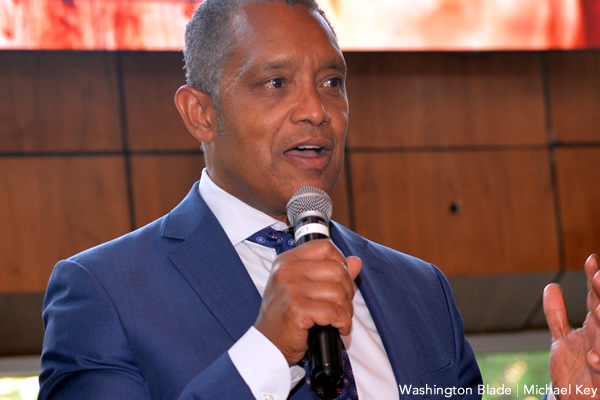
A spokesperson for the Office of the D.C. Attorney General said the office is preparing a statement in response to an inquiry from the Blade on Carter’s discrimination allegations. (We will update this story when we receive the statement.) Among the names appearing on the AG office’s court briefs in the Carter lawsuit is D.C. Attorney General Karl Racine, who has expressed strong support for LGBTQ rights in the past.
Douglas Buchanan, a spokesperson for the D.C. Courts, said he would try to determine whether the court system’s building maintenance department would respond to a Blade request for comment on the Carter lawsuit and its allegations that high-level court officials in the maintenance department engaged in anti-transgender discrimination.
Pershing said he plans to file a separate lawsuit on Carter’s behalf in the U.S. District Court for the District of Columbia claiming the discrimination Carter faced violated his constitutional rights. He said he is hopeful that the D.C. Court of Appeals will rule in Carter’s favor, but a backlog in cases will likely mean a ruling would not take place before June of this year.
Under federal court rules, Carter must file his federal discrimination lawsuit in the U.S. District Court within three years from the time he was fired from his job in June of 2019.
Congress created the D.C. court system as a federal entity shortly before it created D.C.’s home rule government in the early 1970s. The U.S. president nominates, and the U.S. Senate confirms all judges. The D.C. Council and mayor have no control over the court system, with Congress funding the system. The system is run by a Joint Committee on Judicial Administration consisting of five judges and a secretary who serves as the executive officer.
Previous D.C. Court of Appeals rulings have held that the D.C. government rather than the D.C. Courts’ system itself must be named as the defendant in lawsuits seeking redress from the D.C. Courts.






District of Columbia
Gay-owned pizzeria in Dupont Circle burglarized
Protest Pizza owners say community has expressed support

Gay activist Randy Downs said he and his business and life partner Ricky Bennett are grateful for the support they have received from the Dupont Circle community after they released a video showing a suspect breaking into their recently opened pizza shop and taking money from a cash register shortly before 3 a.m. on Friday, Aug. 21.
The surveillance video shows a man wearing black clothing with his face covered, smashing the glass front door of Protest Pizza, located at 1633 ½ P St., N.W. The video, which Downs and Bennett provided to D.C. police, also shows the suspect climbing over the bar to get to a cash register, which he opened to take out cash.
A D.C. police report obtained by the Washington Blade lists the incident as a Burglary in the Second Degree and says the owners reported “approximately $78 in cash” was taken from the cash register. The report says the incident is not listed as a suspected hate crime.
Downs told the Washington Blade that after he and Bennett reported the break-in and theft on social media, they received an overwhelming showing of support from neighbors and others, including business owners, from across the nation.
“The break-in was upsetting, but it is not what will define Protest Pizza,” Downs said. “What defines us is how quickly people showed up,” he told the Blade. “One person came looking for a cash register; our community saw a gathering place worth protecting. The response reminded us that Protest’s real value was never in the register.”
Downs said he and Bennett, who live around the corner on the section of 17th Street, N.W., near several other bars and restaurants, including the gay bar JRs are located, opened Protest Pizza in November 2025.
“Ricky and I built Protest Pizza as a positive, welcoming, queer owned neighborhood restaurant and bar — a space for protest and joy,” he said.
A D.C. police spokesperson said police offer a reward of up to $1,000 for information leading to an arrest and conviction of a suspect responsible for the type of burglary and theft that occurred at Protest Pizza. Police say anyone with information to help solve this type of crime should call the police tipline at 202-727-9099.
District of Columbia
Advocates honored at Engendered Spirit Awards
Annual ceremony held at conclusion of Trans Pride DC
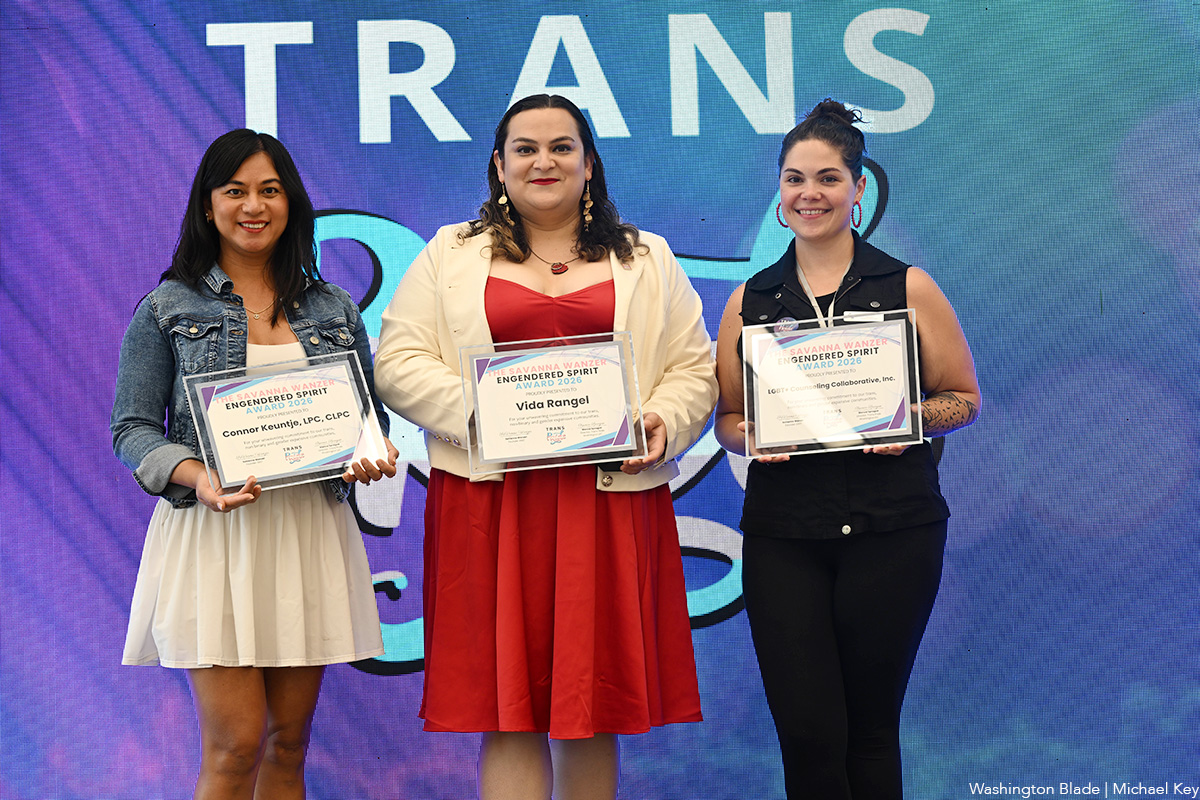
The 2026 SaVanna Wanzer Engendered Spirit Awards ceremony took place at the Martin Luther King, Jr. Memorial Library in D.C. on Saturday. The ceremony was held at the conclusion of the day-long Trans Pride DC: Encore.
Honorees included D.C. Mayor’s Office of Community Affairs Deputy Director Vida Rangel; the LGBT+ Counseling Collaborative, Inc.; and Connor Keuntje, CLP, CLPC.
Trans Pride DC: Encore was held throughout Saturday with several workshop sessions and a virtual conversation with actress and advocate Dominique Jackson.
The annual Engendered Spirit Awards were renamed the “SaVanna Wanzer Engendered Spirit Awards” in honor of SaVanna Wanzer, founder of D.C. Trans Pride. Wanzer died on April 24 of this year.
Speakers at the ceremony included Japer Bowles, director of the D.C. Mayor’s Office of LGBTQ Affairs and Bianca Sprague, executive director of D.C. Trans Pride.
“The intent behind this award and honoring members of our communities, organizations, and allies, is to really elevate all of the work that they’re doing to provide resources, tools, learning opportunities and connections: centering trans folks, gender non-conforming, and gender diverse individuals,” Sprague said.
District of Columbia
Man charged with anti-gay assault in D.C. accepts plea offer
Community service offered in exchange for dismissing hate crime charge

A Germantown, Md., man arrested by D.C. police on a charge of simple assault with a hate crime designation for allegedly assaulting a gay man while using “homophobic slurs” has agreed to an offer by prosecutors to plead guilty to simple assault without the hate crime designation and with the promise of having the charge dismissed if he completes, among other requirements, 48 hours of community service work.
Dean Edmundson, 26, standing beside his attorney, officially accepted the offer of a Deferred Sentencing Agreement at an Aug. 18 status hearing in D.C. Superior Court after Senior Judge Hiram Puig-Lugo explained the details of the agreement and confirmed Edmundson’s decision to waive his right to a trial.
Among other things, the judge said the agreement offered by prosecutors with the Office of the United States Attorney for D.C. includes the requirement that he successfully completes 48 hours of community service work, stays away from the victim of the assault, writes a letter of apology to the victim, and does not violate any other laws or get into trouble for the next 12 months.
Puig-Lugo then announced he scheduled a sentencing hearing for Edmundson for Aug. 18, 2027, at which time a determination will made on whether he has fulfilled all the requirements under the agreement and whether the simple assault charge will be dismissed. The judge added that if it is determined that Edmundson did not fulfil the terms of the agreement the charge would remain in place and he could be sentenced to a possible maximum penalty of 180 days in jail and a $1,000 fine.
Edmundson, who appeared in court wearing a business suit with a dress shirt and tie, was released on his own recognizance following his arrest by D.C. police on Feb. 7, 2026.
Police and court records show he was initially charged by arresting officers with simple assault with a hate crime designation. In a statement announcing the arrest, D.C. police said, “On Saturday, Feb. 7, 2026, at approximately 7:45 p.m. the victim and suspect were in the 1500 block of 14th Street, Northwest. The suspect requested a ‘high five’ from the victim. The victim declined and kept walking,” the statement says.
A follow-up arrest affidavit filed by police states that Edmundson followed the victim and called him “bald, ugly, and gay,” and then “pushed the victim with both hands, shoving them, causing the victim to feel the force of the push.” The affidavit adds, “The victim stated that they felt offended and that they were also gay.”
According to the court records, the Office of the U.S. Attorney filed its official charge of simple assault against Edmunson on Feb. 9 without the hate crime designation. The office has not responded to a request by the Washington Blade for its reason for dropping the hate crime designation. The office has also not immediately responded to a follow-up inquiry from the Blade this week asking if prosecutors consulted the victim to obtain the victim’s thoughts about the plea offer.
The Blade, which has a policy of not disclosing the identify of crime victims in cases like this without their consent, could not immediately obtain contact information to reach the victim for comment.
Court records show that Edmundson rejected an earlier plea agreement offer by prosecutors and he was scheduled for a non-jury trial on Aug. 18. The records show his attorney filed a motion earlier this month asking the judge to convert the trial into status hearing on that same day after his client accepted the Deferred Sentencing Agreement offer by the U.S. Attorney’s office. The judge approved the motion without objection from prosecutors.

Dolly Parton dies at 80

Monument to LGBTQ Canadians officially unveiled

The fight to save one of Baltimore’s last gay bars

When home becomes a journey: migration, memory, and the African diaspora

Gay-owned pizzeria in Dupont Circle burglarized

Trump-Vance administration’s LGBTQ brain drain: what you need to know

Not all trans people are the same

UPDATE: Impulse Group’s ‘PrEP Pool Party’ cancelled

Calendar: August 21-27