District of Columbia
HIV treatment advocates warn GOP ‘cuts will kill’ at Capitol rally
‘These cuts will kill’
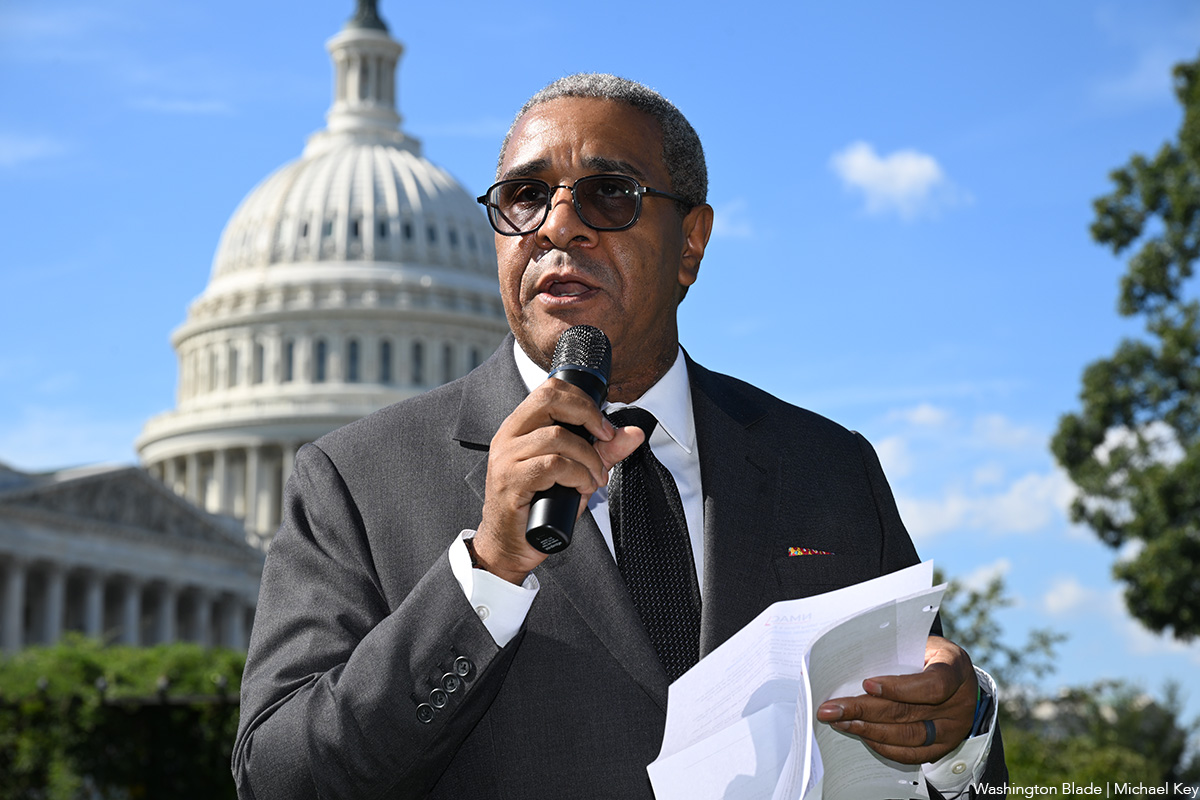
Advocates for HIV treatment and prevention gathered on Capitol Hill on Wednesday afternoon for a rally following meetings with lawmakers. Speakers at the rally included U.S. Rep. Maxine Waters (D-Calif.), the entertainers Peppermint and Javier Muñoz, as well as several movement leaders. The rally was held as NMAC, formerly known as the National Minority AIDS Council, hosts the U.S. Conference on HIV/AIDS in Washington, D.C. this week.
“As thousands of HIV advocates from across the world gather in D.C. this week to share scientific breakthroughs, build up capacity training and surround ourselves with community, we recognize that this particular moment demands a fight for our very existence,” said Harold Phillips, incoming CEO of NMAC, to the crowd. “We are here today not just to raise our voices, but to demand and defend our future.”
“At a time when public health structures are under attack, and when science is politicized, and when the most vulnerable among us is being pushed further to the margins, we stand united to say, ‘funding for HIV testing, prevention, treatment, housing and research must be protected,’” Phillips continued.
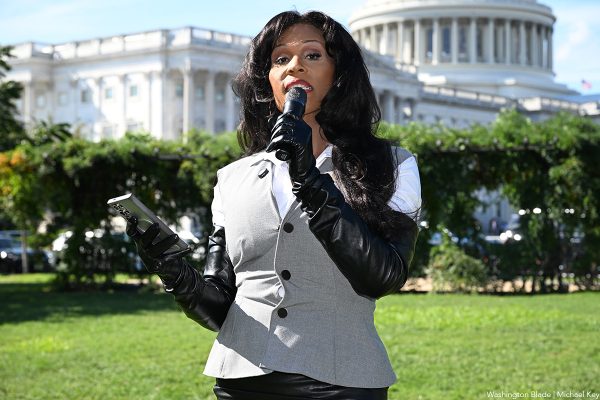
Peppermint, advocate and entertainer of “RuPaul’s Drag Race” fame, gave remarks at the rally.
“The cuts being proposed will completely erase all of our progress, all of the progress we’ve made since the 1980s. Not just in programs, but in science and in lives saved. These cuts will kill,” Peppermint said.
“I stand here today a proud actress, a proud performer, a proud advocate, and a very proud Black, trans woman,” Peppermint continued. “My very existence is the American dream: free to love, and live and express myself. This American dream is, once again, under threat. But from the inside. And I am calling on Congress to see us. Because we are not disposable, we are not invisible and we will not be silent.”
In the remarks Rep. Maxine Waters (D-Calif.) gave at the rally, the congresswoman spoke about U.S. Department of Health and Human Services Secretary Robert F. Kennedy, Jr. Secretary Kennedy faced a grilling on Capitol Hill Thursday in the U.S. Senate.
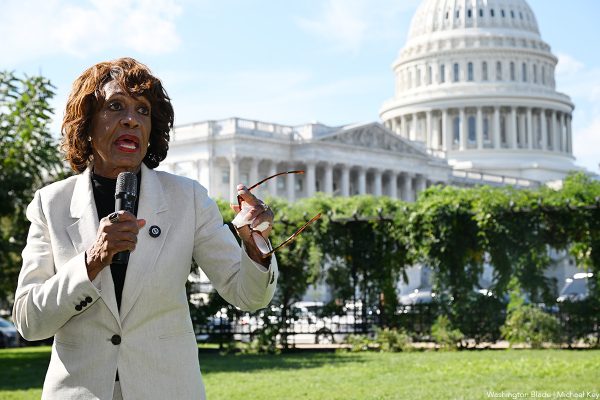
“My staff was trying to remind me of the letter that I sent to Kennedy asking him, first of all, not to fire everybody, and secondly to make sure that he supported the funding,” Waters told the crowd at the rally. “Well, I knew that was going to be a useless thing to do because of who he is, how he has defined himself, how he cannot be trusted and he doesn’t know what the hell he is doing. I sent it anyway, because we learned that you have to do everything that you possibly can from the first time we first realized what needed to be done in order to save lives and to provide the kind of care that was needed for those who were HIV+. “
“Let’s not feel like we are so intimidated by what is going on with the president and all of the sycophants he has appointed to his Cabinet,” Waters continued. “Let’s not be intimidated. Let’s say, it’s time to fight like hell, maybe in ways we’ve never had to do before.”
Hamilton star Javier Muñoz gave a personal account of his experience living with HIV.
“Throughout my 23 years of living with HIV, there have been times when my employment as an artist has waned,” Muñoz recounted. “And with that came the inevitable loss of my health insurance coverage. It has been in these moments that were it not for the financial support from partially federally funded programs and organizations like ADAP [AIDS Drug Assistance Program], I would not have been able to afford the costs of my life-saving and life-sustaining medications.”
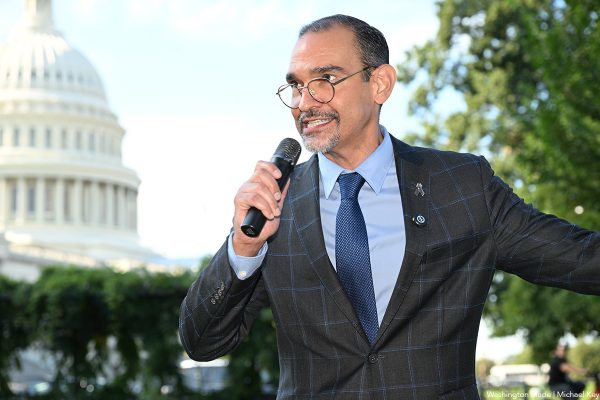
“Back when this epidemic first began, without any treatment options, we watched it ravage an entire generation,” Muñoz continued. “Killing our friends, our neighbors, our brothers, our sisters, our mothers and fathers. Personally robbing me of a future with the love of my life who died in my arms in what was St. Vincent’s Hospital. These cuts threaten to take us back to those times. Back to that grief and that suffering and that violent neglect, which needlessly took thousands of lives. Cuts to HIV funding kill. Period. Cuts to HIV funding increases the need for lifelong healthcare, costing all of us billions of dollars and countless lives in what could be saved right now by preventing these cuts from passing.”
“No matter where you live, no matter who you are, everyone deserves the integrity, the dignity and humanity that only access to healthcare can bring,” Muñoz said. “Access to treatment, access to services: that’s why we keep fighting. Whether we are fighting for ourselves, for someone we love, for the ways this intersects with so many other causes, or for the overall good of the fight — we stand together, now, tomorrow, always. To all living with HIV like me, do not give up and do not be silent.”





District of Columbia
Gay-owned pizzeria in Dupont Circle burglarized
Protest Pizza owners say community has expressed support
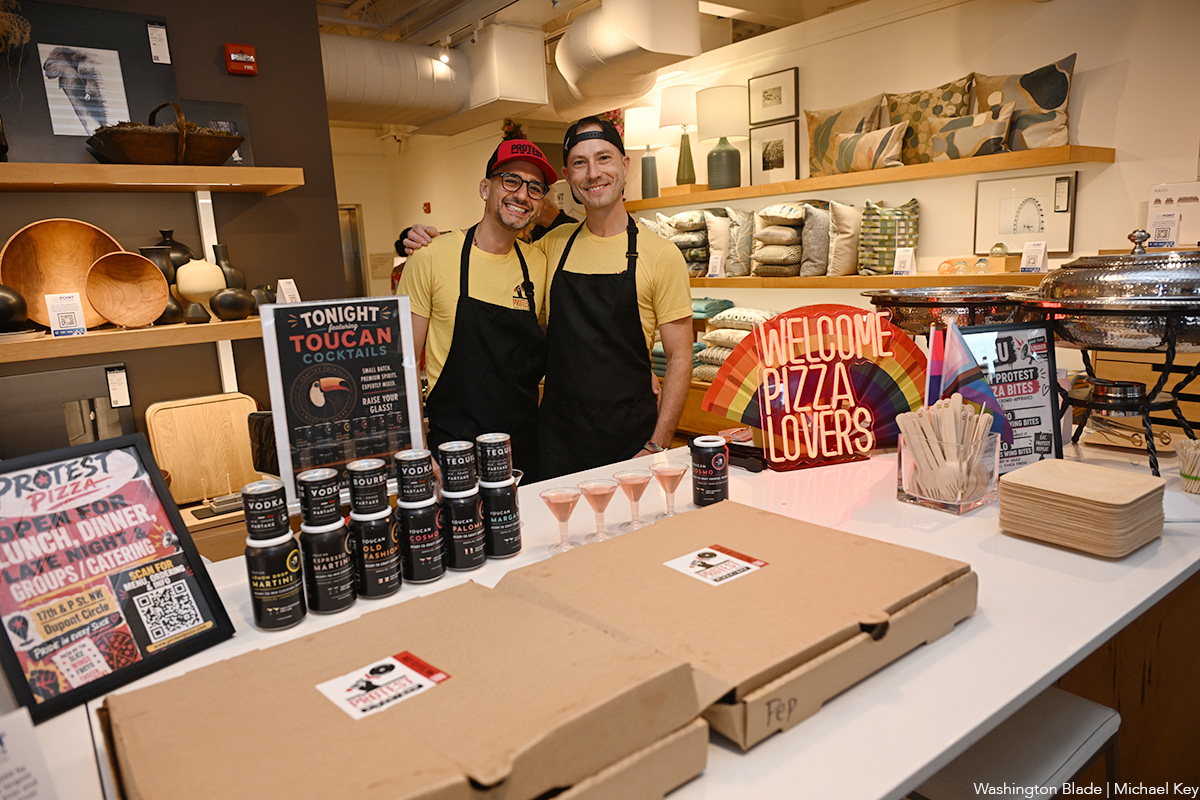
Gay activist Randy Downs said he and his business and life partner Ricky Bennett are grateful for the support they have received from the Dupont Circle community after they released a video showing a suspect breaking into their recently opened pizza shop and taking money from a cash register shortly before 3 a.m. on Friday, Aug. 21.
The surveillance video shows a man wearing black clothing with his face covered, smashing the glass front door of Protest Pizza, located at 1633 ½ P St., N.W. The video, which Downs and Bennett provided to D.C. police, also shows the suspect climbing over the bar to get to a cash register, which he opened to take out cash.
A D.C. police report obtained by the Washington Blade lists the incident as a Burglary in the Second Degree and says the owners reported “approximately $78 in cash” was taken from the cash register. The report says the incident is not listed as a suspected hate crime.
Downs told the Washington Blade that after he and Bennett reported the break-in and theft on social media, they received an overwhelming showing of support from neighbors and others, including business owners, from across the nation.
“The break-in was upsetting, but it is not what will define Protest Pizza,” Downs said. “What defines us is how quickly people showed up,” he told the Blade. “One person came looking for a cash register; our community saw a gathering place worth protecting. The response reminded us that Protest’s real value was never in the register.”
Downs said he and Bennett, who live around the corner on the section of 17th Street, N.W., near several other bars and restaurants, including the gay bar JRs are located, opened Protest Pizza in November 2025.
“Ricky and I built Protest Pizza as a positive, welcoming, queer owned neighborhood restaurant and bar — a space for protest and joy,” he said.
A D.C. police spokesperson said police offer a reward of up to $1,000 for information leading to an arrest and conviction of a suspect responsible for the type of burglary and theft that occurred at Protest Pizza. Police say anyone with information to help solve this type of crime should call the police tipline at 202-727-9099.
District of Columbia
Advocates honored at Engendered Spirit Awards
Annual ceremony held at conclusion of Trans Pride DC
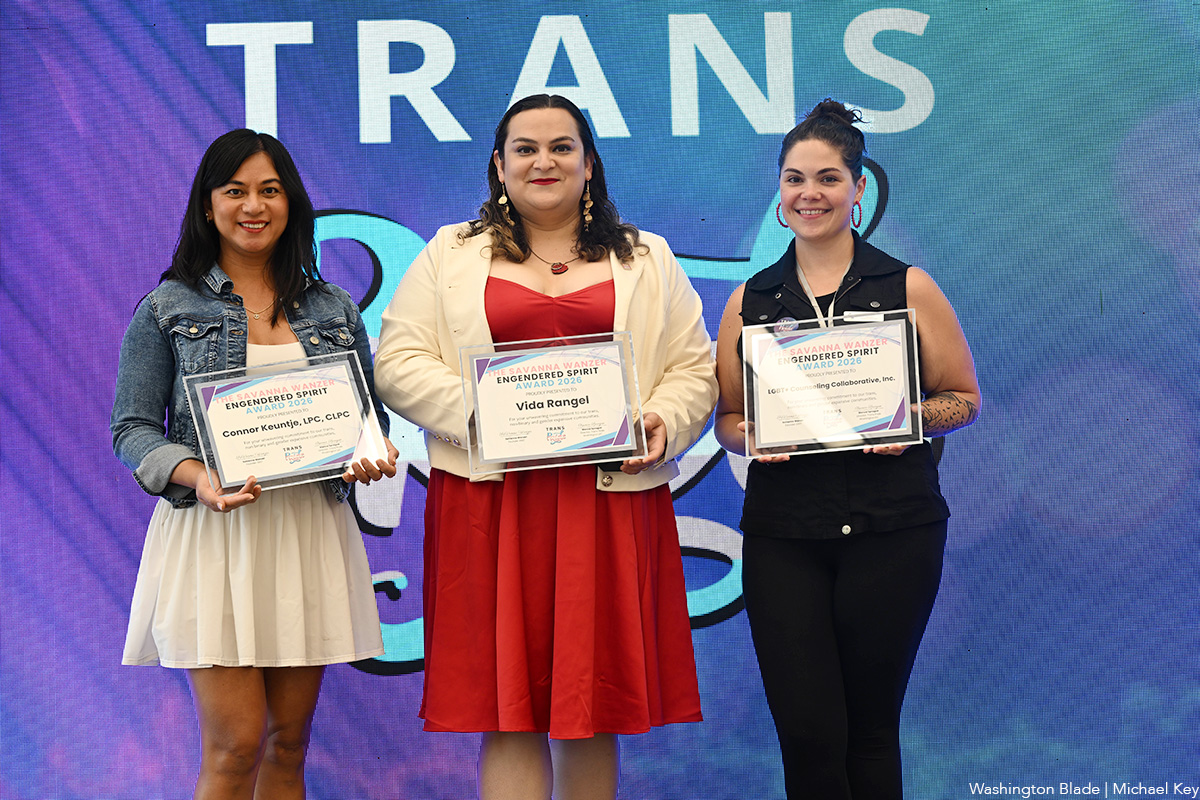
The 2026 SaVanna Wanzer Engendered Spirit Awards ceremony took place at the Martin Luther King, Jr. Memorial Library in D.C. on Saturday. The ceremony was held at the conclusion of the day-long Trans Pride DC: Encore.
Honorees included D.C. Mayor’s Office of Community Affairs Deputy Director Vida Rangel; the LGBT+ Counseling Collaborative, Inc.; and Connor Keuntje, CLP, CLPC.
Trans Pride DC: Encore was held throughout Saturday with several workshop sessions and a virtual conversation with actress and advocate Dominique Jackson.
The annual Engendered Spirit Awards were renamed the “SaVanna Wanzer Engendered Spirit Awards” in honor of SaVanna Wanzer, founder of D.C. Trans Pride. Wanzer died on April 24 of this year.
Speakers at the ceremony included Japer Bowles, director of the D.C. Mayor’s Office of LGBTQ Affairs and Bianca Sprague, executive director of D.C. Trans Pride.
“The intent behind this award and honoring members of our communities, organizations, and allies, is to really elevate all of the work that they’re doing to provide resources, tools, learning opportunities and connections: centering trans folks, gender non-conforming, and gender diverse individuals,” Sprague said.
District of Columbia
Man charged with anti-gay assault in D.C. accepts plea offer
Community service offered in exchange for dismissing hate crime charge

A Germantown, Md., man arrested by D.C. police on a charge of simple assault with a hate crime designation for allegedly assaulting a gay man while using “homophobic slurs” has agreed to an offer by prosecutors to plead guilty to simple assault without the hate crime designation and with the promise of having the charge dismissed if he completes, among other requirements, 48 hours of community service work.
Dean Edmundson, 26, standing beside his attorney, officially accepted the offer of a Deferred Sentencing Agreement at an Aug. 18 status hearing in D.C. Superior Court after Senior Judge Hiram Puig-Lugo explained the details of the agreement and confirmed Edmundson’s decision to waive his right to a trial.
Among other things, the judge said the agreement offered by prosecutors with the Office of the United States Attorney for D.C. includes the requirement that he successfully completes 48 hours of community service work, stays away from the victim of the assault, writes a letter of apology to the victim, and does not violate any other laws or get into trouble for the next 12 months.
Puig-Lugo then announced he scheduled a sentencing hearing for Edmundson for Aug. 18, 2027, at which time a determination will made on whether he has fulfilled all the requirements under the agreement and whether the simple assault charge will be dismissed. The judge added that if it is determined that Edmundson did not fulfil the terms of the agreement the charge would remain in place and he could be sentenced to a possible maximum penalty of 180 days in jail and a $1,000 fine.
Edmundson, who appeared in court wearing a business suit with a dress shirt and tie, was released on his own recognizance following his arrest by D.C. police on Feb. 7, 2026.
Police and court records show he was initially charged by arresting officers with simple assault with a hate crime designation. In a statement announcing the arrest, D.C. police said, “On Saturday, Feb. 7, 2026, at approximately 7:45 p.m. the victim and suspect were in the 1500 block of 14th Street, Northwest. The suspect requested a ‘high five’ from the victim. The victim declined and kept walking,” the statement says.
A follow-up arrest affidavit filed by police states that Edmundson followed the victim and called him “bald, ugly, and gay,” and then “pushed the victim with both hands, shoving them, causing the victim to feel the force of the push.” The affidavit adds, “The victim stated that they felt offended and that they were also gay.”
According to the court records, the Office of the U.S. Attorney filed its official charge of simple assault against Edmunson on Feb. 9 without the hate crime designation. The office has not responded to a request by the Washington Blade for its reason for dropping the hate crime designation. The office has also not immediately responded to a follow-up inquiry from the Blade this week asking if prosecutors consulted the victim to obtain the victim’s thoughts about the plea offer.
The Blade, which has a policy of not disclosing the identify of crime victims in cases like this without their consent, could not immediately obtain contact information to reach the victim for comment.
Court records show that Edmundson rejected an earlier plea agreement offer by prosecutors and he was scheduled for a non-jury trial on Aug. 18. The records show his attorney filed a motion earlier this month asking the judge to convert the trial into status hearing on that same day after his client accepted the Deferred Sentencing Agreement offer by the U.S. Attorney’s office. The judge approved the motion without objection from prosecutors.

Gay-owned pizzeria in Dupont Circle burglarized

Advocates honored at Engendered Spirit Awards

Two awesome, affordable rides

Proposed Indian foreign funding law overhaul could further pressure LGBTQ groups

Why we need to protect ‘sacrilegious’ art

Chicago’s LGBTQ+ youth: Why their zip code still matters

I respect AOC, even though I often disagree with her

Black Educated Lesbians: A movement rooted in community

Hegseth uses transphobic slur while campaigning for Iowa congressman

Trump-Vance administration’s LGBTQ brain drain: what you need to know
-

 Illinois5 days ago
Chicago’s LGBTQ+ youth: Why their zip code still matters
-
Opinions5 days ago
I respect AOC, even though I often disagree with her
-
Opinions5 days ago
Black Educated Lesbians: A movement rooted in community
-
U.S. Military/Pentagon5 days ago
Hegseth uses transphobic slur while campaigning for Iowa congressman