District of Columbia
Ruby Corado jailed after sentencing is postponed
Former Casa Ruby director pleaded guilty to wire fraud in 2024
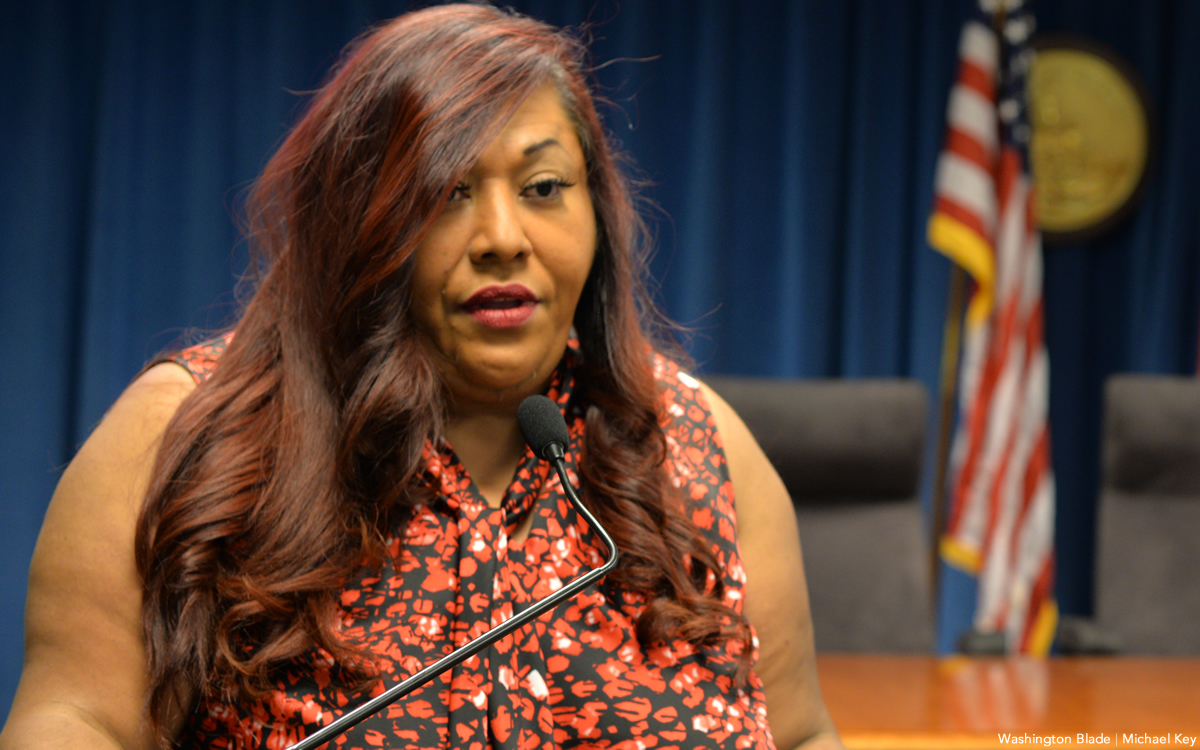
A federal judge on Oct. 14 ordered Ruby Corado, the founder and former executive director of the now closed D.C. LGBTQ community services organization Casa Ruby, held in jail while she awaits sentencing on a charge of wire fraud to which she pleaded guilty in July 2024.
U.S. District Court Judge Trevor N. McFadden postponed the sentencing hearing, which had been scheduled for the next day on Oct. 15, after Corado’s court appointed public defender attorney withdrew her representation of Corado.
The attorney, Elizabeth Mullin, stated in a court motion that her reason for withdrawing from the case was an “irreconcilable breakdown in the attorney-client relationship.”
After calling Corado and Mullin to speak with him at the judge’s bench in a private conversation, McFadden told Corado he was revoking her release status while she awaited sentencing because he was concerned she would not return to court for her sentencing.
Corado disputed the judge’s concern, saying she has always returned to court for previous hearings and would return to court for the sentencing. McFadden refused to reverse his order that she be held until sentencing.
He said he would postpone the Oct. 15 sentencing to give Corado time to retain another lawyer. Corado told the Washington Blade prior to the Oct. 14 hearing outside the courtroom that she planned to retain her own attorney rather than use another court appointed attorney. She said she disputes the charge to which she pleaded guilty but declined to discuss the matter on grounds that she was restricted from publicly discussing her case
The judge’s postponement of the sentencing, which he did not reschedule, marked the seventh time Corado’s sentencing hearing has been postponed. Court records show the previous postponements came mostly at the request of Corado’s attorneys, with one caused by a medical issue faced by Corado.
Online court records posted later in the day on Oct. 14 show Judge McFadden scheduled a follow-up hearing for Dec. 15 at which time arrangements would be made for a new defense attorney to represent Corado.
The charge to which she pleaded guilty is based on the allegation that she diverted at least $180,000 “in taxpayer backed emergency COVID relief funds to private offshore bank accounts for her personal use,” according to an earlier statement released by prosecutors with the Office of the U.S. Attorney for D.C.
Court records show that FBI agents arrested Corado on March 5, 2024, at a hotel in Laurel, Md., shortly after she returned to the U.S. from El Salvador, where authorities said she moved in 2022. Prosecutors have said in charging documents that she allegedly “fled” to El Salvador after “financial irregularities at Casa Ruby became public,” and the LGBTQ organization ceased operating.
Shortly after her arrest, another judge agreed to release Corado into the custody of her niece in Rockville, Md., under a home detention order until the time of her trial.
As part of a plea agreement with prosecutors, additional charges filed against her at the time of her arrest, including bank fraud, laundering monetary instruments, monetary transactions in criminally delivered proceeds, and failure to file a report of foreign bank accounts, were dropped at the time she pleaded guilty.
Under the federal wire fraud law Corado could be sentenced to a possible maximum penalty of 30 years in prison. But in a 16-page sentencing memorandum filed in court on Oct. 8, Assistant U.S. Attorney John W. Borchert, the lead prosecutor in the case, called for a sentence of 33 months of incarceration.
“The defendant and Casa Ruby received no less than $1.2 million in taxpayer-backed funds during the COVID-19 global health crisis,” the sentencing memo states. “But rather than use those funds to support Casa Ruby’s mission as the defendant promised, the defendant further contributed to its demise by unlawfully transferring no less than $180,000 of those federal emergency relief funds into her own private offshore bank accounts,” it says.
“Then when media reports suggested the defendant would be prosecuted for squandering Casa Ruby’s government funding, she sold her house and fled the country,” the memo says. “Meanwhile, the people who she had promised to pay with taxpayer-backed funds – her employees, landlord, and vendors – were left behind flat broke.”
In an Oct. 10 interview with WUSA-9 news, Corado disputed the claims that she used the funds she took from Casa Ruby to El Salvador for personal use. WUSA reports that Corado said she was working on a project to establish a Casa Ruby in El Salvador to help LGBTQ migrants avoid a “dangerous journey” to the U.S.
“At the time there was a huge crisis with immigration,” Corado said in an on-air interview. “We helped them. That was my mission,“ she said. When asked by WUSA if she left the U.S. as Casa Ruby folded, she replied, “There was a famous tweet that said it appears she has left the country. No, I was on and off.”
She added, “The first thing I want to say to people, mainly clients, I am sorry. I am sorry that I have not been there to support you the way I always have. That is something that is part of my healing.”


District of Columbia
Push to elect more LGBTQ ANC members yields results
31 of 43 known LGBTQ ANC members elected in 2024 seeking re-election
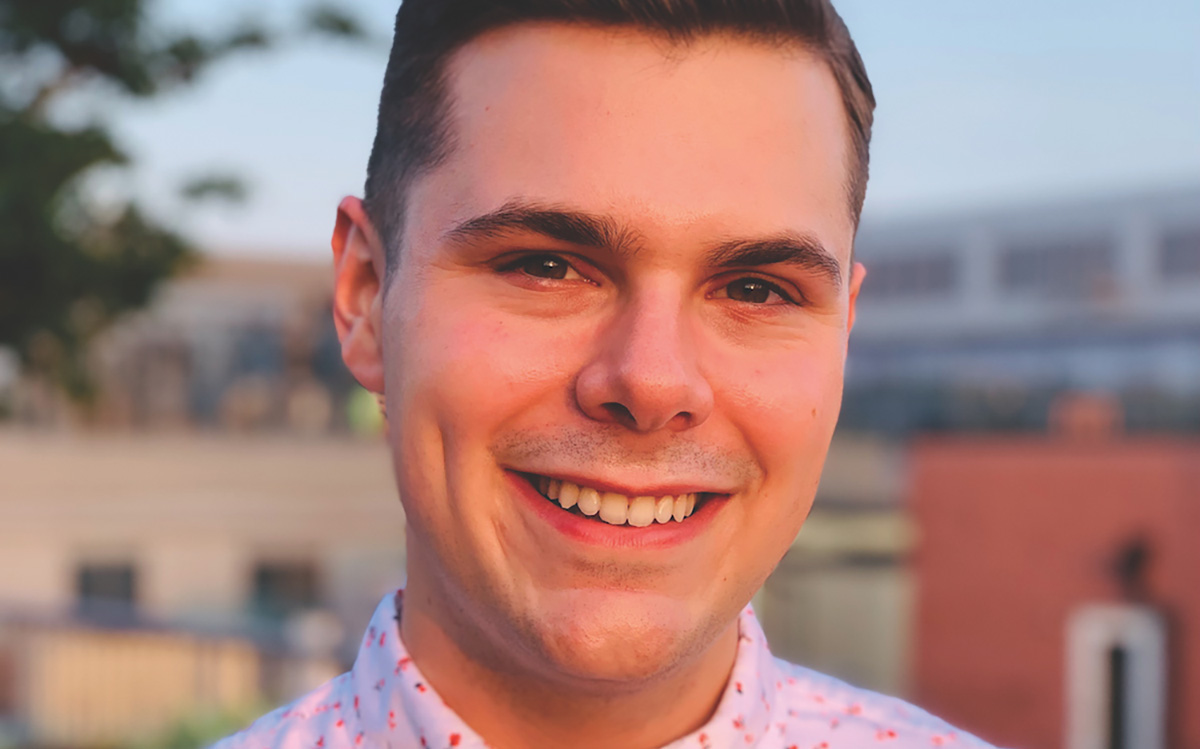
A 2026 list of candidates released by the D.C. Board of Elections shows that 31 of the 43 known LGBTQ candidates who won election in 2024 as Advisory Neighborhood Commissioners have filed the required petition signatures to be placed on the ballot this year to run for re-election.
The Washington Blade reported in 2024 that 43 known LGBTQ candidates won election to ANC seats that year in the November election
In a related development, the president of Capital Stonewall Democrats, D.C.’s largest local LGBTQ political group, said the group this year has recruited at least 39 LGBTQ candidates to run for Advisory Neighborhood Commission seats in the city’s Nov. 3 general election.
The group’s president, Stevie McCarty, an incumbent ANC member in the city’s Shaw neighborhood who is running for re-election, said the 39 candidates and possibly more responded to the group’s Queering ANCs campaign launched on July 7 that includes a website with detailed instructions for how best to run for an ANC seat.
“Since launching in early July, the site has drawn more than 20,000 views, and 39 candidates have used it to actually run,” McCarty said in a statement. He said he wasn’t sure if all the 39 candidates wanted to be identified as LGBTQ, and he was reviewing the list of incumbent LGBTQ ANC members who won election in 2024 to determine if any of the 39 candidates recruited were among those incumbents. He said he was not ready to release the names of the 39 candidates he said his group recruited to run for an ANC seat.
If none of the 39 candidates recruited by Capital Stonewall Democrats are among the 31 known LGBTQ ANC incumbents running for re-election, it would mean at least 70 LGBTQ ANC candidates will be on the city’s November election ballot.
McCarty said Capital Stonewall Democrats will send candidate questionnaires to the known LGBTQ ANC candidates as part of its process for endorsing candidates in the November election. He said he expects the group to help campaign for and provide financial support for the ANC candidates it endorses.
The D.C. local government is believed to be unique among U.S. cities in currently having 46 Advisory Neighborhood Commissions consisting of 345 single member districts in neighborhoods throughout the city in which unpaid Advisory Neighborhood Commissioners are elected for two-year terms.
The commissions are charged with considering a wide range of policies and programs impacting their neighborhoods, including traffic, parking, recreation, street improvements, zoning, liquor licenses, and economic development. Although ANCs do not have authority to set or reject policies or actions by city agencies, the agencies are required to give “great weight” to ANC recommendations, according to the law creating the ANCs.
“As an ANC member, I know firsthand how these seats shape our neighborhoods, from housing and public safety to sanitation,” McCarty said in the Capital Stonewall Democrats statement announcing the launch of the Queering ANCs campaign in July. “I’m proud to lead this effort to ensure more LGBTQ+ Washingtonians see themselves as leaders in their communities,” he said.
Some local LGBTQ activists, who asked not to be identified, said they were not aware of a significant boost in new LGBTQ ANC candidates from the Queering ANCs campaign. However, they praised the effort to recruit more LGBTQ ANC candidates and said the campaign could have yielded more candidates if it had started sooner than less than a month before the deadline for becoming a candidate.
McCarty said Capital Stonewall Democrats will continue to recruit LGBTQ D.C. residents to run as write-in candidates for ANC seats, especially in the 45 single member districts in which no candidate will be on the ballot. The Board of Elections candidate list shows many ANC single member districts that have just one candidate running without an opponent.
Following is a list of 33 known LGBTQ ANC candidates running in D.C.’s November 2026 election and the single member districts and neighborhoods in which they are running. All but two – Vida Rangel and J. Swiderski – are incumbents running for re-election. The Washington Blade will update this list if and when more LGBTQ ANC candidates become known.
1A04 – (Columbia Heights) Jeremy Sherman, he/him
1A10 – (Columbia Heights) Vida Rangel, she/they [non-incumbent candidate]
1B03 – (Columbia Heights/U Street) J. Swiderski, they/he [non-incumbent candidate]
Jamie S. Sycamore, he/him
1B06 – (Columbia Heights/Meridian Hill) Miguel Trindade Deramo, he/him
1B07 – (U Street) Matthew Holden, he/him
1E01 – (Park View) Brad Howard, he/him
2B02 – (Dupont Circle) Jeffrey Rueckgauer, he/him
2B03 – (Dupont Circle) Vincent Slatt, he/him
2C01 – (Penn Quarter) Michael D. Shankle, he/him
2F05 – (Logan Circle) Christopher Dyer, he/him
2F07 – (Logan Circle) Kevin Cataldo, he/him
2G01 – (Shaw)Parker Griffin, he/him Howard Garrett, he/him
2G02 – (Shaw) Alexander ‘Alex’ Padro, he/him
2G04 – (Shaw) Steven McCarty, he/him
3B06 – (Wesley Heights) S. Robert Rodriquez, he/him
3F05 – (Van Ness/Cleveland Park) Adrian Jesus Iglesias, he/him
4B01 – (Takoma) Doug Payton, he/him
4B10 – (Lamond Riggs) Jinin Berry, she/her
4C06 – (Petworth) Christen Boss Hayes, they/them
4E02 – (16th Street Heights) Vince Micone, he/him
5B04 – (Brookland) Ra Amin, he/him
5B05 – (Brookland) Mónica Martínez López, she/her
5D05 – (Trinidad) Salvador Sauceda-Guzman, he/him
5F06 – (Eckington) Joe Bishop-Henchman, he/him
6B03 – (Capitol Hill) David Sobelsohn, he/him
6B09 – (Capitol Hill/Barney Circle) Karen Hughes, she/her
7C01 – (Deanwood) Brian Glover, he/him
7C03 – (Lincoln Heights) Carlos Richardson, he/him
7C04 (Deanwood) Anthony Lorenzo Green
7C08 – (Capitol View) Brandon M. Scott, he/him
8A01 – (Fairlawn) Tom Donohue, he, him
8B06 – (Garfield Heights) Marcus Thomas Hickman, he/him
District of Columbia
Gay-owned pizzeria in Dupont Circle burglarized
Protest Pizza owners say community has expressed support
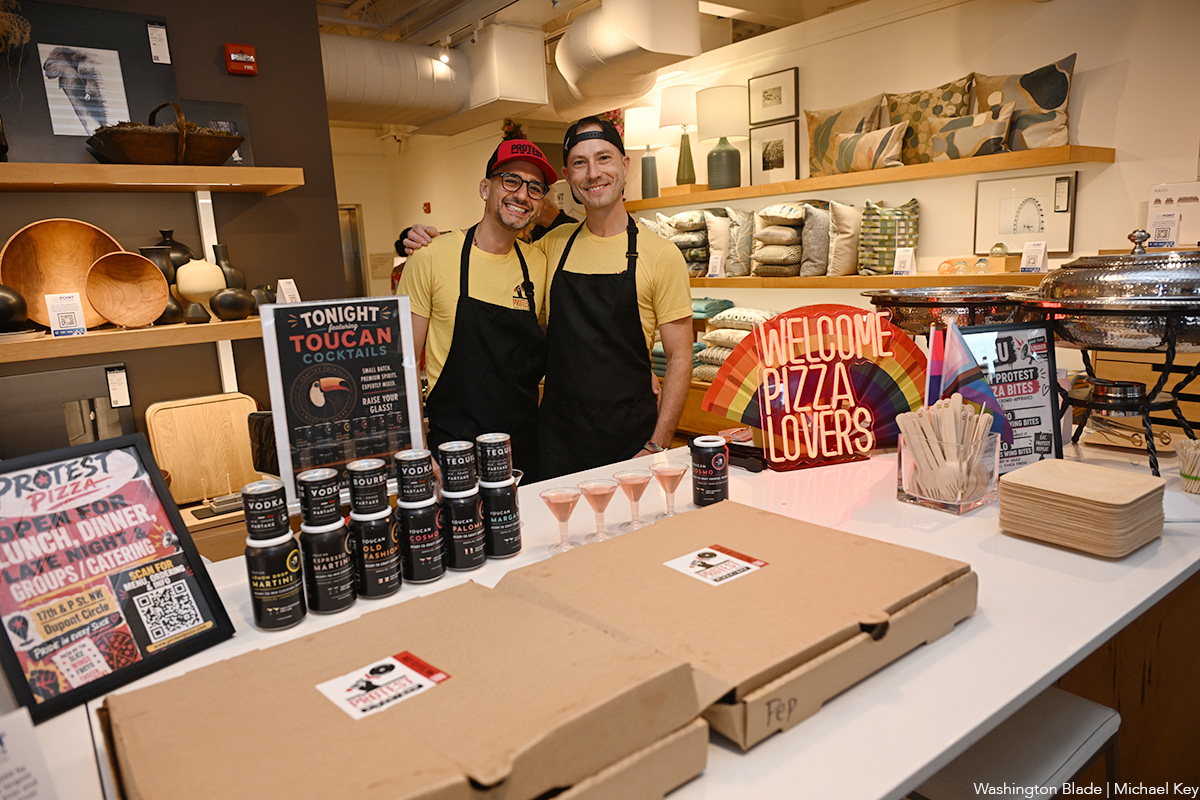
Gay activist Randy Downs said he and his business and life partner Ricky Bennett are grateful for the support they have received from the Dupont Circle community after they released a video showing a suspect breaking into their recently opened pizza shop and taking money from a cash register shortly before 3 a.m. on Friday, Aug. 21.
The surveillance video shows a man wearing black clothing with his face covered, smashing the glass front door of Protest Pizza, located at 1633 ½ P St., N.W. The video, which Downs and Bennett provided to D.C. police, also shows the suspect climbing over the bar to get to a cash register, which he opened to take out cash.
A D.C. police report obtained by the Washington Blade lists the incident as a Burglary in the Second Degree and says the owners reported “approximately $78 in cash” was taken from the cash register. The report says the incident is not listed as a suspected hate crime.
Downs told the Washington Blade that after he and Bennett reported the break-in and theft on social media, they received an overwhelming showing of support from neighbors and others, including business owners, from across the nation.
“The break-in was upsetting, but it is not what will define Protest Pizza,” Downs said. “What defines us is how quickly people showed up,” he told the Blade. “One person came looking for a cash register; our community saw a gathering place worth protecting. The response reminded us that Protest’s real value was never in the register.”
Downs said he and Bennett, who live around the corner on the section of 17th Street, N.W., near several other bars and restaurants, including the gay bar JRs are located, opened Protest Pizza in November 2025.
“Ricky and I built Protest Pizza as a positive, welcoming, queer owned neighborhood restaurant and bar — a space for protest and joy,” he said.
A D.C. police spokesperson said police offer a reward of up to $1,000 for information leading to an arrest and conviction of a suspect responsible for the type of burglary and theft that occurred at Protest Pizza. Police say anyone with information to help solve this type of crime should call the police tipline at 202-727-9099.
District of Columbia
Advocates honored at Engendered Spirit Awards
Annual ceremony held at conclusion of Trans Pride DC
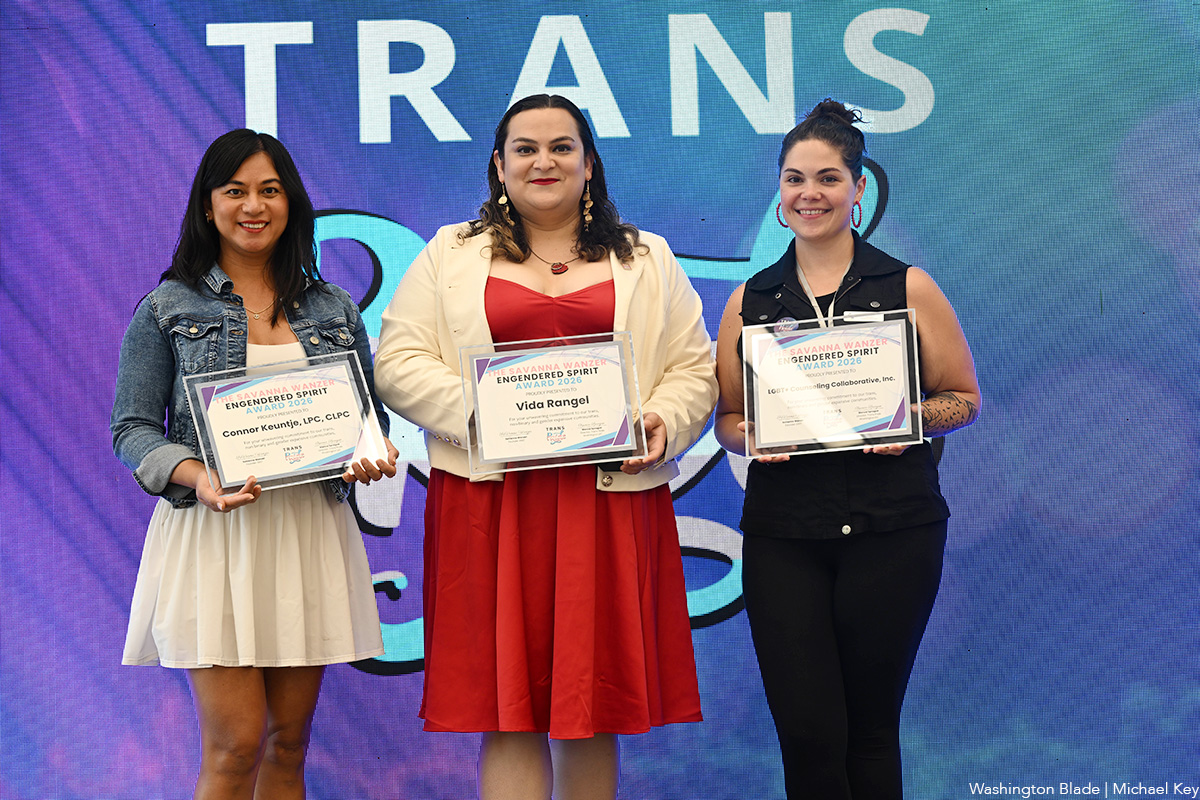
The 2026 SaVanna Wanzer Engendered Spirit Awards ceremony took place at the Martin Luther King, Jr. Memorial Library in D.C. on Saturday. The ceremony was held at the conclusion of the day-long Trans Pride DC: Encore.
Honorees included D.C. Mayor’s Office of Community Affairs Deputy Director Vida Rangel; the LGBT+ Counseling Collaborative, Inc.; and Connor Keuntje, CLP, CLPC.
Trans Pride DC: Encore was held throughout Saturday with several workshop sessions and a virtual conversation with actress and advocate Dominique Jackson.
The annual Engendered Spirit Awards were renamed the “SaVanna Wanzer Engendered Spirit Awards” in honor of SaVanna Wanzer, founder of D.C. Trans Pride. Wanzer died on April 24 of this year.
Speakers at the ceremony included Japer Bowles, director of the D.C. Mayor’s Office of LGBTQ Affairs and Bianca Sprague, executive director of D.C. Trans Pride.
“The intent behind this award and honoring members of our communities, organizations, and allies, is to really elevate all of the work that they’re doing to provide resources, tools, learning opportunities and connections: centering trans folks, gender non-conforming, and gender diverse individuals,” Sprague said.

Immersive ‘Nation-State’ imagines a society free of authoritarianism

New book examines Trump cuts to LGBTQ healthcare

E-INFOSOL leaders encourage youth to pursue tech careers

Milo Yiannopoulos deported to UK

San Francisco, long a queer safe haven, remains competitive for homebuyers

Music icon and dear LGBTQ friend Dolly Parton remembered

New data shows record-high LGBTQ population amid Trump attacks

Push to elect more LGBTQ ANC members yields results

Please join me in supporting the Washington Blade Foundation

Chris Van Hollen says the Democratic Party needs change. Is he the one to lead it?
-

 Obituary5 days ago
Music icon and dear LGBTQ friend Dolly Parton remembered
-
National5 days ago
New data shows record-high LGBTQ population amid Trump attacks
-
District of Columbia5 days ago
Push to elect more LGBTQ ANC members yields results
-
Commentary4 days ago
Please join me in supporting the Washington Blade Foundation