District of Columbia
Fadi Jaber’s Middle Eastern background shapes Adams Morgan bakery
The Cakeroom is on 18th Street, N.W.

Fadi Jaber is the gay owner behind the Cakeroom’s bright pink facade on 18th Street, N.W. He combines his Middle Eastern background and American flavors to bring a nostalgic spread of desserts to Adams Morgan.
Born and raised in a U.S. compound in Saudi Arabia, Jaber first unlocked an interest in classic American desserts from his classmates.
“I was jealous that their moms would bring these delicious cupcakes to school when it was their birthdays, and my mom never made stuff like that. It was just grape leaves and hummus and very good Arabic food,” Jaber said.
After years of making boxed cake mixes in Saudi Arabia, Jaber tried a carrot cake from a friend’s wife from the U.S. He soon decided to make the recipe himself. When letting his parents sample the treat, Jaber’s mother suggested adding dates instead of carrots.
Now, Jaber sells the same date cake at the Cakeroom.
Jaber solidified his appreciation for American baked goods after a friend took him to Magnolia’s Bakery in New York. The visit inspired him to enroll in the Institute of Culinary Education.
“I just fell in love with the concept, and it was very much up my alley,” Jaber said. “I was already baking from scratch and making homemade style desserts that weren’t super chichi and elegant, but more just delicious and fun and nostalgic, and a throwback to people’s childhood.”
Upon leaving culinary school, Jaber moved to Jordan, where his parents relocated. He decided to leave his corporate job and open a bakery. According to Jaber, his father initially refuted the idea until he tried the desserts Jaber perfected in culinary school.
“He was part of the Palestinian diaspora. So, you know, given all the instability in his life having been forced out of their homes in 1948, it was really a very scary thought to add more instability by going out on your own and starting your own business,” Jaber said.
Jaber then opened Sugar Daddy’s, his first bakery, in Amman, Jordan, in 2007.
According to Jaber, the bakery was the first cupcake shop in the Middle East. He soon launched additional locations in Beirut, Lebanon, and Dubai, United Arab Emirates.

After six years, Jaber decided to return to the U.S. Jaber noted that he had “always longed” to live there, but he struggled to make his cakes a novel concept to an American audience.
“I’m kind of bringing pasta to the Italians, in a sense, where my cupcakes were very unique in Jordan, they wouldn’t be as unique in D.C.,” Faber said. “But my mom had confidence. She didn’t even bat an eye, and she was like, ‘I think you should do it.’”
Years prior, Jaber began visiting Washington while attending the College of William & Mary. Upon the move, he settled on Washington as a less competitive market than New York, citing his appreciation for the city’s international feel, architecture and nature.
After recruiting investors, Jaber opened Sugar Daddy’s in Adams Morgan in December 2013. However, upon being struck with a cease and desist letter from a bakery in Ohio with a similar name, Jaber experimented with 20 different names for the business.
Finally, he settled on the Cakeroom in the summer of 2014.
“I actually got some calls from D.C. government employees thanking me for the name change, because they said Sugar Daddy’s didn’t look good when they would Google it on their work laptops,” Jaber said, jokingly.
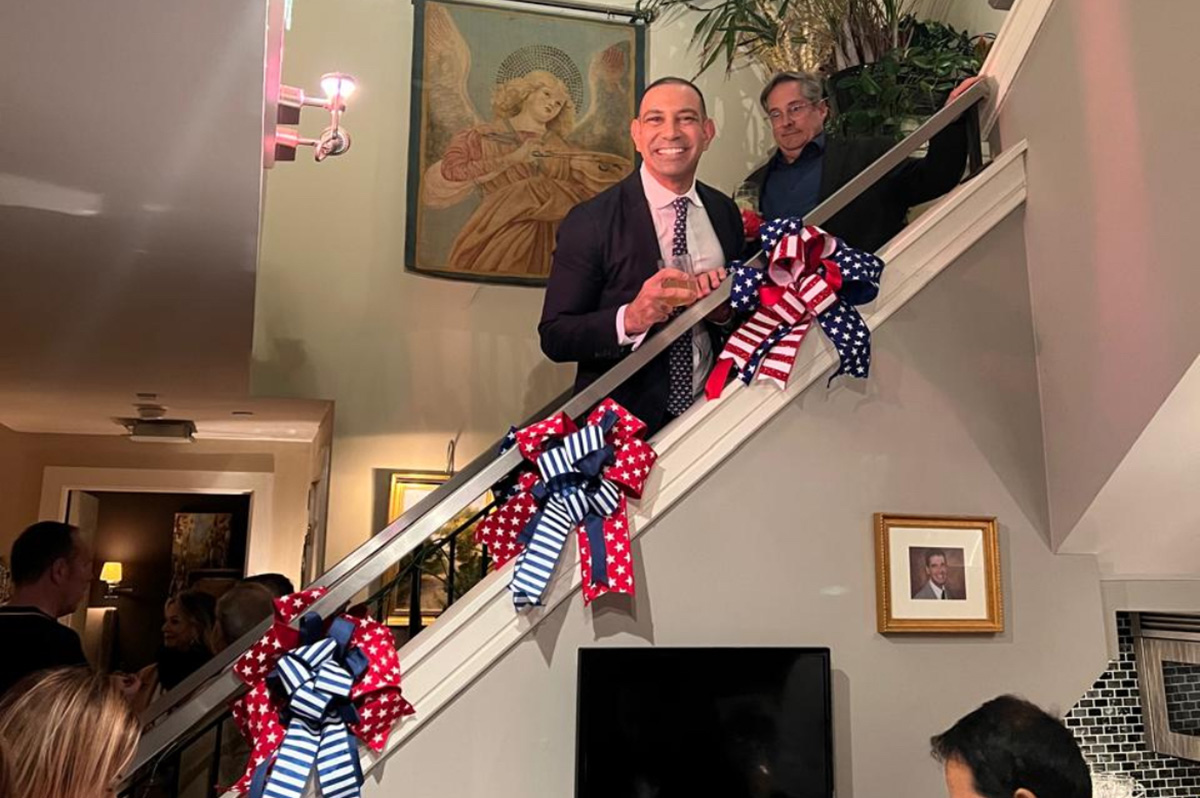
As for Jaber’s identity as a gay man, he notes that he hopes customers visit the Cakeroom because “they like our product” rather than due to his sexual identity. Still, he notes that operating the bakery in an LGBTQ-friendly city increases business opportunities to bake for LGBTQ weddings.
“A lot of people know me as the owner, I’m the face behind the brand. People in D.C. know that I’m gay, so I think we do get some business that way, but I would hate for people to just support my business because of my sexual orientation,” Jaber said.
Jaber manages the Cakeroom remotely, focusing on online orders, deliveries, scheduling, ordering, cash management, and more. He notes that while most days are routine, “at least two, three times a week there’s some firefighting that needs to happen.”
While Jaber does not intend on opening another location of the Cakeroom, he hopes to continue managing the business for another decade.
“I’ve been in this industry for 18 years,” Jaber said. “So if I can just keep it afloat, that would be my hope. It gives me purpose on a daily basis.”
Jaber’s top recommendations from the Cakeroom’s array of sweets include Nutella cookies, the date cake, and the carrot cake.
The carrot cake is based on the dessert that first inspired Jaber to pursue a career in baking.
“I think I altered it just a tiny bit, but for the most part, it is based off of the original recipe that I got from my friend’s wife,” Jaber said.
District of Columbia
Gay-owned pizzeria in Dupont Circle burglarized
Protest Pizza owners say community has expressed support
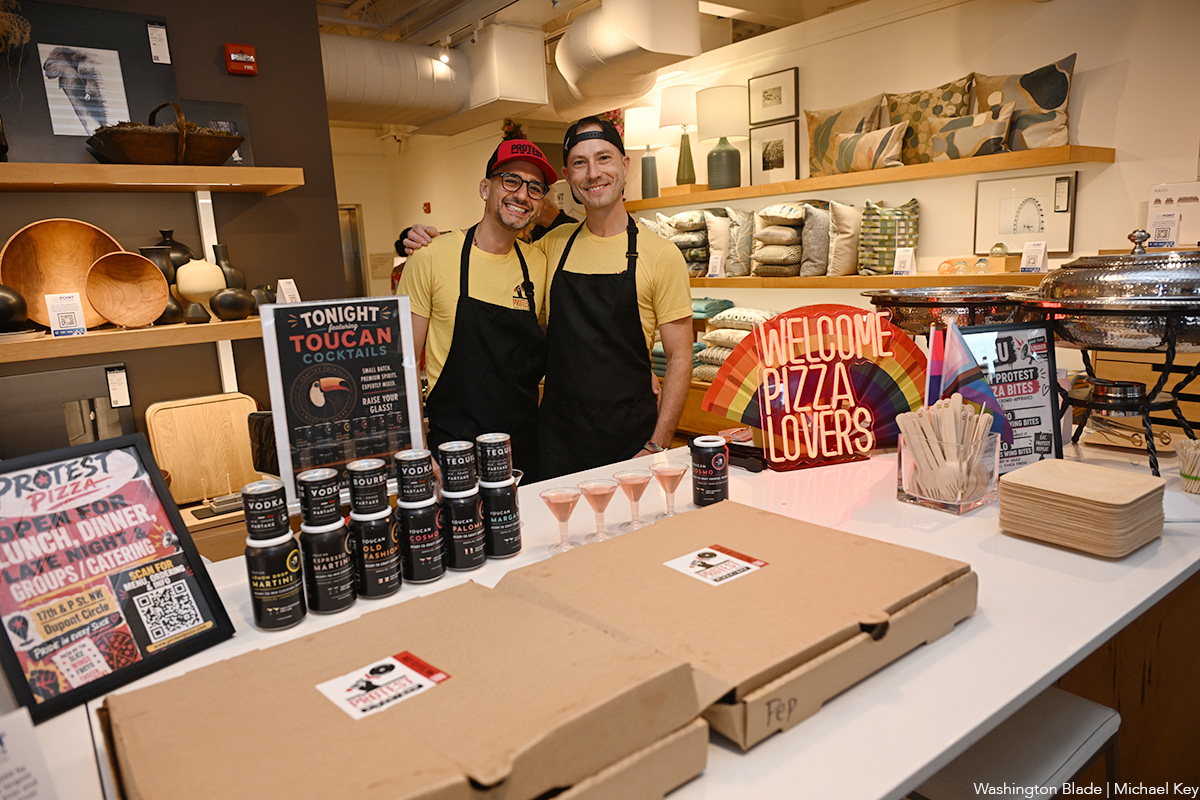
Gay activist Randy Downs said he and his business and life partner Ricky Bennett are grateful for the support they have received from the Dupont Circle community after they released a video showing a suspect breaking into their recently opened pizza shop and taking money from a cash register shortly before 3 a.m. on Friday, Aug. 21.
The surveillance video shows a man wearing black clothing with his face covered, smashing the glass front door of Protest Pizza, located at 1633 ½ P St., N.W. The video, which Downs and Bennett provided to D.C. police, also shows the suspect climbing over the bar to get to a cash register, which he opened to take out cash.
A D.C. police report obtained by the Washington Blade lists the incident as a Burglary in the Second Degree and says the owners reported “approximately $78 in cash” was taken from the cash register. The report says the incident is not listed as a suspected hate crime.
Downs told the Washington Blade that after he and Bennett reported the break-in and theft on social media, they received an overwhelming showing of support from neighbors and others, including business owners, from across the nation.
“The break-in was upsetting, but it is not what will define Protest Pizza,” Downs said. “What defines us is how quickly people showed up,” he told the Blade. “One person came looking for a cash register; our community saw a gathering place worth protecting. The response reminded us that Protest’s real value was never in the register.”
Downs said he and Bennett, who live around the corner on the section of 17th Street, N.W., near several other bars and restaurants, including the gay bar JRs are located, opened Protest Pizza in November 2025.
“Ricky and I built Protest Pizza as a positive, welcoming, queer owned neighborhood restaurant and bar — a space for protest and joy,” he said.
A D.C. police spokesperson said police offer a reward of up to $1,000 for information leading to an arrest and conviction of a suspect responsible for the type of burglary and theft that occurred at Protest Pizza. Police say anyone with information to help solve this type of crime should call the police tipline at 202-727-9099.
District of Columbia
Advocates honored at Engendered Spirit Awards
Annual ceremony held at conclusion of Trans Pride DC
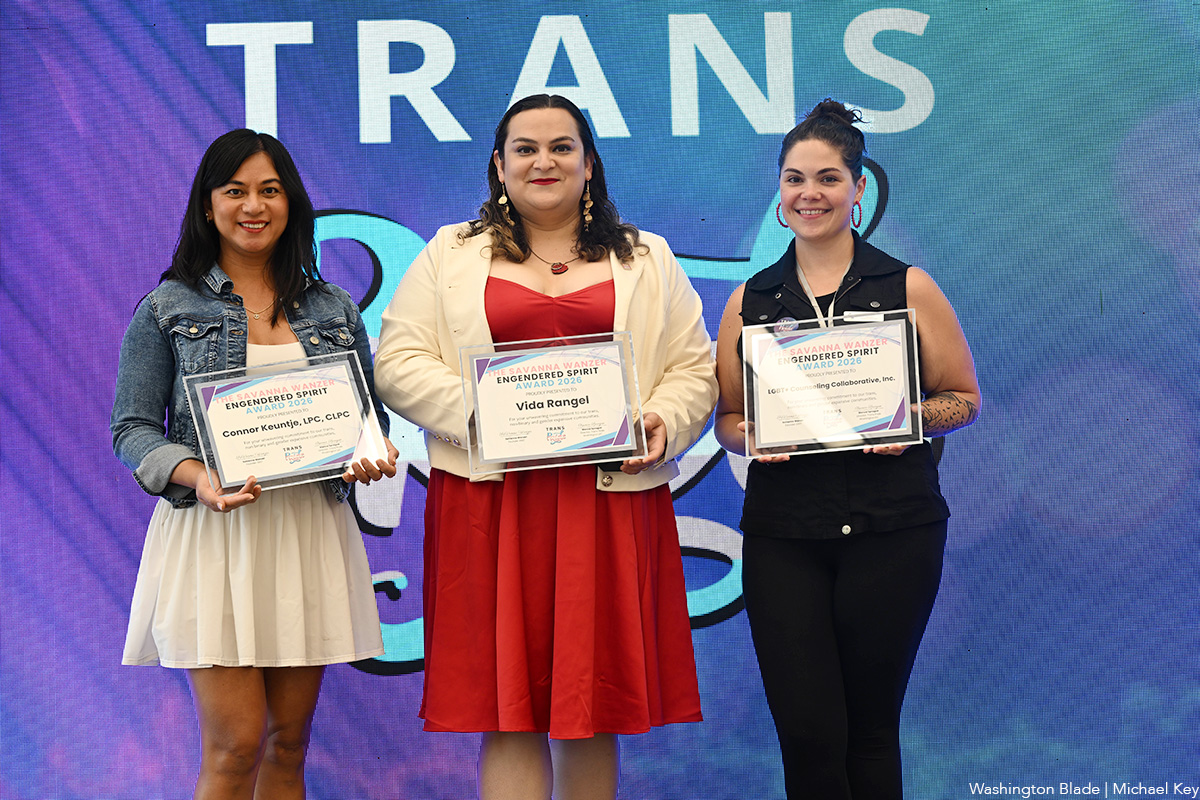
The 2026 SaVanna Wanzer Engendered Spirit Awards ceremony took place at the Martin Luther King, Jr. Memorial Library in D.C. on Saturday. The ceremony was held at the conclusion of the day-long Trans Pride DC: Encore.
Honorees included D.C. Mayor’s Office of Community Affairs Deputy Director Vida Rangel; the LGBT+ Counseling Collaborative, Inc.; and Connor Keuntje, CLP, CLPC.
Trans Pride DC: Encore was held throughout Saturday with several workshop sessions and a virtual conversation with actress and advocate Dominique Jackson.
The annual Engendered Spirit Awards were renamed the “SaVanna Wanzer Engendered Spirit Awards” in honor of SaVanna Wanzer, founder of D.C. Trans Pride. Wanzer died on April 24 of this year.
Speakers at the ceremony included Japer Bowles, director of the D.C. Mayor’s Office of LGBTQ Affairs and Bianca Sprague, executive director of D.C. Trans Pride.
“The intent behind this award and honoring members of our communities, organizations, and allies, is to really elevate all of the work that they’re doing to provide resources, tools, learning opportunities and connections: centering trans folks, gender non-conforming, and gender diverse individuals,” Sprague said.
District of Columbia
Man charged with anti-gay assault in D.C. accepts plea offer
Community service offered in exchange for dismissing hate crime charge

A Germantown, Md., man arrested by D.C. police on a charge of simple assault with a hate crime designation for allegedly assaulting a gay man while using “homophobic slurs” has agreed to an offer by prosecutors to plead guilty to simple assault without the hate crime designation and with the promise of having the charge dismissed if he completes, among other requirements, 48 hours of community service work.
Dean Edmundson, 26, standing beside his attorney, officially accepted the offer of a Deferred Sentencing Agreement at an Aug. 18 status hearing in D.C. Superior Court after Senior Judge Hiram Puig-Lugo explained the details of the agreement and confirmed Edmundson’s decision to waive his right to a trial.
Among other things, the judge said the agreement offered by prosecutors with the Office of the United States Attorney for D.C. includes the requirement that he successfully completes 48 hours of community service work, stays away from the victim of the assault, writes a letter of apology to the victim, and does not violate any other laws or get into trouble for the next 12 months.
Puig-Lugo then announced he scheduled a sentencing hearing for Edmundson for Aug. 18, 2027, at which time a determination will made on whether he has fulfilled all the requirements under the agreement and whether the simple assault charge will be dismissed. The judge added that if it is determined that Edmundson did not fulfil the terms of the agreement the charge would remain in place and he could be sentenced to a possible maximum penalty of 180 days in jail and a $1,000 fine.
Edmundson, who appeared in court wearing a business suit with a dress shirt and tie, was released on his own recognizance following his arrest by D.C. police on Feb. 7, 2026.
Police and court records show he was initially charged by arresting officers with simple assault with a hate crime designation. In a statement announcing the arrest, D.C. police said, “On Saturday, Feb. 7, 2026, at approximately 7:45 p.m. the victim and suspect were in the 1500 block of 14th Street, Northwest. The suspect requested a ‘high five’ from the victim. The victim declined and kept walking,” the statement says.
A follow-up arrest affidavit filed by police states that Edmundson followed the victim and called him “bald, ugly, and gay,” and then “pushed the victim with both hands, shoving them, causing the victim to feel the force of the push.” The affidavit adds, “The victim stated that they felt offended and that they were also gay.”
According to the court records, the Office of the U.S. Attorney filed its official charge of simple assault against Edmunson on Feb. 9 without the hate crime designation. The office has not responded to a request by the Washington Blade for its reason for dropping the hate crime designation. The office has also not immediately responded to a follow-up inquiry from the Blade this week asking if prosecutors consulted the victim to obtain the victim’s thoughts about the plea offer.
The Blade, which has a policy of not disclosing the identify of crime victims in cases like this without their consent, could not immediately obtain contact information to reach the victim for comment.
Court records show that Edmundson rejected an earlier plea agreement offer by prosecutors and he was scheduled for a non-jury trial on Aug. 18. The records show his attorney filed a motion earlier this month asking the judge to convert the trial into status hearing on that same day after his client accepted the Deferred Sentencing Agreement offer by the U.S. Attorney’s office. The judge approved the motion without objection from prosecutors.

Gay-owned pizzeria in Dupont Circle burglarized

Advocates honored at Engendered Spirit Awards

Two awesome, affordable rides

Proposed Indian foreign funding law overhaul could further pressure LGBTQ groups

Why we need to protect ‘sacrilegious’ art

I respect AOC, even though I often disagree with her

Chicago’s LGBTQ+ youth: Why their zip code still matters

Black Educated Lesbians: A movement rooted in community

Hegseth uses transphobic slur while campaigning for Iowa congressman

NYC lawmakers seek to repeal bathhouse ban
-

 Opinions5 days ago
I respect AOC, even though I often disagree with her
-
Illinois5 days ago
Chicago’s LGBTQ+ youth: Why their zip code still matters
-
Opinions4 days ago
Black Educated Lesbians: A movement rooted in community
-
U.S. Military/Pentagon4 days ago
Hegseth uses transphobic slur while campaigning for Iowa congressman