Living
Tough questioning for Gallagher at marriage hearing
Democratic lawmakers hammer anti-gay activist


Maggie Gallagher, chair of the National Organization for Marriage (Blade photo by Michael Key)
Democratic lawmakers on Friday hammered anti-gay activist Maggie Gallagher during a congressional hearing with questions on why same-sex couples should be excluded from marriage and the extent to which the National Organization for Marriage participated in campaigns to rescind state marriage laws.
In testimony before the House Judiciary subcommittee on the Constitution, Gallagher, NOM’s chair and co-founder, said marriage should restricted to one man and one woman because such unions are the only kind that can produce children and because state voters by referenda have affirmed 31 times that marriage shouldn’t be extended to gay couples.
“Marriage is the union of husband and wife for a reason: these are the only unions that create new life and connect those children in love to their mother and father,” Gallagher said. “This is not necessarily the reason why individuals marry; this is the great reason, the public reason why government gets involved in the first place.”
The hearing, which was titled “Defending Marriage,” took place on the heels of President Obama’s announcement on Feb. 23 that the Defense of Marriage Act is unconstitutional and that his administration would no longer defend the anti-gay law against litigation in court. Following a 3-2 party-line vote in March by the Bipartisan Legal Advisory Council, U.S. House Speaker John Boehner (R-Ohio) directed the House general counsel to take up defense of DOMA in place of the administration.
Gallagher said the need to raise children by married parents of opposite genders affirms the rationale for having in place DOMA, the 1996 law that prohibits recognition of same-sex marriage, and criticized the Justice Department for dropping defense of the law.
“This is the rationale for the national definition of marriage proposed by Congress in passing DOMA: ‘civil society has an interest in maintaining and protecting the institution of heterosexual marriage because it has a deep and abiding interest in encouraging responsible procreation and child-rearing,'” Gallagher said. “If we accept, as DOMA explicitly does, that this is a core public purpose of marriage, then treating same-sex unions as marriage makes little sense.”
Following her opening statement, Gallagher bore the brunt of tough questioning from Democratic lawmakers during the question-and-answer session of the hearing.
Rep. Jerrold Nadler (D-N.Y.), ranking Democrat on the subcommittee, asked Gallagher if the children of Jen and Dawn BarbouRouske, a married same-sex couple from Iowa who were present during the hearing, should have parents who can receive the full protections of marriage or if she considers these children “expendable.”
“I think no children are expendable,” Gallagher replied. “Gay people have families that are not marital families, but they are families. I myself was an unwed mother, so I have firsthand experience with being in a family that’s not a marital family. I don’t think you need to have a message of stigmatization and exclusion to protect to an ideal.”
Nadler, sponsor of DOMA repeal legislation in the House, interrupted Gallagher, saying “the whole point” of DOMA is stigmatization and exclusion, and pressed Gallagher further on why the institution of marriage benefits when same-sex couples are excluded.
“Because including same-sex unions as marriages denies at a public level that marriage is about an important way for getting together mothers and fathers and children,” Gallagher said.
Nadler continued to question Gallagher on NOM’s involvement in 2010 Iowa campaign that successfully ousted three justices from the state Supreme Court who ruled in favor of same-sex marriage. The lawmaker asked Gallagher, who estimated that NOM contributed between $600,000 and $650,000 to the campaign, why she would criticize the Justice Department for allegedly making a political decision while her organization politicized the judicial process.
“The National Organization of Marriage is political advocacy organization, and so I think it’s appropriate for us to be politically involved in ways that Department of Justice is not,” Gallagher replied.
Rep. John Conyers (D-Mich.), a co-sponsor of the DOMA repeal bill, asked Gallagher whether reports were true that her organization contributed $1.9 million to the 2009 campaign in Maine to abrogate the states’s same-sex marriage law. Opponents of same-sex marriage succeeded in nullifying the marriage law in the state before gay couples could marry there.
“I don’t have those figures in front of me, but we were involved in the [effort],” Gallagher said. “But that’s probably on the order [of our contributions].”
NOM has repeatedly come under fire for failing to disclose their donors during the campaign against the Maine marriage law. State courts have ordered the organization to reveal their donors in accordance with the law, but NOM has yet to do so.
Following the hearing, Dan Fotou, eastern regional field director for GetEQUAL, praised Democratic lawmakers for hammering Gallagher with tough questions after her testimony.
“I think it was good to hear the Democrats standing up and challenging Maggie Gallagher’s position,” Fotou said. “Fifty-two percent of Americans think that marriage equality is OK, so I think today was good in terms of putting a face on hate once again, and Maggie does a really great job of that.”
Democratic lawmakers’ criticisms during the hearing weren’t limited to Gallagher. Conyers questioned Rep. Trent Franks (R-Ariz.), chair of the subcommittee, why no witnesses from the Justice Department were present to defend Obama’s decision to drop defense of DOMA.
“What bothers me about this hearing at this subcommittee is that the Department of Justice is not present,” Conyers said. “I was informed that they were not invited. … We have one of the leaders of the country, Ms. Gallagher, who’s raised hundreds of thousands of dollars against judges … but there’s nobody here from the Justice Department.”
In response, Franks said the Justice Department would be invited to come during an upcoming hearing in May before the House Oversight & Government Reform Committee on the DOMA decision. Upon further questioning, Franks maintained the panel was fair because its makeup included witnesses on both sides of the issue.
But Franks’ response apparently didn’t allay the concerns of Conyers, who said he hopes Congress can hear the Justice Department to respond to the criticisms of Gallagher.
“There’s a political tone in this hearing that I want to diminish as much as possible,” Conyers said. “The fact of the matter is this is not in regular order and I do not approve the way that we’re starting out this subcommittee [hearing].”
Despite the general tone in favor of DOMA during the hearing, several panel members known for having anti-gay views — including Rep. Steve King (R-Iowa), who’s railed against same-sex marriage in home state, and Rep. Jim Jordan (R-Ohio), who’s leading the effort to eliminate gay nuptials in D.C. — didn’t make an appearance. Neither the office for King nor Jordan responded to the Washington Blade’s request to comment on why the lawmakers didn’t attend the hearing.
Ian Thompson, who’s gay and legislative representative for the American Civil Liberties Union, said the lack of presence by anti-gay lawmakers was telling that the they were uncomfortable with their positions.
“The thing that was particularly striking to me was the fact that so few DOMA supporters on the committee actually were in attendance,” Thompson said. “So, from my perspective, if the hearing was intended to demonstrate the support of the House of Representatives for DOMA, from the attendance alone, it was a complete and total flop.”
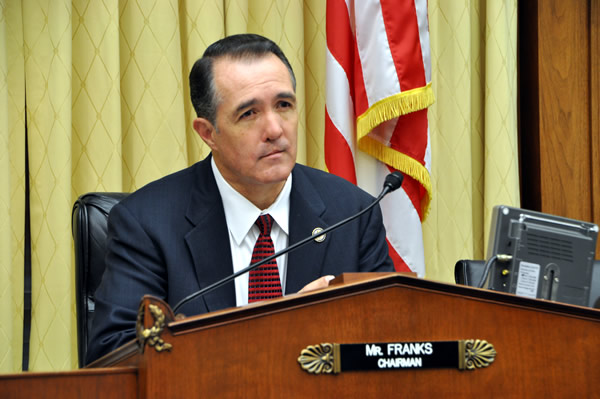
Rep. Trent Franks (Blade photo by Michael Key)
But a few anti-gay Republicans did make an appearance to rebuke the notion of extending marriage rights to gay couples and to criticize the Justice Department for dropping defense of DOMA.
Franks called Obama’s decision to discontinue defense of the anti-gay law an “edict” that “failed to show the caution and respect for Congress and the courts.”
“When the President unilaterally declares a duly enacted law unconstitutional, he cuts Congress and the American people out of the lawmaking process,” Franks said. “Such heavy-handed presidential action undermines the separation of powers and the principle that America is a constitutional republic predicated on the rule of law.”
Franks continued that the arguments in favor of DOMA are “reasonable and right” because marriage between one man and one woman is the best union for raising children.
“Traditional marriage has proven to be the most successful institution in humanity’s history for the propagation and preparation of the next generation,” Franks said. “The traditional family has proven to be the best department of welfare, the best department of education, the best department of crime prevention, and the best department of economic security that there has ever been.”
Rep. Lamar Smith (R-Texas), a lawmaker known for anti-gay views, also made an appearance at the hearing and railed against what he called the government altering the definition of marriage. Smith, chair of the full House Judiciary Committee, offered an opening statement during the hearing even though he’s not a member of the subcommittee.
“If we tamper with the definition of marriage, harmful unintended consequences could follow,” Smith said. “The ability of religious institutions to define marriage for themselves to promote their sincerely held beliefs could be threatened.”
Smith said the will the people is for continued definition of marriage between one man and one woman — noting the 31 successful ballot initiatives that restricted marriage to such unions — and said the U.S. Constitution doesn’t provide protections for same-sex couples seeking to marry.
“No one can seriously believe that the Constitution’s founders intended to create a right to same-sex marriage,” Smith said. “By refusing to defend the Defense of Marriage Act against legal challenges, the administration has allowed the courts to overrule that popular law.”
Franks and Smith’s opening statements were countered by initial remarks from Nadler, who called arguments that Justice Department acted inappropriately by dropping defense of DOMA a “red herring” and said the real question should be whether anyone — either the Obama administration or Congress — should defend the law.
“Far from demeaning, trivializing or destroying the institution of marriage, [gay] couples have embraced this time-honored tradition and the commitment and serious legal duties of marriage,” Nadler said. “Rather than defending DOMA in court, Congress should be working to repeal it.”
Two legal experts on the panel presented opposing views on whether the administration acted within bounds in its decision to discontinue defense of DOMA in court.
Edward Whelan, president of the Ethics & Public Policy Center, said the Justice Department’s decision is in violation of its policy.
“The Obama administration’s decision to abandon defense of DOMA — or more precisely, to abandon its charade of pretending to defend DOMA — departs sharply from the Department of Justice’s long-standing practice,” Whelan said.
Whelan said Obama dropped defense of the anti-gay law to appease a political constituency and to induce the courts to “invent the constitutional right to same-sex marriage.”
“With the exception of laws that intrude on the executive branch’s power, the long-standing practice of the Department of Justice is to vigorously defend the constitutionality of any law where a reasonable may be made,” Whelan said. “This ‘reasonable standard’ is a very low bar. It basically means that the Department of Justice will defend a federal law against constitutional challenge when it can offer non-frivolous grounds in support of the law.”

Carlos Ball, a gay law professor at Rutgers Law School (Blade photo by Michael Key)
But Carlos Ball, a gay law professor from Rutgers Law School, testified that Obama acted within his authority because another statute exists saying that the attorney general must inform Congress if the administration decides to no longer defend a law.
“The existence of that statute seems to be a recognition by the Congress of the reality that the executive branch sometimes, in rare cases, can not defend the constitutionality of a law,” Ball said. “The executive branch, as a co-equal branch of government, has the authority and obligation to make independent assessment’s regarding a law’s constitutionality.”
Ball noted precedent for an administration declaring an existing law unconstitutional and dropping defense of the statute in court — the 1990 case of Metro Broadcasting v. FCC. Then-acting U.S. Solicitor General John Roberts, now Chief Justice of the U.S. Supreme Court, argued that a law providing for minority preferences in broadcast licensing was unconstitutional. Despite the position of the Bush administration, the Supreme Court later upheld the law.






In September 2024, I wrote about the District’s Lead-Free D.C. initiative, an ambitious effort to remove lead pipes and make drinking water safer for every resident in our city. Since that original article, a number of important developments have taken shape that affect everyone living in the District. Key drivers in the legal landscape surrounding this issue such as disclosure, testing, and infrastructure planning have been sharpened. The city’s sweeping pipe replacement efforts are continuing to evolve against the backdrop of broader federal drinking-water rules and funding changes.
What was once largely public health conversation for the future is now a practical reality for many property owners and renters. The water service line replacement project has moved from planning and is presently underway throughout the city.
Elevated levels of lead in drinking water is a perplexing challenge in many U.S cities. Researchers documented elevated lead levels in D.C.’s water system more than two decades ago, spotlighting how old infrastructure can pose a hidden health risk even in one of America’s wealthiest cities. Local leaders responded with pipe replacement plans that have continued in the years since.
The Lead-Free D.C. initiative remains the central effort to reduce that risk by replacing water supply lines. These are the pipes that carry water to your home or rental property from the street. D.C. Water estimates that tens of thousands of lead or galvanized service lines still exist in the city and must be systematically replaced to eliminate this exposure.
What Has Changed Since September 2024
Over the past 18 months, several shifts have rippled through policy, practice, and the daily experience of both landlords and tenants:
- Local Disclosure and Tenant Rights: The city has strengthened disclosure requirements. Today, property owners are expected to provide clear written disclosures about known lead service lines, any testing that has been done, and records of past replacements. Tenants also have the right to request lead testing of their tap water, and landlords are responsible for ordering and passing along the test kit, and are required by law to share results with tenants when requested.This reflects an ongoing push toward transparency and an informed occupancy.
- Pipeline Replacement Planning: D.C. Water and the District Government are continuing to roll out their block-by-block lead service line replacement work, with construction schedules publicly available through a Lead-Free D.C. construction dashboard. The goal is to remove by 2030 all lead service lines on both the public and private side, though timelines and funding mechanisms are still being refined as the work continues. D.C.’s Lead-Free DC initiative stipulates that DC Water is responsible to replace the public portion of a lead service line at no cost to the property owners. This is the section running from the water main under the street to the property owner’s lot line. When DC Water is already replacing the public side as part of a scheduled infrastructure project, it will also offer to replace the private-side service line (into the building) at no cost to the owner, as long as the owner grants access and signs a right-of-entry agreement. In these cases, DC Water pays the contractor directly, and the entire lead service line is removed in one coordinated effort.
When no public-side project is scheduled, owners may still qualify for full private-side replacement coverage through the District’s Lead Pipe Replacement Assistance Program (LPRAP). If approved, the program covers the cost of replacing the private-side lead pipe, with funds paid directly to the contractor. Property owners are typically responsible for selecting the contractor, coordinating the work, and covering any costs outside the approved scope of work. Funding is subject to availability, and eligible applicants may be placed on a waiting list depending on annual program budgets.
- Implementation Best Practices: To avoid challenges and misunderstandings regarding the responsibilities during such a significant undertaking, fully investigating the program and how it works is a good first start as is regular and clear communications.
It’s helpful for both property owners and residents to have a clear understanding of what D.C. Water and construction crews will be doing during a lead service line replacement and what follow-up work may remain once the project is complete. Like any major infrastructure upgrade, the process can involve temporary water shutoffs, excavation around the building, and some restoration afterward, such as repairing landscaping or sections of sidewalk. While these short-term disruptions can be inconvenient, they’re a normal and necessary part of modernizing the city’s water system and ensuring safer drinking water for the long term.
- Federal Drinking Water Rules: On the national stage, the U.S. Environmental Protection Agency (EPA) finalized in October 2024 the Lead and Copper Rule Improvements (LCRI). The LCRI requires public water systems across the country to inventory and plan to replace lead service lines, and to remove all lead pipes within about a decade. It also strengthens testing, monitoring, and public notification requirements and lowers the action level for lead exposure, building on earlier revisions to the Lead and Copper Rule.
While these federal changes do not rewrite Washington, D.C.’s specific legal requirements for landlords and tenants, they do help shape funding opportunities, compliance expectations, and the broader national push to eliminate lead plumbing, which can affect utilities, state programs, and local infrastructure planning.
Federal drinking water regulations are subject to administrative review, litigation, and potential revisions as presidential administrations change. While the EPA’s 2024 Lead and Copper Rule Improvements remain in effect as of this writing, aspects of implementation, enforcement timelines, or funding mechanisms may evolve through future rulemaking, court decisions, or congressional action. These federal rules do not override Washington, D.C.’s independent authority to adopt and enforce its own public health, housing, and water safety requirements, which continue to govern landlord and tenant obligations within the District regardless of federal regulatory shifts.
What Landlords Should Know
For landlords in D.C., these evolving expectations matter in 3 key ways:
- Disclosure Is Now a Must: You are expected to provide prospective tenants with upfront information about lead service lines, known test results, and replacement history before lease signing. Existing tenants must also be informed if you learn anything new about the plumbing system.
- Testing Should Be Welcomed, Not Avoided: When tenants request a lead water test, you’re now required to provide D.C. Water’s approved kit and cooperate with the process. The test results give both sides clear information about water quality and whether additional remediation is advisable.
- Capital Investment May Be Unavoidable: Even if much of the public-side work is funded by D.C. Water, private-side service line replacement costs and restoration work may still fall to the property owner if the home still has lead service lines. Planning for both the expense and the logistics is key to be able to take advantage of this program being offered to D.C. homeowners.
What This Means for Tenants
For renters, the changes bring clearer rights and fewer unknowns. Tenants no longer have to guess whether lead pipes serve their home; they can request testing, receive timely results, and rely on official disclosures when deciding where to live and how to protect their health.
Transparent communication with the landlord, responsiveness to testing requests, and participation in replacement programs turn regulatory requirements into real-world safeguards. In that way, landlord action directly shapes tenant trust, housing stability, and long-term public health outcomes.
At a moment when the District is investing heavily in its infrastructure, landlords who plan ahead and participate help to ensure that these public resources translate into safer housing, stronger neighborhoods, and a city better equipped for the future.
Why This Still Matters
Lead-free water shouldn’t be a luxury. Continued investment by federal and local governments in Washington, D.C.’s water infrastructure reflects a shared commitment to the city’s long-term health and livability. Modernizing service lines helps ensure that people can raise families here, age in place, and remain part of their communities without the added health concerns associated with lead exposure.
Landlords who take the time now to understand, disclose, and plan for lead service line replacement not only comply with evolving expectations, but they also strengthen the long-term value and marketability of their properties.
Scott Bloom is owner and senior property manager of Columbia Property Management.

As the days grow longer and buyers re-emerge from winter hibernation, the spring market consistently proves to be one of the strongest times of year to sell a home. Increased inventory, motivated buyers, and picture-perfect curb appeal make it a prime window for homeowners ready to list.
The good news? Preparing your home for spring doesn’t require a full renovation or a contractor on speed dial. A few thoughtful, cost-effective updates can dramatically elevate your home’s appeal and market value.
Here are smart, inexpensive ways to get your property market-ready:
Fresh Paint: The Highest Return on a Small Investment
Few improvements transform a home as quickly and affordably as paint. Neutral tones remain the gold standard, but today’s buyers are gravitating toward warmer tan hues that create an inviting, elevated feel without overwhelming a space. Soft sandy beiges and warm greige-leaning tans provide a clean backdrop that photographs beautifully and allows buyers to envision their own furnishings in the home.
Freshly painted walls signal care and maintenance — two qualities buyers subconsciously look for when touring properties.
Removable Wallpaper: Style Without Commitment
For homeowners wanting to introduce personality without permanence, removable wallpaper offers a stylish solution. A subtle textured pattern in a powder room, a soft botanical print in a bedroom, or a modern geometric accent wall can add depth and character. Because it’s easily removed, it appeals to both sellers and buyers — creating visual interest without long-term risk.
Upgrade Light Fixtures for Instant Modernization
Outdated lighting can age a home instantly. Swapping builder-grade fixtures for modern, streamlined options is one of the simplest ways to refresh a space. Consider warm metallic finishes or matte black accents to create a cohesive, updated look. Proper lighting not only enhances aesthetics but also ensures your home feels bright and welcoming during showings.
Elevate Curb Appeal: First Impressions Matter Most
Spring buyers often decide how they feel about a home before they ever step inside. Refreshing curb appeal doesn’t require major landscaping. Simple updates such as fresh mulch, trimmed shrubs, seasonal flowers, a newly painted front door, and updated house numbers can dramatically improve first impressions. Power washing the driveway and walkways also delivers a clean, well-maintained appearance for minimal cost. Even if you don’t have a curb to appeal- think potted plants on your patio, balcony and change out your door mat.
Deep Clean & Declutter (Seriously, It Matters)
A deep, top-to-bottom cleaning is basically free and one of the most impactful things you can do. Scrub floors, windows, grout, baseboards, appliances, bathrooms, and everything in between. Don’t forget to clean windows inside and out — natural light is a huge selling point. Declutter by packing up excess stuff, clearing off countertops, and minimizing personal items so buyers can see the space, not your life.
Let the Light Shine
Make your home feel bright and inviting by cleaning windows, opening blinds, and replacing dark or dated light fixtures with contemporary, budget-friendly options. Swapping in LED bulbs offers brighter light and lower utility costs — a small change that buyers appreciate. Pro tip: I always recommend removing widow screens to allow as much light in as possible
Neutralize Scents
Make sure the home smells fresh. Neutralizing odors — whether from pets, cooking, or moisture — creates a clean, welcoming atmosphere. Light natural scents like citrus or subtle florals can be inviting during showings. Think of how your favorite hotel smells and go for that.
Spring market rewards preparation. By focusing on high-impact, low-cost improvements, sellers can position their homes to stand out in a competitive environment. With thoughtful updates and strategic presentation, homeowners can maximize both buyer interest and potential sale price — all without overextending their renovation budget.
As activity increases and inventory begins to rise, now is the time to prepare. A little polish today can translate into significant results tomorrow.
Justin Noble is a Real Estate professional with Sotheby’s International Realty Servicing Washington D.C., Maryland, and the beaches of Delaware.
Advice
Dry January has isolated me from my friends
Is it possible to have social life without alcohol?

Dear Michael,
Some of my friends and I decided to do Dry January.
The six of us are a posse, we’ve been friends for years. Many boyfriends and even a husband or two have come and gone but we get together all the time and travel together.
I think we all agreed that drinking is too big a part of our social lives and thought we’d give Dry January a shot.
So … I am feeling better and it’s only been three weeks.
I’ve actually lost a little weight, and it’s nice not to wake up with a hangover four mornings a week. I’m pushing 40 and no surprise, my body feels relieved.
But, I’m also the only one of us who is still doing it.
Which means they are all going out and I am not. So I am feeling lonely.
I could join them in going out but first of all, I don’t really want to hang out with them when they’re drunk and I’m trying to be alcohol free; and also, there’s a part of me that is afraid I will give in to temptation and have a drink. And then it will be back to business as usual.
But, I spent this past weekend, and every night this week, alone.
All of this has me thinking: what do I do in February? I really don’t want to start drinking again.
But, if I don’t, how do I stay part of my friend group? If they’re buzzed (or drunk) and I’m not, am I still going to fit in?
I’m disappointed in my friends. We were all in this together, I thought, but one thing after another came up for them.
Some special event where “everyone was drinking,” a work dinner where “I didn’t want to deal with everyone’s questions about why I wasn’t drinking,” “too much work stress not to have a martini,” etc. In the end they were all laughing about it and now they’re basically poking fun at me and essentially betting how long I will last. That doesn’t feel good. It’s like the whole thing was a whim or a joke to them.
Also, heavy alcohol use is pretty typical of our community. If I’m not drinking then how do I have a social life?
Appreciate your thoughts.
Michael replies:
It can be hard to be different. For example, to be gay in a straight world, or not to drink in a world where alcohol plays such a big part.
I’m a believer in living in a way that respects whom you actually are. This means doing what you think is important to do, even when there are consequences you don’t like. Only you can decide the boundary where the consequences of your living with integrity become intolerable.
Yes, many gay men drink a lot. So if you decide you don’t want to hang out where alcohol is involved, you will be reducing your options for socializing.
Some possibilities:
- Discuss this situation with your friends. Ask them if they’re willing to spend some time with you and without alcohol. (Not all the time — that would be way too much to ask, given that they clearly enjoy drinking.) Perhaps if you explain why your request is important to you, they’ll be willing to lean in your direction at least some of the time. That they’re now mocking you for not drinking suggests I am a bit too optimistic about this possibility. But who knows? And, what have you to lose by asking?
- See if you can tolerate hanging out with people who are drinking without picking up a drink yourself, and if you can actually enjoy such interactions.
- Start looking for some new friends. There are, in fact, lots of gay men in this world whose social lives don’t revolve around alcohol (or other substances.)
On a separate but related note: given your fear that you will start drinking again, and your concerns about navigating life without alcohol, might you consider Alcoholics Anonymous to get some support?
I’ve seen AA and other 12-step groups help many friends and clients, and I think they work in two main ways.
First, attending meetings gives you support and a feeling of community. You’ll meet others who are working to be sober, hear their stories and share your own struggles with them. You’re likely to feel less alone in your effort to stop drinking, learn tools for staying sober, and make friends you can reach out to when you’re feeling vulnerable. You’ll also have a sponsor, your guide and advocate in the program, whom you talk with regularly.
Second, the program lays out “12 steps” of recovery that are a path to greater self-awareness and personal growth. Like good psychotherapy, the steps give you a framework for looking at your behavior patterns and taking responsibility for yourself.
If you are intrigued, the best way to learn more is to attend several 12-step meetings. There are many in our area, including gay groups (for example, the Triangle Club.) As I mentioned, if you do get involved in AA, a side benefit is that you’re likely to make some new friends who share your desire to build a life without alcohol.
Of course, making new friends does not have to mean cutting off your posse. But if you’re changing in ways that make them less of a great fit, it would be great to find some new folks who might be more on your wavelength to connect with.
Michael Radkowsky, Psy.D. is a licensed psychologist who works with couples and individuals in D.C., Maryland, Virginia, and New York. He can be found online at michaelradkowsky.com. All identifying information has been changed for reasons of confidentiality. Have a question? Send it to [email protected]

The rule of law, not the rule of religion

Meet the Scandals, D.C.’s LGBT rugby team

D.C. journalist, video producer Sean Bartel dies at 37

The very few queer highlights of the Oscars

Protecting D.C.’s promise: why Kenyan McDuffie deserves our support

Trump proclamation targets trans rights as State Dept. shifts visa policy

Top EU court issues landmark transgender rights ruling

Gay Cameroonian immigrant will be freed from ICE detention — for now

Bowser appoints first nonbinary person to Cabinet-level position

‘Are you on PrEP?’
-

 The White House4 days ago
Trump proclamation targets trans rights as State Dept. shifts visa policy
-
Bulgaria5 days ago
Top EU court issues landmark transgender rights ruling
-
Cameroon4 days ago
Gay Cameroonian immigrant will be freed from ICE detention — for now
-
District of Columbia5 days ago
Bowser appoints first nonbinary person to Cabinet-level position