
Opinions
Hands out of D.C.’s empty cookie jar
Reduced revenue growth requires spending cuts to reverse future deficits
There’s no way to sugarcoat it – D.C. surplus revenue projections beginning in October and beyond are gone. The city is suddenly, and again, facing deficits absent upwardly revised future estimates.
The revelation — coupled with resident, consumer and business taxes already among the highest in the nation and at such ignominious levels that further rate increases are a political non-starter — requires elected officials to focus on balancing budgets.
District officials announced only days ago that a projected FY 2014 revenue upgrade is more than completely spent prior to any new initiatives. This sudden status change in local government finances is primarily the result of what is characterized as the naturally rising cost of providing current government services, adding $107 million to expenditures in the coming annual budget period.
Subtract additional public and charter school costs resulting from increased enrollment, monies required to keep public employee retirement funds solvent and low-income assistance payments not covered by federal funds for which local government reform has again been postponed, and the District is reported to be more than $40 million in the hole.
The outlook through 2016 is equally glum, based on these considerations and a continued reduction in surplus levels enjoyed for the past two years.
This deficit calculation exists prior to D.C. Mayor Vincent Gray’s commitment to make a one-time expenditure of $100 million to develop affordable housing units, $15 million in nonprofit grants and an unspecified amount expected to total in the tens of millions to fund pay raises for the city’s more than 30,000 employees.
When Gray presents his 2014 fiscal year budget plan on March 28, he may have adequate wiggle room for some or all of these priorities by utilizing excess funds from the current period. Reoccurring costs in future years affecting pay raises for city workers, for example, complicate and could reduce or preclude the allocation. In addition, little will be left for the D.C. Council to expend on its additional priorities.
Unless, of course, the mayor reverses his prudent and popular decision to exclusively designate last year’s largess for adequately strengthening the city’s reserve fund. He has not indicated any intention to reduce the allotment. Nor should he, given the need to both protect the District’s bond rating and hedge against potential economic downturns.
Deferred spending objectives of D.C. Council members also compete for available funds, along with a litany of newer spending proposals advanced by individual legislators in recent days. The list is long, and expensive.
Despite the budget challenges confronting city leaders, special interest groups advocating more spending have been slow to adapt. Calls for increasing program budgets and initiating new project expenditures have been rendered distinctly dissonant in light of recent revisions to future balance sheets.
Giddiness over a growing population, robust development and talk of being a city of “boomtown” status during tough times elsewhere has evaporated along with the money. While the local government’s financial situation is stable, the expectations of only a few months ago that continuing surpluses would fuel opportunities for more disbursements have dissipated.
Although those we elect may not relish the role, their task for the foreseeable future will be determining spending priorities and disappointing some constituencies. Correcting a shamefully inadequate record of effective oversight and ferreting out waste and inefficiencies will be paramount. If they hope to do more they will have to do better with what they’ve got.
Like the rest of us, their job will increasingly involve counting the coins, deciding what to spend them on – all while avoiding misspending our money.
Mark Lee is a long-time entrepreneur and community business advocate. Follow on Twitter: @MarkLeeDC. Reach him at [email protected].



Opinions
Community comes together to repair WorldPride history exhibition
Vandals damaged pictures, timeline walls on June 22
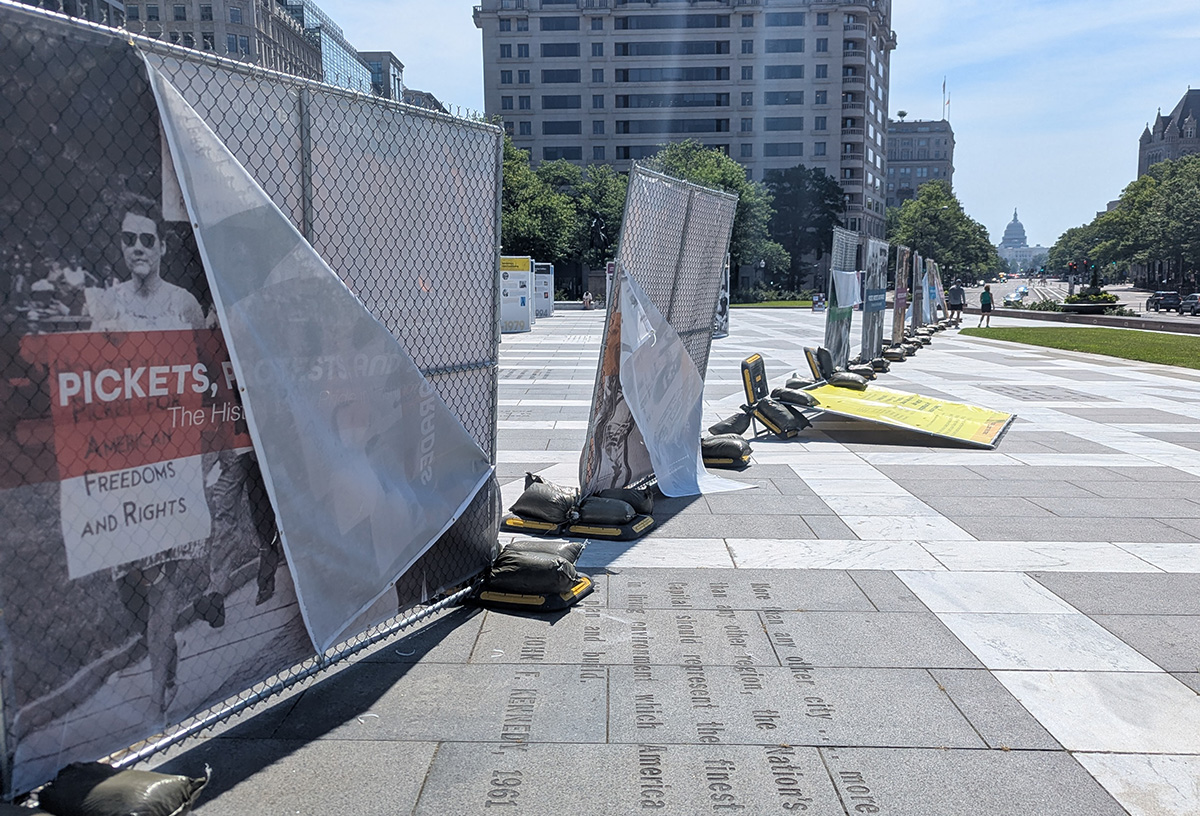
Earlier this month, vandals shouting homophobic slurs damaged the 8-foot hero cubes and timeline walls of the Rainbow History Project’s (RHP) WorldPride exhibition “Pickets, Protests, and Parades: The History of Gay Pride in Washington.” The week’s incident was the fifth homophobic attack on the exhibition chronicling DC’s LGBTQ+ History, the vandalism damage was only made worse by the storms this past week.
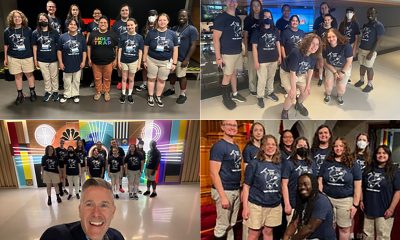
In response, RHP posted a call online for volunteers and donations and over a dozen volunteers showed up on Saturday to repair the exhibition in its final stretch.
It took three hours, but the group assembled during a heat advisory to bend the fences back into place, fix the cubes and zip tie all the materials together to keep them safe. Some of those who came out to volunteer, Slatt said, were known RHP volunteers but most were total strangers who had attended an event here or there or just wanted to get involved for the first time, one was even in D.C. as an out-of-town guest and after seeing the Instagram call, decided to spend their day lifting some heavy fencing back into place.
When asked why they showed up, volunteer Abbey said: “especially during Pride month, it’s so important to come together as a community, not just to celebrate, but to support each other. To know that this historic exhibit is even able to exist right now under this administration is really amazing. The fact that we’re just able to help continue it in its last leg of being out here is really important.”
“Rainbow History Project does a lot of work for the community,” another volunteer Ellie said, “they show up in a lot of ways that I think we really need right now, so in terms of being asked to come out and do a couple hours of lifting, that is something that we can easily support and do.”
“We put out a call asking for support from the community, and so we didn’t know what we’d get,” Slatt continued, “but strangers have shown up. We were upset, we were crying. We were trying to come up with a battle plan and more and more people have shown up with open arms and empty hands to do this. It’s 95 degrees, we are melting in the heat. It’s just amazing the number of people who have come here.”
If anything, the anonymous exhibit designer said, the people who vandalized the exhibit made the community stronger and mobilized members passionate about preserving and sharing our histories. Their efforts backfired in a big way — bringing together people who had only attended one or two RHP events or had read about the organization online to actively contribute to the work.
It’s a meaningful representation of the history of D.C.’s LGBTQ+ community, one that often starts with a small group of people who come together to protest but soon mobilize their communities and enact monumental change in the nation’s capital.
“If Pride in D.C. started with 10 people picketing the White House,” Slatt remarked, “you just got 12 more to join the gay history movement.”
This was especially poignant, another volunteer Mattie said, on the week that the Supreme Court issued a decision allowing Tennessee to ban puberty blockers and hormone therapy for minors seeking gender affirming care. It was a devastating moment for the LGBTQ+ community who mobilized once more in front of the Supreme Court this past Friday.
“It’s been actually really important to see this community come together in the face of direct attack on our history in the wake of direct attacks on our rights,” Mattie said, “and we stand up to that. We come together, and we represent. That is so important to maintaining our strength and our community throughout trying times now and ahead.”
When asked about how community members can support RHP’s work and repair the damage long-term to the exhibit, Slatt urged people to donate to RHP, to volunteer as exhibit monitors, and to come visit the exhibit.
“We’ve been doing this for 25 years. This is our 25th anniversary, and if it weren’t for volunteers donating their time and their talents, if it weren’t for small dollar donors, we would never have gotten anything done,” Slatt said. “I’d say to anyone out there that we are on this plaza all through Independence weekend, we are here through the Smithsonian Folklife Festival, people can come on down.”
Slatt and other volunteers will be leading tours each evening at 7 p.m. at Freedom Plaza, and people can pre-order the exhibition catalog right now, which will be delivered in time for LGBTQ+ History Month in October.
Emma Cieslik is a D.C.-based museum worker and public historian.
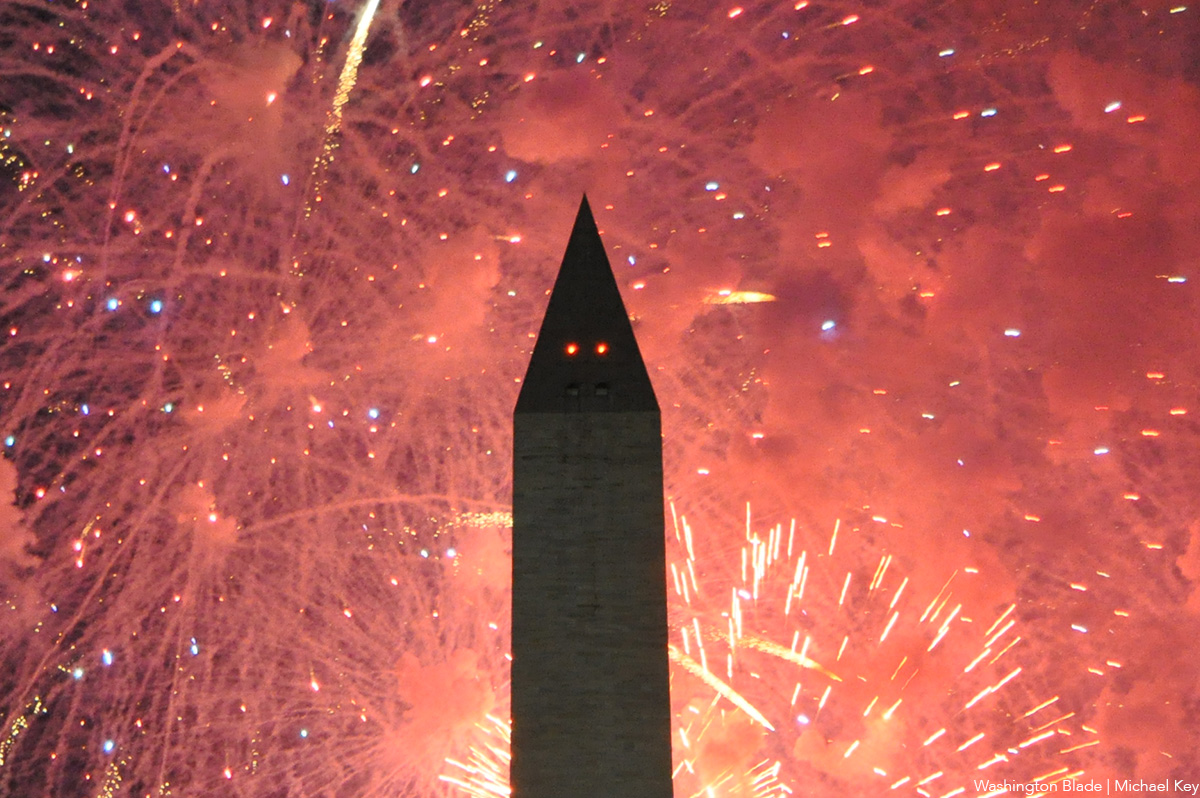
Independence Day, commonly known as the Fourth of July, is a federal holiday commemorating the ratification of the Declaration of Independence by the Second Continental Congress on July 4, 1776, establishing the United States of America. The delegates of the Second Continental Congress declared the 13 colonies are no longer subject (and subordinate) to the monarch of Britain, King George III and were now united, free, and independent states. The Congress voted to approve independence by passing the Lee resolution on July 2, and adopted the Declaration of Independence two days later, on July 4.
Today we have a felon in the White House, who wants to be a king, and doesn’t know what the Declaration of Independence means. Each day we see more erosion of what our country has fought to stand for over the years. We began with a country run by white men, where slavery was accepted, and where women weren’t included in our constitution, or allowed to vote. We have come far, and next year will celebrate 250 years. Slowly, but surely, we have moved forward. That is until Nov. 5, 2024, when the nation elected the felon who now sits in the Oval Office.
There are some who say they didn’t know what he would do when they voted for him. They are the ones who were either fooled, believing his lies, or just weren’t smart enough to read the blueprint which laid out what he would do, Project 2025. It is there for everyone to see. There should be no surprise at what he is doing to the country, and the world. Last Friday his Supreme Court, and yes, it is his, the three people he had confirmed in his first term, gave him permission to be the king he wants to be. The kind of king our Declaration of Independence said we were renouncing. A man who with the stroke of a pen can ruin thousands of lives, and change the course of America’s future. A man who has set back our country by decades, in just a few months.
So, I understand why many are suggesting there is nothing to celebrate this Fourth of July. How do we have parties, and fireworks, celebrating the 249th year of our independence when so many are being sidelined and harmed by the felon and his MAGA sycophants in the Congress, and on the Supreme Court. Yes, there are those celebrating all he is doing. Those who want to pretend transgender people don’t exist, and put their lives in danger; those who think it’s alright to take away a women’s right to control her body, and her healthcare; those who think parents should be able to interfere on a daily basis with their children’s schooling and wipe out the existence of gay people for them. Those who pretend there was a mandate in the last election, when it was only won by about 1 percent. Those who think disparaging veterans, firing them, and taking away their healthcare, is ok. Those in the LGBTQ community like Log Cabin Republicans, who think supporting a racist, sexist, homophobe is the right thing to do.
So, what do we, as decent caring people, do this Fourth of July. What do we say to those who are being harmed as we celebrate. What do we say to those trans people, those women, those immigrants who came here to escape their own dictators, and are now finding they have come to a country with its own would-be dictator. I say to them, please don’t give up on America. Don’t give up on the possibility decent loving people in our country will finally wake up and say, “enough.” That the majority of Americans will remember we fought a revolution to escape a king, and we fought a civil war to end slavery. That we moved forward and gave women the right to vote, and gave the LGBTQ community the right to marry. Don’t give up on the people that did all that, and think they won’t rise up again, and tell the felon, racist, homophobe, misogynist, found liable for sexual assault, now in the White House, and his sycophants in congress, and his cult, that we will take back our country in the 2026 midterm elections. That we will vote in large numbers, and demand our freedom from the tyranny that he is foisting on our country.
So yes, I will celebrate this Fourth of July not for what is happening in our country today, but rather for what our country actually stands for. Not for birthday parades, and abandonment of the heroes in Ukraine in support of dictators like Putin. But for the belief the decent people in our country will rise up and vote. That is what I will celebrate and pray for this Fourth of July. That is what I think the fireworks will mean this July Fourth. I refuse to accept defeat the same way our revolutionary soldiers wouldn’t, and the way our troops in the civil war wouldn’t till the confederacy was defeated.
I will celebrate this Fourth of July because I refuse to accept we will not defeat those who would destroy our beautiful country, and what it really stands for.
Peter Rosenstein is a longtime LGBTQ rights and Democratic Party activist.
Opinions
Is it time for DC to have new congressional representation?
Del. Eleanor Holmes Norton will turn 89 in June
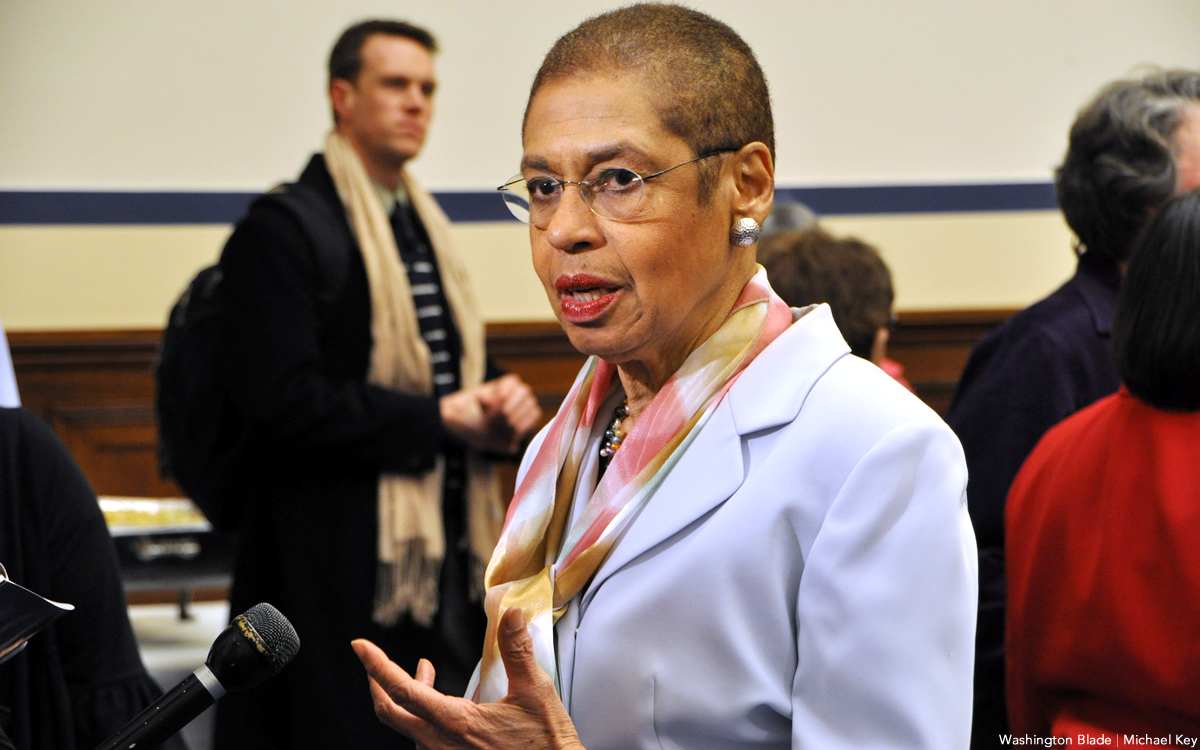
With WorldPride, Supreme Court decisions, military parades in our streets, mayor and City Council discussions about a new football stadium, it is entirely understandable if we missed the real local political story for our future in the halls of Congress. Starting this past May, the whispered longtime discussions about the city’s representation in Congress broke out. Stories in Mother Jones, Reddit, Politico, Axios, NBC News, the New York Times, and even the Washington Post have raised the question of time for a change after so many years. A little background for those who may not be longtime residents is definitely necessary.
Since the passage of the 1973 District of Columbia Home Rule Act, we District residents have had only two people represent us in Congress, Walter Fauntroy and Eleanor Holmes Norton, who was first elected in 1990 after Mr. Fauntroy decided to run for mayor of our nation’s capital city.
No one can deny Mrs. Norton’s love and devotion for the District. Without the right to vote for legislation except in committee, she has labored hard and often times very loud to protect us from congressional interference and has successfully passed District of Columbia statehood twice in the House of Representatives, only to see the efforts fail in the U.S. Senate where our representation is nonexistent.
However, the question must be asked: Is it time for a new person to accept the challenges of working with fellow Democrats and even with Republicans who look for any opportunity to harm our city? Let us remember that the GOP House stripped away millions of OUR dollars from the D.C. budget, trashed needle exchange programs, attacked reproductive freedoms, interfered with our gun laws at a moment’s notice, and recently have even proposed returning the District to Maryland, which does not want us, or simply abolishing the mayor and City Council and returning to the old days of three commissioners or the very silly proposal to change the name of our Metro system to honor you know you.
Mrs. Norton will be 89 years old next year around the time of the June 2026 primary and advising us she is running for another two-year term. Besides her position there will be other major elected city positions to vote for, namely mayor, several City Council members and Board of Education, the district attorney and the ANC. Voting for a change must not be taken as an insult to her. It should be raised and praised as an immense thank you from our LGBTQ+ community to Mrs. Norton for her many years of service not only as our voice in Congress but must include her chairing the Equal Employment Opportunity Commission, her time at the ACLU, teaching constitutional law at Georgetown University Law School, and her role in the 1963 March on Washington.
Personally, I am hoping she will accept all the accolades which will come her way. Her service can continue by becoming the mentor/tutor to her replacement. It is time!
John Klenert is a longtime D.C. resident and member of the DC Vote and LGBTQ+ Victory Fund Campaign boards of directors.

‘A Wrinkle in Time’ comes to Arena Stage

Celebrate the power of homeownership this Fourth of July

Two new documentaries highlight trans history

Trans cyclist’s victory sparks outrage in conservative media

Activist recalls experience in Tel Aviv after Israel-Iran war began

Supreme Court to consider bans on trans athletes in school sports

Celebrate the Fourth of July the gay way!

Va. court allows conversion therapy despite law banning it

UPenn erases Lia Thomas’s records as part of settlement with White House

LGBTQ suicide prevention hotline option is going away. Here’s where else to go in Md.
-
 U.S. Supreme Court2 days ago
Supreme Court to consider bans on trans athletes in school sports
-
 Out & About2 days ago
Celebrate the Fourth of July the gay way!
-
 Virginia2 days ago
Va. court allows conversion therapy despite law banning it
-
 Federal Government4 days ago
UPenn erases Lia Thomas’s records as part of settlement with White House