News
Republican’s proposal would make it easier to harass gay service members
Measure would put burden of proof on commanders to show ‘actual harm’
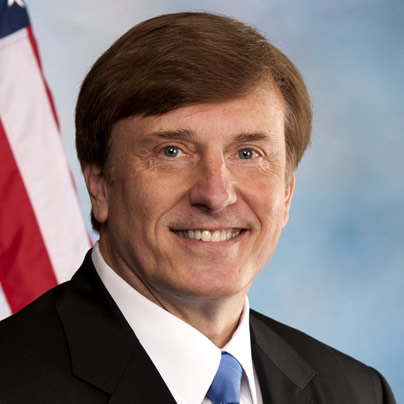
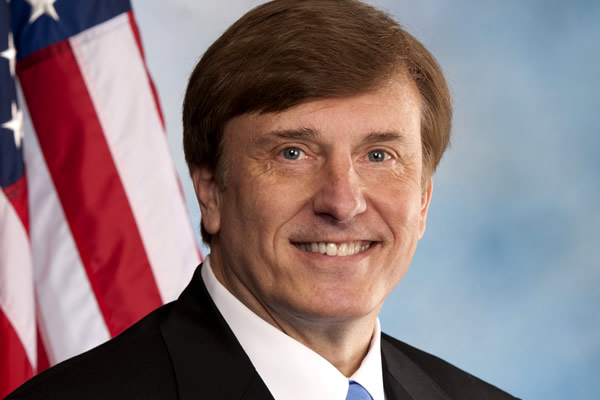
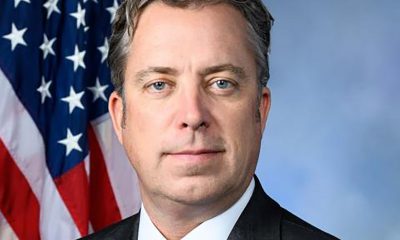
Rep. John Fleming (R-La.) is introducing an amendment to expand the “conscience” provision in defense law. (Photo public domain)
A House Republican from Louisiana is proposing a measure to expand the “conscience provision” in defense law in a way that would make it easier for service members to harass their gay comrades, according to a copy of his amendment provided by the American Civil Liberties Union.
The amendment, proposed by Rep. John Fleming (R-La.), puts the burden on the Pentagon to prove that the expression of religious beliefs would be an “actual harm” to good order and discipline in refusing to make an accommodation.
Further, the measure requires the Pentagon to implement regulations within 120 days after the defense secretary consults with “official military faith-group representatives who endorse military chaplains.”
Fleming introduced the amendment before the House Armed Services Committee as a proposed change to the fiscal year 2014 defense authorization bill. The markup of that bill started at 10 a.m. on Wednesday and is expected to conclude late in the evening.
Ian Thompson, legislative representative of the ACLU, said the language proposed by the three-term House Republican would have a detrimental impact on a commanding officer’s ability to protect gay service members from harassment.
“It would tie the hands of commanders, prohibiting them from responsibly addressing threats to unit cohesion that an accommodation might create,” Thompson said.
The amendment would expand an existing “conscience provision” already in the law that President Obama signed under Section 533 as part of the Fiscal Year 2013 Defense Authorization Act. At the time of the signing, Obama called it “unnecessary” and said he was signing the defense package under assurances the Pentagon wouldn’t “permit or condone discriminatory actions that compromise good order and discipline or otherwise violate military codes of conduct.”
Sexual orientation isn’t mentioned anywhere in the amendment, nor in the existing provision in the law that it would expand, but the amendment is likely intended to protect anti-gay service members.
Fleming’s office didn’t immediately respond to a request for comment on the amendment or to verify the language offered by the ACLU.
The language of the amendment as provided by the ACLU follows:
SEC. 5 EXPANSION AND IMPLEMENTATION OF PROTECTION OF RIGHTS OF CONSCIENCE OF MEMBERS OF THE ARMED FORCES AND CHAPLAINS OF SUCH MEMBERS
(a) ACCOMMODATION OF MEMBERS’ BELIEFS, ACTIONS, AJ’\JD SPEECH.-Subsection (a)(1) of section 533 of the National Defense Authorization Act for Fiscal Year 2013 (Public Law 112-239; 126 Stat. 1727; 10 U.S.C. prec. 1030 note) is amended –
(1) by striking “The Armed Forces shall accommodate the beliefs” and inserting “Except in cases of military necessity, the Armed Forces shall accommodate the beliefs, actions, and speech”; and
(2) by inserting “, actions, or speech” after “such beliefs”.
(b) NARROW EXCEPTION.-Subsection (a)(2) of this section is amended by striking “that threaten” and inserting “that actually harm”.
(c) DEADLINE FOR REGULATIONS; CONSULTATION.-The implementation regulations required by subsection (c) of such section shall be issued not later than 120 days after the enactment of this Act. In preparing such regulations, the Secretary of Defense shall consult with the official military faith-group representatives who endorse military chaplains.



Hungary
Charges against Budapest mayor for organizing Pride march dropped
Country’s new government took office last month

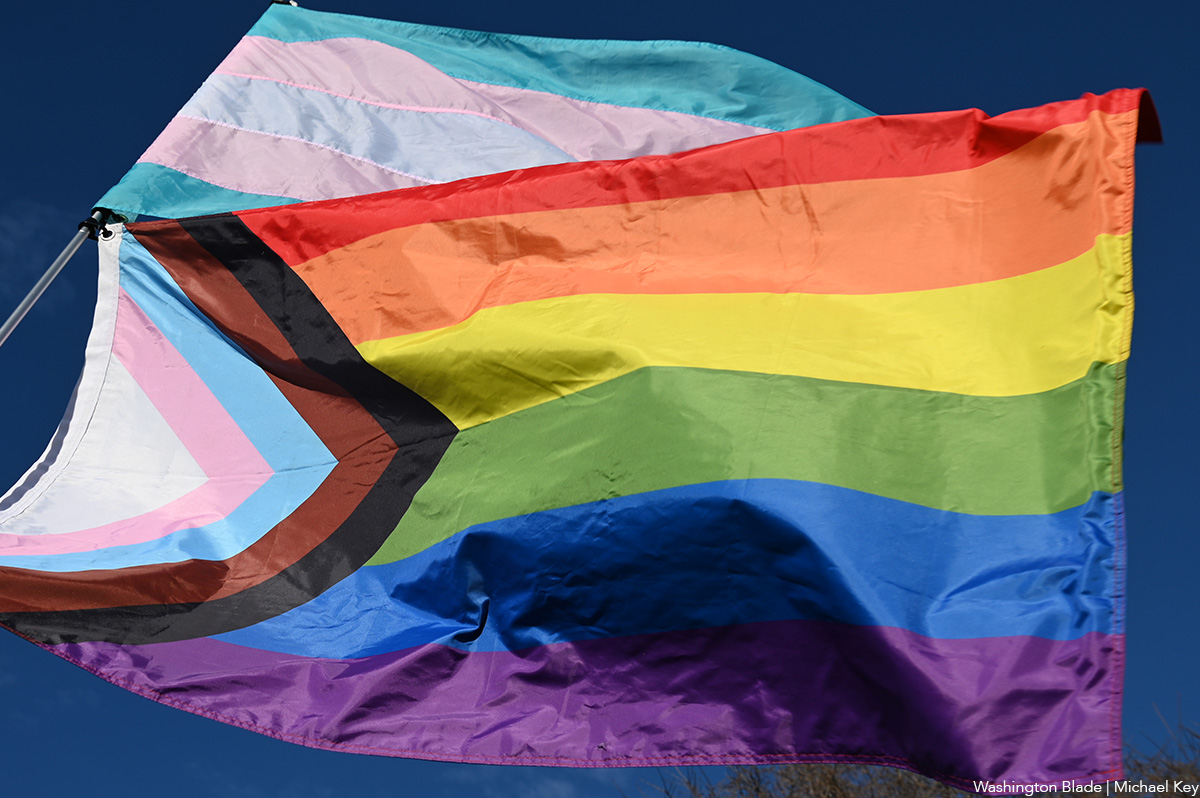
Hungarian authorities on Thursday dropped charges against Budapest Mayor Gergely Karácsony over his role in organizing the city’s 2025 Pride march.
Karácsony spoke at the event, even though then-Prime Minister Viktor Orbán’s government banned it.
More than 100,000 people defied the ban and participated in the march that took place on June 28, 2025. The Associated Press notes the Budapest Chief Prosecutor’s Office in January charged Karácsony with “organizing the unlawful assembly despite a prohibition order.”
Karácsony, who has been Budapest’s mayor since 2019, described himself as a “proud defendant” after his indictment.
“It seems that in this country, this is the price you pay if you stand up for your own freedom and the freedom of others,” he said in a statement, according to the AP. “If anyone thinks they can ban me, deter me, or prevent me and my city from doing so, they are gravely mistaken.”
Budapest is Hungary’s capital and largest city.
Prime Minister Péter Magyar took office last month after his center-right Tisza party ousted Orbán’s Fidesz-KDNP coalition in elections that took place on April 12.
Hungarian police on May 29 announced they will allow the Budapest Pride march to take place this year.
The European Union’s top court, the EU Court of Justice, days after Orbán’s ouster struck down Hungary’s anti-LGBTQ propaganda law that MPs approved in 2021. The BBC notes Hungarian authorities cited the decision in their decision to drop the charges against Karácsony.
Authorities in Pécs, a city near Hungary’s border with Croatia, have also dropped charges against Géza Buzás-Hábel, who organized a 2025 Pride event.
National
Gallup finds LGBTQ support among Americans is dropping
Marriage equality support lowest since 2016
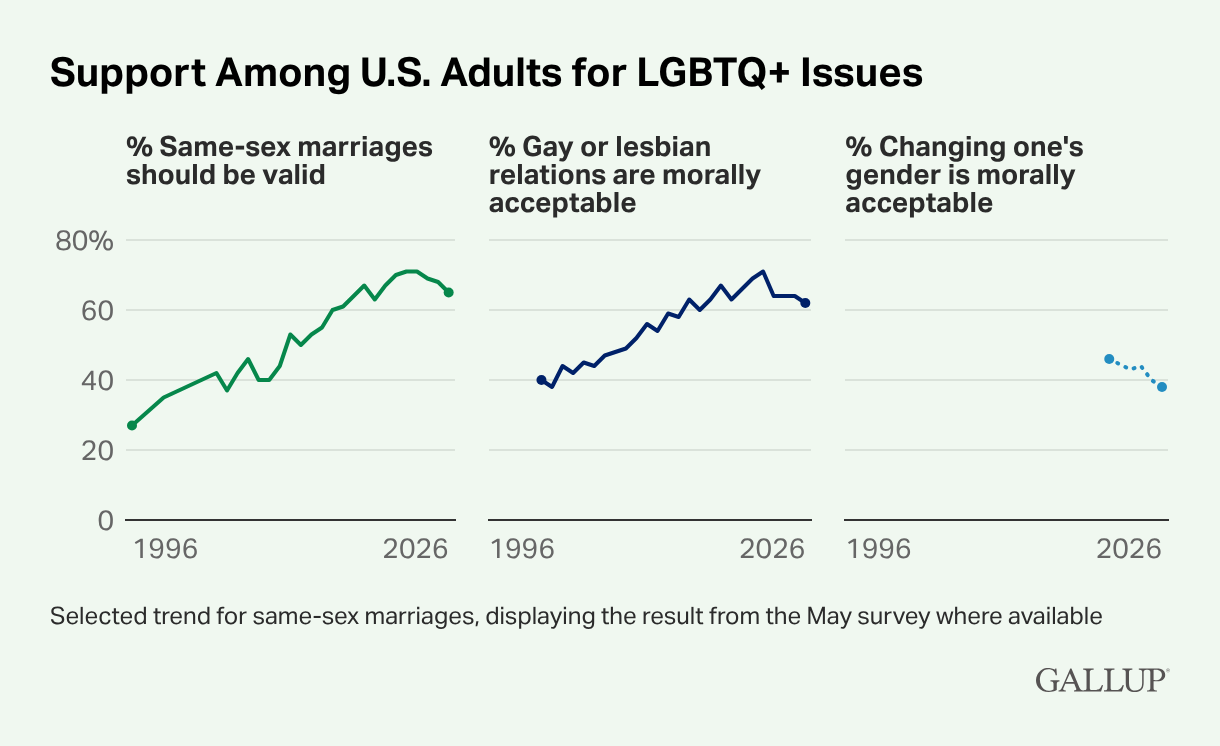
Gallup, one of the leading organizations in public opinion polling, has found that LGBTQ support among Americans is dropping.
The poll, whose data was collected using Gallup’s annual Values and Beliefs survey, was conducted in May and was published on Wednesday. The data was collected through telephone interviews from a sample of more than 1,000 adults living in all 50 states and D.C. using random digit dialing.
It highlights declining attitudes surrounding LGBTQ issues in multiple areas — from support for same-sex marriage to views on gender identity and the morality of one’s sexuality.
One of the most striking findings was that support for marriage equality fell six points from its 2022-2023 high.
The survey also found that 62 percent of Americans view gay and lesbian relations as morally acceptable, the lowest level since 2016 just after same-sex marriage was legalized nationwide by the U.S. Supreme Court.
One newer question on the poll found that the perceived morality of changing one’s gender has dropped eight points since 2021, indicating the American public is less supportive of transgender people.
The data attributes much of the decline to shifting Republican views alongside the party itself. Conservative leaders have pushed back against diversity, equity, and inclusion programs that were intended to foster greater acceptance of LGBTQ people and other historically disadvantaged groups.
President Donald Trump has been a guiding force behind waves of anti-LGBTQ sentiment, particularly when it comes to trans rights. The president has enacted multiple executive orders, including Executive Order 14168, “Defending Women from Gender Ideology Extremism and Restoring Biological Truth to the Federal Government,” which mandates that gender be defined by one’s sex assigned at birth. He also signed Executive Order 14183, “Prioritizing Military Excellence and Readiness,” which barred qualified trans applicants from joining the military and led to the removal of trans service members already serving in the armed forces.
Additionally, he signed Executive Order 14201, “Keeping Men Out of Women’s Sports,” which prohibits trans female athletes from participating on women’s and girls’ sports teams.
In February, Gallup found that an estimated 9 percent of Americans identified as part of the LGBTQ community in some form.
The organization also found that 23 percent of adults under age 30 identify as LGBTQ, compared with 10 percent of those ages 30 to 49 and 3 percent or less among those ages 50 and older.
Congress
Ogles faces bipartisan backlash over anti-gay social media post
Tenn. congressman blamed the comment on staffer
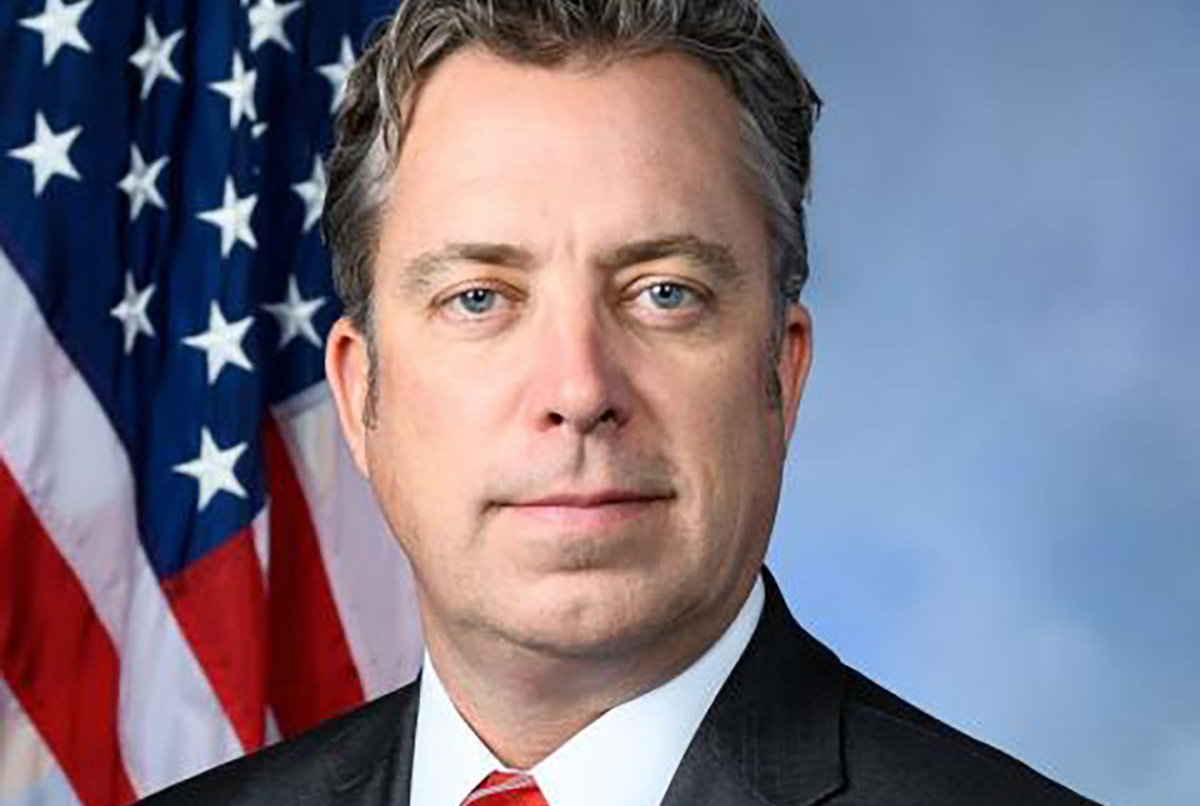
U.S. Rep. Andy Ogles (R-Tenn.), who represents Tennessee’s 5th Congressional District, is facing backlash from LGBTQ advocates and fellow Republicans after a social media post declared that “homosexuality has no place in America.”
“Homosexuality has no place in America. Happy Nuclear Family Month,” the congressman wrote in a post on X that was later deleted.
According to the Williams Institute at UCLA School of Law, an estimated 6.3 percent of U.S. adults identify as LGBTQ.
Following widespread criticism, Ogles removed the post and blamed it on a staff member.
“The post was stupid, hurtful and a complete distraction from my America First focus. The employee has been reprimanded,” Ogles said in a statement.
The Washington Blade reached out to Ogles’s office for comment but did not receive a response by press time.
Among those condemning the message was U.S. Rep. Mike Lawler (R-N.Y.), who called it “absolutely idiotic” in a social media post.
“Homosexuality exists. In America,” Lawler wrote on X. “In fact, Andy, you have family, friends, neighbors, colleagues, and constituents who are gay and lesbian. It doesn’t make them less than or somehow unworthy of being an American.”
U.S. Sen. Ted Cruz (R-Texas) also criticized Ogles’s remarks.
“For all of recorded history, homosexuals have been a part of humanity,” Cruz told TMZ DC. “I think the behavior of consenting adults is their business.”
Chris Sanders, the executive director for the Tennessee Equality Project and Tennessee Equality Project Foundation provided a statement to the Blade about Ogles’s comment.
“The Tennessee Nuclear Family Month resolution has really backfired on conservatives by ensnaring Congressman Ogles in scandal. He used the resolution as a pretext to say that our community doesn’t belong in America, resulting in incredible backlash from across the partisan divide,” Sanders said. “It is a good opportunity for him to pause and reflect on whether it’s time for him to resign. Fighting one’s own constituents is not the purpose of serving in Congress.”
Human Rights Campaign Senior Press Secretary Jarred Keller provided a statement to the Blade regarding Ogles’s comments.
“LGBTQ+ people are woven into the fabric of America, and any politician who questions that is severely out of touch with reality. When so many people are worried about whether they can afford gas to get to work or groceries for their families, the last thing we need is right-wing Republicans targeting marginalized communities with hateful attacks,” Keller said. “Representative Ogles should spend less time attacking LGBTQ+ people and start addressing the issues that actually matter, because last I checked, our community isn’t the reason families are struggling to make ends meet.”
The controversy comes as Tennessee continues to advance legislation affecting LGBTQ residents. The state already has several laws on the books that LGBTQ advocates have criticized, including the Adult Entertainment Act, enacted in 2023, which restricts certain “adult cabaret performances.”
Lawmakers have also introduced additional measures this legislative session, including the “No Pride Flag or Month Act,” which would prohibit state employees, volunteers, and agents from displaying Pride flags or participating in Pride observances while acting in an official capacity.
Another proposal, the “Banning Bostock Act” would seek to limit the application of state anti-discrimination protections based on the U.S. Supreme Court’s decision in Bostock v. Clayton County. Tennessee lawmakers have also passed other measures restricting LGBTQ rights and access to gender-affirming health care.

PHOTOS: Shepherdstown Pride Parade

Charges against Budapest mayor for organizing Pride march dropped

Gallup finds LGBTQ support among Americans is dropping

Ogles faces bipartisan backlash over anti-gay social media post

First gay underwear party? How to have fun nearly naked

Books for a pre-Pride celebration

Barney Frank’s powerful legacy for LGBTQ federal employees

Claudia López comes up short in Colombian presidential election

PHOTOS: Hagerstown Pride